
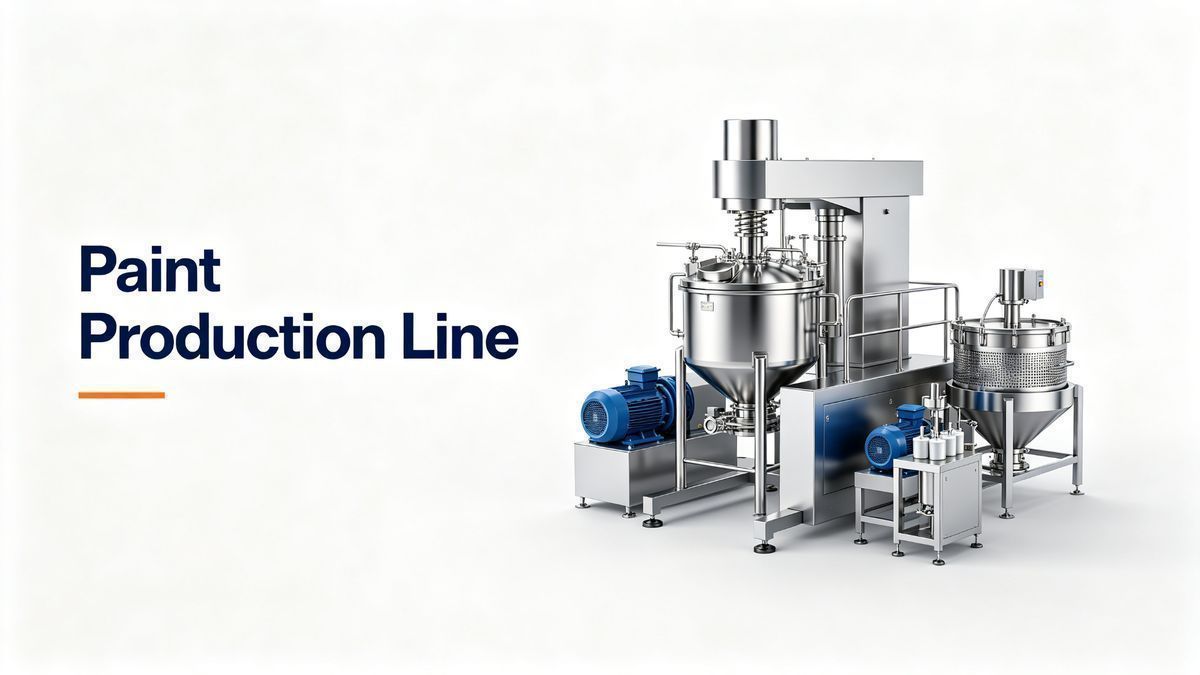
A basket mill is a submerged wet grinding head that operates directly inside the production vessel, combining pre-dispersion and fine grinding in one machine. Unlike horizontal bead mills, it requires no pump, piping or separate premix tank, which makes it the standard choice for pigment pastes, colourants and batch-to-batch colour-sensitive products. This guide covers basket mill specifications, selection criteria, operating limits and total cost of ownership.
How a basket mill works
The grinding basket is lowered into the vessel and rotates at high speed. Product is drawn into the basket through the bottom, passes through a bed of grinding media accelerated by the agitator disc, and exits through the side screen. The media is retained by the screen while the ground product recirculates back into the vessel. Because the same vessel is used for premixing, grinding and letdown, there is no product loss between stages and cleaning is minimal.
Basket mill specifications: what the numbers mean
| Specification | POLYC range | What it determines |
|---|---|---|
| Vessel capacity | 20 L - 1,000 L | Maximum batch size |
| Motor power | 3 kW - 55 kW | Grinding energy and maximum viscosity |
| Agitator speed | 300 - 1,500 rpm | Tip speed and grinding intensity |
| Media size | 0.8 mm - 2.5 mm | Final fineness (smaller = finer) |
| Media volume | 1.5 L - 60 L | Grinding capacity and media cost |
| Final fineness | 5 um - 20 um (single pass) | Product quality; finer requires longer cycle |
| Cycle time (typical) | 30 - 120 min per batch | Throughput and labour cost |
| Lifting stroke | Hydraulic, 500 - 1,500 mm | Vessel changeover and cleaning access |
Basket mill vs horizontal bead mill: when to choose which
| Factor | Basket mill | Horizontal bead mill |
|---|---|---|
| Batch size | 20 - 1,000 L | Continuous, any volume |
| Fineness | 5 - 20 um typical | 50 nm - 10 um |
| Colour change time | 15 - 30 min | 60 - 120 min |
| Product loss | Minimal (same vessel) | Higher (pump + piping) |
| Energy efficiency | Lower (recirculation) | Higher (single pass) |
| Capital cost | Lower (no pump/piping) | Higher |
| Best for | Colourants, pastes, small batches | High volume, nano-scale |
How to select the right basket mill
Step 1: Determine batch size and vessel compatibility
Basket mills are sized by vessel capacity, not chamber volume. A 500 L basket mill fits vessels from 200 L to 500 L, with optimal fill at 60-80% of rated capacity. If you use multiple vessel sizes, choose a mill that covers the largest vessel and accept slightly lower efficiency on smaller batches. Vessel diameter must match the basket diameter for proper recirculation - too large a vessel causes dead zones at the walls.
Step 2: Match motor power to product viscosity
As a rule of thumb, allow 0.05-0.1 kW per litre of vessel capacity for low-viscosity products (below 10,000 cP), and 0.1-0.15 kW per litre for high-viscosity pastes (10,000-100,000 cP). A 500 L vessel processing pigment paste at 50,000 cP needs at least 37 kW. Underpowered mills run hot, take longer to reach fineness and cause uneven grinding.
Step 3: Select media size and material
Basket mills typically use 1.0-2.5 mm zirconia or glass beads. Larger media (1.5-2.5 mm) are better for coarse pre-grinding and high-viscosity products. Smaller media (0.8-1.2 mm) give finer results but require longer cycle times. Zirconia beads last 3-5 times longer than glass but cost 5-10 times more. For colourant production where media contamination is a concern, use yttria-stabilized zirconia with purity above 95%.
Step 4: Evaluate automation and material handling
Manual basket mills require an operator to lower the basket, set speed and timer, and monitor temperature. Automated systems with PLC control can run complete recipes: premix at high speed, grind at medium speed with temperature monitoring, then letdown at low speed. For facilities running more than 5 batches per day, automation reduces labour cost and improves batch-to-batch consistency. Vacuum degassing options are available for products that trap air during high-shear mixing.
What affects basket mill price
- Size and power: a 1,000 L, 55 kW mill costs 3-4 times a 100 L, 11 kW mill
- Lifting system: hydraulic lifting is standard; pneumatic lifting reduces cost for small machines but is less precise
- Vessel package: machines sold with 1-2 vessels cost more; vessel-only or mill-only configurations reduce initial investment
- Seal and bearing: double mechanical seals with flush are standard for solvent-based products; single seals reduce cost for water-based only
- Cooling: basket cooling jacket plus shaft cooling is standard; additional vessel jacket cooling adds cost
- Automation: PLC with recipe management, vacuum degassing and temperature control adds 20-30% to base price
- Media package: initial media charge is typically included; replacement zirconia media is a recurring cost
Key Takeaways
- Basket mills combine premixing and grinding in one vessel, eliminating pump and piping losses and reducing product waste
- Best for fineness targets of 5-20 microns, batch sizes of 20-1,000 L, and products requiring frequent colour changes
- For fineness below 5 microns or nano-scale products, a horizontal pin type bead mill is the better choice
- Size by vessel capacity and motor power: allow 0.05-0.15 kW per litre depending on viscosity
- Colour change in 15-30 minutes makes basket mills the most economical choice for multi-product, small-batch facilities
Frequently Asked Questions
Can a basket mill achieve nano-scale fineness?
Basket mills typically achieve 5-20 microns in a single batch cycle. With extended grinding times and small media (0.6-0.8 mm), they can reach 1-2 microns, but cycle times become very long and energy efficiency drops. For consistent sub-micron or nano-scale production, a horizontal pin type bead mill is more economical.
How much product is lost during colour change?
Because the basket lifts out of the vessel and there is no pump or piping, product loss during colour change is typically less than 1% of batch volume. The basket and shaft can be cleaned in 5-10 minutes with solvent flush. This is the main advantage of basket mills over horizontal mills for colourant production.
What is the maximum viscosity a basket mill can handle?
Basket mills can process products up to approximately 200,000 cP, depending on motor power and vessel geometry. Above that, the product does not recirculate properly and dead zones form around the vessel walls. For very high-viscosity pastes (above 200,000 cP), a three-roll mill or planetary mixer with grinding function may be more suitable.
How long does a basket mill last?
With proper maintenance, a basket mill frame and lifting system lasts 15-20 years. Wear parts include the agitator disc (3-5 years), screen (2-3 years), bearings (5-8 years) and mechanical seals (2-4 years). Media is replaced every 2,000-5,000 hours depending on product abrasiveness.
Related POLYC MACHINE equipment
- Basket Mill - 20 L to 1,000 L vessel capacity, 3 kW to 55 kW
- 1000L Basket Mill for Pigment - large capacity pigment paste production
- Pin Type Bead Mill - for fineness below 5 microns and nano-scale
- Vacuum Dispersing Machine - for pre-dispersion and vacuum degassing
Need help selecting the right basket mill for your colourant or paste product? Request a free process consultation. We can run a grinding test with your formulation and recommend the optimal vessel size, motor power and media configuration.