
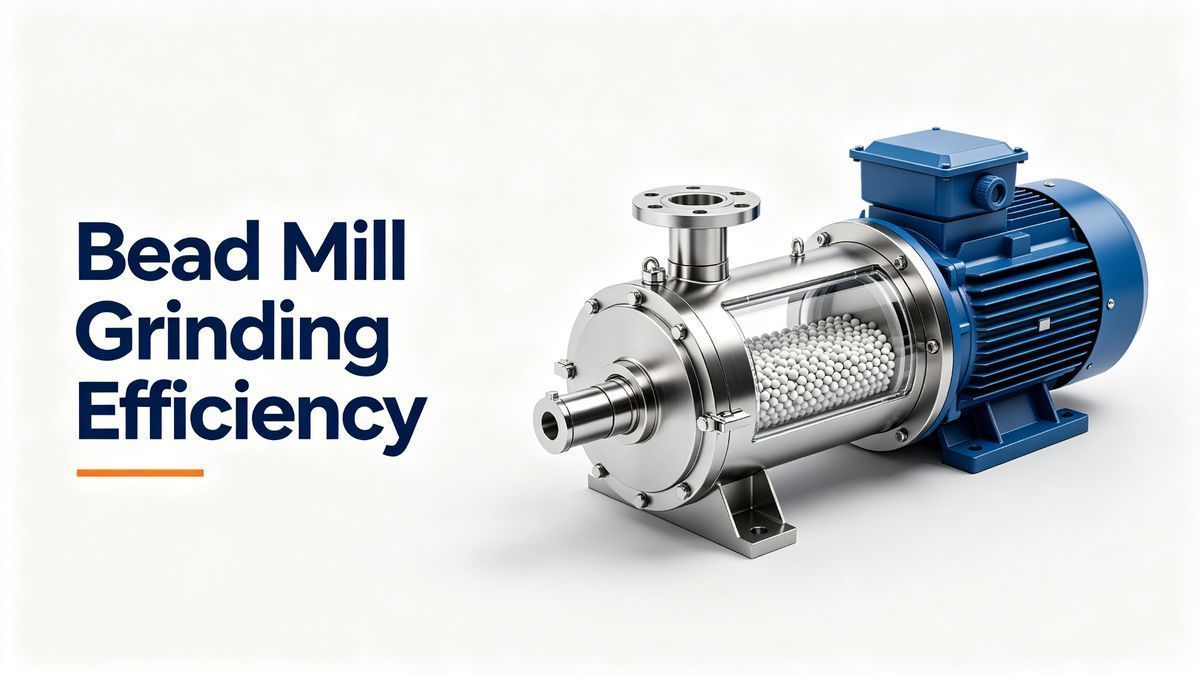
A bead mill is a wet grinding machine that uses grinding media (zirconia, glass or steel beads) to reduce pigment, filler or chemical particle size through high-energy impact and shear. It is the standard finishing equipment in coatings, inks, agrochemicals and specialty chemicals when target fineness is below 20 microns. This guide explains the specifications that matter, how to select between horizontal disc, pin type and basket configurations, and what drives the total cost of ownership.
How a bead mill works
Product is pumped through a horizontal or vertical grinding chamber filled with media. A rotating shaft with discs or pins accelerates the media, creating impact and shear forces that break agglomerates into primary particles. A separation system (screen, gap or dynamic separator) retains the media while the ground product exits. The key performance parameters are specific energy input (kWh per ton), media size and material, flow rate and residence time.
Bead mill specifications: what the numbers mean
| Specification | Typical range | What it determines |
|---|---|---|
| Chamber volume | 0.5 L - 1,000 L | Batch capacity and throughput |
| Motor power | 1.5 kW - 110 kW | Energy input and maximum viscosity |
| Tip speed | 8 - 16 m/s | Grinding intensity and media wear |
| Media size | 0.3 mm - 3.0 mm | Final fineness (smaller = finer) |
| Media filling rate | 70% - 90% | Grinding efficiency and heat generation |
| Flow rate | 50 - 20,000 L/h | Throughput and residence time |
| Final fineness | 50 nm - 20 um | Product quality and number of passes |
| Cooling area | Double jacket + shaft cooling | Heat removal for temperature-sensitive products |
Three bead mill configurations compared
1. Horizontal disc type bead mill
The most common configuration for medium-to-high volume production. Disc-type agitators provide uniform energy distribution and are suitable for fineness requirements from 5 microns down to 200 nm. POLYC dynamic disc type mills range from 5 L to 500 L chambers with 7.5 kW to 75 kW motors, suitable for automotive paints, industrial coatings and solvent-based inks.
2. Pin type bead mill (nano mill)
Pin-type agitators deliver higher energy density and narrower particle size distribution than disc-type mills. They are the standard choice for nano-scale grinding (below 200 nm) and high-value products such as inkjet inks, ceramic slurries and pharmaceutical suspensions. POLYC ceramic/PU pin type nano mills use 0.3 mm to 0.8 mm zirconia media and achieve fineness down to 50 nm in multiple passes.
3. Basket mill (batch grinding)
A basket mill is a submerged grinding head that operates inside the production vessel, eliminating pump and piping losses. It is ideal for frequent colour changes, small-to-medium batches and products that cannot tolerate high shear pumping. POLYC basket mills range from 20 L to 1,000 L vessel capacity and are the preferred choice for pigment pastes, colourants and batch-to-batch colour-sensitive products.
How to select the right bead mill
Step 1: Define your fineness target
The single most important selection criterion is final particle size. Above 20 microns, a high-speed disperser may be sufficient. Between 5 and 20 microns, a basket mill or single-pass horizontal mill works. Below 5 microns, a horizontal disc or pin type mill with multiple passes is required. Below 200 nm, a pin type nano mill with small media is the only practical option.
Step 2: Calculate required throughput
Throughput depends on chamber volume, flow rate and number of passes. As a rule of thumb, a 50 L horizontal mill processes 200-500 kg/h of standard paint at 10 micron fineness in a single pass. For nano-scale products, throughput drops to 20-100 kg/h and may require 2-3 passes. Always request a process test with your actual formulation before finalising equipment size.
Step 3: Consider viscosity and solids content
Higher viscosity requires higher motor power and larger media. Solvent-based products at 50-70% solids typically use 1.0-1.5 mm media. Water-based products at 60-80% solids may require 1.5-2.0 mm media. High-viscosity pastes (above 100,000 cP) are better processed in a basket mill than a pumped horizontal mill.
Step 4: Evaluate changeover and cleaning requirements
If you run multiple colours or formulations per day, cleaning time becomes a major cost factor. Basket mills are fastest to clean because the grinding head lifts out of the vessel. Horizontal mills with double mechanical seals and self-cleaning designs reduce changeover time but still require flushing. For dedicated single-product lines, horizontal mills give the lowest cost per kilogram.
What affects bead mill price
Bead mill pricing varies widely based on configuration and options. The main cost drivers are:
- Chamber material: standard carbon steel with polyurethane lining is most economical; ceramic (SiC or ZrO2) linings for abrasive or high-purity products cost 30-50% more
- Media package: a full charge of 0.3 mm yttria-stabilized zirconia beads can cost as much as the mill itself for large chambers
- Seal system: double mechanical seals with flush systems are standard for solvent-based products; single lip seals reduce cost for water-based only
- Cooling system: shaft cooling plus double jacket is standard; additional condenser or chiller packages add cost
- Automation: PLC control with recipe management, flow control and temperature monitoring adds 15-25% to base price
- Certification: CE marking, ATEX explosion-proof design and FDA-compliant materials for pharmaceutical/food applications add engineering and documentation costs
Key Takeaways
- Select by fineness target first: above 20 um = disperser, 5-20 um = basket mill, below 5 um = horizontal mill, below 200 nm = pin type nano mill
- Horizontal disc mills offer the lowest cost per kg for medium-to-high volume production at 200 nm to 5 um fineness
- Pin type nano mills deliver higher energy density and narrower particle size distribution for sub-micron and nano-scale products
- Basket mills are fastest to clean and best for frequent colour changes, small batches and high-viscosity pastes
- Always request a process test with your actual formulation - throughput and fineness vary significantly by product
Frequently Asked Questions
What is the difference between a bead mill and a sand mill?
There is no functional difference. "Sand mill" is the traditional term from when natural sand was used as media. Modern machines use zirconia, glass or ceramic beads and are called bead mills. The terms are interchangeable in most industry contexts.
How long does grinding media last?
Yttria-stabilized zirconia beads typically last 2,000-5,000 operating hours before wear requires replacement. Glass beads last 500-1,000 hours. Media life depends on product abrasiveness, tip speed and media size. Higher tip speeds and harder products accelerate wear.
Can a bead mill handle high-viscosity products?
Horizontal bead mills handle products up to approximately 50,000 cP at the mill inlet. Above that, pumping becomes difficult and a basket mill is the better choice. Basket mills can process products up to 200,000 cP because the product is not pumped through the mill.
What is the typical payback period for a bead mill?
For contract manufacturers or production facilities running two shifts, a bead mill typically pays back in 12-24 months through reduced labour, lower energy consumption per kg and improved product consistency. For single-shift operation or low-volume products, payback may extend to 36-48 months.
Related POLYC MACHINE equipment
- Pin Type Bead Mill - 20 L to 1,000 L, 11 kW to 110 kW, fineness down to 50 nm
- Basket Mill - 20 L to 1,000 L vessel capacity, ideal for frequent colour changes
- Dynamic Disc Type Horizontal Bead Mill - 5 L to 500 L, 7.5 kW to 75 kW
- Ceramic/PU Pin Type Nano Bead Mill - sub-micron and nano-scale grinding
Need help selecting the right bead mill for your product? Request a free process consultation with our engineering team. We can run a grinding test with your formulation and recommend the optimal configuration, chamber size and media package.