
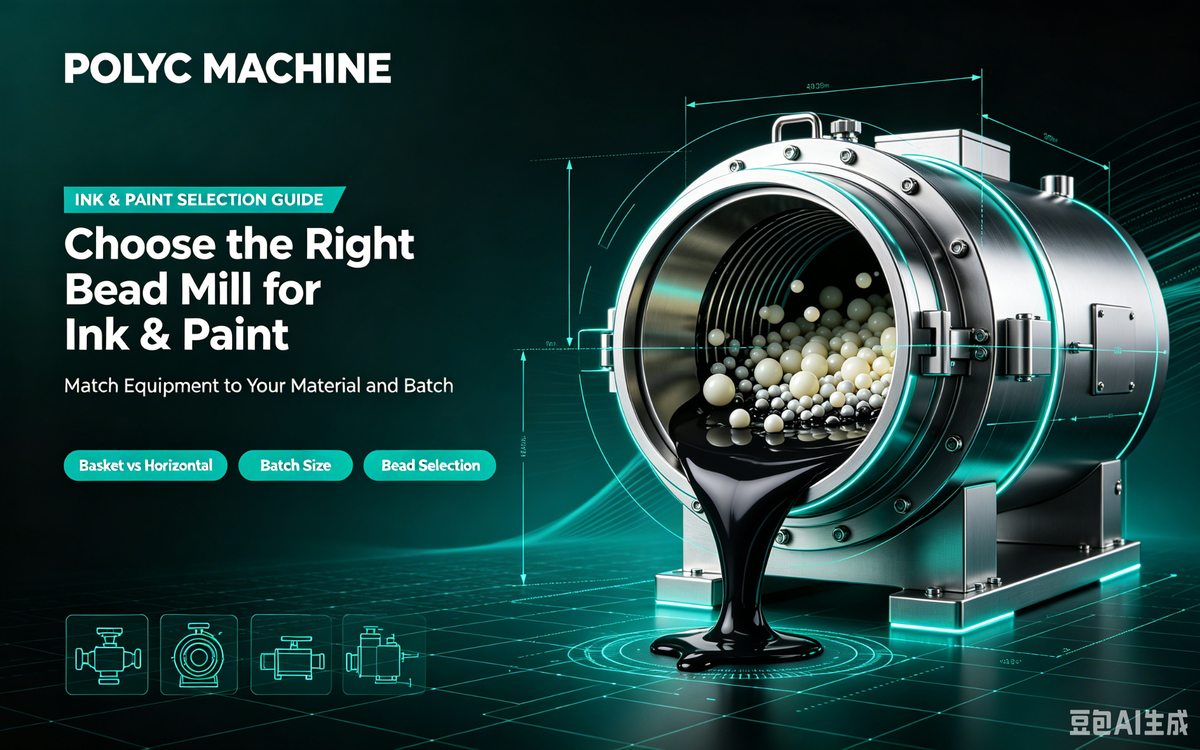
Choose a bead mill for ink and paint by matching target fineness, batch size, and color-change frequency. A basket mill is often practical for flexible batches and frequent cleanout, while a horizontal pin-type bead mill can be evaluated for continuous or recirculating production where consistent fine grinding is required. The final choice should be confirmed with the actual formulation.
What fineness do you need for ink and paint?
Fineness is the first selection question because it determines the grinding energy, media range, circulation strategy, cooling duty, and quality-control method that the process needs. Ink and paint formulations do not share one universal target: pigment chemistry, resin system, solids level, gloss requirement, color strength, and end-use application all affect the acceptable particle-size distribution.
As common industry reference points, industrial coatings and color pastes are often controlled in a 5 to 20 micrometre range. Offset inks and many solvent-based inks commonly work in a finer 1 to 5 micrometre range. Inkjet inks and electronic inks are commonly specified in the sub-micron range; some specialist formulations target roughly 100 to 200 nm. These are process references rather than POLYC performance guarantees, and the required result must always be verified against the actual pigment and test method.
As the target becomes finer, the process commonly needs smaller grinding media, a more carefully managed residence time or recirculation strategy, and stronger heat removal. A basket mill can be a practical starting point when a batch route needs dispersion and grinding in the same vessel. Where the process calls for sub-micron work, a continuous or recirculating route, and a tightly controlled fine-grinding result, a horizontal pin-type bead mill is commonly the more suitable equipment family to evaluate.
Media selection is closely connected to this decision. See the technical guide to bead size selection for the factors that affect energy transfer, separator performance, wear, and flow behavior during ultrafine milling.
Basket mill vs horizontal bead mill: which fits ink and paint?
Both equipment types support wet grinding, but they fit different operating patterns. A basket mill carries out dispersion and grinding in a batch vessel. A horizontal bead mill normally supports a continuous or recirculating route. The best fit depends on the number of colors, batch workflow, cleanout requirement, target quality, and downstream filtration or filling arrangement.
| Decision factor | Basket Mill | Horizontal Bead Mill |
|---|---|---|
| Typical application | Multiple products, frequent color changes, and small-to-medium batches | Larger dedicated runs, continuous production, and very fine pigment dispersions |
| Typical fineness discussion | Can be evaluated for sub-micron batch work when the formulation and trial support it | Commonly evaluated from sub-micron work toward specialist nano-scale applications |
| Color-change workflow | Typically quick because the basket operates in the vessel; solvent or compatible cleaning liquid circulation in the vessel commonly takes about 5 to 15 minutes before verification | Usually takes longer because the chamber, feed and return lines, pump, and loop must all be cleaned |
| Pump and piping | No external feed pump or circulation loop is normally required for the grinding step | Requires a feed pump, piping, and a recirculation or continuous-transfer arrangement |
| Cooling approach | Vessel jacket or double-wall cooling is commonly reviewed | Chamber cooling and the heat load around separation and recirculation require review |
| Capital and integration | Usually lower initial integration complexity for flexible batch work | Usually higher because the mill is part of a pump, pipe, control, and transfer system |
| Often selected for | Ink development, small-batch color pastes, and flexible paint production | Inkjet inks, dedicated fine dispersions, and continuous production routes |
For a broader process comparison, read horizontal vs basket mill. The PZM basket mill for ink route is worth reviewing when the production plan benefits from one vessel for premixing, dispersion, and grinding.
What batch size are you running?
Start with the real batch pattern, not only the annual output target. Laboratory work, pilot validation, color development, and routine production can have very different requirements for cleaning, transfer, operator time, and quality sampling. The basket mill product family on this site lists a capacity range of 0.5 to 1,000 L, while its detailed selection still depends on the formulation and working method.
As a practical planning guide, 0.5 to 5 L is commonly used for laboratory work and drawdown or formulation trials; 10 to 100 L often fits pilot and small-batch work; and 100 to 1,000 L is typically discussed for production batches. These ranges identify a production conversation, not a model promise. Confirm the working volume, product viscosity, filling level, vessel geometry, and cooling demand against the actual process.
As batch size grows, the consequences of long milling cycles, heat removal, transfer losses, filtration time, and cleaning become more important. Larger batches can still suit a basket-mill route when flexibility is valuable, but a horizontal continuous or recirculating arrangement is commonly considered when output must be sustained over dedicated runs. Review batches per shift, vessel access, cooling duty, filtration, filling, and cleaning time as one connected workflow.
How does viscosity affect your choice?
Viscosity affects wet-out, pumping, heat removal, bead movement, and the torque required during premixing. As common ink-and-coating reference bands, low-viscosity water-based or solvent-based systems are often below 5,000 cP. High-solids color pastes are often discussed in a 5,000 to 20,000 cP band. Paste-like products and some offset-ink systems can exceed 20,000 cP. These are typical planning ranges, not POLYC equipment limits.
A low-viscosity liquid may move easily through a circulation loop but still contain persistent pigment agglomerates. A medium-viscosity concentrate commonly needs attention to feed consistency, pump selection, cooling, and motor torque. At higher viscosity, the premix often becomes the limiting stage: the process may need strong bulk movement and controlled powder incorporation before fine grinding can begin.
Do not assume that a mill alone solves a high-viscosity formulation. Review the sequence of powder addition, disperser geometry, vessel cooling, transfer method, and whether vacuum deaeration is required. Where the upstream stage involves heavy pastes or high-solids materials, high viscosity mixing equipment can be considered before a batch grinding step.
How can you avoid metal contamination in ink?
Contamination control should be assessed across the full wet-grinding route, including grinding media, product-contact surfaces, seals, hoses or piping, filtration, transfer, and cleaning practice. Iron or other metal ions can change shade, promote flocculation, reduce gloss, or affect storage stability in sensitive pigment systems. The allowable level and the most suitable contact materials depend on the specific pigment, resin, solvent or water system, and finished-product requirement.
Common engineering options include zirconia ceramic contact surfaces or liners, high-purity zirconia grinding media, double mechanical seals where the duty requires them, and PTFE-based sealing components where they are chemically compatible. For regulated food, pharmaceutical, or similar hygienic duties, the material specification and surface finish are often reviewed around polished 316L stainless steel. Those choices must be matched to the actual chemistry, cleaning regime, and applicable standard.
The same disciplined review applies to other sensitive slurry processes. Our guide to preventing metal contamination explains why media, wetted surfaces, seals, piping, filters, and cleaning need to be considered together. For an ink or paint project, verify material compatibility and contamination tolerance during a process trial.
Which grinding media should you use?
Grinding media is selected with the pigment hardness, feed agglomerates, target distribution, viscosity, mill design, separator behavior, and wear tolerance in mind. Glass and ceramic media families can serve different process conditions, but there is no universal bead that is correct for every ink.
| Media type | Relative density | Relative hardness | Common use | Relative cost |
|---|---|---|---|---|
| Glass beads | Low | Medium | Coarse grinding and lower-viscosity duties | Low |
| Zirconium silicate beads | Medium | Medium to high | General fine-grinding duties | Medium |
| 95% zirconia beads | High | High | Ultrafine and low-contamination duties, including many ink dispersions | High |
Common starting ranges are 1.5 to 3.0 mm for coarser grinding, 0.6 to 1.2 mm for fine or sub-micron work, and 0.3 to 0.6 mm for specialist ultrafine duties. Smaller media can increase contact frequency but may also make separation, pressure drop, wear, heat removal, and feed quality more demanding. These figures are industry reference ranges only; run a representative trial before fixing the production setting.
Establish a trial plan that records media material, loading, feed condition, temperature, flow or batch sequence, fineness result, and wear observation. The bead size selection guide provides the engineering checks to document before scale-up. A horizontal pin-type bead mill can then be configured around the confirmed process window.
What is a simple selection decision tree?
- Is the target a specialist nano-scale or tightly controlled sub-micron dispersion? Start by evaluating a horizontal pin-type bead mill, smaller-media strategy, cooling capacity, and the required recirculation or continuous route.
- Are colors changed frequently and are batches relatively small? A basket mill is commonly the first route to assess because it combines dispersion and grinding in one vessel and can simplify batch cleaning.
- Is the feed a high-viscosity paste? Review a planetary or other high-torque premixing stage before the grinding step so the feed reaches the mill uniformly.
- Is the requirement a large dedicated production run? Evaluate a horizontal continuous or recirculating route together with pumps, piping, cooling, filtration, and transfer controls.
This decision tree is a screening tool, not a substitute for laboratory work. The product, pigment loading, viscosity, quality target, and operating constraints determine the final route.
Where does the bead mill fit in the ink production process?
Wet grinding is one part of a connected ink route. A typical workflow begins with pre-dispersion and wet-out, then fine milling, followed by letdown, final adjustment, filtration, and packaging. Each stage affects the next: a weak premix can increase milling time, while inadequate filtration or cleaning can undermine an otherwise acceptable grinding result.
Read the full ink production process guide for a practical explanation of the four stages and the equipment decisions that connect them. Use it alongside actual trial data when deciding whether the process should use a batch basket mill, a recirculating bead mill, or a combined line.
What information should you prepare before requesting a mill recommendation?
A productive equipment discussion starts with the material and the operating target: pigment and vehicle system, solids content, present and target fineness, viscosity profile, batch volume or hourly requirement, number of colors, cooling availability, contamination tolerance, filtration requirement, and cleaning method. This information lets an engineering team compare a basket mill for ink with a horizontal grinding route on the same basis.
It is also useful to provide representative samples and the existing quality-control method. A documented trial can then establish the practical operating window before scaling from development work to production equipment.
Frequently asked questions
Is a basket mill enough for ink production?
For flexible small-to-medium batches and frequent color changes, a basket mill can be a practical option because dispersion and grinding take place in one vessel. For a continuous or recirculating production route, evaluate a horizontal pin-type bead mill against the actual fineness, throughput, cooling, and cleaning requirements.
What bead size should I use for ink milling?
There is no single bead size for every ink. As a typical industry starting point, 0.6 to 1.2 mm media is often evaluated for sub-micron ink work, while 1.5 to 3.0 mm media can be considered for earlier or coarser dispersion. Select the final media using feed agglomerates, target distribution, viscosity, mill design, separator behavior, and wear requirement.
How do I clean a basket mill between ink colors?
Define a cleaning procedure for the actual ink chemistry, solvent or water system, vessel, basket, and transfer equipment. In industry practice, a compatible solvent or cleaning liquid run commonly takes about 5 to 15 minutes before inspection and verification. Basket milling can simplify batch changeover because the grinding assembly operates in the vessel, but cleaning effectiveness must be verified for each formulation.
Can I use the same mill for solvent-based and water-based inks?
Potentially, provided the wetted parts, seals, gaskets, cleaning procedure, and process controls are compatible with both chemistries. Confirm material compatibility and carryover requirements before switching products.