
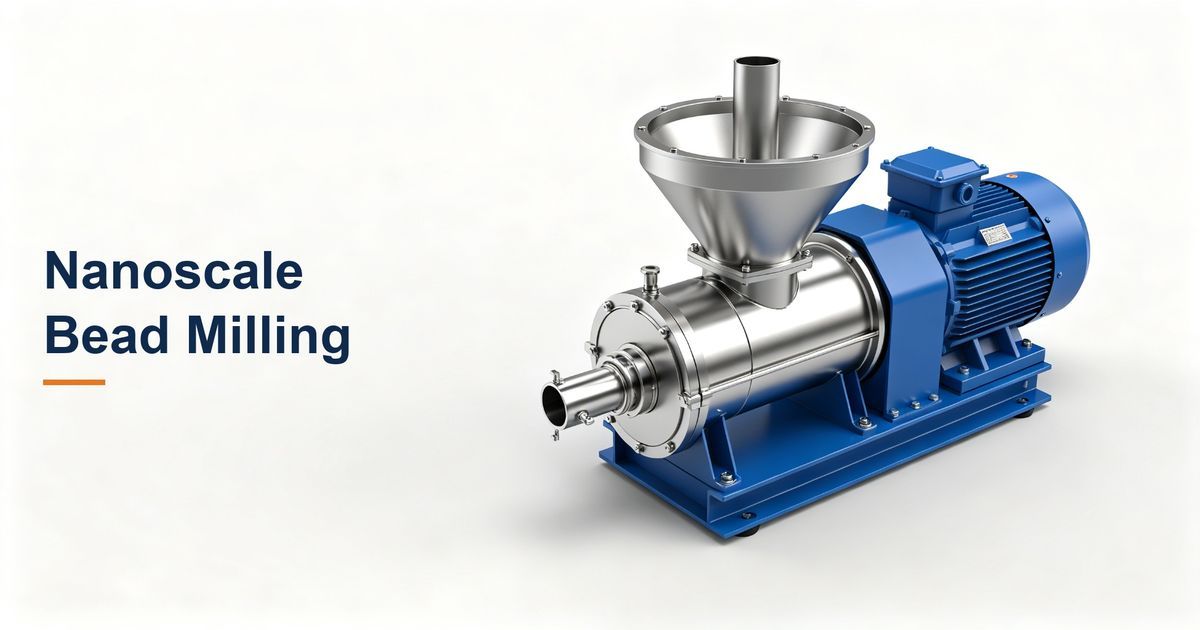
What Is Nanoscale Grinding?
Nanoscale grinding refers to wet milling processes that reduce particle size to the sub-micron or nanometer range, typically defined as D90 below 1 μm or D50 below 200 nm. This level of refinement is increasingly required across industries where particle size directly determines product performance.
The transition from conventional micron-level grinding to nanoscale grinding represents a significant engineering challenge. As particles become smaller, the energy required for further size reduction increases dramatically — a phenomenon described by the comminution theory, where the specific energy needed to halve particle size increases by a factor of 2–3 at each successive size reduction step.
For many products, achieving nanoscale particle size is not merely a quality improvement — it is a functional requirement:
- Agrochemical suspension concentrates (SC): Finer particles improve suspension stability, bioavailability, and rainfastness
- Inkjet inks: Particle size must be below 200 nm to prevent nozzle clogging and ensure consistent print quality
- Automotive coatings: Nanoscale pigment dispersion provides superior color strength, transparency, and weather resistance
- Battery materials: Cathode and anode slurries require controlled particle size distribution for optimal electrochemical performance
- Pharmaceutical suspensions: Nanonization improves dissolution rate and bioavailability of poorly soluble active ingredients
- Ceramic slurries: Fine, uniform particle size enables high green density and reduces sintering temperature
Why Nanoscale Grinding Is Difficult
Grinding to nanoscale dimensions presents several interconnected challenges that distinguish it from conventional micron-level milling.
1. Exponential Energy Requirement
The energy required for particle size reduction follows a nonlinear relationship. The Rittinger law states that energy input is proportional to the new surface area created. As particle size decreases from 10 μm to 1 μm, the specific surface area increases tenfold, and the energy required increases correspondingly.
In practical terms:
- Reducing from 100 μm to 10 μm might require 0.05–0.1 kWh/kg
- Reducing from 10 μm to 1 μm typically requires 0.3–0.8 kWh/kg
- Reducing from 1 μm to 100 nm can require 2–5 kWh/kg or more
This exponential energy demand means nanoscale grinding operations must be designed for high energy efficiency and effective heat removal.
2. Re-agglomeration and Thermodynamic Instability
As particles approach nanoscale dimensions, their high surface energy creates a strong driving force for re-agglomeration. Primary particles spontaneously cluster together to reduce total surface energy, forming secondary agglomerates that can be 5–10 times larger than the primary particle size.
This phenomenon creates a dynamic equilibrium during grinding:
- Mechanical forces break agglomerates into smaller primary particles
- Interparticle forces cause re-agglomeration as soon as mechanical energy is removed
- The final particle size represents the balance between these opposing forces
Effective nanoscale grinding requires not only sufficient mechanical energy to break agglomerates but also proper dispersion stabilization to prevent re-agglomeration.
3. Grinding Media Size Limitation
The size of grinding media directly limits the minimum achievable particle size. As a general rule:
- Bead diameter should be 50–100 times the target particle size for efficient grinding
- To achieve 100 nm particles, beads of 50–100 μm (0.05–0.1 mm) are theoretically required
- Most production-scale mills use 0.3–1.0 mm beads, which are better suited for 1–5 μm final particle size
Using very small beads creates operational challenges:
- Screen clogging: Small beads can pass through or clog conventional separation screens
- Bead loss: Small beads are more easily carried out with product flow
- Wear rate: Small beads have higher specific surface area and wear faster
- Flow resistance: High filling ratios of small beads increase pressure drop and reduce flow rate
4. Heat Generation and Temperature Control
The high specific energy input required for nanoscale grinding generates significant heat. As discussed in temperature control fundamentals, 85–95% of motor input power converts to heat in the product stream.
For nanoscale grinding operations:
- Specific energy inputs of 2–5 kWh/kg can cause temperature rises of 20–40°C in a single pass
- Temperature-sensitive products may degrade before reaching target fineness
- Effective cooling systems are essential — double jackets, stator cooling, and intermediate heat exchangers are often required
5. Viscosity and Flow Behavior
Nanoscale particles significantly affect product rheology:
- High surface area increases viscosity by immobilizing more liquid in the boundary layer around particles
- Non-Newtonian behavior becomes more pronounced, with shear-thinning or yield-stress characteristics
- High viscosity reduces heat transfer and increases energy consumption for pumping and agitation
- Optimal solids content must be determined — too high causes excessive viscosity, too low reduces grinding efficiency
Equipment Selection for Nanoscale Grinding
Choosing the right equipment is critical for successful nanoscale grinding operations.
Horizontal Bead Mills
Horizontal bead mills are the most common choice for production-scale nanoscale grinding:
Advantages: - Uniform bead distribution throughout the chamber length - High energy density with tip speeds up to 14–16 m/s - Available in sizes from 1L laboratory units to 1000L+ production machines - Dynamic separation systems (centrifugal, gap, or screen) can handle small beads - Suitable for continuous or recirculation operation
Considerations: - Larger chamber volumes have less favorable surface-to-volume ratios for cooling - High energy density requires robust cooling systems - Dynamic separators require careful maintenance and adjustment
Pin-Type (Rod) Bead Mills
Pin-type or rod-type bead mills use cylindrical pins instead of disc-shaped agitators:
Advantages: - More uniform energy distribution throughout the chamber - Less localized high-shear zones, reducing temperature peaks - Better handling of high-viscosity products - Can operate with higher bead filling ratios (80–85%)
Considerations: - Generally lower maximum tip speed than disc-type mills - May require more passes for equivalent fineness - Pin geometry affects grinding efficiency and must be matched to product characteristics
Centrifugal Bead Mills
Centrifugal bead mills use centrifugal force to separate grinding media from product:
Advantages: - Can use very small beads (0.05–0.3 mm) without screen clogging - High separation efficiency allows high flow rates - Suitable for continuous nanoscale grinding operations - Low risk of bead contamination in product
Considerations: - Higher capital cost than conventional mills - Complex mechanical design requires specialized maintenance - Centrifugal separator may generate additional heat - Limited maximum viscosity for effective separation
Basket Mills
Basket mills are immersion-type mills that lower a media-filled basket into the product vessel:
Advantages: - No product loss between batches — all material remains in the vessel - Easy cleaning and product changeover - Suitable for small-to-medium batch sizes - Simple operation with minimal peripheral equipment
Considerations: - Limited energy density compared to horizontal mills - Less effective for nanoscale grinding — typically achieves 2–5 μm fineness - Batch-to-batch temperature control depends on vessel cooling - Not suitable for continuous production
Laboratory Mills
Laboratory-scale mills (0.5–5L chamber volume) are essential for process development:
Advantages: - Small material requirements for formulation development - Precise control over all process parameters - Scalable results to production equipment when properly characterized - Essential for determining specific energy requirements and temperature profiles
Key consideration: Laboratory results must be carefully scaled — heat transfer is more efficient in small chambers, and energy density may differ from production machines.
Grinding Media Selection
The choice of grinding media is perhaps the most critical decision in nanoscale grinding.
Bead Material
| Material | Density (g/cm³) | Hardness (Mohs) | Wear Rate | Best For |
|---|---|---|---|---|
| Yttria-stabilized zirconia (YTZ) | 6.0–6.1 | 12 | Very low | High-energy nanoscale grinding, contamination-sensitive products |
| Magnesia-stabilized zirconia | 5.5–5.7 | 11 | Low | General-purpose fine grinding, cost-sensitive applications |
| Zirconia-silica (ZrO₂-SiO₂) | 3.8–4.0 | 8–9 | Moderate | Medium-energy grinding, less demanding applications |
| Soda-lime glass | 2.4–2.6 | 5–6 | High | Low-energy pre-grinding, cost-sensitive, non-critical applications |
| Steel | 7.8–7.9 | 6–7 | Moderate | High-viscosity products, metal contamination acceptable |
For nanoscale grinding, yttria-stabilized zirconia (YTZ) is generally preferred due to its combination of high density (delivers more kinetic energy per collision), high hardness (resists wear), and low contamination risk.
Bead Size
Selecting the right bead size requires balancing grinding efficiency with operational practicality:
- 0.05–0.1 mm: Theoretical optimum for <100 nm grinding, but requires centrifugal separation and has high wear rate
- 0.1–0.3 mm: Practical range for nanoscale grinding with advanced separation systems, good balance of efficiency and bead life
- 0.3–0.5 mm: Most common for sub-micron grinding (D90 < 1 μm), compatible with conventional screen separators
- 0.5–1.0 mm: Suitable for 1–5 μm fineness, not recommended for true nanoscale grinding
General guideline: Use the smallest bead size that your separation system can reliably handle, while maintaining acceptable bead life and operating cost.
Bead Filling Ratio
The optimal filling ratio depends on mill type and product characteristics:
- Disc-type horizontal mills: 70–80% filling ratio is typical
- Pin-type mills: 80–85% filling ratio is common
- Centrifugal mills: 75–80% filling ratio
- Basket mills: 70–80% of basket volume
Overfilling increases energy consumption and heat generation without proportional improvement in grinding efficiency, and can cause excessive bead wear and screen clogging.
Process Parameter Optimization
Successful nanoscale grinding requires careful optimization of multiple interrelated parameters.
Tip Speed
Tip speed determines the kinetic energy delivered to grinding media:
- 8–10 m/s: Low-energy grinding for temperature-sensitive or easily dispersed products
- 10–12 m/s: Standard range for most fine grinding applications
- 12–14 m/s: High-energy grinding for difficult-to-disperse products or nanoscale targets
- 14–16 m/s: Very high energy, only for specialized applications with robust cooling
For nanoscale grinding, start at 10–12 m/s and increase gradually while monitoring product temperature and fineness progression. Higher tip speeds generate more heat and may not improve efficiency if the product is already receiving sufficient energy.
Flow Rate and Pass Count
The relationship between flow rate, pass count, and final fineness is critical:
- Low flow rate / few passes: High specific energy per pass, but high temperature rise and risk of over-processing
- High flow rate / many passes: Lower temperature per pass, more uniform energy distribution, but longer total processing time
- Optimal operating point: Determined by product temperature sensitivity, cooling capacity, and production schedule requirements
For temperature-sensitive nanoscale products, use higher flow rates with more passes to keep peak temperatures low while achieving cumulative specific energy input.
Multi-Pass vs Single-Pass
Most nanoscale grinding operations use multi-pass recirculation:
Multi-pass advantages: - Allows cooling between passes in the holding tank - Enables incremental monitoring of fineness progression - Provides more uniform energy distribution - Reduces risk of over-processing localized material
Single-pass (continuous) advantages: - Higher throughput for large-scale production - Consistent residence time distribution - Lower labor requirement for automated operations - Suitable for well-characterized products with stable formulations
For process development and small-to-medium production, multi-pass recirculation is generally preferred. For high-volume production of well-characterized products, continuous single-pass or series mill configurations may be more efficient.
Product Formulation Considerations
The product formulation itself plays a crucial role in nanoscale grinding success:
Dispersant selection: - Use dispersants with strong adsorption affinity for the specific pigment or active ingredient - Ensure sufficient dispersant dosage to cover the increased surface area at nanoscale - Consider polymeric dispersants for superior stabilization against re-agglomeration - Match dispersant chemistry to the solvent or water phase
Solids content: - Optimize solids content to balance viscosity and grinding efficiency - Too high: excessive viscosity, poor heat transfer, high energy consumption - Too low: reduced grinding efficiency, longer processing time, higher cost - Typical range: 30–60% solids for most nanoscale grinding operations
pH control (water-based systems): - Maintain pH in the optimal range for dispersant effectiveness - Monitor pH during grinding — particle size reduction can alter surface charge and pH - Use appropriate buffers if pH stability is critical
Applications by Industry
Agrochemicals
Nanoscale grinding is transformative for agrochemical suspension concentrates:
- Improved bioavailability: Finer particles have larger surface area, enhancing contact with target organisms
- Better suspension stability: Smaller particles settle more slowly and are more easily resuspended
- Reduced application rate: Higher efficacy allows lower active ingredient dosage per hectare
- Improved rainfastness: Finer particles adhere better to leaf surfaces
Typical target fineness: D90 < 3–5 μm for conventional SC, D90 < 1–2 μm for premium or nano-SC formulations.
Printing Inks
Inkjet and high-quality printing inks demand nanoscale particle size:
- Nozzle clogging prevention: Particles must be significantly smaller than nozzle diameter (typically < 1/10 of nozzle size)
- Color strength and transparency: Nanoscale pigment particles provide superior color development and transparency
- Storage stability: Fine particles resist settling and maintain consistent viscosity
- Print quality: Uniform particle size ensures consistent print density and color reproduction
Typical target fineness: D90 < 200 nm for inkjet inks, D90 < 500 nm for high-quality gravure and flexographic inks.
Coatings
Automotive and industrial coatings benefit from nanoscale pigment dispersion:
- Color strength: Finer pigment particles provide higher tinting strength, reducing pigment loading
- Transparency and gloss: Nanoscale particles improve coating clarity and surface gloss
- Weather resistance: Uniform dispersion enhances UV resistance and coating durability
- Metallic and pearlescent effects: Controlled particle size is essential for special effect coatings
Typical target fineness: D90 < 1 μm for premium automotive coatings, D90 < 2–3 μm for general industrial coatings.
Battery Materials
Lithium-ion battery manufacturing requires precise particle size control:
- Cathode materials: Controlled particle size distribution affects packing density and electrochemical performance
- Anode materials: Graphite and silicon-based anodes require specific particle size ranges
- Conductive additives: Carbon black and carbon nanotubes must be well-dispersed at nanoscale
- Slurry stability: Uniform particle size prevents settling and ensures consistent coating quality
Typical target fineness: D90 < 1–3 μm for electrode slurries, with conductive additives dispersed to nanoscale.
Pharmaceuticals
Nanonization is a proven strategy for improving drug delivery:
- Enhanced dissolution rate: Finer particles dissolve faster due to larger surface area
- Improved bioavailability: Poorly soluble drugs show improved absorption when nanonized
- Reduced dosage: Higher bioavailability allows lower therapeutic doses
- Parenteral suspensions: Nanoscale particles are required for injectable suspensions to prevent capillary blockage
Typical target fineness: D90 < 200–500 nm for oral nanosuspensions, D90 < 100 nm for certain parenteral applications.
Troubleshooting Nanoscale Grinding Challenges
Problem: Cannot Reach Target Fineness
Possible causes and solutions: - Insufficient specific energy input: Increase pass count or reduce flow rate - Bead size too large: Switch to smaller beads (if separation system allows) - Inadequate dispersant: Increase dispersant dosage or switch to more effective dispersant chemistry - Bead filling ratio too low: Increase filling ratio to manufacturer's recommended level - Tip speed too low: Increase agitator speed gradually while monitoring temperature - Re-agglomeration: Verify dispersant effectiveness and consider post-grinding stabilization
Problem: Excessive Temperature Rise
Possible causes and solutions: - Cooling system inadequate: Increase coolant flow, lower coolant temperature, or add intermediate heat exchanger - Flow rate too low: Increase flow rate and use more passes to distribute energy - Tip speed too high: Reduce agitator speed and compensate with additional passes - Bead overfilling: Reduce filling ratio to recommended level - Feed temperature too high: Improve pre-cooling of feed material - Cooling jacket fouled: Clean or descale cooling jacket
Problem: Bead Loss or Screen Clogging
Possible causes and solutions: - Bead size too small for separator: Increase bead size or upgrade separation system - Separator damaged or worn: Inspect and replace screens, gaps, or centrifugal separator components - Excessive flow rate: Reduce flow rate to within manufacturer's recommendations - Bead fragmentation: Switch to higher-quality beads (YTZ) or reduce tip speed - Product viscosity too high: Dilute product or use a mill design better suited for high viscosity
Problem: Product Contamination from Bead Wear
Possible causes and solutions: - Bead material too soft: Switch to harder beads (YTZ zirconia) - Tip speed too high: Reduce agitator speed - Bead age/wear: Replace worn beads — beads should be replaced when 10–15% of original weight is lost - Improper bead size: Using beads too small for the application increases wear rate - Chamber material: Check if chamber or agitator wear is contributing to contamination
POLYC Solutions for Nanoscale Grinding
POLYC MACHINE offers a comprehensive range of equipment and engineering support for nanoscale grinding applications, backed by 25 years of experience in wet grinding and dispersion technology.
Equipment Portfolio
Horizontal Bead Mills: - Laboratory series: 0.5L, 1L, and 5L chamber volumes for process development - Production series: 10L to 500L chamber volumes with double-spiral cooling jackets - High-energy series: Pin-type agitator design for high-viscosity and difficult-to-disperse products - Nano-series: Centrifugal separation systems capable of using 0.1–0.3 mm beads for true nanoscale grinding
Complementary Equipment: - High-speed dispersers: For pre-dispersion and slurry preparation before fine grinding - Multi-shaft mixers: For high-viscosity products and complete formulation preparation - Vacuum emulsifiers: For products requiring deaeration and high-shear emulsification - Filtration and filling equipment: For complete production line integration
Engineering Support
POLYC provides end-to-end engineering support for nanoscale grinding projects:
Laboratory Testing: - Material evaluation in our fully equipped laboratory - Determination of specific energy requirements and temperature profiles - Optimization of dispersant selection and dosage - Bead size and material selection testing - Scale-up characterization from laboratory to production equipment
Process Engineering: - Complete process flow sheet development - Cooling system sizing and heat exchanger selection - Production capacity calculation and equipment selection - Control system design with temperature monitoring and automation - Clean-in-place (CIP) system design for multi-product facilities
Commissioning and Training: - On-site installation and commissioning support - Operator training on equipment operation and maintenance - Process optimization during initial production runs - Troubleshooting support during warranty period and beyond
Complete Production Lines
For customers requiring turnkey solutions, POLYC designs and supplies complete nanoscale grinding production lines:
- Slurry preparation section: High-speed dispersers, multi-shaft mixers, and jacketed holding tanks
- Fine grinding section: Horizontal bead mills in series or recirculation configuration with intermediate cooling
- Filtration section: Bag filters, cartridge filters, or vibration screens for final product filtration
- Filling section: Automatic or semi-automatic filling machines with weight control
- Control system: PLC-based centralized control with recipe management, data logging, and remote monitoring
Conclusion
Nanoscale grinding is a demanding process that requires careful attention to equipment selection, grinding media choice, process parameter optimization, and product formulation. The exponential energy requirement, re-agglomeration tendency, bead size limitations, and heat generation challenges make nanoscale grinding significantly more complex than conventional micron-level milling.
However, with the right equipment — horizontal bead mills with enhanced cooling, appropriate grinding media (YTZ zirconia in the smallest practical size), and optimized process parameters — consistent nanoscale particle size can be achieved reliably in production. POLYC MACHINE's 25 years of engineering experience and comprehensive equipment portfolio provide a solid foundation for solving even the most challenging nanoscale grinding applications.
The key to success is systematic process development: start with laboratory testing to determine specific energy requirements and formulation optimization, scale up carefully with attention to heat transfer differences, and implement robust process control with real-time temperature and particle size monitoring.