
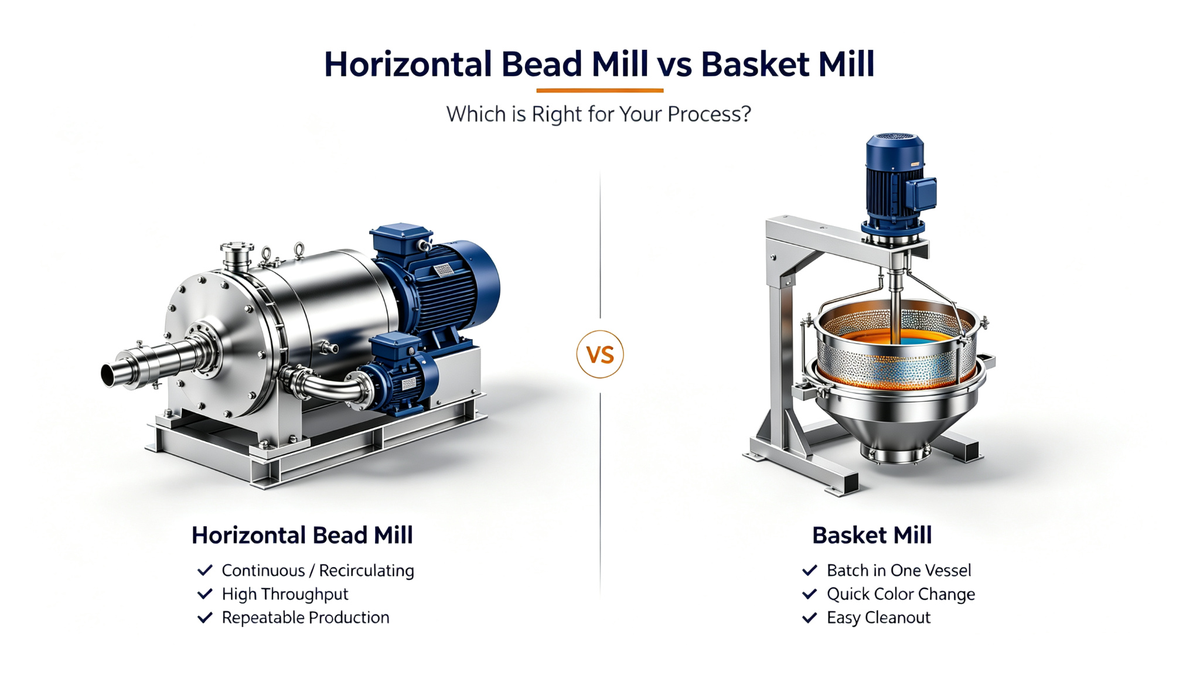
 Horizontal bead mills and basket mills both reduce particle size using grinding media, so fineness capability alone rarely decides between them. The meaningful differences lie in production pattern: how many products you run, how large the batches are, how often you change over, and what space and services are available.
A basket mill grinds inside the production vessel, which suits batch production with many colours or formulations and fast changeover. A horizontal bead mill is a separate machine fed from a premix vessel, giving higher throughput and more consistent fineness for a given product at higher volume.
This article compares them directly on throughput, batch pattern, changeover, fineness consistency, floor space and services, then sets out the decision logic we use when advising customers. The comparison reflects 25 years of supplying both configurations to coatings, ink and chemical plants.
Horizontal bead mills and basket mills both reduce particle size using grinding media, so fineness capability alone rarely decides between them. The meaningful differences lie in production pattern: how many products you run, how large the batches are, how often you change over, and what space and services are available.
A basket mill grinds inside the production vessel, which suits batch production with many colours or formulations and fast changeover. A horizontal bead mill is a separate machine fed from a premix vessel, giving higher throughput and more consistent fineness for a given product at higher volume.
This article compares them directly on throughput, batch pattern, changeover, fineness consistency, floor space and services, then sets out the decision logic we use when advising customers. The comparison reflects 25 years of supplying both configurations to coatings, ink and chemical plants.
Key Takeaways
- Basket mills suit batch flexibility and fast changeover; horizontal mills suit high-volume consistent output
- The deciding factor is product mix and batch pattern, not achievable fineness
- Horizontal mills give lower cost per tonne at volume but need premix vessel, pump, cooling and piping
- Basket mills integrate into an existing vessel, giving an advantage where space or services are limited
- Changeover time is often the real capacity constraint in multi-product plants
How Each Machine Works
A basket mill mounts a media-filled grinding basket in the production vessel. The basket is lowered into the batch and an impeller circulates material through the media, so dispersion and grinding occur in the same vessel with no external circuit. The basket lifts clear for cleaning, media inspection and colour changeover.
A horizontal bead mill is a separate machine with its own media-filled chamber and agitator. Product is pumped from a premix vessel through the chamber and either recirculated or passed through multiple times. Grinding conditions are therefore independent of vessel geometry and batch size, which is the source of its consistency advantage.
The mechanical difference drives every practical difference that follows. Because the basket depends on circulation within the vessel, its performance is influenced by vessel geometry, batch size and product viscosity. Because the horizontal mill has a dedicated chamber, its performance is governed by pump rate, media condition and machine settings instead.
Throughput and Fineness Consistency
For a given product at volume, a horizontal bead mill generally delivers higher throughput and tighter fineness consistency. The dedicated chamber provides a controlled residence time and a stable energy input that do not vary with batch size, and multi-pass or multi-mill arrangements can narrow the distribution further.
Basket mills trade some of that consistency for flexibility. They process one batch at a time, and cycle time is influenced by batch size and viscosity. For moderate batches and many products, that trade is usually correct, because the alternative would be cleaning an external circuit between every product.
Where fineness specification is contractual and volume justifies it, the horizontal mill is normally the right choice. Where specifications are moderate and products change frequently, the basket mill's flexibility usually delivers more effective annual output despite a longer cycle per batch.
Changeover and Cleaning
Changeover is where the two configurations differ most in daily operation. The basket mill lifts clear of the vessel, allowing the vessel and basket to be cleaned with direct access and no external circuit to flush. For plants running many colours, this is often decisive.
A horizontal mill requires flushing the chamber, the separator, the pump and the transfer piping. Effective cleaning is entirely achievable, and clean-in-place provision can be specified, but the circuit volume and number of components make changeover inherently longer than lifting a basket clear.
Because of this, plants with high product variety should evaluate candidates on total changeover time rather than on milling throughput alone. In many multi-product operations, the time between products rather than the time spent grinding determines weekly output.
Floor Space, Services and Installation
Basket mills integrate into an existing vessel, requiring only the machine, its drive and a suitable vessel. This gives a clear advantage where floor space is constrained or where services such as cooling water and compressed air are limited. It also simplifies installation into an existing plant.
Horizontal bead mills require a premix vessel, feed pump, product piping, cooling supply for the chamber jacket and controls. The installation is larger and more complex, but throughput per unit of floor space is generally higher at volume, so the additional infrastructure is usually justified above a certain annual output.
When planning either installation, confirm services early. Under-specified cooling is a common cause of inconsistent fineness in horizontal installations, and inadequate vessel circulation is a common cause of long cycles in basket mill installations.
Decision Logic: Which to Choose
The decision follows product mix and batch pattern. If you produce many products in moderate batches with frequent colour or formulation changes, a basket mill usually delivers more effective capacity, because its changeover advantage outweighs its longer cycle. If you produce fewer products at higher volume with contractual fineness, a horizontal mill gives lower cost per tonne and tighter control.
Annual volume per product is the most useful single indicator. Where a single product justifies continuous or campaign running, the horizontal mill's economics improve quickly. Where the product list is long and each item is a small fraction of output, flexibility wins.
Many plants ultimately run both: basket mills for development, small batches and multi-colour work, and horizontal mills for the higher-volume products. Send your product list with batch sizes and annual volumes through the inquiry form and we will model both options against your actual mix.
Technical Specifications
| Basket mill batch size | approximately 20 - 1,000 L |
| Horizontal mill throughput | approximately 50 - 2,000 L/h depending on model and product |
| Typical fineness | basket 5 - 20 micron; horizontal sub-micron to 15 micron |
| Media size | basket 1.0 - 2.5 mm; horizontal 0.05 - 2.0 mm |
| Changeover | basket lifts clear for direct cleaning; horizontal requires flushing chamber, separator, pump and piping |
| Services | basket minimal; horizontal needs pump, cooling water, piping and controls |
Troubleshooting Guide
Basket mill cycle time is much longer than expected
Cause: Batch too large for the basket, or viscosity limiting circulation through the media
Solution: Match batch size to basket capacity and confirm vessel circulation; consider a scraper agitator option for higher viscosity
Horizontal mill fineness varies between batches
Cause: Inconsistent premix quality, media wear, or inadequate cooling
Solution: Standardise the premix cycle, implement media screening and top-up, and verify cooling capacity against actual heat load
Changeover between colours takes too long
Cause: External circuit volume in a horizontal installation, or inadequate drainage
Solution: Specify flush-optimised geometry and drainage, or use a basket mill where product variety is high
Basket mill will not reach the required fineness
Cause: Specification below the practical capability of basket geometry, or media too coarse
Solution: Confirm the target is achievable by trial; move to finer media or a horizontal or nano bead mill for sub-micron targets
Frequently Asked Questions
Which gives finer grinding, a basket mill or a horizontal bead mill?
Horizontal bead mills generally reach finer specifications, particularly in pin-type or nano configurations with small media, giving sub-micron capability. Basket mills are well suited to moderate fineness in the 5 to 20 micron range. If your specification is below that, a horizontal or nano mill is usually required.
Is a basket mill cheaper?
Capital cost is usually lower, because there is no external circuit, pump or piping. Operating cost per tonne is generally higher at volume, however, because cycles are longer. The right comparison is annual output against total cost for your actual product mix.
Can a basket mill handle high-viscosity products?
Standard basket mills suit low to medium viscosity millbases. With a scraper or butterfly agitator option they handle more viscous material, but above a practical window, circulation through the basket slows and efficiency falls. Reviewing your rheology data is the reliable way to confirm suitability.
How often does media need attention in a basket mill?
Media should be inspected at changeover and topped up on a documented schedule, with fineness monitored as the leading indicator. Basket design allows quick media inspection because the basket lifts clear, which is one of the practical advantages of the configuration.
Do I need a separate premix stage for a basket mill?
A basket mill performs both dispersion and grinding in the vessel, so a separate premix stage is not required in the way it is for a horizontal mill. Good wetting practice still matters, and staged addition with adequate wetting time improves cycle time.
Can I install a horizontal bead mill into an existing plant?
Yes, provided there is space for the machine and a premix vessel, plus cooling water, electrical supply and compressed air. Feasibility is confirmed from your layout and services, and we provide dimensional and utility drawings early in the proposal.
Should I buy both types?
Many plants do. Basket mills serve development, small batches and multi-colour work, while horizontal mills handle higher-volume products more economically. Modelling your product list with batch sizes and annual volumes usually shows where each belongs.
Recommended POLYC MACHINE equipment
The following machines are commonly evaluated for the process described above. Final selection depends on formulation, target particle size, viscosity, capacity and contamination limits.
Related technical guides
Next step
Share your material, required capacity, target fineness and operating conditions with POLYC MACHINE engineers for a configuration review and quotation.
Explore our Coatings solutions for application-specific equipment configurations and process recommendations.