
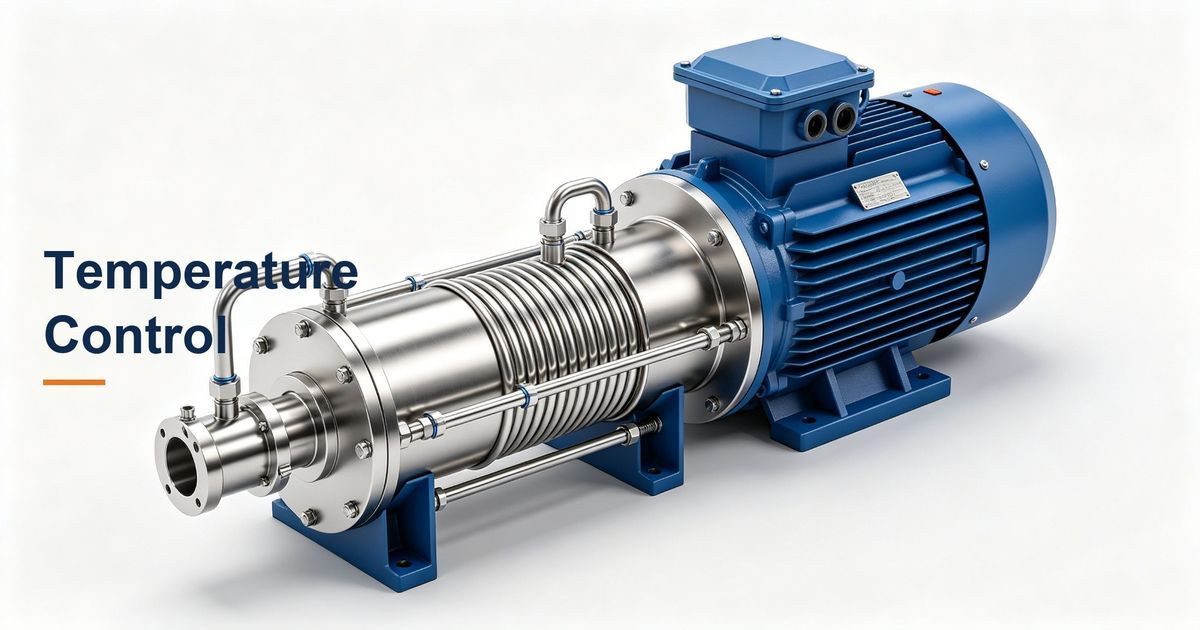
Understanding Heat Generation in Bead Mills
During wet grinding, nearly all mechanical energy input into a bead mill eventually converts to heat. Understanding where this heat comes from is the first step toward effective temperature control.
The primary heat sources in a bead mill include:
- Friction between grinding media: As beads collide and slide against each other at high speed, kinetic energy converts to thermal energy
- Shear between media and chamber wall: The relative motion between beads and the grinding chamber inner surface generates frictional heat
- Viscous dissipation of product: High-shear zones around the disperser discs cause the liquid product to absorb mechanical energy, which dissipates as heat
- Particle fracture energy: A portion of energy goes into breaking agglomerates, but even this process generates heat through internal friction
- Mechanical friction of seals and bearings: Though smaller in magnitude, mechanical friction contributes to overall heat load
In practice, a bead mill operating at full load can convert 85–95% of motor input power into heat within the product stream. This means a 75 kW mill can inject over 60 kW of thermal energy into the material being ground.
Why Temperature Rise Matters
Excessive temperature rise is not merely an equipment concern — it directly affects product quality and process economics.
Product Quality Impacts
For temperature-sensitive materials, uncontrolled grinding temperature can cause:
- Resin degradation in coatings and inks: Many binder systems begin to lose molecular weight above 60–70°C, leading to reduced film hardness and poor adhesion
- Pigment flocculation: Temperature changes alter the adsorption equilibrium of dispersants on pigment surfaces, potentially causing re-agglomeration and loss of color strength
- Solvent loss and viscosity drift: In solvent-based systems, elevated temperatures accelerate solvent evaporation, shifting viscosity and potentially causing skin formation or film defects
- Thermal degradation of active ingredients: In agrochemical and pharmaceutical applications, certain active compounds degrade at elevated temperatures, reducing product efficacy
- Microbial risk in water-based systems: Warm conditions can promote microbial growth if biocide levels are insufficient
Process and Equipment Impacts
Beyond product quality, high operating temperatures affect:
- Seal life: Mechanical seals rely on a thin fluid film for lubrication and cooling. Excessive temperatures can cause seal face distortion, accelerated wear, and premature failure
- Bead wear rate: Higher temperatures soften some bead materials and increase wear rates, leading to more frequent media replacement and potential contamination
- Energy efficiency: A mill running hot is essentially wasting energy as heat rather than using it for particle size reduction
- Operator safety: Elevated surface temperatures on chamber walls and piping create burn hazards for maintenance personnel
Key Factors That Influence Temperature Rise
Temperature rise in a bead mill is governed by several interrelated factors. Understanding these variables allows operators to make informed process decisions.
1. Specific Energy Input
The single most important factor is the amount of energy applied per unit of product. Specific energy input, measured in kWh/kg or kJ/kg, directly correlates with temperature rise.
As a general engineering estimate:
- 1 kWh/kg of specific energy input corresponds to approximately 4–5°C of temperature rise for water-based products
- For solvent-based products with lower specific heat capacity, the same energy input can cause 6–8°C of rise
This means a product requiring 0.3 kWh/kg to reach target fineness may experience a 12–15°C temperature increase in a single pass.
2. Flow Rate and Residence Time
Product flow rate determines how long material stays in the grinding chamber:
- Low flow rate = longer residence time = higher temperature rise: Material spends more time absorbing energy before exiting
- High flow rate = shorter residence time = lower per-pass rise: But may require more passes to achieve target fineness
The relationship is not linear — at very low flow rates, heat removal capacity decreases while heat generation continues, leading to disproportionately high temperatures.
3. Grinding Media Loading and Size
Bead loading affects both heat generation and heat transfer:
- Higher bead filling ratio: More media means more collision points and higher energy dissipation, but also increases the effective heat transfer surface area within the chamber
- Smaller beads: Provide more contact points and higher specific surface area for heat transfer, but generate more friction per unit volume
- Bead material density: Higher density beads (zirconia) deliver more kinetic energy per collision, generating more heat per unit volume than glass beads
4. Agitator Speed and Tip Speed
The rotational speed of the disperser directly determines the energy input rate:
- Higher tip speed = higher shear intensity = more heat generated per unit time
- Tip speeds above 12–14 m/s are generally associated with high heat generation rates
- For temperature-sensitive products, reducing tip speed while increasing residence time can sometimes achieve equivalent fineness with lower peak temperatures
5. Product Viscosity and Solids Content
Product formulation plays a significant role:
- Higher viscosity products: Generate more viscous dissipation heat in high-shear zones, and have poorer heat transfer characteristics
- High solids loading: Increases effective viscosity and reduces the heat capacity per unit volume, leading to higher temperature rises
- Low specific heat solvents: Solvent-based products generally heat up faster than water-based products for the same energy input
6. Cooling System Effectiveness
The ability to remove heat depends on:
- Cooling jacket surface area: Larger chambers have more jacket area, but the volume-to-surface ratio increases with scale
- Coolant flow rate and temperature: Higher coolant flow and lower inlet temperature improve heat removal, but are limited by condensation risk and utility costs
- Cooling jacket design: Double-spiral or baffled jackets provide more turbulent coolant flow and better heat transfer than simple annular jackets
- Product-side heat transfer coefficient: This depends on product velocity near the wall, viscosity, and thermal conductivity
Temperature Control Strategies
Effective temperature management requires a combination of equipment design, process optimization, and operational discipline.
Equipment-Level Solutions
1. Enhanced Cooling Jacket Design
Modern bead mills employ several cooling design improvements:
- Double-spiral cooling channels: Create turbulent coolant flow and maximize heat transfer coefficient across the chamber wall
- Stator tube cooling: In addition to the outer jacket, some designs cool the inner stator tube, providing a second heat removal surface close to the high-shear zone
- Agitator shaft cooling: Cooling the disperser shaft and discs removes heat directly from the highest-energy region
- Large-diameter coolant ports: Ensure adequate coolant flow rates without excessive pressure drop
2. Chamber Material Selection
Thermal conductivity of the chamber wall affects heat transfer:
- Stainless steel (304/316L): Standard material with moderate thermal conductivity (~16 W/m·K), good corrosion resistance
- Ceramic-lined chambers: Provide excellent wear resistance but lower thermal conductivity, requiring more aggressive cooling
- Silicon carbide liners: Offer both high wear resistance and good thermal conductivity, but at higher cost
3. Multi-Pass and Series Configuration
For products requiring high specific energy input:
- Multi-pass recirculation: Product passes through the mill multiple times, allowing cooling between passes in the holding tank
- Series mill configuration: Two or more mills connected in series, with intermediate cooling heat exchangers between stages
- Each mill operates at lower specific energy per pass, reducing peak temperature while achieving overall fineness target
Process-Level Optimization
1. Optimize Flow Rate and Pass Count
Finding the right balance between flow rate and number of passes is critical:
- Start with the manufacturer's recommended flow range for the specific product viscosity and target fineness
- Monitor discharge temperature at various flow rates to identify the optimal operating point
- For temperature-sensitive products, use higher flow rates with more passes rather than low flow rates with fewer passes
2. Pre-Cool Feed Material
Cooling the product before it enters the mill provides additional thermal headroom:
- Use jacketed holding tanks with cooling coils to maintain feed temperature at 20–25°C
- Install inline heat exchangers between the feed tank and mill for high-throughput operations
- Avoid starting with warm feed material, especially in summer or after extended equipment idle periods
3. Control Agitator Speed
For products with temperature sensitivity:
- Reduce tip speed from the maximum recommended value to 70–80% of maximum
- Compensate with longer residence time or additional passes
- Use variable-frequency drives (VFD) to allow precise speed adjustment based on product temperature feedback
4. Optimize Grinding Media Selection
Bead selection affects heat generation:
- Use slightly larger beads for temperature-sensitive products — they generate less frictional heat per unit volume while still achieving target fineness
- Consider bead material: Zirconia beads deliver more energy per collision but may generate more heat; glass beads run cooler but wear faster
- Maintain proper bead filling ratio: Overfilling increases heat generation without proportional improvement in grinding efficiency
Operational Best Practices
1. Real-Time Temperature Monitoring
- Install temperature sensors at both product inlet and discharge points
- Set high-temperature alarms at 5°C below the product's critical temperature threshold
- Record temperature data for each batch to identify trends and optimize future runs
2. Proper Coolant Management
- Maintain coolant inlet temperature at 10–15°C below target product temperature
- Ensure adequate coolant flow rate — typically 2–3 times the product flow rate by volume
- Regularly inspect and clean cooling jackets to remove scale and sediment that reduce heat transfer
- Use water-glycol mixtures in cold climates to prevent freezing, but note that glycol reduces heat transfer capacity
3. Batch Size and Tank Cooling
- Use jacketed holding tanks with adequate cooling capacity for recirculation grinding
- Avoid overfilling tanks — leave headspace for proper agitation and heat exchange
- Consider tank cooling coils in addition to jacket cooling for large-volume batches
Vertical vs Horizontal Mills: Temperature Differences
The orientation of a bead mill affects its temperature characteristics in several ways.
Vertical Bead Mills
- Natural convection assists cooling: Warm product rises toward the top of the chamber, enhancing contact with cooling surfaces
- Gravity-assisted bead separation: Static separation screens at the top allow product to exit while retaining beads
- Typically smaller chamber volumes: Most vertical mills are designed for 5–100L volumes, with favorable surface-to-volume ratios
- Limited to low-to-medium viscosity products: High-viscosity materials can cause uneven bead distribution and localized hot spots
Horizontal Bead Mills
- More uniform bead distribution: Agitator discs maintain consistent media distribution throughout the chamber length
- Higher energy density: Can operate at higher tip speeds and bead filling ratios, generating more heat per unit volume
- Larger chamber volumes: Available from 1L to over 1000L, but larger volumes have less favorable surface-to-volume ratios
- Require dynamic separation systems: Centrifugal or gap separators are needed to retain beads while allowing product flow
- Better suited for high-viscosity and high-solids products: Uniform media distribution prevents settling and channeling
Practical Implications
For temperature-sensitive products:
- Small-to-medium batches: Vertical mills often run cooler due to favorable surface-to-volume ratios and natural convection
- Large-scale production: Horizontal mills with enhanced cooling systems (double jackets, stator cooling) are generally preferred despite higher heat generation, because of their throughput advantage
- High-viscosity products: Horizontal mills are necessary, but require careful attention to cooling system capacity
Troubleshooting High Discharge Temperature
When a bead mill consistently runs hotter than expected, systematically diagnose the cause:
Step 1: Verify Cooling System Performance
- Check coolant inlet temperature with a calibrated thermometer
- Measure coolant flow rate through the jacket
- Inspect coolant for discoloration, sediment, or biological growth
- Verify that cooling valves are fully open
- Check for coolant bypass around the mill
Step 2: Assess Process Parameters
- Compare current flow rate with manufacturer's recommendations
- Check agitator speed against the product's recommended range
- Verify bead filling ratio — overfilling is a common cause of overheating
- Assess product viscosity — has the formulation changed?
- Check feed temperature — is pre-cooling functioning?
Step 3: Inspect Equipment Condition
- Check for excessive seal friction or bearing heat
- Inspect cooling jacket for scale buildup or blockage
- Verify that disperser discs are not worn or damaged
- Check for product buildup on chamber walls that insulates against cooling
Step 4: Implement Corrective Actions
Based on the diagnosis, appropriate actions may include:
- Increasing coolant flow rate or lowering coolant temperature
- Reducing agitator speed and increasing pass count
- Reducing bead filling ratio to the manufacturer's recommended level
- Installing an inline heat exchanger between mill passes
- Cleaning or descaling the cooling jacket
- Pre-cooling feed material to a lower starting temperature
POLYC Approach to Temperature Control
POLYC MACHINE designs bead mills and dispersion systems with temperature management as a core engineering priority, drawing on 25 years of experience in coating, ink, agrochemical, and new-energy material processing.
Design Features
- Double-spiral cooling jackets on all production-scale horizontal bead mills, providing turbulent coolant flow and maximum heat transfer
- Stator tube cooling on high-energy models, adding a second cooling surface near the high-shear zone
- Large coolant ports with optimized flow paths to minimize pressure drop and ensure adequate cooling capacity
- Variable-frequency drives as standard on all production models, allowing precise speed control for temperature-sensitive products
- Integrated temperature monitoring with inlet and discharge sensors, high-temperature alarms, and optional automatic speed reduction
Process Support
POLYC engineers work with customers to optimize temperature-sensitive processes through:
- Laboratory trial testing to determine the specific energy requirement and temperature profile for each product
- Process flow sheet development that includes cooling capacity calculations and heat exchanger sizing
- Equipment selection guidance based on product temperature sensitivity, viscosity, and required throughput
- Commissioning support to verify cooling system performance and optimize operating parameters
Complete Line Integration
For turnkey production lines, POLYC integrates:
- Jacketed holding tanks with cooling coils and temperature control
- Inline heat exchangers between milling stages for multi-pass processes
- Centralized cooling water systems with adequate capacity for all equipment
- PLC-based temperature control with automated valve actuation and setpoint management
Conclusion
Temperature control in bead milling is not an afterthought — it is a fundamental process parameter that directly affects product quality, equipment life, and operating cost. By understanding heat generation mechanisms, identifying the key factors that influence temperature rise, and implementing appropriate equipment and process solutions, manufacturers can achieve consistent fineness without compromising product quality.
The most effective temperature control strategy combines well-designed cooling systems with optimized process parameters and disciplined operational practices. POLYC MACHINE's 25 years of engineering experience in wet grinding and dispersion provides a solid foundation for solving even the most challenging temperature control applications.