
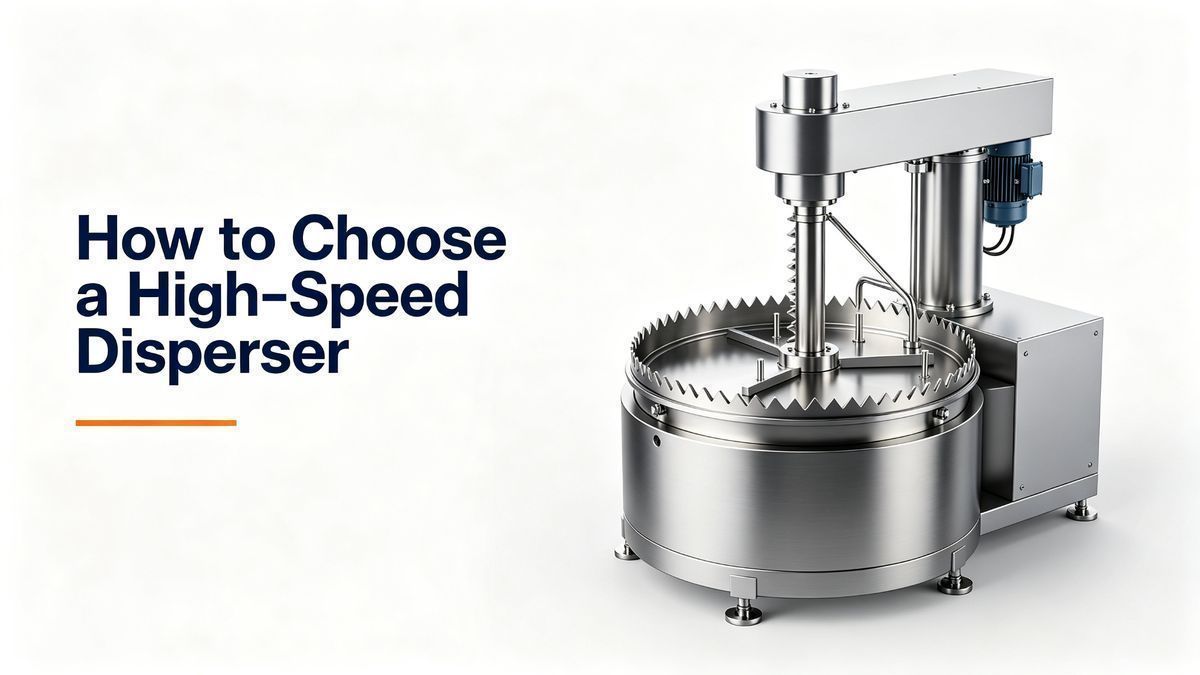
Before a bead mill can fine-grind a pigment, the powder must first be wetted and broken down. A high-speed disperser, also called a dissolver, does this with a sawtooth disc rotating at up to 1,450 rpm, creating shear and turbulence that deagglomerate powders into liquid.
Step 1: Match motor power to batch volume
Larger vessels need more power and a longer lifting stroke. The table below shows the standard PDM range; final power is confirmed against your material viscosity and target dispersion time.
| Model | Power (kW) | Speed (rpm) | Disc Diameter (mm) | Lifting Height (mm) | Capacity (L) |
|---|---|---|---|---|---|
| PDM1.5/2.2 | 1.5/2.2 | 0-1450 | 150 | 600 | 50-100 |
| PDM4.5/5.5 | 4.5/5.5 | 0-1450 | 200 | 800 | 100-200 |
| PDM7.5/11/15 | 7.5/11/15 | 0-1450 | 250/300 | 900 | 400-600 |
| PDM18.5/22/30 | 18.5/22/30 | 0-1450 | 350/400 | 1200 | 600-2000 |
| PDM37/45 | 37/45 | 0-1200 | 450 | 1600 | 1000-2500 |
| PDM55/75/90 | 55/75/90 | 0-1200 | 500/550/600 | 1600 | 5000 |
Example: a 1000 L vessel (about 1100 mm internal diameter) is typically paired with a 22 kW disperser and a 350 mm disc.
Step 2: Disc diameter is about one third of the vessel diameter
The sawtooth disc generates shear and turbulence at the vessel wall. A disc that is too small leaves dead zones; one that is too large can overload the motor and draw air into the batch. As a rule of thumb, disc diameter is approximately vessel diameter divided by three. For a 1000 L vessel (about 1100 mm), a 350 mm disc is the standard match. Single- or double-layer discs are available depending on the material.
Step 3: Water-based or solvent-based decides explosion-proof
Explosion protection is driven by the solvent content of the material, not by machine size. Water-based paints, latex and aqueous slurries can use standard non-explosion-proof motors and control panels. Solvent-based coatings, inks and resins require explosion-proof motors, explosion-proof control panels and safety interlocks. If the plant area is classified as hazardous, the full electrical package must match the local classification.
Step 4: Match voltage and frequency to the plant
Machines are built for the local supply. Common three-phase options are 380V 50Hz, 415V 50Hz and 460V 60Hz. Confirm your plant voltage when requesting a quote so the motor, VFD and control panel are configured correctly.
Step 5: Which disperser type do you need?
Beyond the standard single-shaft dissolver, several configurations cover different process needs:
- PDM single-shaft high-speed disperser - standard wet dispersion for paints, coatings, inks and pigments. Hydraulic lift, VFD speed, 50-5000 L. View PDM disperser
- PVM vacuum disperser - adds a vacuum pump for degassing after dispersion, used when air bubbles must be removed from the final batch. View vacuum disperser
- PSD platform (mezzanine) disperser - for large batches of 3000 L and above. One disperser can serve two or three vessels by lifting and rotating to the next tank. View PSD platform disperser
- Dissolver kettle (dispersing reactor) - a closed vessel with a dished top for solvent-based paint and coating lines; flat-top versions are common for water-based materials. The working principle is the same as a standard disperser, in a pressure-rated structure.
- Laboratory disperser - small bench units used to test formulations before scaling to production. View lab disperser
Engineering details that change dispersion results
Power, disc size and explosion-proof rating get you the right machine, but three operating details determine whether it actually reaches target fineness: tip speed, heat rise and charging order.
Tip speed. The meaningful speed is not the motor rpm but the peripheral speed of the disc, calculated as V = 2πfR, where f is the shaft speed in rpm and R is the disc radius. The high-efficiency window for pigment dispersion is roughly 2,100 to 2,700 cm/s (21 to 27 m/s). Below this range the disc does not generate enough shear; above it the flow regime changes past the critical Reynolds number and dispersion efficiency drops sharply. When comparing machines, convert the quoted rpm to tip speed using your actual disc diameter rather than comparing rpm directly.
Heat rise. High-speed dispersion generates significant frictional heat. As temperature rises, viscosity drops sharply, which reduces the shear the disc can transfer to the pigment, accelerates solvent evaporation and can trigger self-polymerisation in resins with reactive double bonds. For production batches, specify a mixing vessel with a cooling-water jacket so the batch can be held in its working viscosity window. Lab and small-batch work may rely on natural cooling, but production-scale dispersers should always be quoted with jacketed vessels when the formulation is heat-sensitive.
Charging order and rate. Pigments differ in density and how easily they wet out. Follow the principle of light before heavy, difficult before easy: add lower-density and harder-to-wet pigments first so they have the longest residence time in the resin, then add denser or easier pigments. Add powder gradually rather than dumping the full charge at once, which can form dry lumps that the disc cannot break open. Resin and solvent should form the liquid base before any pigment is introduced.
Key Takeaways
- Match motor power to batch volume; a 1000 L vessel typically uses a 22 kW disperser.
- Disc diameter is about vessel diameter divided by three; a 350 mm disc pairs with an approximately 1100 mm vessel.
- Solvent-based materials require explosion-proof motors and control panels; water-based materials can use standard motors.