
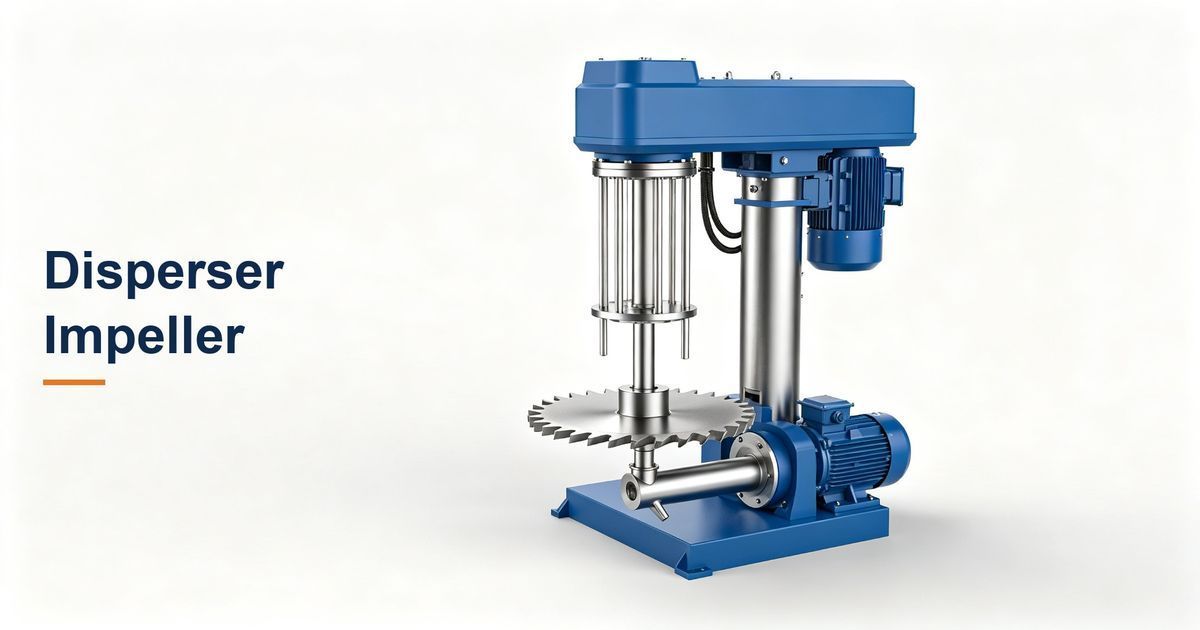
Understanding High-Speed Disperser Impellers
The impeller (or dispersing disc) is the heart of a high-speed disperser. Its design directly determines the shear intensity, flow pattern, and dispersion efficiency of the entire machine. Selecting the right impeller for a specific application is critical for achieving optimal pigment wetting, agglomerate breakdown, and batch uniformity.
High-speed dispersers operate on the principle of high-shear mechanical dispersion. The rotating impeller creates a high-velocity zone at the disc edge, where material is subjected to intense shear forces that break apart pigment agglomerates and wet individual particles. The impeller design controls how this shear energy is generated and distributed throughout the batch.
Common Impeller Types
1. Single Saw-Tooth Disc (Cowles Type)
The single saw-tooth disc, also known as a Cowles disc, is the most common and versatile impeller used in high-speed dispersers.
Design Characteristics: - Single circular disc with serrated or saw-tooth edges around the perimeter - Typically 30–50% of vessel diameter - Mounted at the end of the disperser shaft - Available in various tooth profiles: standard teeth, high-shear teeth, and deep teeth
How It Works: - As the disc rotates at high speed (tip speeds typically 8–20 m/s), the serrated edges create intense localized shear zones - Material is thrown outward from the disc edge by centrifugal force - The outward flow creates a vortex that draws material down from the surface and back toward the disc - This creates a continuous circulation pattern within the vessel
Advantages: - Versatile — suitable for a wide range of viscosities (1,000–50,000 cP) - Effective for most pigment dispersion applications - Simple design, easy to clean and maintain - Good balance of shear and flow - Cost-effective
Limitations: - Less effective for very high-viscosity materials (>50,000 cP) - May not provide sufficient turnover in very large batches - Single shear zone limits maximum dispersion efficiency for difficult-to-disperse pigments
2. Dual Saw-Tooth Disc (Twin Disc)
The dual saw-tooth disc configuration uses two discs mounted on the same shaft, separated by a specific distance.
Design Characteristics: - Two identical saw-tooth discs mounted on the same shaft - Disc spacing typically 0.5–1.0 times the disc diameter - Both discs rotate at the same speed - Lower disc positioned near the vessel bottom, upper disc at mid-height
How It Works: - The lower disc handles material near the vessel bottom, preventing settling and ensuring bottom turnover - The upper disc creates a second shear zone at mid-height, improving overall batch circulation - The two discs work together to create a more uniform flow pattern throughout the vessel - The dual shear zones provide more cumulative shear energy per pass
Advantages: - Better batch turnover, especially in tall vessels - Two shear zones provide more efficient dispersion - Reduces settling of heavy pigments at vessel bottom - More uniform temperature distribution throughout the batch - Suitable for medium-to-high viscosity materials (5,000–100,000 cP)
Limitations: - Higher power consumption compared to single disc - More complex shaft design - Disc spacing must be optimized for specific vessel geometry - May create excessive vortex in low-viscosity materials
3. High-Shear Tooth Profile (Deep Tooth / Knife Edge)
High-shear tooth profiles feature deeper, more aggressive teeth designed for maximum shear intensity.
Design Characteristics: - Deeper tooth cutouts compared to standard saw-tooth discs - Knife-edge or sharp tooth geometry - Sometimes features alternating tooth heights or angles - May include additional holes or slots in the disc face for increased turbulence
How It Works: - The deep teeth create more intense localized shear at the tooth edges - Sharp edges provide higher shear rates for breaking tough agglomerates - Additional turbulence from disc features improves mixing - Higher shear intensity but potentially lower bulk flow
Advantages: - Maximum shear intensity for difficult-to-disperse pigments - Effective for hard agglomerates and high-oil-absorption pigments - Faster dispersion time for challenging formulations - Good for carbon black, phthalocyanine blue, and other hard-to-disperse pigments
Limitations: - Higher power consumption - May generate more heat due to higher shear intensity - Can cause excessive vortex and air entrainment in low-viscosity materials - Less effective for high-viscosity materials due to reduced flow
4. Anchor / Gate Impeller (for High Viscosity)
Anchor or gate impellers are used in combination with high-speed dispersers for very high-viscosity materials.
Design Characteristics: - Large, slow-speed anchor or gate-shaped impeller that sweeps the vessel wall - Typically driven by a separate, low-speed motor - Often used in dual-shaft or triple-shaft mixer configurations - May include scrapers to remove material from vessel walls
How It Works: - The anchor rotates slowly (20–60 rpm) to provide bulk turnover of high-viscosity material - It sweeps material from the vessel walls and bottom, bringing it into the high-shear zone of the disperser disc - Prevents material from sticking to vessel walls and ensures uniform processing - The high-speed disc provides intense shear, while the anchor provides batch turnover
Advantages: - Essential for very high-viscosity materials (50,000–1,000,000+ cP) - Prevents wall buildup and dead zones - Ensures uniform temperature throughout the batch - Enables processing of pastes, putties, and high-solids formulations
Limitations: - Requires dual-shaft or triple-shaft machine configuration - Higher equipment cost - More complex maintenance - Not needed for low-to-medium viscosity applications
Key Impeller Design Parameters
Disc Diameter
The disc diameter is one of the most important parameters affecting dispersion performance.
General Guidelines: - Standard ratio: Disc diameter = 30–40% of vessel diameter - For low viscosity: Larger disc (40–50% of vessel diameter) for better flow - For high viscosity: Smaller disc (25–35% of vessel diameter) to reduce power demand - For deep vessels: May require dual discs to cover full vessel height
Effects of Disc Size: - Larger disc: More flow, better batch turnover, lower shear intensity per unit area, higher power consumption - Smaller disc: Higher shear intensity at disc edge, less flow, lower power consumption, may cause dead zones
Tip Speed
Tip speed is the linear velocity at the outer edge of the rotating disc, and it directly determines shear intensity.
Calculation: Tip Speed (m/s) = π × Disc Diameter (m) × RPM / 60
Typical Ranges: - Low shear: 5–8 m/s — for gentle mixing, low-viscosity materials, temperature-sensitive products - Standard dispersion: 8–12 m/s — for most coating and ink applications - High shear: 12–16 m/s — for difficult-to-disperse pigments, carbon black, phthalocyanines - Very high shear: 16–20 m/s — for specialized applications, requires robust cooling
Important Considerations: - Tip speed above 16 m/s can cause excessive heat generation - Very high tip speeds may cause air entrainment and vortex formation - Optimal tip speed depends on product viscosity and pigment characteristics - Variable-frequency drives (VFD) allow adjustment of tip speed for different products
Tooth Profile and Number
The tooth design affects how shear energy is generated and distributed.
Tooth Height: - Standard teeth: 10–15% of disc radius — balanced shear and flow - Deep teeth: 15–25% of disc radius — higher shear, more turbulence - Shallow teeth: 5–10% of disc radius — gentler shear, more flow
Tooth Number: - Fewer teeth (8–12): Larger gaps between teeth, more flow, less shear per revolution - More teeth (16–24): More shear points, higher shear intensity, potentially more heat - Typical: 12–18 teeth for most standard applications
Tooth Angle: - Vertical teeth: Standard, balanced performance - Angled teeth: Can improve axial flow and reduce vortex - Alternating angles: Can create more turbulence and improve dispersion
Application Boundaries by Viscosity
Low Viscosity (1,000–10,000 cP)
Typical Products: - Solvent-based coatings and inks - Water-based primers and sealers - Low-solids pigment concentrates - Thin pastes and slurries
Recommended Impeller: - Single standard saw-tooth disc is usually sufficient - Disc diameter: 35–45% of vessel diameter - Tip speed: 8–12 m/s - May benefit from larger disc for better flow
Key Considerations: - Watch for excessive vortex and air entrainment at high tip speeds - Lower viscosity materials may require baffles to prevent solid-body rotation - Dispersion time is typically shorter for low-viscosity materials - Temperature control is usually less critical
Medium Viscosity (10,000–50,000 cP)
Typical Products: - Architectural paints (interior/exterior) - Industrial coatings - Printing inks (offset, flexographic) - Adhesives and sealants - Pigment pastes
Recommended Impeller: - Single saw-tooth disc works well for most applications - Dual disc may be beneficial for tall vessels or difficult pigments - Disc diameter: 30–40% of vessel diameter - Tip speed: 10–14 m/s
Key Considerations: - This is the most common viscosity range for high-speed dispersers - Standard saw-tooth discs provide excellent performance - Monitor batch temperature — medium viscosity materials can heat up significantly - Ensure adequate vessel coverage — disc should be positioned 1–1.5 disc diameters below the surface
High Viscosity (50,000–200,000 cP)
Typical Products: - Automotive coatings (basecoats, clearcoats) - High-solids coatings - Offset printing inks - High-viscosity adhesives - Putties and fillers - High-pigment-loading concentrates
Recommended Impeller: - Dual saw-tooth disc is recommended for better batch turnover - Anchor assist may be needed for the upper end of this range - Disc diameter: 25–35% of vessel diameter - Tip speed: 8–12 m/s (lower to reduce heat)
Key Considerations: - Single discs may leave dead zones at vessel bottom or top - Dual discs provide much better circulation in high-viscosity materials - Heat generation is significant — ensure adequate cooling - Dispersion times are longer — may require 30–60 minutes or more - Consider pre-mixing with a low-speed anchor before high-speed dispersion
Very High Viscosity (200,000+ cP)
Typical Products: - Sealants and caulks - Putties and body fillers - High-solids pastes - Certain adhesive formulations - Battery electrode slurries (high solids)
Recommended Impeller: - Dual-shaft or triple-shaft configuration with anchor/gate impeller is essential - High-speed disc provides shear, anchor provides bulk turnover - Disc diameter: 20–30% of vessel diameter - Tip speed: 6–10 m/s
Key Considerations: - Single high-speed disperser cannot effectively process very high-viscosity materials - Anchor or gate impeller is required to bring material to the shear zone - Wall scrapers may be needed to prevent material buildup - Power requirements are significantly higher - Dispersion is a slow process — may require several hours - Temperature control is critical — high viscosity materials have poor heat transfer
Impeller Selection by Product Type
Coatings and Paints
Typical Viscosity: 5,000–100,000 cP Recommended Impeller: Single or dual saw-tooth disc Key Factors: - Titanium dioxide disperses relatively easily — standard disc is sufficient - Organic pigments (phthalocyanines, quinacridones) may require high-shear tooth profile - Carbon black is the most difficult — use deep-tooth disc and higher tip speed - Automotive coatings often require dual discs for uniform high-quality dispersion
Printing Inks
Typical Viscosity: 1,000–50,000 cP (varies by ink type) Recommended Impeller: Single saw-tooth disc for most types Key Factors: - Offset inks are high viscosity — may need dual disc or anchor assist - Flexographic and gravure inks are lower viscosity — standard disc works well - Inkjet inks require very fine dispersion — may need subsequent bead milling - Pigment loading is often high in inks — ensure adequate power
Adhesives and Sealants
Typical Viscosity: 10,000–500,000+ cP Recommended Impeller: Dual disc or dual-shaft with anchor Key Factors: - Many adhesives are filled with calcium carbonate or other fillers — good flow is important - High-viscosity sealants require anchor assist - Temperature control is important — many adhesives are temperature-sensitive - Air entrainment must be minimized — use appropriate tip speed and disc size
Agrochemical Formulations
Typical Viscosity: 500–10,000 cP (suspension concentrates) Recommended Impeller: Single saw-tooth disc Key Factors: - SC formulations often require subsequent bead milling for final particle size - Disperser is used for pre-dispersion and wetting - Low viscosity — watch for vortex and air entrainment - Many active ingredients are temperature-sensitive — control temperature
New Energy Materials (Battery Slurries)
Typical Viscosity: 1,000–50,000 cP Recommended Impeller: Dual disc or dual-shaft for high-solids formulations Key Factors: - Cathode slurries contain lithium metal oxides — abrasive, require wear-resistant discs - Anode slurries contain graphite or silicon — can be high viscosity - Conductive carbon black is difficult to disperse — use high-shear disc - Moisture control is critical — often processed under vacuum or dry conditions - Uniform dispersion is essential for battery performance
Common Impeller Problems and Solutions
Problem: Excessive Vortex and Air Entrainment
Symptoms: - Deep vortex forming at liquid surface - Air bubbles visible in product - Product volume appears to increase during dispersion - Foaming after dispersion
Causes: - Tip speed too high for product viscosity - Disc diameter too large - Vessel too deep relative to diameter - No baffles in vessel - Disc positioned too close to surface
Solutions: - Reduce tip speed by lowering RPM - Use smaller diameter disc - Add baffles to vessel (if not already present) - Lower disc position deeper in the vessel - Use dual discs to reduce vortex intensity - Consider vacuum dispersion for air-sensitive products
Problem: Poor Batch Turnover and Dead Zones
Symptoms: - Material at vessel bottom not being dispersed - Uneven pigment distribution - Temperature variation within batch - Settling of heavy pigments
Causes: - Single disc in tall vessel - Product viscosity too high for single disc - Disc positioned too high in vessel - Disc diameter too small
Solutions: - Switch to dual disc configuration - Add anchor or gate impeller for high viscosity - Lower disc position closer to vessel bottom - Use larger diameter disc (if power allows) - Consider using a vessel with better height-to-diameter ratio
Problem: Excessive Heat Generation
Symptoms: - Product temperature rises rapidly during dispersion - Product too hot to touch after dispersion - Temperature-sensitive products degrade - Solvent loss in solvent-based systems
Causes: - Tip speed too high - High-shear tooth profile generating excessive shear - Long dispersion time - Inadequate cooling (no jacketed vessel) - High viscosity product with poor heat transfer
Solutions: - Reduce tip speed - Use standard tooth profile instead of high-shear - Reduce dispersion time (check fineness more frequently) - Use jacketed vessel with cooling water - For high viscosity, use dual discs to reduce required dispersion time - Pre-cool starting material
Problem: Insufficient Shear / Poor Dispersion
Symptoms: - Pigment not fully dispersed after recommended time - Fineness gauge readings not reaching target - Color strength lower than expected - Visible agglomerates or specking in applied film
Causes: - Tip speed too low - Standard tooth disc for difficult pigment - Disc diameter too small - Insufficient dispersion time - Product formulation issues (insufficient dispersant)
Solutions: - Increase tip speed (within safe limits) - Switch to high-shear deep-tooth disc - Use larger diameter disc (if power allows) - Extend dispersion time - Check dispersant dosage and pigment wetting - Consider subsequent bead milling for ultrafine requirements
Problem: Disc Wear and Damage
Symptoms: - Teeth becoming rounded or worn down - Cracks or bends in disc - Reduced dispersion performance over time - Metal contamination in product
Causes: - Abrasive pigments (titanium dioxide, calcium carbonate, iron oxides) - Excessive tip speed - Improper disc material - Impact with vessel wall or other objects - Fatigue from long-term use
Solutions: - Use wear-resistant materials (hardened steel, stainless steel, polyurethane coating) - For highly abrasive products, consider ceramic-coated or tungsten carbide discs - Reduce tip speed - Ensure proper clearance between disc and vessel wall - Regularly inspect discs and replace when worn - Never start disperser with disc touching settled solid material
Impeller Maintenance Best Practices
Regular Inspection
- Before each batch: Inspect disc for wear, cracks, or damage
- Weekly: Check shaft alignment and disc tightness
- Monthly: Measure tooth height and compare to new disc specifications
- Quarterly: Perform thorough inspection of shaft, bearings, and seals
Replacement Criteria
Replace the disperser disc when: - Tooth height is reduced by 20% or more from original - Cracks or significant bends are visible - Dispersion performance has noticeably decreased - Metal contamination is suspected - Disc has been in service for more than 2,000 hours (depending on application)
Proper Installation
- Ensure disc is securely tightened to shaft
- Use correct keyway or set screw configuration
- Verify disc is perpendicular to shaft (no wobble)
- Check clearance between disc and vessel wall (typically 25–50 mm)
- Ensure shaft seal is properly installed and functioning
POLYC Disperser Impeller Solutions
POLYC MACHINE offers a comprehensive range of high-speed dispersers and impeller configurations, backed by 25 years of experience in coating, ink, adhesive, and new-energy material processing.
Equipment Portfolio
High-Speed Dispersers: - Laboratory series: 1.1–7.5 kW, 5–50L vessel capacity - Production series: 11–132 kW, 100–5,000L vessel capacity - Hydraulic lifting: Standard on all production models for easy vessel changeover - Variable-frequency drives: Allow precise tip speed control for different products - Explosion-proof options: Available for solvent-based applications
Dual-Shaft and Triple-Shaft Mixers: - Dual-shaft: High-speed disc + low-speed anchor for medium-to-high viscosity - Triple-shaft: High-speed disc + low-speed anchor + emulsifier for very high viscosity - Vacuum capability: For air-sensitive and deaeration applications - Jacketed vessels: For temperature control during processing
Impeller Options
POLYC dispersers can be equipped with various impeller configurations:
- Standard saw-tooth discs: For general-purpose dispersion
- High-shear deep-tooth discs: For difficult-to-disperse pigments
- Dual disc configurations: For tall vessels and high-viscosity materials
- Anchor/gate impellers: For dual-shaft and triple-shaft machines
- Custom tooth profiles: Available for specialized applications
- Wear-resistant coatings: For abrasive products
Engineering Support
POLYC engineers help customers select the right impeller configuration through:
- Laboratory trial testing to determine optimal disc size, tip speed, and dispersion time
- Process flow sheet development including vessel sizing, power requirements, and cooling capacity
- Impeller selection guidance based on product viscosity, pigment type, and required fineness
- Commissioning support to verify dispersion performance and optimize operating parameters
- Retrofit services to upgrade existing dispersers with dual discs or anchor impellers
Conclusion
Selecting the right high-speed disperser impeller is a critical decision that directly affects dispersion quality, processing time, energy consumption, and product consistency. The single saw-tooth (Cowles) disc remains the most versatile choice for low-to-medium viscosity applications, while dual disc configurations and anchor-assisted designs are necessary for high-viscosity materials and large batches.
Key selection factors include product viscosity, pigment characteristics, vessel geometry, required fineness, and temperature sensitivity. Tip speed, disc diameter, and tooth profile should be optimized for each specific application. Regular maintenance and timely disc replacement ensure consistent dispersion performance over time.
POLYC MACHINE's 25 years of engineering experience in high-speed dispersion technology, combined with a comprehensive equipment portfolio and laboratory testing capabilities, provides a solid foundation for selecting and optimizing the right impeller solution for even the most challenging dispersion applications.