
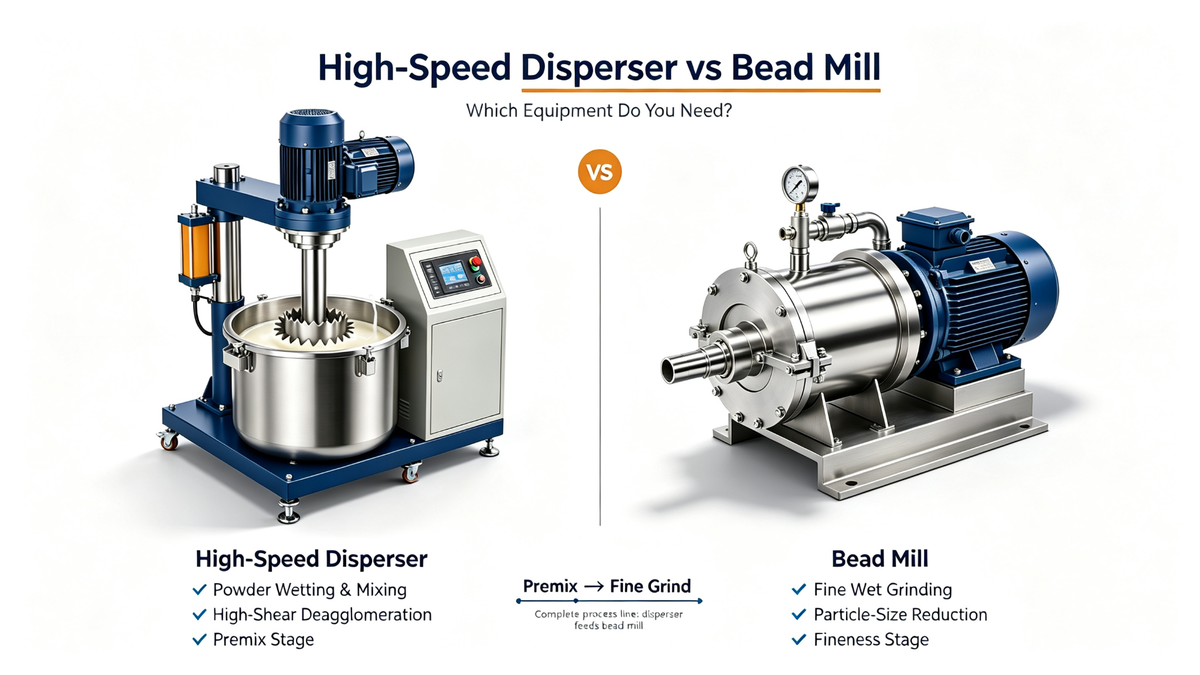
 High speed dispersers and bead mills are frequently compared as if they were alternatives, but they perform different functions in a dispersion process. A disperser wets pigment and breaks soft agglomerates, producing a uniform premix. A bead mill reduces particle size further by grinding between media, doing finishing work a disperser cannot do regardless of running time.
Understanding which function your product needs avoids both under-processing and unnecessary capital expenditure. Many architectural coatings are finished by dispersion alone, while industrial coatings, inks and agrochemical suspensions require milling to meet specification.
This article explains the mechanism of each machine, sets out the practical test for deciding whether you need milling, and explains why the two are most effective when used together rather than as substitutes. It also covers the cost implications of each configuration.
High speed dispersers and bead mills are frequently compared as if they were alternatives, but they perform different functions in a dispersion process. A disperser wets pigment and breaks soft agglomerates, producing a uniform premix. A bead mill reduces particle size further by grinding between media, doing finishing work a disperser cannot do regardless of running time.
Understanding which function your product needs avoids both under-processing and unnecessary capital expenditure. Many architectural coatings are finished by dispersion alone, while industrial coatings, inks and agrochemical suspensions require milling to meet specification.
This article explains the mechanism of each machine, sets out the practical test for deciding whether you need milling, and explains why the two are most effective when used together rather than as substitutes. It also covers the cost implications of each configuration.
Key Takeaways
- Dispersers wet and premix; bead mills grind to specification
- If fineness plateaus with disperser time while agglomerates remain, you need a mill
- The two work best as a pair: good pre-dispersion raises mill throughput substantially
- Many architectural coatings finish with dispersion alone; most inks and industrial coatings need milling
- Adding a mill without fixing pre-dispersion usually disappoints
What a High Speed Disperser Actually Does
A high speed disperser draws material into a rotating disc and subjects it to shear and impact. This is highly effective at wetting pigment, breaking soft agglomerates and producing a uniform premix. It is fast, economical and, for many products, sufficient on its own.
The limiting factor is the energy density achievable in an open vessel. Once the formulation reaches the practical shear limit of the disc, additional running time produces heat rather than finer particles. This is why a disperser cannot substitute for a mill where a tight specification applies.
Disperser performance depends on correct setup: disc-to-vessel ratio, immersion depth, tip speed and the order of addition. Most disperser performance complaints trace to setup rather than to machine capability, which is why the correction is usually quick and inexpensive.
What a Bead Mill Adds
A bead mill reduces particle size by passing product through a chamber filled with moving media. Particles are caught between beads and between beads and the agitator, and are broken by compression and shear across very many contact events. This delivers fineness levels an open-vessel disperser cannot reach.
The practical consequence is that a mill performs finishing work: reaching a contractual D90, fully developing colour strength, and ensuring the product will not block nozzles or filters. For industrial coatings, printing inks and agrochemical suspension concentrates, this work is essential rather than optional.
The mill does not, however, replace wetting. If material enters the chamber with poorly wetted agglomerates, the mill spends energy on work a disperser should have completed, and throughput falls. This is why mill performance is strongly dependent on the quality of the stage before it.
The Practical Test: Do You Need Milling?
A simple test resolves most cases. Run the disperser and measure fineness and colour strength at intervals. If both continue to improve, dispersion is still working and more time may be sufficient. If they plateau while visible agglomerates remain, the formulation has reached the practical limit of dispersion and requires milling.
The specification itself is also a guide. Architectural coatings with moderate fineness requirements are commonly finished by dispersion alone. Industrial and automotive coatings, printing inks and agrochemical suspensions with tight particle specifications require milling, as do any products that must pass fine filters or nozzles.
Where the decision is marginal, laboratory trials settle it quickly and cheaply. Sending your formulation for trial milling establishes achievable fineness and the cycle required, which converts a judgement call into a measured decision.
Why They Work Best Together
In most production plants the two machines are complementary rather than competing. The disperser produces a properly wetted and deagglomerated premix, which allows the mill to reach specification in fewer passes and at higher throughput. Plants that invest in pre-dispersion consistently get more from an existing mill.
The reverse is also true. Adding a bead mill without addressing pre-dispersion quality is a common disappointment, because the new machine inherits a bottleneck that was never in the mill. Correcting the premix stage is usually the cheapest available capacity increase.
For this reason, specify the two stages as one system. Size the disperser to produce consistent premix at the rate the mill consumes it, and document the premix cycle as part of the validated process rather than leaving it to operator judgement.
Cost and Capacity Implications
Capital cost differs substantially; a disperser is a fraction of the cost of a bead mill installation, which also requires a pump, cooling and piping. The decision should therefore be based on whether milling is genuinely required rather than on a preference for more capable equipment.
Where milling is required, the throughput benefit of good pre-dispersion often exceeds the benefit of specifying a larger mill. This makes the disperser stage one of the highest-return items in a milling plant, despite its modest cost.
Where milling is not required, adding it would increase capital, energy and cleaning cost without improving the product. The test described above, supported by laboratory trials where the answer is marginal, keeps investment aligned with actual requirement.
Technical Specifications
| Disperser function | wetting, deagglomeration of soft agglomerates, uniform premix |
| Disperser tip speed | typically 18 - 24 m/s for the dispersion stage |
| Bead mill function | fine grinding to specification via media contact |
| Bead mill fineness | sub-micron to 15 micron depending on media and configuration |
| Decisive test | whether fineness and colour strength plateau with disperser time |
| Optimum arrangement | disperser produces premix; mill finishes to specification |
Troubleshooting Guide
Fineness will not improve however long the disperser runs
Cause: Formulation has reached the practical shear limit of the disc; hard agglomerates remain
Solution: Add bead milling for the finishing stage rather than extending disperser cycles, which only generates heat
New bead mill is not delivering expected throughput
Cause: Pre-dispersion quality limiting the mill, or premix stage undersized
Solution: Optimise and standardise the premix cycle, and ensure the disperser can supply premix at the rate the mill consumes it
Product meets specification but energy cost is high
Cause: Milling work being done that effective pre-dispersion would remove
Solution: Improve wetting and staged addition in the premix so the mill performs only the grinding work it was designed for
Colour strength stops developing while fineness still improves
Cause: Stabilisation is limiting rather than grinding
Solution: Review dispersant selection and addition, since further grinding will not improve strength once stabilisation limits development
Frequently Asked Questions
Can a high speed disperser replace a bead mill?
Only where the specification can be met by dispersion alone, which is true for some architectural coatings. Where a tight particle size is contractual, or the product must pass fine filters or nozzles, milling is required because a disperser reaches a practical shear limit beyond which extra time only generates heat.
How do I know if my product needs bead milling?
Measure fineness and colour strength at intervals during dispersion. If both plateau while agglomerates remain, you need milling. The specification is also a guide: industrial coatings, inks and agrochemical suspensions almost always require it.
Is it worth buying a mill if I already have a good disperser?
Yes, if the specification requires it, and the disperser remains essential as the premix stage. Good pre-dispersion raises mill throughput substantially, so the two together usually outperform either alone. The disperser is not made redundant by adding a mill.
Does better pre-dispersion really improve mill throughput?
Yes, and it is usually the largest single gain available. A well-wetted, deagglomerated premix lets the mill perform only the grinding work it was designed for. Plants that optimise pre-dispersion typically gain more than plants that buy a larger mill.
What is the cost difference between the two?
A disperser costs a fraction of a bead mill installation, which also requires a pump, cooling supply and piping. The decision should rest on whether milling is genuinely required, not on a preference for more capable equipment.
Can I add a bead mill later if my specification tightens?
Yes, and this is a common growth path. Plan services and floor space with that possibility in mind, and ensure the premix stage is capable of supplying a mill at the required rate so the later addition does not create a new bottleneck.
Recommended POLYC MACHINE equipment
The following machines are commonly evaluated for the process described above. Final selection depends on formulation, target particle size, viscosity, capacity and contamination limits.
Related technical guides
Next step
Share your material, required capacity, target fineness and operating conditions with POLYC MACHINE engineers for a configuration review and quotation.
Practical Selection by Fineness Target
The most reliable way to decide between a disperser and a bead mill is to start from the fineness your product must reach, because that single number determines which machine does the finishing work. A high-speed disperser is the correct finishing tool when the specification is met by wetting pigment and breaking soft agglomerates into a uniform premix, which covers a large share of architectural and decorative coatings. A bead mill becomes necessary when the target particle size sits in the micron or sub-micron range and must be held consistently from batch to batch.
| Typical fineness target | Recommended configuration |
|---|---|
| Above 20 µm (Hegman below 4) | Disperser only, no mill required |
| 5 to 20 µm | Disperser plus a standard horizontal bead mill |
| 1 to 5 µm | Disperser plus a high-energy bead mill with small media |
| Below 1 µm / nano | Disperser plus a nano-capable mill with reliable separation |
Common Pitfalls When Specifying
- Expecting a disperser to reach a fine specification by running longer. Once agglomerates are broken, extra time only heats the batch and risks flocculation.
- Adding a mill without first improving pre-dispersion. A poor premix forces the mill to do wetting work it was not designed for, which cuts throughput and shortens media life.
- Ignoring viscosity. Both machines have practical viscosity ceilings; exceeding them reduces efficiency and raises temperature.
- Sizing the mill on peak output instead of average demand, which inflates capital cost and leaves capacity idle.
Throughput and Energy in Practice
A disperser moves large volumes at relatively low specific energy because it is premixing rather than grinding. A bead mill delivers the fineness but consumes more energy per kilogram because it is performing real size reduction. Running the two in sequence is usually cheaper in total energy and faster in throughput than pushing either machine past its design point. For most plants the optimal layout is a premix tank fed by one or more dispersers, discharging into a bead mill sized for the finished fineness, with recirculation only where the product truly demands it.
Integration and Footprint
A typical skid-mounted configuration places the disperser above a premix vessel, with the bead mill on a shared frame and a slip-stream to a lab fineness check. Keeping premix and milling on one controlled loop reduces transfer losses and makes changeover between shades or products faster. Where floor space is tight, a basket mill can combine premixing and milling in a single mobile unit, trading some throughput for flexibility.
Explore our Coatings solutions for application-specific equipment configurations and process recommendations.