
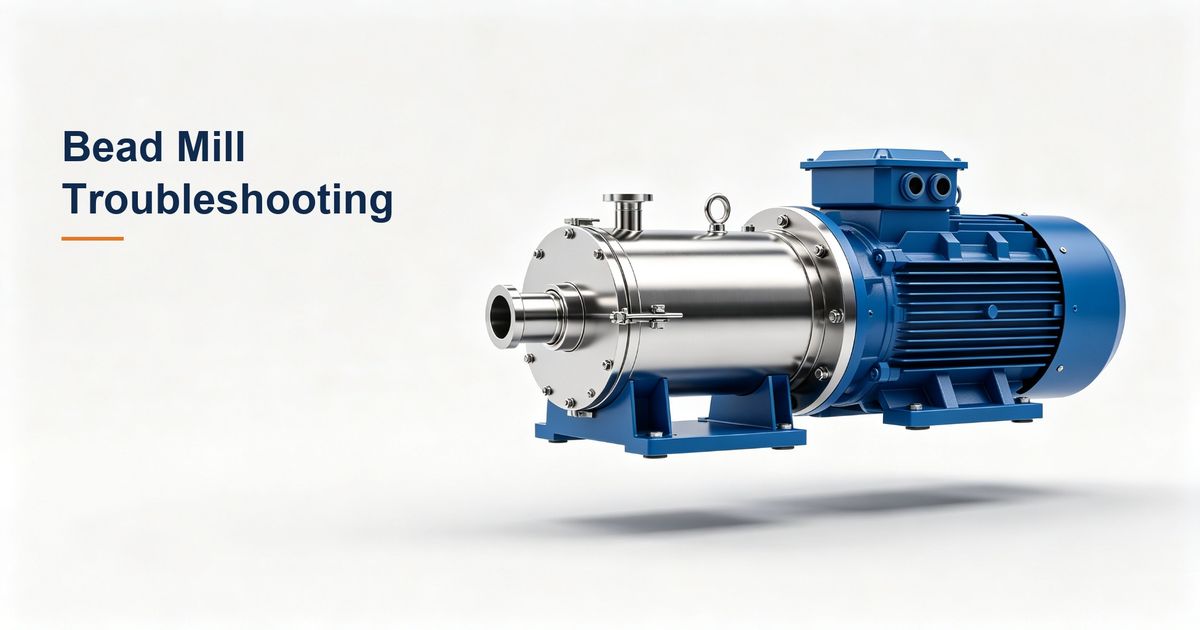
Bead mill operations — especially in high-viscosity wet grinding applications — often encounter issues such as overheating, contamination, separator screen clogging, material leakage, and irregular slurry flow. These common problems reduce the efficiency of horizontal bead mills, increase downtime, and raise production costs.
For industries relying on consistent performance — coatings, cosmetics, inks, pharmaceuticals, and battery materials — solving these issues is critical. This guide explores practical solutions to optimize performance and reduce operational disruptions, based on POLYC's 25 years of experience manufacturing wet grinding equipment.
Common Bead Mill Problems and Solutions
Bead mills process highly viscous slurries containing large agglomerates and abrasive compounds. Imprecise design, poor separator screen quality, inconsistent feed pumping, and other factors lead to poor performance in both short- and long-term production. Here are the most common problems and how to address them.
1. Overheating During Wet Grinding
High-speed agitation and intense collisions between the slurry and grinding media generate substantial heat during wet grinding. Without proper cooling systems, elevated temperatures can damage heat-sensitive materials — especially in food processing, pharmaceuticals, cosmetics, and chemicals — leading to thermal degradation, wasted raw materials, and compromised product quality.
Solutions:
- Ensure the cooling system is properly sized and maintained for continuous operation
- Use bead mills with a long, cylindrical grinding chamber engineered for optimal cooling performance and efficient heat dissipation
- Monitor product temperature at the discharge and adjust feed rate or cooling water flow accordingly
- For sensitive formulations, consider staged grinding with intermediate cooling to preserve product integrity while reducing energy waste
2. Material Leakage in Horizontal Bead Mills
In horizontal bead mills, mechanical seals are critical for preventing slurry from leaking out of the grinding chamber. Poor seal quality, incorrect installation, or pressure inconsistencies can lead to material leakage, resulting in contamination, resource loss, and damage to internal components. This issue is particularly harmful when handling abrasive slurries, which can accelerate seal wear.
Solutions:
- Use high-quality double mechanical seals with proper flush systems
- Ensure correct installation and alignment during maintenance
- Monitor seal flush pressure and flow rate regularly
- For abrasive applications, select seal materials rated for the specific slurry characteristics
- Establish a preventive maintenance schedule for seal inspection and replacement
3. Separator Screen Clogging
The separator screen (or dynamic separator) is responsible for retaining grinding media while allowing processed slurry to exit. When the screen becomes clogged with agglomerated material, oversized particles, or broken media fragments, discharge flow decreases, chamber pressure rises, and grinding efficiency drops.
Solutions:
- Regularly inspect and clean the separation system according to a preventive maintenance schedule
- Use appropriate screen gap size matched to the grinding media diameter
- Ensure pre-dispersion and pre-filtration prevent oversized particles from entering the chamber
- Consider bead mills with self-cleaning separator designs for applications prone to clogging
- Monitor discharge pressure as an early warning indicator of screen blockage
4. Irregular Slurry Flow
Inconsistent slurry flow is a frequent but overlooked issue in wet bead mill systems. The physical properties of the slurry — viscosity, particle concentration, and flow behavior — vary significantly across industries. Without proper control, irregular flow disrupts media interaction, reduces grinding efficiency, and can damage internal components. Poor flow also leads to chamber pressure buildup, overloading the motor and increasing the risk of leakage and operational shutdowns.
Solutions:
- Use high-efficiency pumps designed for accurate flow regulation at both inlet and outlet
- For viscous slurries, use rotary lobe pumps to maintain a consistent feed rate
- For variable fluid conditions, use pneumatic diaphragm pumps for strong suction and pressure control
- Install flow meters and pressure sensors to monitor and stabilize slurry circulation
- Ensure steady slurry circulation inside the bead mill to minimize stress on the motor while enhancing particle dispersion consistency
5. Cross-Product Contamination
In wet grinding equipment, contamination can occur during batch transitions or due to equipment design flaws. Poor-quality seals, non-enclosed chambers, and low-grade storage tanks increase the risk of foreign particles, dust, or moisture entering the product — especially when handling sensitive formulations. Cross-product contamination is a major concern for pharmaceuticals, chemicals, and cosmetics, where even trace impurities can compromise product safety, violate regulations, and damage brand reputation.
Solutions:
- Use bead mills fully compatible with CIP (Clean-in-Place) and SIP (Sterilize-in-Place) systems for complete decontamination between batches
- Use corrosion-resistant stainless-steel storage tanks with custom configurations tailored to your process
- Ensure enclosed processing environments to maintain the highest purity standards from start to finish
- Establish validated cleaning procedures between batch transitions, especially for color-critical or regulated products
- Use dedicated equipment for highly sensitive formulations when cross-contamination risk is unacceptable
Why Preventive Maintenance Matters
Preventive maintenance allows you to address minor wear or inconsistencies before they escalate into serious problems. Regular inspections, part replacements, and cleaning cycles:
- Reduce the risk of machine failure and downtime
- Maintain product quality and particle size consistency
- Extend the operational life of your bead mill
- Prevent issues like screen clogging, leakage, and overheating
The Role of Proper Installation
Proper installation directly affects the performance and stability of your wet grinding system. Benefits include:
- Accurate machine alignment and structural stability
- Optimized slurry flow and circulation
- Effective cooling system operation
- Safer, more consistent production outcomes
- Simplified system monitoring and control
Operator Training Impacts Efficiency and Safety
Well-trained operators know how to run bead mill machines at optimal parameters without overloading or causing unnecessary wear. This minimizes:
- Human error and safety risks
- Incorrect settings that cause particle inconsistency
- Maintenance frequency and energy waste
POLYC provides expert training for operators to streamline operations and maximize wet grinding efficiency.
Conclusion
Common bead mill problems — overheating, leakage, screen clogging, irregular flow, and contamination — are often preventable with proper equipment selection, preventive maintenance, correct installation, and operator training. Rather than treating each issue in isolation, address the root cause through a systematic approach to equipment design, process optimization, and maintenance.
POLYC delivers complete custom wet grinding systems designed to eliminate production bottlenecks, reduce unplanned downtime, and extend equipment life. Backed by 25 years of industry experience and CE-certified manufacturing, POLYC is the bead mill manufacturer trusted by industries ranging from paints and coatings to pharmaceuticals, inks, and batteries. From ISO-certified production processes to expert-led R&D, we focus on delivering results — not just equipment. Our team supports you throughout the entire product lifecycle, including training, maintenance, and process optimization.
Don't let common grinding problems slow down your operations. Speak with our engineering team to design a custom wet grinding solution tailored to your material, industry, and capacity requirements.