
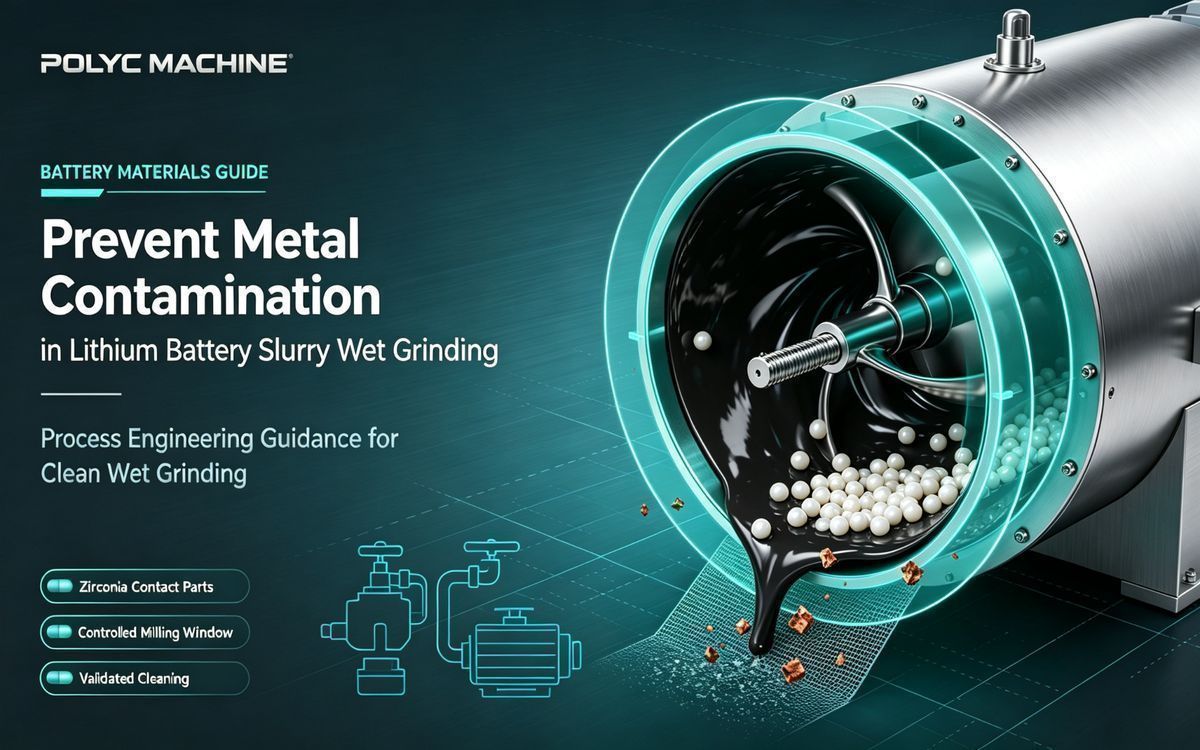
Trace metal contamination introduced during wet grinding measurably degrades lithium-ion cell performance. Iron, copper and nickel ions increase self-discharge and shorten cycle life, and the effect appears at concentrations far lower than most process engineers initially assume.
Contamination enters wherever product touches metal: the grinding chamber, the agitator, the separator, seals, transfer piping and the media itself. Even stainless surfaces release measurable metal under the shear and impact inside a bead mill, which is why material selection rather than process adjustment is the control.
This article sets out where contamination enters, how to exclude it through equipment design, and how to verify that a configured circuit actually meets your limits. It covers contact materials, media purity, sealing and downstream piping, and the baseline testing that turns an assumption into a documented result.
POLYC MACHINE configures contamination-controlled milling with fully ceramic-lined chambers, coated rotors and high-purity zirconia media, verified by analysis. Send your contamination limits through the inquiry form.
Key Takeaways
- Specify fully ceramic-lined chambers with ceramic or polymer-coated rotors to eliminate metallic contact
- Use high-purity yttria-stabilised zirconia media and screen out worn beads
- Specify separators, seals and downstream piping to the same contamination standard as the mill
- Verify limits by trial milling followed by magnetic and elemental analysis
- Document the baseline so later changes to media, wear parts or suppliers can be evaluated quickly
Where Contamination Enters
The grinding zone is the primary source. Inside a bead mill, media and product are subjected to intense shear and repeated impact, and any metallic surface in that environment releases ions into the slurry. The chamber wall, the agitator and the separator are the three components in direct contact with the product-media mixture.
Seals are the second source. A mechanical seal with metallic components in the product path releases contamination through normal wear, and this is frequently overlooked because the seal is treated as a maintenance item rather than a product-contact component. Seal selection should therefore be part of the contamination review.
Downstream piping and holding tanks are the third source, and the most counterproductive, because they can reintroduce contamination after the slurry has been processed cleanly. A ceramic-lined mill feeding stainless transfer piping and tanks undermines the entire specification.
Media itself is the final source. Standard zirconia is low-wear but not zero-wear, and worn or broken beads contribute both particles and dissolved elements. Media purity should be confirmed with the supplier and maintained through screening.
Equipment Design: Eliminating Metallic Contact
The first design decision is to eliminate metallic contact surfaces in the grinding zone. A fully ceramic-lined chamber with a ceramic or polymer-coated rotor provides that path, and it is the standard configuration for cathode, anode and conductive additive processing. Ceramic separator components complete the product-contact set.
Where a fully ceramic path is not feasible for a particular duty, the alternative is to quantify the contamination and confirm it falls within limits. This is less robust than elimination, because wear rates change over time, so the margin should be generous and monitoring more frequent.
Seals and gaskets should be specified with non-metallic product-contact materials where available. Where metallic components are unavoidable, they should be located outside the product path and monitored as part of the maintenance schedule.
Downstream matters as much as the mill. Specify ceramic-lined or polymer-lined transfer piping and appropriate holding tanks with vacuum deaeration, so the slurry remains in a controlled path from milling through to coating.
Media Purity and Maintenance
High-purity yttria-stabilised zirconia is the standard media for battery work. It combines high density, which supports efficient nano dispersion, with very low wear, which limits both dissolved and particulate contamination. Purity should be confirmed with the supplier rather than assumed from a generic product description.
Media wears gradually, and worn beads change the size distribution while contributing contamination. A documented screening and top-up schedule removes broken and undersized beads, keeping both grinding behaviour and contamination levels stable across a campaign.
Because media is a consumable that is replaced repeatedly, supplier consistency matters. Where media is changed to a different source or grade, re-establishing the contamination baseline is a prudent step rather than an optional one.
Recording the media specification, including size, grade and supplier, as part of the validated parameter set makes any future comparison immediate and avoids re-qualification being triggered by an undocumented change.
Verification: Establishing a Baseline
Contamination limits should be verified rather than assumed. The standard method is trial milling with the selected media and contact materials, followed by analysis of the processed slurry for magnetic and elemental impurities. Magnetic impurity testing is particularly relevant because it captures the metallic particles most damaging to cell performance.
The result becomes a baseline. Documenting it allows any subsequent change, whether to media, wear parts, seals or supplier, to be evaluated by comparison rather than by repeating the full qualification cycle. This is the practical value of doing the work up front.
Verification should also be repeated after major maintenance or after replacing any product-contact component. Wear parts change the contamination profile, and confirming the baseline is restored avoids discovering a problem through cell test results much later.
Where limits are extremely tight, consider whether additional magnetic separation downstream of milling is warranted. This adds a control step that captures any particles introduced by wear between verification intervals.
Operating Practices That Sustain Control
Contamination control is sustained by operating practice as much as by design. Avoid running at higher energy input than the validated setting, because excess energy increases wear without improving dispersion and therefore raises contamination over time.
Maintain temperature control. Stable temperature keeps viscosity stable, which avoids the temptation to compensate by raising energy input, and it protects both dispersion quality and the wear behaviour of contact components.
Keep the validated parameter set documented, covering media charge, tip speed, feed rate, temperature limits, pass count and the contamination baseline. Deviations become visible immediately, and investigations start from a known reference.
Finally, treat any product-contact replacement as a change requiring re-verification. This discipline is what keeps a contamination-controlled circuit controlled over years rather than only at commissioning.
Technical Specifications
| Parameter | Specification |
|---|---|
| Chamber lining | fully ceramic-lined for contamination control |
| Rotor | ceramic or polymer-coated pin type |
| Media | high-purity yttria-stabilised zirconia, typically 0.05 - 0.8 mm |
| Separator and seals | non-metallic product-contact materials where available |
| Downstream | ceramic-lined or polymer-lined transfer piping and appropriate holding tanks |
| Verification | trial milling followed by magnetic and elemental impurity analysis |
| Baseline review | repeat after major maintenance or any product-contact replacement |
Troubleshooting Guide
1. Magnetic impurity limits exceeded
Cause: Metallic contact in the chamber, rotor, separator, seals or downstream piping
Solution: Specify a fully ceramic product-contact path and verify by trial milling with analysis
2. Contamination increases over a campaign
Cause: Media or wear part degradation raising metal release
Solution: Screen media on schedule, inspect wear parts, and re-establish the baseline after any product-contact replacement
3. Baseline was acceptable but production is not
Cause: Downstream piping or tanks reintroducing metal after the mill
Solution: Extend the contamination-controlled path through transfer piping and holding tanks to the coater
4. Contamination rose after a media supplier change
Cause: Different media purity or wear characteristics
Solution: Confirm purity with the supplier and re-establish the contamination baseline whenever media source or grade changes
5. Cell self-discharge higher than expected
Cause: Trace metal from grinding affecting electrochemical performance
Solution: Review the full product-contact path, verify by analysis, and consider magnetic separation downstream of milling
Frequently Asked Questions
1. Why is metal contamination so damaging in battery slurry?
Iron, copper and nickel ions increase self-discharge and shorten cycle life, and the effect appears at concentrations far lower than most engineers expect. Because the contamination is invisible in the finished electrode, control has to be designed into the equipment rather than detected afterwards.
2. Can I use a standard stainless bead mill with good media?
Not for strict limits. Even stainless surfaces release measurable metal under the shear and impact inside a bead mill, so high-purity media alone does not solve the problem. A fully ceramic-lined chamber with a ceramic or polymer-coated rotor is the standard configuration.
3. Does downstream piping matter?
Yes, and it is frequently overlooked. A ceramic-lined mill feeding stainless transfer piping and holding tanks reintroduces contamination after the slurry has been processed cleanly, which undermines the entire specification. Extend the controlled path through to the coater.
4. How do I verify that contamination limits are met?
Run trial milling with the selected media and contact materials, then analyse the processed slurry for magnetic and elemental impurities. Magnetic impurity testing is especially relevant because it captures the metallic particles most damaging to cell performance.
5. What is a contamination baseline and why document it?
It is the measured impurity level from a verified configuration. Documenting it means any later change to media, wear parts, seals or supplier can be evaluated by comparison rather than by repeating the full qualification cycle, which saves considerable time.
6. How often should verification be repeated?
After major maintenance and after replacing any product-contact component, since wear parts change the contamination profile. Confirming the baseline is restored avoids discovering a problem later through cell test results.
7. Can operating settings affect contamination?
Yes. Running at higher energy input than the validated setting increases wear without improving dispersion, raising contamination over time. Maintain validated tip speed and temperature control, and document the parameter set so deviations are visible.