
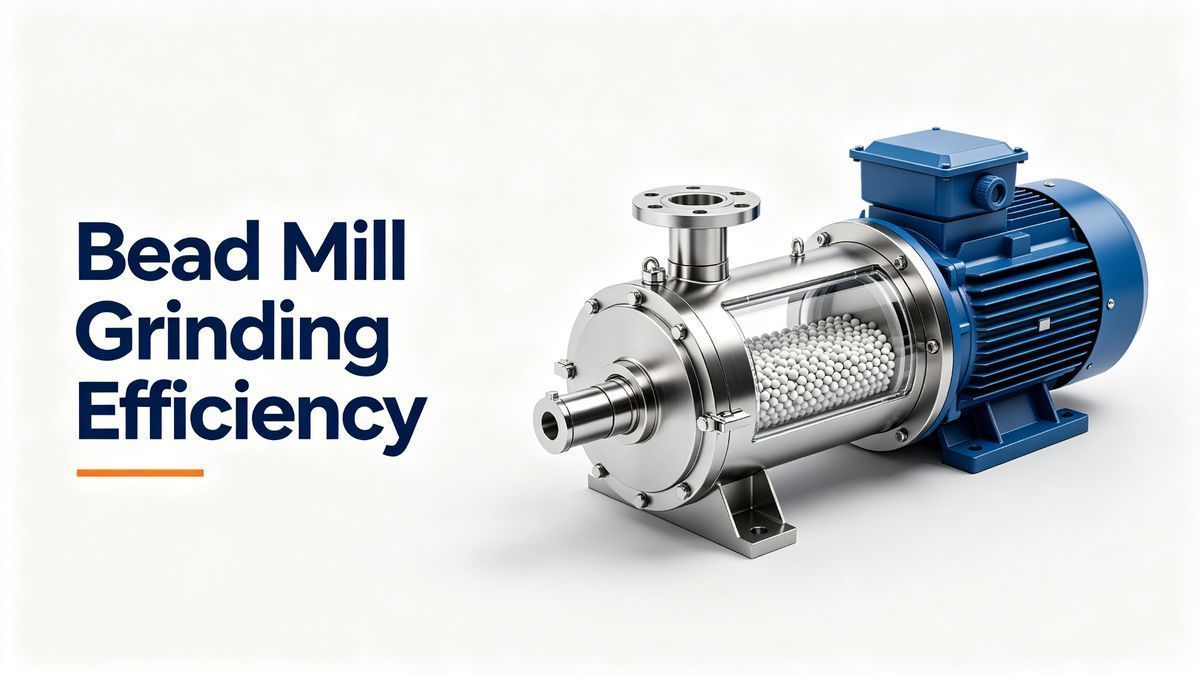
Bead mill grinding efficiency determines how quickly a pigment or filler reaches target fineness, and how much energy, media wear and labour the process consumes. Efficiency is not set by the machine alone: it depends on pre-dispersion, mill base viscosity, grinding media choice, flow rate, dispersant and resin content, and formulation strategy. This guide explains the seven factors that control bead mill throughput and final particle size, based on POLYC MACHINE process engineering practice.
Why grinding efficiency matters
A mill that runs below its optimum flow rate or with the wrong media can take twice as many passes to reach the same fineness, raising energy cost, media wear and solvent loss. Getting the seven factors below right keeps the mill in its high-efficiency window and avoids the common trap of blaming the machine when the feed or media is the real bottleneck.
Factor 1: Pre-dispersion quality
The single largest lever is what enters the mill. A well pre-dispersed slurry already has pigment agglomerates broken open and wetted by resin, so the bead mill only has to finish the job. Poor pre-dispersion sends dry, tightly bound agglomerates into the chamber, which overload the media, reduce effective shear and can leave grit in the final product. Use a high-speed disperser to wet out pigments before milling, and match pre-dispersion time to the pigment's oil absorption.
Factor 2: Mill base viscosity
Viscosity controls how much shear the media can transfer to the particles. Too low and the media slides past the pigment without enough friction; too high and the media loses kinetic energy and the mill stalls. Each pigment family has its own working window:
| Pigment type | Typical mill base viscosity (KU at 25°C) |
|---|---|
| Titanium dioxide | 95 - 125 |
| Carbon black | 65 - 75 |
| Other inorganic or organic pigments | 60 - 90 |
Adjust viscosity with resin or dispersant rather than excess solvent, because over-thinning reduces shear and increases solvent recovery load.
Factor 3: Grinding media
Media choice breaks into three decisions: material, diameter and fill level.
Material. Harder media grinds faster. The common ranking is glass beads < specialty glass beads < zirconia beads. For products with modest fineness requirements, glass beads are the economical choice; use zirconia media only when the target fineness justifies the higher media and liner wear cost.
Diameter. Larger beads carry more kinetic energy but move more slowly, so they suit coarse or medium fineness targets. Smaller beads move faster and collide more frequently, giving better results for fine grinding. A mix of bead sizes is often the best compromise: large beads break agglomerates, small beads finish the particle size distribution.
Fill level. Follow the equipment manual, typically 65% to 80% of the chamber volume. Under-filling reduces contact frequency; over-filling raises heat and media wear without improving throughput.
Factor 4: Flow rate and recirculation strategy
The right flow rate depends on whether you run a single-vessel recirculation or a multi-vessel pass-through setup. In single-vessel recirculation, a higher flow rate gives more passes per hour and is generally preferred. In a two-vessel or pass-through setup, lower the flow rate so each pass does more work, reducing the total number of passes needed. Always confirm that the feed pump can deliver the target rate without cavitation, especially with high-viscosity mill bases.
Factor 5: Dispersant selection
A dispersant that matches the pigment surface lowers mill base viscosity, stabilises newly created particle surfaces and prevents re-agglomeration during milling. The right dispersant can reduce the number of passes needed to reach target fineness and improve gloss and colour strength. Dispersant choice is pigment- and resin-system specific, so test a small range before locking the production formulation.
Factor 6: Resin content in the mill base
As pigment particles are dispersed, their total surface area increases, and more resin is needed to wet and stabilise those surfaces. A mill base with too little resin leaves particles under-wetted and prone to re-agglomeration, which shows up as poor gloss or a fineness that refuses to drop further. If viscosity must be reduced, use resin or dispersant rather than solvent. That said, excess resin increases total mill base volume and lowers effective pigment loading, which reduces throughput - so the resin level is a balance, not a maximum.
Factor 7: Formulation splitting and co-grinding
Two formulation strategies can lift effective mill capacity without buying another machine. First, split out difficult pigments: if a formulation contains a small amount of a hard-to-grind pigment, mill that pigment separately on a smaller mill and add it back at the letdown stage. The main mill then runs on an easier formulation and throughput improves. Second, co-grind mixed colours: when colour accuracy is not critical, combine several pigments into one mixed-colour mill base instead of milling each colour separately, then tint at the letdown stage. Both strategies reduce total mill hours and changeover time.
Industry trends in bead mill design
Beyond the seven formulation and process factors above, bead mill manufacturers are also changing the mechanical design of their machines to improve grinding efficiency. Four trends are worth knowing when specifying new equipment or evaluating whether an existing mill is becoming inefficient.
Shorter, wider chambers
Newer horizontal bead mills tend to have a smaller length-to-diameter ratio, meaning the grinding chamber is shorter and wider than older designs. A wider chamber reduces the tendency of grinding media to settle or stratify under gravity, which improves media distribution and energy density across the full chamber volume. It also reduces the pressure drop across the chamber, which lowers pumping energy and allows higher flow rates.
Higher flow rate, shorter residence time
The trend is toward higher product flow rates and shorter residence time per pass, combined with more recirculation passes. Shorter residence time reduces the amount of energy input per pass, which limits temperature rise and thermal degradation of heat-sensitive materials. The total energy required to reach target fineness is delivered over multiple gentle passes rather than one aggressive pass, which gives better control over particle size distribution and temperature.
Higher energy density, lower shaft speed
Modern bead mills are designed to deliver higher energy per unit volume of grinding chamber while running at lower shaft speeds. This is achieved through improved rotor and stator geometry, smaller chamber volumes and more precise media sizing. Lower shaft speed reduces mechanical wear on the rotor, chamber lining and grinding media, which extends service life and reduces contamination from worn media. The energy is delivered through structural design rather than raw rotational speed.
Higher media fill rate and static discharge
Newer mills are designed to operate with higher grinding media fill rates (often 70-85% of chamber volume, compared with 60-70% in older designs), which increases the number of active grinding contacts per unit volume. Static discharge systems (also called gap separators or screen separators) are increasingly used instead of dynamic agitator-disc separators, because they allow higher media fill rates, reduce media wear at the discharge point and are less prone to clogging with fine media.
When comparing bead mill specifications from different suppliers, look at these four design parameters in addition to the headline motor power. A mill with a shorter wider chamber, higher flow rate, lower shaft speed and higher media fill rate will typically deliver better grinding efficiency and lower operating cost than a mill with the same motor power but an older design.
Key Takeaways
- Pre-dispersion is the biggest single lever: wet out pigments fully on a high-speed disperser before milling.
- Match mill base viscosity to the pigment: titanium dioxide 95-125 KU, carbon black 65-75 KU, other pigments 60-90 KU.
- Choose media by hardness, diameter and fill level (typically 65-80%); mix bead sizes for coarse-plus-fine work.
- Use resin or dispersant to adjust viscosity, not excess solvent; split out hard pigments or co-grind to lift effective mill capacity.
- Cooling duty must match the energy input: double-wall chambers and shaft cooling prevent thermal degradation of heat-sensitive pigments and resins.