
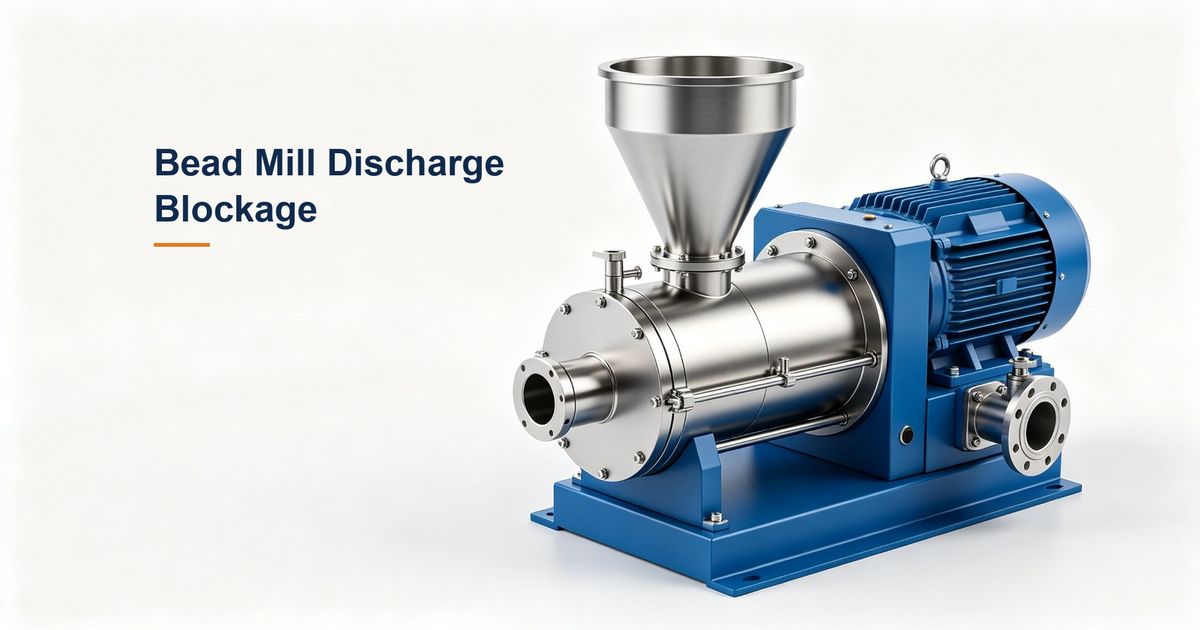
During wet grinding operations, a bead mill may experience a noticeable decrease in discharge flow — or in more severe cases, no material discharge at all. A blocked discharge reduces production efficiency, causes increased chamber pressure, higher material temperature, and increased motor load. If not addressed promptly, it affects both equipment operation and process stability.
So what causes discharge blockage in a bead mill, and how should it be diagnosed and handled? This practical troubleshooting guide is based on POLYC's 25 years of experience in wet grinding applications across coatings, inks, pesticides, and battery materials.
1. What to Check When Discharge Flow Decreases
When the discharge flow suddenly decreases or stops, troubleshoot the system in this order:
Feeding System → Discharge Pipeline → Internal Separation System
Check the Feeding System
First, confirm that material is being supplied to the bead mill normally. Check:
- Whether the feed pump is operating properly
- Whether the feed pressure and flow rate are normal
- Whether the feed pipeline is blocked
- Whether all relevant valves are in the correct position
- Whether sufficient material is being supplied
If the feeding system is not working properly, the discharge flow will naturally decrease. Rule out feed-related issues first.
Check the Discharge Pipeline
If the feeding system is operating normally, inspect the discharge side. Pay particular attention to:
- Bent, compressed, or damaged discharge hoses
- Material buildup or blockage inside the pipeline
- Incorrect outlet valve position
- Excessive bends or restrictions in the discharge piping
For high-viscosity, easily settling, or easily solidifying materials, residual slurry inside the pipeline may gradually accumulate and restrict material flow.
Check the Screen or Separation System
If both feeding and discharge pipelines are normal, inspect the internal separation system. Check:
- Whether the discharge screen is blocked
- Whether material has accumulated around the separator
- Whether the grinding media filling level is appropriate
- Whether the grinding media size is suitable for the material and process
A blocked screen or separator is one of the most common causes of reduced discharge flow in a bead mill.
2. Why Pressure Increases When Discharge Is Blocked
During normal operation, slurry enters the grinding chamber through the feeding system, is processed by the grinding media, and exits through the separation system. When the discharge path is restricted, material accumulates inside the chamber. This causes:
- Increased chamber pressure — material cannot exit freely, so pressure builds up
- Higher material temperature — reduced flow means less heat carried away by the product
- Increased motor load — the agitator must work harder against the pressurized, denser slurry
- Reduced grinding efficiency — material residence time becomes unpredictable
If you observe rising pressure together with decreasing discharge flow, stop increasing feed pressure immediately — this will only worsen the blockage and may damage the mechanical seal.
3. Common Causes of Discharge Blockage
1. Material Viscosity Too High
If the slurry viscosity exceeds the suitable operating range of the bead mill, flow resistance increases significantly, resulting in poor feeding and discharge performance. Material viscosity, solids content, and rheological properties should be considered during equipment selection and process design.
2. Large Particles or Impurities in the Material
Insufficient pre-dispersion may leave large agglomerates in the slurry. Foreign particles or oversized solids can accumulate around the screen or separator and eventually restrict discharge flow. Proper pre-dispersion, pre-grinding, and filtration help reduce this risk.
3. Blocked Discharge Screen
The discharge screen is a critical part of the media separation system. For materials that tend to agglomerate, adhere, or settle, prolonged operation may gradually reduce the effective open area of the screen, resulting in reduced discharge flow, increased chamber pressure, and unstable grinding performance. Regular inspection and cleaning of the separation system maintain stable operation.
4. Excessive Grinding Media Filling
More grinding media does not necessarily mean better grinding performance. Excessive media filling increases flow resistance inside the grinding chamber and places additional load on the equipment. The appropriate filling level depends on the bead mill model, grinding media size, material characteristics, and target particle size.
5. Improper Pipeline Design
Discharge pipelines that are too narrow, too long, or contain excessive bends increase flow resistance — particularly when processing high-viscosity slurries. When designing a wet grinding production line, carefully consider pipeline diameter, length, layout, and number of bends to ensure smooth material flow.
6. Material Solidification After Shutdown
For materials that tend to settle, crystallize, or solidify, residual slurry may remain inside the grinding chamber, screen, or pipeline after shutdown. If the bead mill is not cleaned promptly, the remaining material may harden and cause blockage during the next startup. Establish a proper shutdown and cleaning procedure according to material characteristics.
4. How to Prevent Discharge Blockage
Preventing blockage is more effective than dealing with it after it occurs. To reduce the risk:
- Select the appropriate bead mill according to material viscosity, solids content, initial particle size, and target particle size
- Ensure sufficient pre-dispersion before fine grinding
- Prevent oversized particles and impurities from entering the grinding chamber
- Select an appropriate screen or separation system
- Use the correct grinding media size and filling level
- Optimize feed and discharge pipeline design
- Establish proper shutdown and cleaning procedures for materials that easily settle or solidify
Because different materials behave differently during wet grinding, the cause of discharge blockage varies from one application to another. Conducting material testing and process validation before equipment selection helps determine the appropriate bead mill configuration, grinding media, operating parameters, and process design.
Conclusion
Bead mill discharge blockage may appear to be a simple operating problem, but its root cause can involve multiple factors — material properties, the separation system, grinding media, pipeline design, and operating conditions. When reduced discharge flow occurs together with an abnormal increase in chamber pressure, follow a systematic troubleshooting procedure rather than simply increasing feed pressure or forcing the bead mill to continue operating.
POLYC specializes in wet grinding and dispersion equipment and process solutions. Based on the customer's material viscosity, solids content, initial particle size, target particle size, and production capacity requirements, POLYC provides bead mill selection, material testing, process optimization, and complete wet grinding solutions backed by 25 years of industry experience and CE-certified manufacturing.
Need help diagnosing a discharge issue or selecting the right bead mill for your application? Contact our engineering team for a free consultation.