
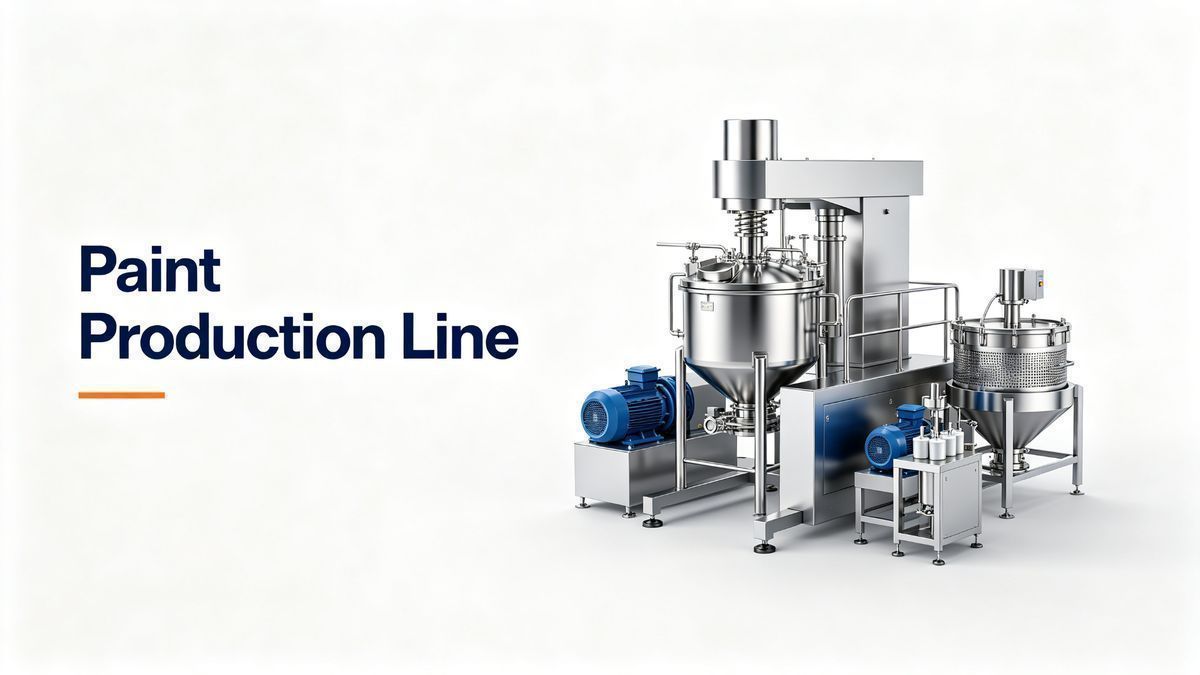
Paint production is not one machine, it is a sequence. Raw resin and solvent are charged into a dissolver, pigment is wetted and pre-dispersed, the premix goes through a bead mill for fineness, then letdown, filtration and filling turn it into a finished coating. Each stage sets limits on the next.
The four steps of paint production
Every industrial paint line follows the same four-stage sequence, regardless of whether it is a simple single-vessel setup or a fully automated plant.
- Pre-dispersion. Pigment is first mixed with part of the resin and solvent in a high-speed disperser to form a mill base. This step wets out the pigment surface and breaks open loose agglomerates, which dramatically reduces the work the grinding mill has to do.
- Grinding / dispersion. The pre-dispersed mill base passes through a bead mill or basket mill to reduce pigment particle size to the target fineness. The choice of mill depends on target fineness, batch size, viscosity and colour-change frequency.
- Letdown /调漆. The remaining resin, solvent, additives and any tinting colour are added to the ground pigment paste to bring the batch to final formulation, viscosity and colour.
- Filtration and packaging. The finished paint is filtered to remove oversize particles, skins and contaminants, then filled into cans, drums or bulk containers.
Standard equipment for a small-to-medium paint line
For a typical small-to-medium paint plant producing architectural and light industrial coatings, the standard equipment set is:
- High-speed disperser with a jacketed mixing vessel (拉缸) for pre-dispersion and letdown
- Basket mill for grinding (or a horizontal bead mill for higher fineness or larger volumes)
- Filter trolley for final filtration before packaging
- Filling machine for cans, drums or bulk
This layout is flexible and well suited to multi-product, multi-colour plants where changeover time matters. The basket mill is particularly popular in this segment because pre-dispersion and grinding can be done in the same vessel, which reduces transfer losses and cleaning time between colours.
Motor power sizing by batch volume
One of the most common questions is what motor power is needed for a given batch size. Based on POLYC MACHINE process engineering practice for water-based architectural paints, the recommended disperser motor power is:
| Batch volume | Recommended disperser motor power | Notes |
|---|---|---|
| 500 L | 11 kW | Standard for interior and exterior latex paints |
| 1,000 L | 18.5 kW | Standard for interior and exterior latex paints |
For solvent-based industrial coatings, high-viscosity pastes, or pigments with high oil absorption, move up one power grade from the table above. The higher power prevents motor overload during the high-viscosity pre-dispersion phase and gives enough tip speed to wet out difficult pigments. If you are unsure which power grade fits your formulation, provide the material viscosity, solids content and target dispersion time and POLYC MACHINE will recommend a specific configuration.
Process notes for architectural paints
Interior and exterior latex paints have relatively low fineness requirements compared with industrial coatings or printing inks. Several practical points follow from this:
- Interior paints may not need grinding at all if ultra-fine pigment powders are used. Many interior latex formulations are dispersed directly on the high-speed disperser without a separate grinding step.
- Exterior latex paints are generally not ground in current practice, because the pigment fineness and weathering requirements can be met by high-speed dispersion alone.
- For lower-grade interior paints, vertical bead mills are still used in some plants. For most other architectural products, basket mills are the more common choice because they are easier to clean and change over.
- Industrial solvent-based paints running on this simple flow will have significant solvent odour in the production area (xylene and other aromatic solvents). Adequate ventilation and, where required, explosion-proof electrical equipment are essential.
If a single grinding pass is not enough to reach target fineness, the batch can be recirculated through the mill or transferred between vessels for additional passes rather than investing in a second mill immediately.
Key Takeaways
- Every paint line follows four steps: pre-dispersion, grinding, letdown, filtration and packaging.
- A standard small-to-medium line uses a high-speed disperser with jacketed vessel, a basket mill (or horizontal bead mill), a filter trolley and a filling machine.
- For water-based architectural paints, size the disperser at 11 kW for 500 L batches and 18.5 kW for 1,000 L; move up one power grade for solvent-based or high-viscosity products.
Frequently Asked Questions
Do I need a bead mill for producing interior latex paint?
What is the difference between a basket mill and a horizontal bead mill for paint production?
How do I know if my disperser motor is powerful enough?
Key Equipment for Paint Production Lines
A complete paint production line typically includes the following POLYC MACHINE equipment:
- High-Speed Dispersers - pre-dispersion and pigment wetting
- Basket Mill - batch grinding for frequent color changes
- Pin-Type Bead Mill - fine grinding for high-gloss finishes
- Butterfly Double-Shaft Mixer - high-viscosity paste mixing
- Filter Filling Machine - bag filtration and automatic filling