
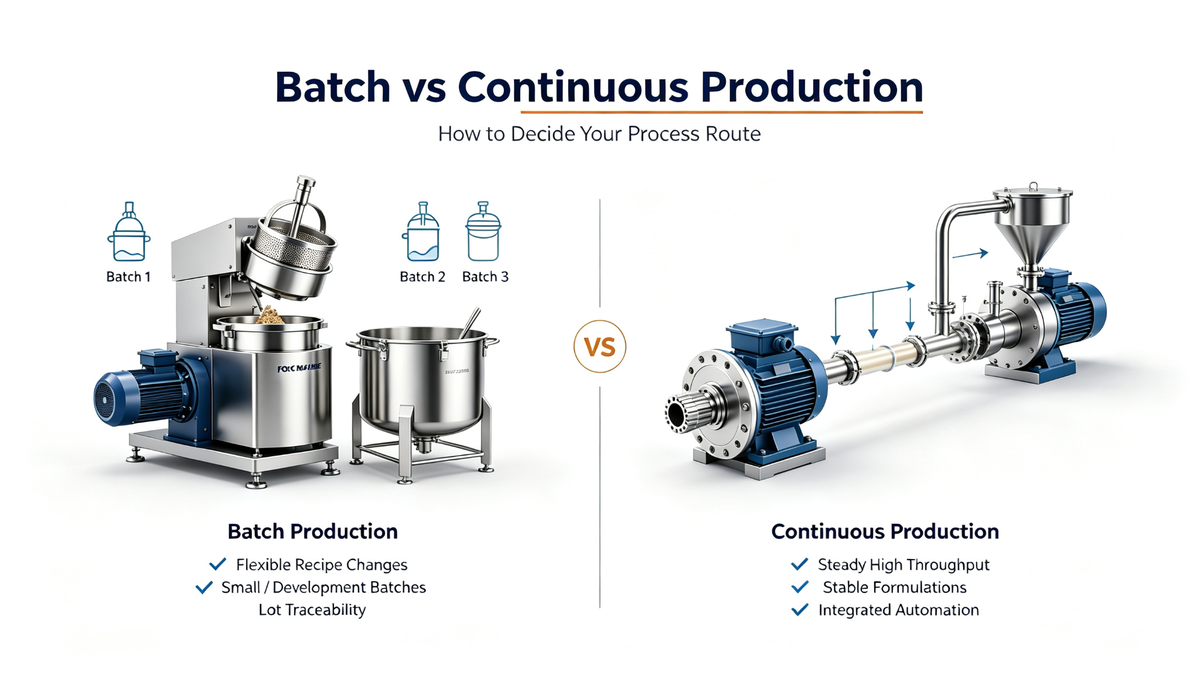
Batch production processes discrete loads with identifiable start and finish points, while continuous production maintains a material flow through connected equipment. Product variety, throughput, traceability, cleaning, automation and capital budget determine which route is practical.
Core differences and decision criteria
| Factor | Engineering view | How to verify |
|---|---|---|
| Control point | Why it matters | How to verify |
| Material behavior | A hybrid route can combine batch premixing with continuous grinding or filtration. Evaluate total operating time, including changeover, sampling, cleaning, transfer and quality release, instead of comparing machine output alone. | Test representative material at process temperature |
| Equipment setting | Speed, loading and residence time interact | Record settings with each sample |
| Quality result | A single endpoint can hide a broad distribution | Use a defined laboratory method and repeat samples |
Define the process before choosing equipment
Begin with feed state, viscosity, solids, temperature sensitivity, target particle-size distribution, batch size and required throughput. Record the test method and sampling point. These inputs determine whether a mixer, disperser, bead mill, reactor or combined line is appropriate.
Core operating principles
A hybrid route can combine batch premixing with continuous grinding or filtration. Evaluate total operating time, including changeover, sampling, cleaning, transfer and quality release, instead of comparing machine output alone. The correct setting is a balance: more energy can increase dispersion or grinding rate, but can also increase heat, wear and power demand. Use staged trials, change one major variable at a time and retain samples for comparison.
Application examples
For coatings and inks, inspect colour development, gloss, fineness and filterability. For battery or electronic materials, add contamination and temperature controls. For adhesives and sealants, evaluate torque, deaeration, wall scraping and discharge. For powders, include bulk density, segregation, dust and cleanout.
How to choose a practical configuration
Shortlist equipment by the complete process route, not by nameplate power. Compare the vessel, rotor or tool geometry, contact materials, seals, cooling, transfer, controls and cleaning access. Request a material trial when the target quality or rheology is demanding.
Common mistakes and troubleshooting
Typical mistakes include using a nominal capacity outside the tested fill range, changing speed without checking temperature, ignoring viscosity changes, and judging quality from one sample. When results drift, check feed preparation, sampling, cooling, wear, air entrainment and measurement repeatability before changing the machine.
Maintenance and documentation
Inspect wear parts, seals, screens, bearings and contact surfaces on a planned schedule. Keep a recipe, cleaning record, inspection log and laboratory result together. A documented baseline makes abnormal noise, temperature, pressure or power easier to detect early.
Illustrative test plan
A useful trial starts with a representative material charge and a written acceptance criterion. Measure the starting condition, run a controlled setting, take samples at the same process point, and repeat the run to check variation. For example, an engineer may compare two media sizes or two mixing speeds while holding formulation, fill level and cooling constant. The resulting table should show mass, time, power, temperature, viscosity and particle-size results. This is an illustrative method, not a promised production result; the actual test plan should follow the material and the customer's quality system.
Limits of catalogue comparisons
Catalogue capacity, speed and viscosity figures are not interchangeable across suppliers because definitions, fill factors, measurement methods and material assumptions differ. A responsible comparison states whether capacity is batch volume or flow, whether viscosity is measured at operating temperature, and how fineness or uniformity was tested. Confirm utilities, electrical area, contact materials, noise, access, cleaning and spare parts before approving a layout. These checks protect both the product and the production schedule.
Related POLYC MACHINE resources and equipment
basket mill | horizontal bead mill | high-speed disperser | planetary mixer | process comparison | coatings case study
Frequently Asked Questions
What is the first selection input?
Start with material behavior, target quality, batch or hourly capacity, temperature limit and cleaning requirements.
Can the stated ranges be treated as guarantees?
No. Ranges are engineering starting points; final performance must be confirmed with representative material and an agreed test method.
How should I compare two machines?
Compare quality, throughput, energy, wear, cleanout, safety and total process integration at the same duty.
Why is cooling important?
Mechanical energy becomes heat. Temperature can change viscosity, chemistry, solvent loss and product quality.
How often should equipment be inspected?
Set inspection frequency from duty, wear, operating hours and the supplier manual; increase checks during commissioning.
What information should I send for a quotation?
Send formulation or powder properties, feed size, viscosity, solids, target result, capacity, utilities and safety requirements.
Can POLYC MACHINE help with scale-up?
The engineering team can review laboratory or pilot results and propose a production route subject to material trials and project specifications.
How do I request a process review?
Use the POLYC MACHINE contact form and include representative samples or test data where possible.
Conclusion: validate the process before final selection
Equipment selection is strongest when it is based on a representative sample, a defined test method and a complete process balance. Share your material, capacity, target quality, viscosity, temperature limit and cleaning requirements with the POLYC MACHINE engineering team for a practical recommendation and quotation.
Engineering principles behind production-mode selection
Batch And Continuous Equipment should be evaluated as part of a complete process, not as an isolated machine. The useful operating window is governed by product variety, cleanout, traceability, automation and demand stability. A robust evaluation begins with a representative sample and a written definition of success. That definition should name the laboratory method, sampling point, temperature, time limit, permitted contamination and the acceptable range for the final product. Without a shared method, apparent improvements can be caused by sampling or measurement variation rather than by the equipment.
During development, engineers normally change one major factor at a time and retain samples from each condition. This creates an evidence trail that can be reviewed when a formulation, raw-material supplier or production scale changes. A practical run sheet records material mass, starting condition, working volume, speed, flow or mixing time, coolant condition, power trend, product temperature, sample identification and cleaning observation. These records are more useful than a single final result because they reveal the process margin.
Numbers: how to use them responsibly
Published ranges are useful only as trial starting points. For example, a wet-grinding trial may compare two media sizes, two energy settings or two recirculation passes; a mixing trial may compare two speed profiles and two fill levels. The values are selected from the material, equipment geometry and safety constraints. They are not transferable promises of D50, D90, throughput, yield, energy use or temperature rise. The final numbers must be confirmed using the customer's material and agreed test method.
| Trial variable | Purpose | Example comparison | Decision evidence |
|---|---|---|---|
| Material preparation | Control feed variability | Two defined premix procedures | Viscosity and feed-size record |
| Energy setting | Balance quality and heat | Low and higher validated set points | Power and temperature curve |
| Residence or mix time | Check process completion | Two timed samples | Distribution or uniformity result |
| Cleaning sequence | Protect product changeover | Defined flush and inspection | Residue and recovery record |
Material, equipment and utility review
The material review should cover chemistry, solids, viscosity at the actual operating temperature, density, abrasiveness, corrosion risk and any restrictions on product-contact materials. The equipment review then covers working volume rather than nominal vessel size, drive range, tool or media compatibility, seals, cooling surface, pumps, filters, controls and access for cleaning. Utility review includes electrical supply, cooling medium, compressed air, vacuum where required, drainage, ventilation and plant layout. Each item has a direct effect on repeatability and safe operation.
Sampling and data quality
Use the same sample location, container, conditioning time and analysis method for each comparison. For particle-size work, state whether the result is a distribution, a fineness gauge reading or a visual assessment; these are not interchangeable. For mixing work, define where top, middle and bottom samples are taken and how uniformity is measured. Record product temperature at the moment of sampling. A small amount of disciplined sampling prevents a large amount of incorrect scale-up work.
From trial to production
Production design should preserve the critical process relationships demonstrated in the trial, then validate the factors that change with scale. Heat removal, pumpability, transfer-line volume, cleaning, filtration and operator sequence often become more important as equipment becomes larger. A pilot stage is valuable when quality is sensitive or the process uses high solids, high viscosity, abrasive material, volatile solvent or strict contamination limits. The production acceptance plan should include functional checks, documented settings, agreed samples and a clear handover procedure.
Common decision errors
Common errors are selecting by motor power alone, treating nominal capacity as working capacity, changing several settings at once, ignoring changeover time, and relying on a single unqualified sample. Another error is presenting an illustrative result as a customer guarantee. A better approach is to state assumptions, define the test, compare like with like and maintain a record of what changed. This makes the process easier to troubleshoot and more credible to quality, operations and procurement teams.
Maintenance and lifecycle planning
Lifecycle planning starts before purchase. Specify inspection access, spare parts, wear-part identification, seal and screen service, lubrication, calibration and cleaning verification. Establish normal ranges for temperature, vibration, pressure, power and product result during commissioning. When a value drifts, compare it against the baseline before increasing speed or changing the recipe. This protects product quality while helping maintenance teams find the cause early.
Questions to take to a process review
Bring a current formulation range, safety documentation, representative samples, current process sketch, quality target, capacity requirement, utilities, layout limits and desired commissioning date. Ask how the proposed configuration handles the material, how it will be cleaned, what will be measured during trials, which assumptions require validation and what support is available after handover. A well-prepared review is the fastest route to a realistic engineering proposal.
Project documentation and acceptance checklist
Before a process trial moves to procurement, assemble one controlled project file. It should identify the material and formulation range, intended process route, quality method, required batch or hourly capacity, temperature limit, utility conditions, materials of construction, cleaning method, site restrictions and responsible reviewers. Keep the laboratory report with the samples, settings and photographs or instrument outputs that support it. This avoids a common handover problem: a promising trial is remembered, but the exact feed preparation, sample point or test method cannot be reproduced.
For the equipment proposal, verify the working volume, drive range, contact parts, seals, cooling duty, pumps, filters, valves, electrical supply, controls, access for maintenance and the scope of commissioning. For safety-sensitive processes, document what must be assessed by the site and relevant local authority. During factory acceptance or commissioning, agree the sequence for charging, operation, sampling, discharge, cleaning and inspection. Record normal temperature, pressure, power, vibration and quality readings as a baseline. The resulting document package gives operations, maintenance and quality teams a shared reference for future batches, troubleshooting, process changes and spare-parts planning.
Recommended POLYC MACHINE equipment
The following machines are commonly evaluated for the process described above. Final selection depends on formulation, target particle size, viscosity, capacity and contamination limits.
Related technical guides
Next step
Share your material, required capacity, target fineness and operating conditions with POLYC MACHINE engineers for a configuration review and quotation.
Explore our Fine Chemicals solutions for application-specific equipment configurations and process recommendations.