
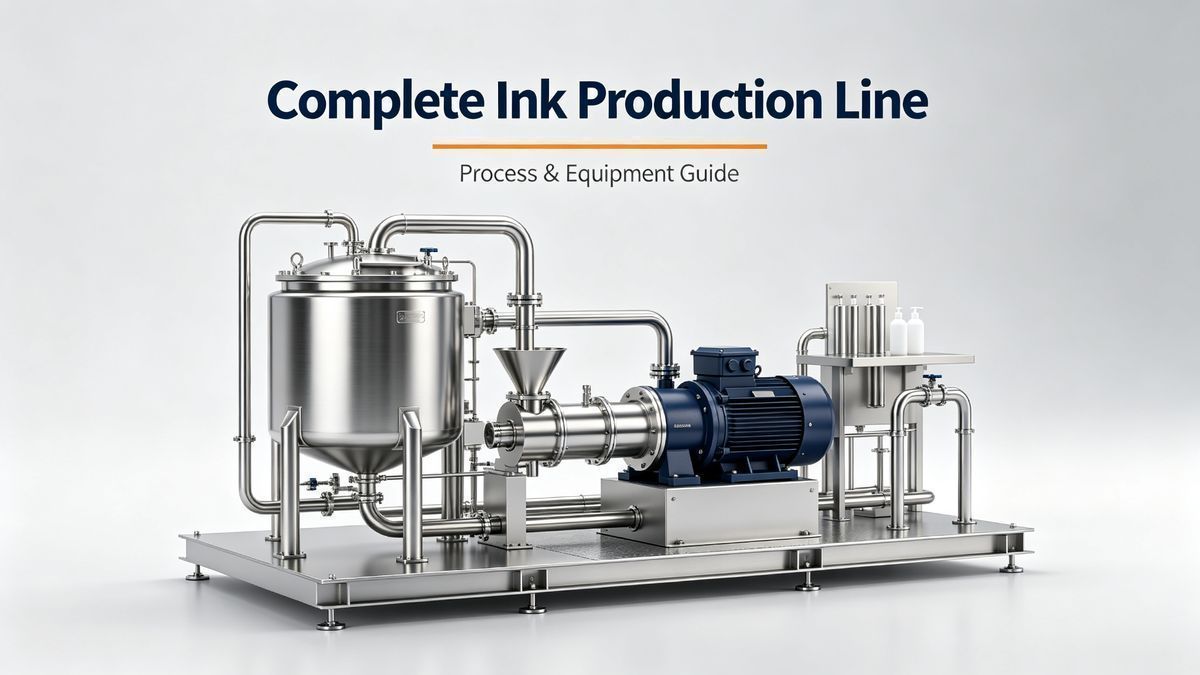
An ink production line is an integrated system of pre-dispersion, fine grinding, letdown, filtration and filling machines configured to manufacture printing inks at consistent quality and throughput. Unlike individual machines, a production line is designed as a single process with matched capacities, automated material transfer and centralised control. This guide covers ink line specifications, the five process stages, equipment selection, capacity planning and total cost of ownership.
The five stages of ink production
Every industrial ink line follows the same five-stage sequence, regardless of whether it produces gravure, flexo, offset or UV ink:
- Pre-dispersion: resin, solvent and pigment are charged into a high-speed disperser or basket mill and mixed until the pigment is fully wetted (Hegman 5-7)
- Fine grinding: the premix passes through a horizontal bead mill or basket mill to achieve target fineness (typically 2-10 microns for gravure/flexo, below 5 microns for high-quality offset)
- Letdown: the ground mill base is transferred to a mixing kettle and let down with additional resin, solvent and additives to reach final formulation
- Filtration: the finished ink is filtered through a bag filter or cartridge filter to remove oversize particles, skins and contaminants
- Filling: the filtered ink is filled into cans, drums or IBCs using a filling machine with weight or volume control
Ink production line specifications: what the numbers mean
| Specification | Small line | Medium line | Large line |
|---|---|---|---|
| Annual capacity | 500-2,000 tons | 2,000-10,000 tons | 10,000-50,000 tons |
| Batch size | 200-500 L | 500-2,000 L | 2,000-10,000 L |
| Pre-dispersion power | 11-22 kW | 22-55 kW | 55-132 kW |
| Bead mill chamber | 5-20 L | 20-50 L | 50-200 L |
| Bead mill power | 7.5-18.5 kW | 18.5-45 kW | 45-110 kW |
| Letdown kettle | 500-1,000 L | 1,000-3,000 L | 3,000-10,000 L |
| Filtration rating | 25-50 micron | 10-25 micron | 5-10 micron |
| Filling speed | 10-30 cans/min | 30-60 cans/min | 60-120 cans/min |
| Operators per shift | 2-3 | 3-5 | 5-8 |
Equipment selection by ink type
Gravure and flexo inks (solvent-based)
The highest-volume ink segment. Solvent-based gravure and flexo inks typically require 5-10 micron fineness and low viscosity (100-1,000 cP at application). A standard configuration uses a high-speed disperser for pre-dispersion, a horizontal disc bead mill for fine grinding (single pass for 10 micron, two passes for 5 micron), a jacketed letdown kettle, bag filtration and automatic filling. Explosion-proof (ATEX) design is required for solvent-based lines due to flammable solvent vapours.
Offset inks (oil-based)
Offset inks are high-viscosity pastes (50,000-200,000 cP) requiring fineness below 5 microns and precise tack control. Pre-dispersion uses a butterfly double shaft mixer or basket mill. Fine grinding uses a three-roll mill for the highest quality, or a high-energy bead mill for medium volume. Letdown is done in a jacketed kettle with temperature control. Offset ink lines are typically smaller batch (200-1,000 L) but higher value per kg.
Water-based inks
Water-based inks are growing due to environmental regulations. They require similar equipment to solvent-based lines but without explosion-proof requirements. Pre-dispersion uses a vacuum disperser to reduce foaming. Fine grinding uses a horizontal bead mill with polyurethane lining (water-based inks can be corrosive). Filtration is typically 10-25 micron. Water-based lines require careful attention to foaming and bacterial growth during storage.
UV inks
UV inks are 100% solids (no solvent) and high viscosity (10,000-100,000 cP). They require fineness below 5 microns and strict temperature control (UV monomers can polymerise if overheated). Pre-dispersion uses a butterfly mixer with cooling jacket. Fine grinding uses a three-roll mill or cooled bead mill. UV ink lines are typically small batch (100-500 L) but very high value. Light exclusion is required during storage and filling to prevent premature curing.
How to plan ink production line capacity
Step 1: Define annual production volume
Start with your target annual capacity in tons, then divide by the number of working days (typically 250-300 per year) and shifts per day (1-3) to get daily capacity. For example, a 5,000 ton/year line running 250 days, 2 shifts = 10 tons per day = 1.25 tons per hour. This determines the required bead mill throughput and vessel sizes.
Step 2: Match equipment capacities
Each stage must have matched capacity to avoid bottlenecks. As a rule of thumb, the bead mill is the bottleneck in most ink lines. If the bead mill processes 500 kg/h at target fineness, the pre-disperser must produce at least 500 kg/h of premix, the letdown kettle must hold at least one batch (typically 2-4 hours of mill output), and filtration/filling must handle at least 500 kg/h. Oversizing downstream equipment by 20-30% provides flexibility for product changes and maintenance.
Step 3: Plan for product changes
Most ink manufacturers produce 20-100 different SKUs. Product change time (cleaning, flushing, setup) directly affects effective capacity. For multi-colour facilities, basket mills reduce changeover time compared to horizontal mills. Dedicated lines for major colours (black, cyan, magenta, yellow) with shared equipment for spot colours is a common strategy. Always include 15-20% capacity margin for changeover and maintenance when sizing equipment.
Step 4: Consider automation level
Manual lines require 3-5 operators per shift and are suitable for small volumes or frequent product changes. Semi-automatic lines with PLC control, automated material transfer and recipe management require 2-3 operators and improve consistency. Fully automatic lines with SCADA, automated batching and centralised control require 1-2 operators but have higher capital cost. For lines above 5,000 tons/year, semi-automatic or automatic control typically pays back in 2-3 years through reduced labour and improved yield.
What affects ink production line price
- Capacity: a 5,000 ton/year line costs 3-5 times a 1,000 ton/year line
- Ink type: solvent-based lines require ATEX explosion-proof design, adding 20-30%; offset lines require three-roll mills, adding 30-50%; UV lines require cooling and light exclusion, adding 15-25%
- Grinding equipment: horizontal bead mills are standard; three-roll mills for offset/UV add significant cost; multiple mills for high volume add cost
- Automation: manual is lowest cost; semi-automatic PLC adds 20-30%; fully automatic SCADA adds 50-100%
- Material of construction: standard carbon steel with stainless contact parts; full stainless 316L for water-based or corrosive products adds 20-30%
- Material handling: manual charging is standard; automated powder feeding, vacuum conveying and bulk handling add 15-25%
- Certification: CE marking, ATEX, ISO 9001 documentation and factory acceptance testing add engineering and validation costs
- Installation and commissioning: typically 10-15% of equipment cost, including installation, piping, wiring, commissioning and operator training
Key Takeaways
- An ink line has five stages: pre-dispersion, fine grinding, letdown, filtration and filling - each must have matched capacity
- The bead mill is typically the bottleneck - size the line around mill throughput at target fineness
- Solvent-based lines require ATEX explosion-proof design; water-based lines do not but need foaming control
- Offset and UV inks use three-roll mills for highest quality; gravure/flexo use horizontal bead mills
- Include 15-20% capacity margin for product changeover and maintenance when sizing equipment
Frequently Asked Questions
What is the typical payback period for an ink production line?
For a 5,000 ton/year line running two shifts, typical payback is 2-4 years through reduced labour cost, improved yield (less waste from inconsistent batches), lower energy consumption per kg and reduced reliance on contract manufacturing. For smaller lines (below 1,000 tons/year), payback may extend to 4-6 years. Lines producing high-value offset or UV inks typically pay back faster due to higher margin per kg.
Can one line produce multiple ink types?
Yes, but with limitations. A line designed for solvent-based gravure inks can also produce solvent-based flexo inks with minimal changes. However, switching between solvent-based and water-based requires thorough cleaning and may require different filtration. Switching to offset or UV inks typically requires additional equipment (three-roll mill, cooling). Most manufacturers dedicate lines to broad ink categories (solvent, water, offset) and handle product changes within each category.
What fineness do different ink types require?
Gravure and flexo inks: 5-10 microns (Hegman 6-7). Standard offset inks: 2-5 microns (Hegman 7-8). High-quality offset and UV inks: below 2 microns (Hegman 8+). Water-based inks: 5-15 microns depending on application. Fineness is measured with a Hegman gauge or grindometer. Always confirm fineness requirements with your customers before specifying grinding equipment.
How much floor space does an ink production line need?
A small line (1,000 tons/year) needs approximately 200-400 square metres, including equipment, material storage and work areas. A medium line (5,000 tons/year) needs 600-1,200 square metres. A large line (20,000 tons/year) needs 2,000-4,000 square metres. Include space for solvent storage (separate fire-rated area for solvent-based lines), raw material warehouse, finished goods warehouse and QC laboratory. Ceiling height should be at least 5 metres for vessel access and lifting.
Related POLYC MACHINE equipment
- Ink Production Line - complete integrated system for gravure, flexo, offset and UV inks
- Pin Type Bead Mill - fine grinding for 50 nm to 5 micron fineness
- Basket Mill - pre-dispersion and batch grinding for frequent colour changes
- Vacuum Dispersing Machine - pre-dispersion with vacuum degassing
- Bag Filter - filtration for finished ink
- Filling Machine - automatic filling into cans, drums and IBCs
Planning a new ink production line or upgrading an existing one? Request a free line planning consultation with our engineering team. We can design a complete ink line matched to your product types, capacity requirements and budget, including equipment selection, layout design and automation planning.