
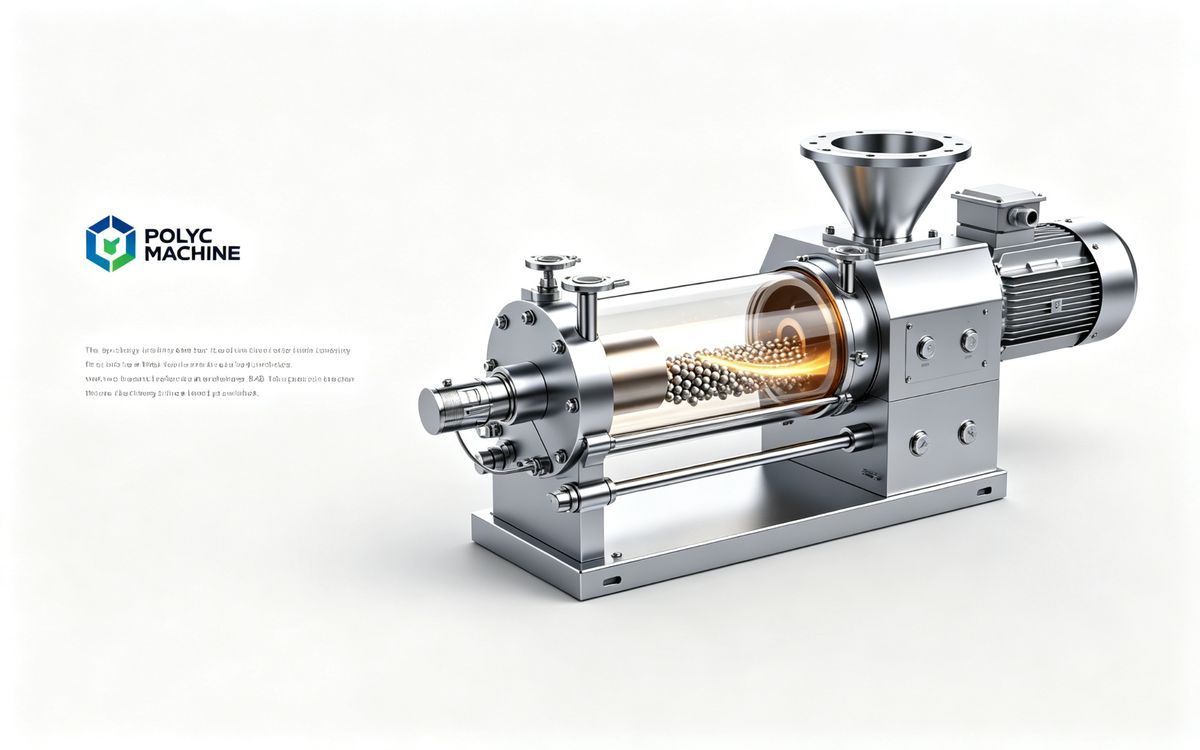
Ink production involves six key steps: resin dissolving, pigment pre-dispersion, bead milling, letdown, filtration and filling. The critical control points are viscosity, particle size distribution and color consistency. A repeatable line controls these variables at every stage instead of trying to correct them only at the end of the batch.
This guide expands on the basic production route with practical operating ranges, common failure modes, and selection considerations for solvent-based, water-based, and UV ink. Treat the values below as engineering references: formulation trials and plant safety requirements determine the final process window.
Ink Production Process Overview
Each production step prepares the batch for the next one. Resin quality and wetting determine how efficiently pigment disperses; stable pre-dispersion makes bead milling more productive; final letdown and filtration protect application consistency and filling quality. Read the basic ink production process guide for a broader introduction to the complete route.
| Step | Purpose | Critical control point |
|---|---|---|
| 1. Resin dissolving | Prepare a uniform binder solution | Temperature, agitation, dissolution time |
| 2. Pigment pre-dispersion | Wet and break down pigment agglomerates | Speed, wetting sequence, viscosity |
| 3. Bead milling | Reach the target particle-size distribution | Media, filling level, cooling, residence time |
| 4. Letdown | Adjust viscosity, solids, and application properties | Addition order, color, temperature |
| 5. Filtration | Remove oversized particles and contamination | Filter rating, differential pressure |
| 6. Filling | Transfer accepted product into packaging | Final QC, air control, fill accuracy |
Resin Dissolving: Key Parameters
The binder solution establishes viscosity, pigment wetting behavior, adhesion, gloss, and final rheology. Rosin-modified, acrylic, and polyurethane systems each require a compatible solvent or carrier and a controlled temperature profile. For many solvent-based systems, dissolving at 60-80°C with 200-500 rpm agitation provides useful turnover without excessive air entrainment.
Incomplete dissolving often appears as gels, soft lumps, unstable viscosity, or poor color development after milling. Charge liquid first, add resin at a controlled rate, and allow each addition to dissolve before increasing solids. Excess temperature can damage sensitive resins or accelerate solvent loss, so measure both jacket and actual batch temperature.
Pigment Pre-Dispersion
Pre-dispersion wets pigment surfaces and breaks down loose agglomerates before material reaches the bead mill. A stable premix shortens milling time, produces a narrower particle-size distribution, and reduces the chance of dry pockets or mill blockage.
| Pigment type | Recommended equipment | Typical speed | Typical time |
|---|---|---|---|
| Organic pigments | High-speed disperser | 1,500-3,000 rpm | 15-30 min |
| Inorganic pigments | High-speed disperser | 1,000-2,000 rpm | 10-20 min |
| Carbon black | High-speed disperser | 2,000-3,000 rpm | 20-40 min |
Use a high-speed disperser to establish the premix before fine milling. If the pre-dispersion remains too viscous, contains dry pigment clusters, or has poor circulation, the mill will consume more energy and may still leave a broad particle-size distribution.
Bead Milling: The Critical Step
Bead milling turns a well-wetted premix into a controlled fine dispersion. The objective is not simply the smallest possible number on a fineness gauge; it is the specified distribution, color strength, gloss, viscosity, and storage stability at a practical throughput. For mill selection by batch size and fineness, see How to Choose the Right Bead Mill for Ink & Paint Production.
Grinding media selection
| Media | Diameter | Suitable fineness | Characteristics |
|---|---|---|---|
| Glass beads | 1.0-2.0 mm | 5-20 µm | Lower cost, higher wear |
| Zirconia beads | 0.6-1.2 mm | 1-5 µm | Wear resistant and widely used |
| Yttria-stabilized zirconia beads | 0.3-0.6 mm | 0.5-2 µm | Finer result, higher cost |
| Zirconium oxide beads | 0.1-0.3 mm | 0.1-0.5 µm | Nano-scale processing |
Grinding process parameters
As a starting rule, select bead diameter at roughly one tenth to one twentieth of the target fineness, then confirm with trials. Typical media filling is 60-80% of chamber volume. Many ink systems run between 1,500 and 3,000 rpm, while the actual peripheral speed, flow rate, and residence time must be matched to the mill geometry. Keep product temperature below 40°C when formulation stability or solvent loss is a concern.
Common milling problems
- Fineness is insufficient: check media diameter, media loading, residence time, and whether the premix is fully wetted.
- Temperature is too high: review cooling capacity, fill level, feed rate, and the condition of the milling chamber.
- Particle-size distribution is broad: check dispersant selection, milling time, pre-dispersion quality, and sampling consistency.
Letdown & Color Adjustment
Letdown converts the milled concentrate into the final ink. This stage adjusts viscosity, shade, solids, drying behavior, and application properties without undoing the dispersion quality achieved in the mill. A reliable addition sequence is solvent first, then resin solution, then controlled color adjustment and final additives.
Floating and flooding, viscosity drift, or shade variation often result from an unsuitable dispersant package, inconsistent addition order, or large temperature changes. Use retained standards and measure viscosity at a fixed temperature so batch results can be compared honestly.
Filtration & Quality Control
Final filtration removes oversized agglomerates, foreign particles, and debris before filling. Filter ratings commonly fall between 5 and 25 µm, selected around pigment size, product viscosity, package type, and the risk tolerance of the final printing process. A filter that is too fine can restrict production; one that is too open can let defects reach the package.
Release testing normally includes fineness or particle-size distribution, viscosity, color or shade, solids content, density, and visual inspection. Record filter differential pressure and final batch temperature. A sudden increase in pressure can be an early sign of poor milling, contamination, or incompatible material.
Common Ink Production Problems
| Problem | Likely cause | Corrective action |
|---|---|---|
| Unstable fineness | Inconsistent milling time | Standardize operating parameters and sampling |
| Viscosity fluctuation | Incomplete resin dissolving | Control temperature and dissolution time |
| Shade variation | Inaccurate pigment weighing | Use controlled weighing and retained color standards |
| High contamination | Insufficient filtration | Review filter rating and filter-change procedure |
| Fast settling | Insufficient dispersant | Review dispersant dosage and milling quality |
When troubleshooting, change one variable at a time and compare samples at the same temperature. Increasing mill speed, extending time, and adding solvent simultaneously makes it difficult to identify the real cause.
How to Choose Equipment for Your Ink Type
Equipment should follow chemistry, target fineness, batch frequency, and cleaning requirements. The selection below is a practical starting point for discussion with an engineer.
| Ink type | Typical route | Why it fits |
|---|---|---|
| Solvent-based ink | Basket mill with closed premixing | Flexible batches and fast color changes |
| Water-based ink | Horizontal bead mill after high-speed dispersion | Consistent circulation and productive micron-scale milling |
| UV ink | Basket mill with vacuum-capable finishing | Fine dispersion with controlled air and temperature exposure |
For an integrated route from resin dissolving through filling, see the Turnkey Ink Production Line. It combines premixing, wet grinding, letdown, filtration, filling, and controls around the actual material and capacity target.
Frequently Asked Questions
What is the ideal particle size for printing inks?
The target depends on printing method, pigment, substrate, and required appearance. Many conventional inks are controlled in the low-micron range, while inkjet and high-performance systems may require submicron distributions. Confirm the specification with the pigment supplier, application method, and quality standard rather than using one universal number.
How long does it take to mill ink to fineness?
Milling time can range from minutes to several hours depending on pigment hardness, starting agglomerate size, target fineness, media, mill size, cooling, and flow rate. A stable pre-dispersion and suitable media usually improve throughput more reliably than simply extending milling time.
Why does my ink separate after storage?
Storage separation can result from insufficient dispersion, an unsuitable dispersant package, a viscosity that is too low, density differences between phases, or incomplete resin compatibility. Check particle-size distribution, viscosity, additives, and retained samples before changing the production route.
What is the difference between batch and continuous ink production?
Batch production processes one defined vessel at a time and is flexible for small lots and frequent color changes. Continuous or recirculation production uses pumps and inline equipment for more stable high-volume output. The preferred mode depends on throughput, cleaning frequency, formulation stability, and plant layout.