
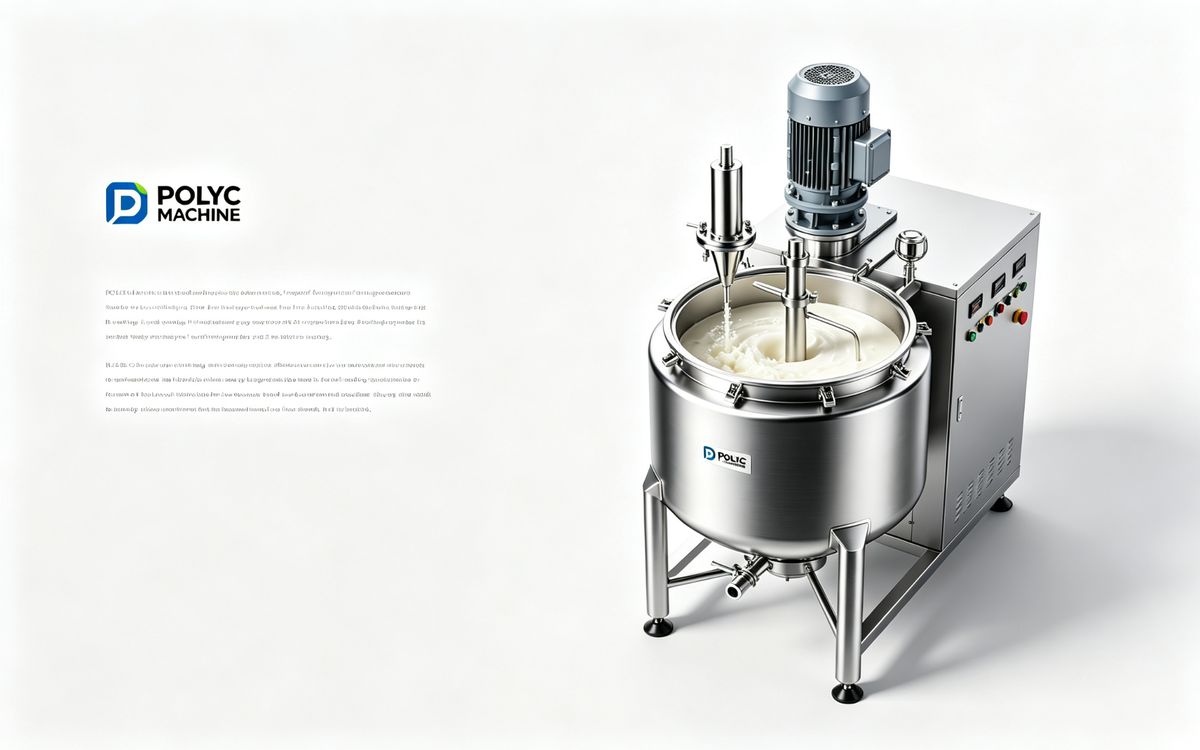
High shear emulsifiers are selected based on three main factors: material viscosity, required droplet size, and production capacity. For most applications below 10,000 mPa·s, a standard inline or batch rotor-stator works well. The final selection should also account for temperature rise, cleaning requirements, phase addition method, and whether the process runs batch or continuously.
This guide explains how to match rotor-stator emulsifying equipment to the formulation and production target. It is intended as a practical starting point; product trials remain the best way to confirm the final configuration.
What Is a High Shear Emulsifier and How Does It Work?
A high shear emulsifier uses a fast rotor turning inside a stationary stator. As material is drawn through the narrow rotor-stator gap, mechanical and hydraulic shear, turbulence, and repeated circulation break one liquid phase into smaller droplets within another phase. The result can be a more uniform emulsion, suspension, or dispersion.
The shear head is only one part of the process. Vessel geometry, bulk circulation, phase addition, temperature control, and residence time all influence the final droplet-size distribution. In a batch process, a lifting or bottom-mounted head works with the vessel circulation. In an inline process, a feed pump moves material through the rotor-stator chamber once or repeatedly.
Typical applications include creams and lotions, sauces, resin emulsions, agrochemical formulations, liquid-liquid blends, and chemical suspensions. For a combined vessel, high-shear head, heating, cooling, and vacuum arrangement, see the emulsifying/homogenization kettle.
Main Types of High Shear Emulsifiers
The correct configuration depends first on production mode and material flow behavior.
| Type | Working method | Suitable viscosity | Best fit |
|---|---|---|---|
| Batch emulsifier | Head works inside a vessel | 1,000-100,000 mPa·s | Small batches and multiple products |
| Inline emulsifier | Material passes through a pipeline chamber | 1-10,000 mPa·s | High throughput and continuous production |
| Centrifugal emulsifier | High-speed centrifugal shear and circulation | 1-5,000 mPa·s | Fine and nano-scale emulsion work |
A hydraulic lifting shearing emulsifier supports flexible batch vessels and easier cleaning. A pipeline high shearing emulsifier pump is better suited to controlled continuous or recirculation duty. Laboratory trials can be started with a laboratory high shearing emulsifier.
How to Select by Viscosity
Viscosity determines how easily material can circulate through the shear zone. As viscosity rises, bulk turnover and drive torque become more important than maximum rotor speed alone.
| Viscosity range | Recommended equipment | Typical speed | Shear head type |
|---|---|---|---|
| 1-1,000 mPa·s | Inline emulsifier | 1,500-3,000 rpm | Round-hole |
| 1,000-10,000 mPa·s | Batch emulsifier | 1,500-3,000 rpm | Saw-tooth |
| 10,000-100,000 mPa·s | High-viscosity batch emulsifier | 1,000-1,500 rpm | Compound head |
| Over 100,000 mPa·s | Planetary mixer with emulsifier | 50-100 rpm | Low-speed, high-torque system |
For high-viscosity formulations, consider a vessel with an anchor or planetary agitator to feed material back to the high-shear zone. An inline emulsifier is not normally the first choice once viscosity prevents stable pump feeding or causes excessive pressure drop.
How to Select by Capacity
Choose capacity from the working batch, required cycle time, cleaning frequency, and the number of batches per day. Do not size only from vessel volume: usable working volume, head diameter, heat removal, and discharge losses also matter.
| Production scale | Recommended batch size | Indicative motor power |
|---|---|---|
| Laboratory | 5-20 L | 0.5-1.5 kW |
| Small batch | 50-200 L | 3-7.5 kW |
| Medium batch | 500-2,000 L | 15-45 kW |
| Large production | 5,000 L and above | 75 kW and above |
These ranges are preliminary references, not guaranteed production results. The final drive and head are confirmed from viscosity, density, phase ratio, target droplet size, batch time, and temperature limit.
Common Problems and Troubleshooting
Most emulsification issues are caused by a mismatch between shear energy, circulation, and formulation behavior rather than one setting alone.
1. Uneven droplet size
Inspect the shear head for wear, verify rotor speed, and confirm that the batch is circulating through the head. Increase processing time only after checking that temperature and viscosity remain in range.
2. Excessive temperature rise
Review jacket cooling, batch fill level, and phase-addition rate. Reducing the temperature at which material enters the shear zone can protect heat-sensitive ingredients and keep viscosity more stable.
3. High noise or vibration
Check bearings, shaft alignment, and the rotor-stator clearance. A damaged or poorly aligned head can create vibration and reduce shear consistency.
4. Unstable output from batch to batch
Record feed viscosity, temperature, phase-addition sequence, rotor speed, and run time for every batch. Small formulation or temperature changes can alter the apparent shear response substantially.
Emulsifier vs. Disperser vs. Homogenizer
These terms are sometimes used interchangeably, but their primary process roles differ. Selection starts with identifying whether the process must mix immiscible liquids, wet solids into a liquid, or produce a very fine and narrow droplet-size distribution.
| Dimension | High Shear Emulsifier | High Speed Disperser | Homogenizer |
|---|---|---|---|
| Primary purpose | Emulsification (liquid-liquid) | Dispersion (solid-liquid) | Ultra-fine homogenization |
| Typical particle or droplet target | 1-10 µm | 10-50 µm | Below 1 µm |
| Typical viscosity range | 1-10,000 mPa·s | 1,000-50,000 mPa·s | 1-1,000 mPa·s |
| Relative capital cost | Medium | Lower | Higher |
A high-speed disperser is often used before fine grinding when powders must first be wetted and deagglomerated. Read High Speed Disperser vs Bead Mill: Which Equipment Do You Need? for a related selection comparison.
Frequently Asked Questions
What is the difference between a high shear emulsifier and a homogenizer?
A high shear emulsifier uses a rotor-stator head to disperse one liquid phase into another, typically targeting droplets in the 1-10 micrometre range. A homogenizer is generally selected when a finer, often submicron, and more uniform result is required. The correct choice depends on the formulation, target droplet size, throughput, and allowable temperature rise.
How do I choose the right rotor-stator gap?
Choose the gap from the target droplet size, viscosity, material sensitivity, and required throughput. A narrower gap creates higher local shear but also more heat and pressure drop. Confirm the head geometry with a product trial using the actual formulation whenever possible.
What viscosity is too high for an inline emulsifier?
For many inline emulsifiers, viscosity above roughly 10,000 mPa·s makes stable feeding and pressure control difficult. Higher-viscosity products are commonly processed in a batch vessel with high-torque bulk mixing, or with a planetary mixer and integrated high-shear head.
How often should I replace the shear head?
Inspect the rotor and stator at scheduled maintenance intervals and replace them when wear changes the clearance, causes vibration, or reduces product consistency. Actual replacement intervals depend on abrasive solids, operating hours, speed, cleaning method, and material compatibility.