
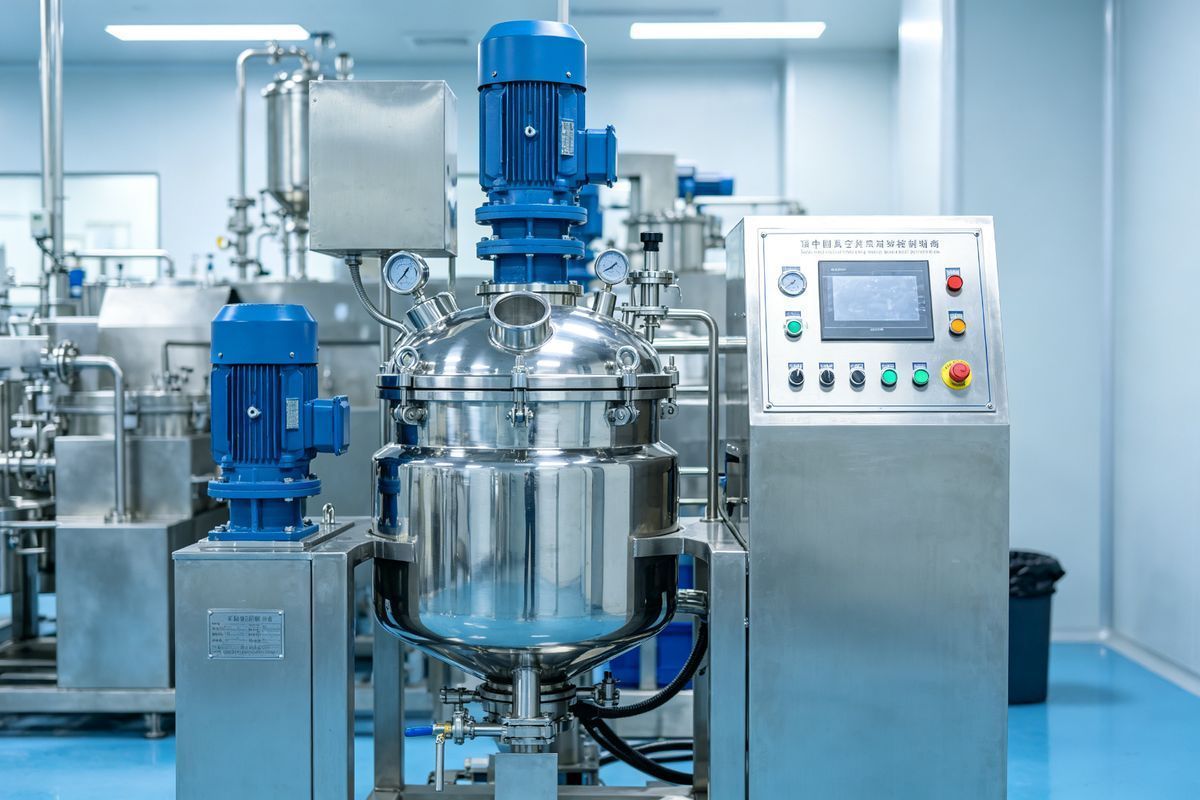
Vacuum emulsifying mixers are essential for producing stable emulsions and dispersions in cosmetics, pharmaceuticals, food, and specialty chemical industries. These systems combine high-shear homogenization with vacuum degassing and controlled heating/cooling to create fine, stable emulsions with particle sizes down to sub-micron levels. Chinese manufacturers have developed extensive expertise in vacuum emulsifying mixer design, offering systems from laboratory 5 L units through production 5,000 L systems with PLC control and recipe management. This guide profiles the leading Chinese vacuum emulsifying mixer manufacturers in 2026 to help you identify suppliers that match your industry, capacity, and process requirements.
What makes a vacuum emulsifying mixer different
A vacuum emulsifying mixer combines three key functions in a single system: (1) high-shear homogenization using a rotor-stator head that generates intense shear to break droplets into sub-micron sizes, (2) vacuum degassing to remove entrained air and create bubble-free products, and (3) jacketed heating/cooling for precise temperature control during emulsification and cooling. Additional features typically include anchor or frame agitators with PTFE wall scrapers for uniform mixing, water and oil phase tanks for pre-heating raw materials, and hydraulic lifting for easy vessel access and cleaning. These systems are designed for batch production of creams, lotions, ointments, gels, pastes, and other emulsified products.
1. POLYC MACHINE (Shanghai Polyc Technology Co., Ltd.)
Location: Shanghai, China | Founded: 2001 (25 years) | Key products: Vacuum emulsifying mixers (5-5,000 L), high shear emulsifiers, inline homogenizers, hydraulic lifting emulsifiers, pipeline emulsifier pumps, cosmetic/pharmaceutical/food grade
POLYC MACHINE offers a comprehensive vacuum emulsifying mixer range covering laboratory 5 L through production 5,000 L systems, with configurations including top-mounted homogenizers, bottom-mounted homogenizers, and inline recirculation systems. Their vacuum emulsifying mixers feature high-shear rotor-stator homogenizers (up to 10,000+ rpm) capable of producing sub-micron emulsions, vacuum systems to -0.098 MPa for bubble-free products, and jacketed vessels with precise temperature control (plus or minus 1 degree C). Standard features include anchor agitators with PTFE wall scrapers, hydraulic lifting for easy access, and SS316L stainless steel construction with mirror-polished interiors (Ra < 0.4 um) for pharmaceutical and cosmetic applications. Options include PLC control with recipe management, CIP/SIP clean-in-place systems, explosion-proof electrical systems, and integrated water/oil phase tanks. All models are CE-certified. POLYC provides 24-hour technical response for export customers.
Best for: Full-range vacuum emulsification from lab to production, with strong customization for pharmaceutical/cosmetic/food-grade finishes, CIP/SIP, explosion-proof, and integrated production line configurations.
2. Shanghai ELE Mechanical & Electrical Equipment Co., Ltd.
Location: Shanghai | Key products: Vacuum emulsifying mixers, high shear homogenizers, inline emulsifiers, cosmetic production lines
Shanghai ELE focuses on high-end vacuum emulsifying mixers for the cosmetic and pharmaceutical industries, with particular strength in fully automated production lines with PLC control and recipe management. Their vacuum emulsifying mixers feature precision-engineered rotor-stator homogenizers, integrated vacuum systems, and advanced temperature control with data logging. They offer both standard and custom configurations with options for CIP/SIP systems, touchscreen HMI interfaces, and SCADA integration for production monitoring. Their equipment is widely used in the cosmetic, pharmaceutical, and personal care industries where consistent product quality and regulatory compliance are critical.
Best for: High-automation vacuum emulsifying systems for cosmetic, pharmaceutical, and personal care production with strict quality and regulatory requirements.
3. Wuxi Hongyuan Chemical Machinery Co., Ltd.
Location: Wuxi, Jiangsu | Key products: Vacuum emulsifying mixers, high shear emulsifiers, homogenizers, cosmetic equipment
Wuxi Hongyuan offers a solid range of vacuum emulsifying mixers from 50 L to 2,000 L, with standard configurations including top-mounted homogenizers, anchor agitators with PTFE scrapers, and hydraulic lifting. Their mixers feature SS304 or SS316L stainless steel construction with jacketed heating/cooling and vacuum capability. They are known for competitive pricing on standard production models and reliable delivery times. Their vacuum emulsifying mixers are widely used in the cosmetic, personal care, and chemical industries across China and export markets, with a strong reputation for robust construction and low maintenance.
Best for: Standard production vacuum emulsifying mixers at competitive price points for cosmetic, personal care, and chemical applications.
4. Guangzhou Lijie Chemical Machinery Co., Ltd.
Location: Guangzhou, Guangdong | Key products: Vacuum emulsifying mixers, high shear emulsifiers, cosmetic equipment, filling machines
Guangzhou Lijie serves the South China market with vacuum emulsifying mixers from 50 L to 3,000 L, with particular focus on the cosmetic and personal care industries. Their mixers feature robust construction and straightforward maintenance, with options for SS316L stainless steel, mirror-polished interiors, and integrated water/oil phase tanks. They have strong experience serving the cosmetic, skincare, and personal care sectors in South China and Southeast Asia, with good after-sales support in the region. Their machines are known for reliable performance in multi-product cosmetic facilities with frequent formulation changes.
Best for: Cosmetic, skincare, and personal care vacuum emulsification in South China and Southeast Asia.
5. Zhejiang Lishou Machinery Co., Ltd.
Location: Wenzhou, Zhejiang | Key products: Vacuum emulsifying mixers, high shear emulsifiers, inline homogenizers, cosmetic production lines, filling machines
Zhejiang Lishou offers vacuum emulsifying mixers as part of their integrated cosmetic and chemical equipment range, with models from 50 L to 3,000 L. Their strength lies in turnkey production line solutions that combine vacuum emulsifying mixers with water/oil phase tanks, storage tanks, filling machines, and labeling machines for complete cosmetic or pharmaceutical production lines. Their mixers feature standard construction with options for custom voltages and certifications. They provide comprehensive project management for complete production line installations, including layout design, equipment selection, installation supervision, and commissioning.
Best for: Turnkey cosmetic and pharmaceutical production lines requiring emulsification, storage, filling, and packaging from a single supplier.
6. Jiangsu Yinhong Chemical Equipment Co., Ltd.
Location: Yixing, Jiangsu | Key products: Vacuum emulsifying mixers, high shear emulsifiers, homogenizers, chemical equipment
Jiangsu Yinhong offers mid-range vacuum emulsifying mixers from 50 L to 1,500 L, focusing on reliable performance for standard cosmetic and chemical emulsion formulations. Their mixers feature straightforward construction with SS304 or SS316L stainless steel wetted parts, jacketed heating/cooling, and vacuum capability, with robust construction for continuous production use. They offer basic customization for special voltages and certifications, and their machines are priced competitively for budget-conscious buyers. They have good experience serving the chemical and agrochemical industry for emulsion concentrates (EC) and microemulsion formulations.
Best for: Cost-effective standard vacuum emulsifying mixers for cosmetic, chemical, and agrochemical production.
7. Shenzhen Boyu Industrial Equipment Co., Ltd.
Location: Shenzhen, Guangdong | Key products: Vacuum emulsifying mixers, high shear emulsifiers, laboratory homogenizers, cosmetic equipment
Shenzhen Boyu serves the South China market with vacuum emulsifying mixers from 5 L to 1,000 L, with particular focus on the cosmetic, electronic material, and specialty chemical industries. Their mixers feature compact designs for space-constrained facilities and easy operation for small-to-medium batch production. They offer both standard and custom configurations, with good after-sales support for customers in the Pearl River Delta region and Southeast Asia. Their equipment is widely used in the cosmetic, electronic adhesive, and specialty chemical industries where consistent emulsion quality and clean operation are important.
Best for: Cosmetics, electronic adhesives, and specialty chemical emulsification in South China and Southeast Asia, particularly for space-constrained facilities.
8. Shanghai Root Mechanical & Electrical Equipment Co., Ltd.
Location: Shanghai | Key products: Laboratory vacuum emulsifying mixers, high shear homogenizers, inline emulsifiers, pilot-scale systems
Shanghai Root specializes in laboratory and pilot-scale vacuum emulsifying mixers for R&D and small-batch production. Their laboratory mixer range covers 1 L to 50 L, with precision speed control (digital display), vacuum capability, temperature control with data logging, and quick-change homogenizer heads for formulation development. They offer scale-up support from laboratory to production volumes, helping customers transition from R&D to manufacturing with consistent process parameters. Their equipment is widely used in corporate R&D centers and university laboratories for cosmetic, pharmaceutical, and food emulsion formulation development.
Best for: Laboratory and pilot-scale vacuum emulsification for R&D, formulation development, and small-batch specialty production.
Key considerations when selecting a vacuum emulsifying mixer supplier
Homogenizer type and performance: Determine whether you need a top-mounted, bottom-mounted, or inline recirculation homogenizer based on your product viscosity and batch size. Verify homogenizer rpm range (typically 3,000-15,000 rpm) and achievable particle size (sub-micron for fine emulsions). Request particle size analysis (D50, D90) using your actual formulation to confirm performance.
Vacuum capability and seal design: Confirm the maximum vacuum level (target -0.098 MPa or better for bubble-free products) and the seal design for maintaining vacuum during operation. Double mechanical seals with barrier fluid are preferred for vacuum operation. Verify that the vessel, lid, and all connections are properly sealed for vacuum integrity.
Temperature control and heat transfer: Evaluate jacketed heating/cooling capability, including heat transfer area, temperature control accuracy (target plus or minus 1 degree C), and heating/cooling rate. For products requiring precise temperature profiles (e.g., cosmetic creams with phase inversion temperatures), verify that the supplier can provide programmable temperature ramps and holds with data logging.
Material of construction and cleanability: For pharmaceutical, food, and cosmetic applications, confirm SS316L stainless steel wetted parts with mirror-polished interiors (Ra < 0.4 um). Evaluate CIP (clean-in-place) capability, including spray ball placement and coverage, and SIP (sterilize-in-place) capability if required for pharmaceutical applications. Verify that all internal surfaces are accessible for manual cleaning if CIP is not available, and that gaskets are food-grade/pharmaceutical-grade.
Key Takeaways
- Chinese vacuum emulsifying mixer manufacturers offer systems from laboratory 5 L through production 5,000 L, with top/bottom/inline homogenizer configurations, vacuum to -0.098 MPa, and precise temperature control for cosmetic, pharmaceutical, food, and specialty chemical applications.
- POLYC MACHINE offers the most comprehensive range (5-5,000 L) with 25 years of manufacturing experience, CE certification, and strong customization for pharmaceutical/cosmetic/food-grade finishes, CIP/SIP, explosion-proof, and integrated production line configurations.
- Shanghai ELE excels in high-automation systems for cosmetic and pharmaceutical production with strict quality requirements, while Guangzhou Lijie focuses on cosmetic and personal care applications in South China.
- Always verify homogenizer performance with actual particle size analysis, vacuum capability and seal design, temperature control accuracy, and material of construction/cleanability for your specific industry and regulatory requirements.
Frequently Asked Questions
Q: What particle size can a vacuum emulsifying mixer achieve?
A: Modern vacuum emulsifying mixers with high-shear rotor-stator homogenizers (operating at 5,000-15,000 rpm) can achieve emulsion droplet sizes of D50 = 0.5-2 microns for most cosmetic and pharmaceutical formulations, with D90 typically below 5 microns. For finer requirements (nanoemulsions with D50 below 100 nm), multiple passes through an inline high-pressure homogenizer may be necessary after initial vacuum emulsification. Actual particle size depends on formulation (oil phase content, emulsifier type and concentration, viscosity), homogenizer speed, and processing time. We recommend material testing with your actual formulation to confirm achievable particle size and emulsion stability.
Q: Why is vacuum important in emulsifying mixers?
A: Vacuum serves three critical functions in emulsion production: (1) Degassing - high-shear mixing introduces air into the product, which can cause bubbles, foaming, and reduced product stability. Vacuum removes entrained air to create smooth, bubble-free products with improved appearance and shelf life. (2) Oxidation prevention - vacuum reduces oxygen exposure during processing, which is important for oxidation-sensitive products (e.g., products containing vitamins, essential oils, or unsaturated fats). (3) Raw material handling - vacuum can be used to draw raw materials into the vessel without opening the lid, reducing contamination risk and operator exposure to volatile ingredients. Typical vacuum levels are -0.08 to -0.098 MPa (approximately 24-29 inches Hg), with -0.098 MPa preferred for high-quality cosmetic and pharmaceutical products.
Q: What is the difference between a top-mounted and bottom-mounted homogenizer?
A: Top-mounted homogenizers are installed through the vessel lid and extend down into the product, with the rotor-stator head positioned near the vessel bottom. They are easier to access for maintenance and cleaning, and allow the vessel to be fully drained without removing the homogenizer. Bottom-mounted homogenizers are installed through the vessel bottom, with the rotor-stator head flush with or slightly above the vessel floor. They provide better circulation for high-viscosity materials (as the product flows downward through the homogenizer), reduce vortex formation and air entrainment, and allow for smaller batch sizes (as the homogenizer is at the lowest point). Bottom-mounted homogenizers require a mechanical seal at the vessel bottom, which is a potential leak point, and may require the vessel to be elevated for access. Top-mounted is preferred for general-purpose applications, while bottom-mounted is preferred for high-viscosity products and small batch sizes.
Q: What certifications are required for cosmetic and pharmaceutical vacuum emulsifying mixers?
A: For cosmetic and pharmaceutical applications, key certifications and requirements include: (1) CE certification (Europe) covering mechanical safety and electrical standards; (2) FDA or 3-A certification for food-contact surfaces (United States); (3) GMP (Good Manufacturing Practice) compliance for pharmaceutical equipment, including design documentation, material traceability, and validation support; (4) Surface finish requirements - SS316L stainless steel wetted parts with mirror-polished interiors (Ra < 0.4 um); (5) Gasket materials - food-grade or pharmaceutical-grade silicone, EPDM, or PTFE with FDA certification; (6) Documentation - material certificates (3.1 certificates), weld maps, surface finish reports, and factory acceptance test (FAT) protocols. For pharmaceutical applications, additional documentation may include installation qualification (IQ), operational qualification (OQ), and performance qualification (PQ) protocols. Always verify that the supplier can provide the specific certifications and documentation required by your regulatory authority and quality system.
Q: What is the typical lead time for a custom vacuum emulsifying mixer from China?
A: Standard models typically ship within 30-45 days from order confirmation. Custom configurations (special voltages, explosion-proof certification, custom homogenizer designs, CIP/SIP systems, pharmaceutical-grade surface finishes, PLC control with recipe management) may require 60-90 days. Large production systems (2,000 L+) or complete production lines with water/oil phase tanks, storage tanks, and filling machines may require 90-120 days including factory acceptance testing. Vacuum emulsifying mixers with custom metallurgy (e.g., Hastelloy, titanium) or high-containment features may require additional lead time. Always confirm lead time in writing and build buffer time into your project schedule, especially for first-time orders with custom requirements or regulatory certifications.
Ready to discuss your vacuum emulsifying mixer requirements?
POLYC MACHINE offers free material testing and technical consultation for vacuum emulsifying mixer selection. Our process engineers can help you determine the optimal mixer configuration, homogenizer type, and capacity for your specific application. Contact us today to discuss your project, or explore our complete vacuum emulsifying mixer product range.