
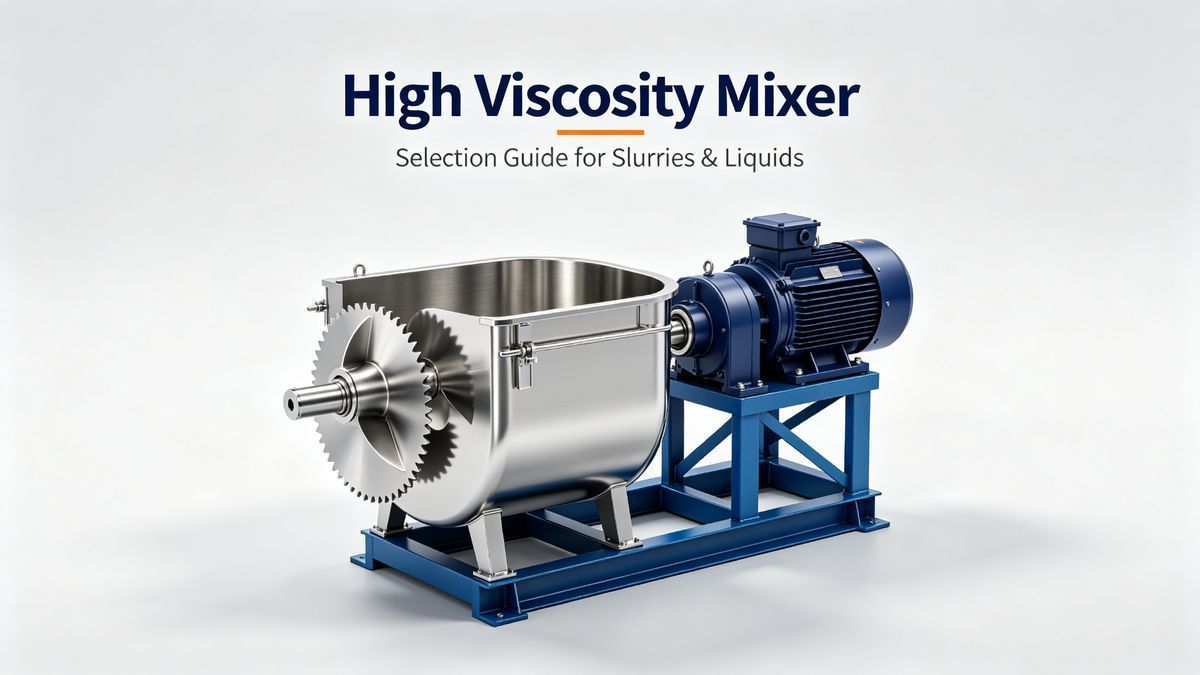
A high viscosity mixer is a heavy-duty mixing machine designed for products above 50,000 cP, where conventional high-speed dispersers cannot produce sufficient flow or wall turnover. It uses combinations of low-speed anchor scrapers, medium-speed butterfly or gate agitators, and high-speed disperser shafts to mix, homogenise and deaerate thick pastes, sealants, adhesives and slurries. This guide covers high viscosity mixer specifications, the three main configurations, selection criteria and total cost of ownership.
Why high viscosity needs a different mixer
Above 50,000 cP, a single high-speed shaft cannot move the bulk product. The disc spins in a localised cavity while the product at the vessel walls remains unmixed. High viscosity mixers solve this with multiple shafts operating at different speeds: a low-speed anchor or gate scraper continuously wipes the vessel walls and moves product toward the centre, while one or two high-speed shafts provide shear and dispersion in the centre. This combination ensures uniform mixing throughout the vessel, even at viscosities up to 1,500,000 cP.
High viscosity mixer specifications: what the numbers mean
| Specification | POLYC range | What it determines |
|---|---|---|
| Vessel capacity | 50 L - 12,000 L | Maximum batch size |
| Total motor power | 7.5 kW - 200 kW | Mixing energy and maximum viscosity |
| Maximum viscosity | Up to 1,500,000 cP | Product range (planetary = highest) |
| Anchor speed | 10 - 60 rpm | Wall turnover and heat transfer |
| Disperser speed | 0 - 1,500 rpm | Shear and dispersion intensity |
| Vacuum capability | Standard, -0.09 MPa | Degassing for bubble-free products |
| Jacket heating/cooling | Steam, oil or water | Temperature control for exothermic reactions |
| Hydraulic discharge | Optional, 10,000 - 1,000,000 cP | Removal of thick product from vessel |
Three high viscosity mixer configurations compared
1. Butterfly double shaft mixer
The most common high viscosity mixer configuration. One low-speed butterfly agitator (two counter-rotating blades) provides bulk movement and wall scraping, while one high-speed disperser shaft provides shear. Suitable for products from 50,000 to 500,000 cP, including sealants, adhesives, putties and pigment pastes. POLYC butterfly mixers range from 100 L to 5,000 L with 11 kW to 75 kW total power.
2. Concentric double shaft mixer
Similar to the butterfly mixer but with the two shafts mounted concentrically (one inside the other) rather than offset. This produces a more symmetrical flow pattern and is better for round vessels and products requiring very uniform mixing. The concentric design also allows the vessel to be fully sealed for vacuum operation. POLYC concentric mixers range from 100 L to 3,000 L and are preferred for high-gloss sealants and optical adhesives.
3. Planetary mixer (triple shaft)
The highest-performance high viscosity mixer. Two high-speed disperser shafts orbit around the vessel centre (like planets around the sun) while a low-speed gate or anchor scraper wipes the walls. The planetary motion ensures every part of the vessel is sheared, producing the most uniform mixing and the highest viscosity capability (up to 1,500,000 cP). POLYC planetary mixers range from 50 L to 2,000 L with 15 kW to 110 kW total power, suitable for silicone sealants, structural adhesives, dental materials and high-value thick pastes.
How to select the right high viscosity mixer
Step 1: Define your viscosity range
Viscosity is the primary selection criterion. Below 50,000 cP, a standard high-speed disperser may be sufficient. Between 50,000 and 500,000 cP, a butterfly or concentric double shaft mixer works. Between 500,000 and 1,000,000 cP, a heavy-duty butterfly or planetary mixer is needed. Above 1,000,000 cP, only a planetary mixer with high-torque gearbox can provide sufficient wall turnover. Always specify viscosity at processing temperature, not at room temperature.
Step 2: Calculate required power
High viscosity mixers require significantly more power than standard dispersers. As a rule of thumb: 50,000-200,000 cP needs 0.08-0.12 kW per litre; 200,000-500,000 cP needs 0.12-0.18 kW per litre; above 500,000 cP needs 0.18-0.25 kW per litre. A 1,000 L planetary mixer processing silicone at 800,000 cP needs at least 110 kW total power. Underpowered mixers cannot turn the anchor at high viscosity, causing localised overheating and incomplete mixing.
Step 3: Evaluate discharge method
Products above 100,000 cP do not flow out of a bottom valve. Options include: tilting vessel (for up to 200,000 cP), hydraulic ram discharge (for 100,000-1,000,000 cP), or screw discharge (for above 1,000,000 cP). Hydraulic discharge is the most common and uses a ram plate that presses down on the product, forcing it out through a bottom valve. This also removes air from the product during discharge. POLYC hydraulic discharge systems handle products from 10,000 to 1,000,000 cP.
Step 4: Consider heating, cooling and vacuum
Many high viscosity products are exothermic during mixing (e.g., silicone sealants, polyurethane adhesives). A double jacket with water or oil cooling is essential to control temperature. For products that require heating during processing (e.g., hot-melt adhesives, waxes), steam or oil heating jackets are available. Vacuum is standard on most high viscosity mixers because high-shear mixing traps air. Vacuum degassing produces bubble-free products with better appearance and mechanical properties. For products sensitive to oxidation, nitrogen blanketing is available as an option.
What affects high viscosity mixer price
- Configuration: butterfly double shaft is most economical; concentric adds 15-25%; planetary adds 40-60% over butterfly
- Size and power: a 2,000 L, 75 kW mixer costs 3-4 times a 300 L, 22 kW unit
- Vacuum system: vacuum lid, seal and pump are standard on most models; high-vacuum (below -0.095 MPa) adds cost
- Hydraulic discharge: ram plate, hydraulic cylinder and power pack add 20-30% to base price
- Jacket system: double jacket for heating/cooling is standard; half-pipe or dimple jacket for high pressure adds cost
- Material of construction: standard stainless steel 304; 316L for pharmaceutical or corrosive products adds 20-30%; Hastelloy for highly corrosive adds 100%+
- Automation: PLC with recipe management, temperature control, vacuum control and data logging adds 15-25%
- Certification: CE marking, ATEX explosion-proof, FDA-compliant materials and ASME pressure vessel certification add engineering and documentation costs
Key Takeaways
- High viscosity mixers are for products above 50,000 cP where standard dispersers cannot move the bulk product
- Butterfly double shaft: 50,000-500,000 cP, most economical, best for sealants, adhesives and putties
- Concentric double shaft: 50,000-500,000 cP, more uniform flow, better for vacuum and round vessels
- Planetary mixer: up to 1,500,000 cP, highest performance, best for silicone, structural adhesives and high-value pastes
- Size by viscosity and power: allow 0.08-0.25 kW per litre depending on viscosity; always specify viscosity at processing temperature
Frequently Asked Questions
What is the difference between a double shaft mixer and a planetary mixer?
A double shaft mixer has two fixed shafts (one low-speed anchor, one high-speed disperser) that do not orbit. A planetary mixer has two high-speed shafts that orbit around the vessel centre while the anchor rotates, providing more complete coverage. Planetary mixers handle higher viscosity (up to 1,500,000 cP vs 500,000 cP) and produce more uniform mixing, but cost 40-60% more.
Can a high viscosity mixer also disperse pigment?
Yes. The high-speed disperser shaft in a double shaft or planetary mixer provides sufficient shear for pigment wetting and pre-dispersion. However, for fineness below 20 microns, a separate bead mill or basket mill is still needed for fine grinding. High viscosity mixers are best for products where pigment is pre-dispersed in a resin paste before mixing with other components.
How do you clean a high viscosity mixer?
Cleaning depends on the product. For solvent-based products, flush with solvent followed by wiping. For water-based products, clean with water and detergent. The anchor scraper can be raised or removed for access to the vessel bottom. Vessels with hydraulic discharge can be cleaned by running a cleaning solution through the discharge system. For products that cure (e.g., epoxy, polyurethane), immediate cleaning before curing is essential.
What is the typical batch time for a high viscosity mixer?
Batch time depends on product complexity and viscosity. Simple mixing of pre-made components: 30-60 minutes. Full formulation including pigment dispersion, vacuum degassing and cooling: 2-4 hours. Complex products with multiple addition stages and exothermic reactions: 4-8 hours. High viscosity mixers are typically batch machines, not continuous, so throughput is measured in batches per day rather than kg per hour.
Related POLYC MACHINE equipment
- Planetary Mixer - 50 L to 2,000 L, up to 1,500,000 cP, triple shaft planetary
- Butterfly Double Shaft Mixer - 100 L to 5,000 L, 50,000-500,000 cP
- Concentric Double Shaft Mixer - 100 L to 3,000 L, concentric design for uniform mixing
- Hydraulic Discharging Machine - 10,000-1,000,000 cP product discharge
Need help selecting the right high viscosity mixer for your sealant, adhesive or paste product? Request a free process consultation with our engineering team. We can recommend the optimal configuration, vessel size, power and discharge method for your formulation and production volume.