
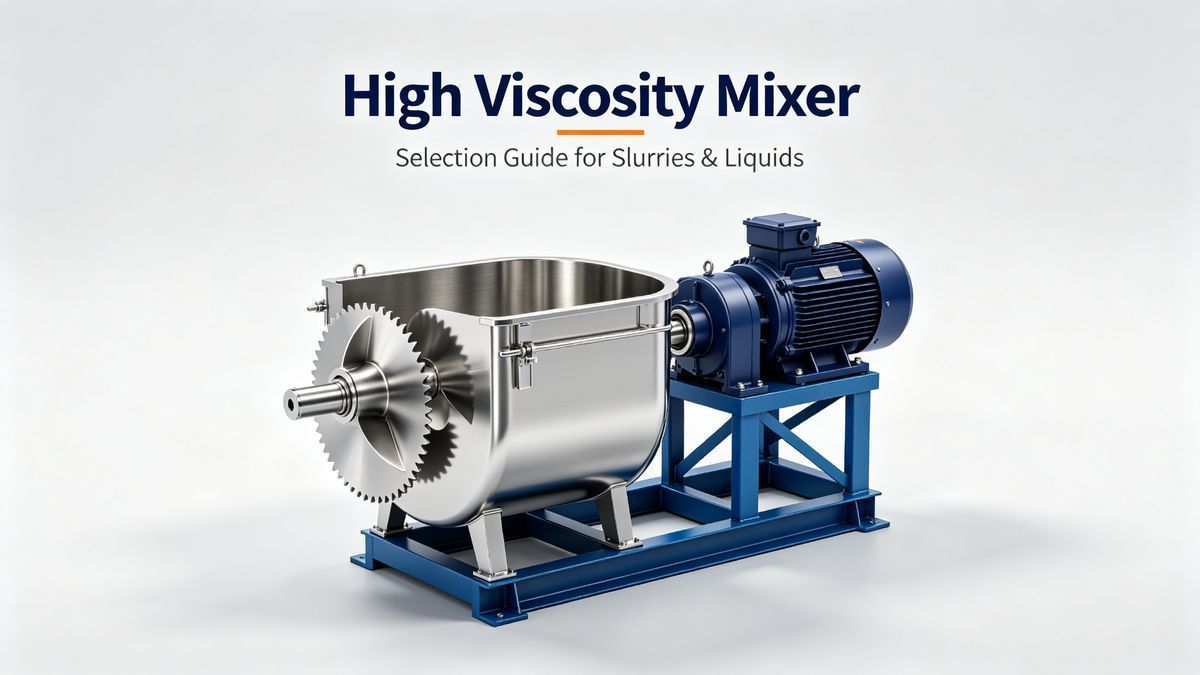
When a material gets so thick that a standard agitator cannot move it, you need a high viscosity mixer. These machines handle slurries, pastes, adhesives and sealants up to 1,500,000 cP using planetary, dual-shaft or multi-shaft agitator designs.
What counts as a high viscosity material?
There is no single cutoff, but the practical point is when a simple propeller or turbine no longer moves the whole batch. Materials that fall into this category include ceramic and battery slurries, pigment dispersions, sealants, adhesives, coatings resins, and various pastes. In these cases the limiting factor is not just viscosity number on paper; it is how the material behaves as fillers are added, as temperature drops, and as the batch thickens during the mixing cycle.
A useful selection brief records the viscosity across the whole process, the thixotropic or shear-thinning behavior, filler loading, temperature range, and whether the material tends to leave slow-moving zones near the vessel wall and bottom.
Why ordinary agitators fail on viscous material
With high viscosity material, a small impeller often only mixes locally. It leaves the wall and bottom stagnant, builds dead corners, and makes powder wetting unreliable. The answer is not a bigger propeller; it is an agitator geometry that couples bulk movement with local shear. The low-speed element sweeps the wall and bottom and pushes material toward the high-shear zone, while the high-speed element wets powders and breaks agglomerates.
Which mixer for high viscosity slurry and liquid?
For mid-viscosity slurries and liquids that still flow, a concentric double-shaft mixer or a butterfly double-shaft mixer is commonly reviewed. The low-speed sweep keeps the batch circulating while the high-speed disperser develops shear. This suits coatings, inks, slurries and medium-viscosity adhesives where the product remains mobile enough for two agitators to reach all zones.
For very high-viscosity pastes, sealants and heavy adhesives that resist wetting, a planetary mixer or a triple shaft mixer is usually the better fit. Planetary motion moves tools through a large portion of the vessel and can be combined with vacuum, heating or cooling, and high-torque drives. The choice between double, dual, triple shaft and planetary depends on the actual rheology, filler content, deaeration requirement and discharge method rather than on a single viscosity figure.
For typical end uses, see the industrial mixer range, the high-speed disperser range for powder wetting, and the adhesives and sealants industry guide.
How to choose: match viscosity and process demands
Start with the viscosity profile during the whole batch, not only the final value. Powder addition, temperature changes and filler loading can make the material much harder to move at one stage than another. Then assess shear demand: pigment wetting may need a high-speed disperser, while filler incorporation needs slow, high-torque movement. If both actions are needed in different vessel zones at the same time, more shafts or planetary action can be useful.
Batch size, color-change frequency, cleaning method and discharge also matter. Frequent product changes favor equipment that can be inspected and cleaned predictably. Ask the supplier to review the full batch sequence: charging, wetting, dispersion, vacuum step if used, final adjustment, discharge and cleaning. That conversation is more useful than selecting a mixer from a single viscosity number.
Frequently Asked Questions
What mixer is best for high viscosity liquids?
For viscous liquids and slurries that still flow, a double or dual shaft mixer with a sweep blade and high-speed disperser is commonly used. For very heavy pastes, a planetary or triple shaft mixer is usually more effective.
How does a high viscosity slurry mixer work?
It couples a low-speed wall-and-bottom sweep that pushes material into the active zone with a high-speed disperser that develops local shear, so the whole batch circulates and powders are wetted evenly.
What viscosity needs a planetary mixer?
When a double or dual shaft machine leaves stagnant zones, cannot wet fillers, or the material becomes a heavy paste, a planetary or triple shaft mixer is usually recommended. The decision should follow the actual rheology and batch sequence.
Key Takeaways
- A high viscosity mixer couples bulk wall/bottom movement with local shear, instead of relying on a single propeller.
- Double and dual shaft mixers suit mid-viscosity slurries, liquids and adhesives that still flow.
- Planetary or triple shaft mixers suit very high-viscosity pastes, sealants and hard-to-wet fillers.