
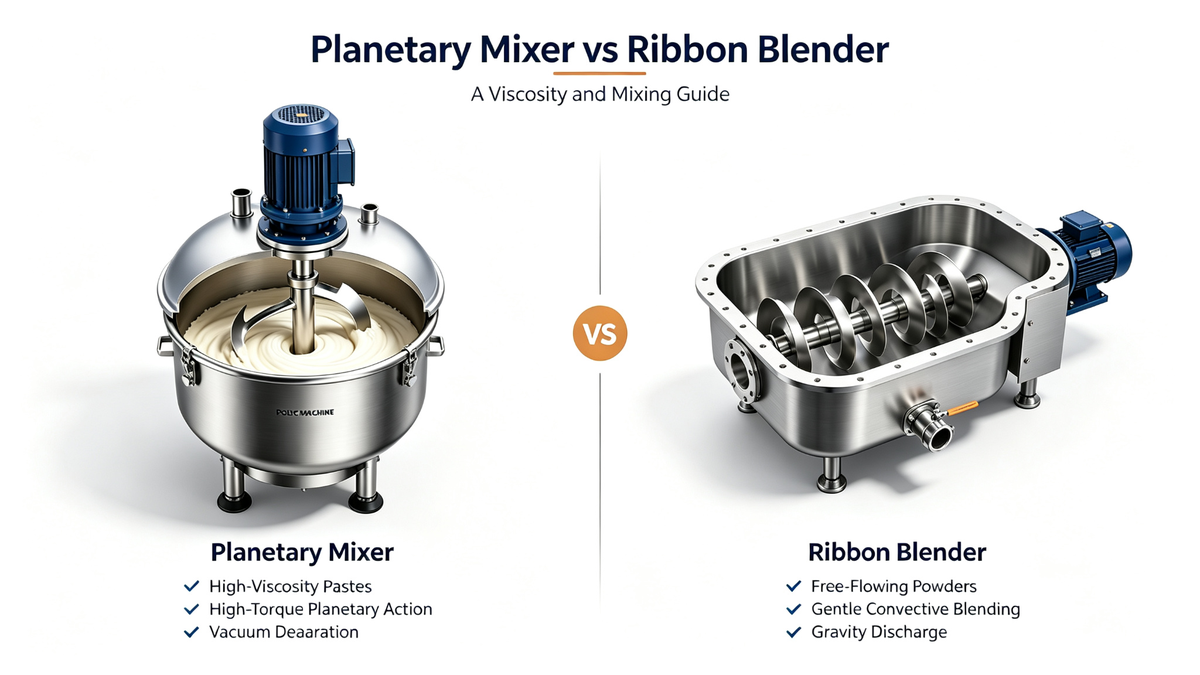
 Planetary mixers and ribbon blenders are both batch mixers, but they are designed for opposite ends of the viscosity spectrum. A planetary mixer moves stiff paste, mastic and dough-like compounds by orbiting agitators through the vessel, while a ribbon blender gently convects free-flowing powders in a trough using a helical ribbon.
Choosing between them therefore starts with viscosity and physical state. Above roughly 50,000 to 100,000 cP, a ribbon blender will stall or leave unmixed material, while a planetary mixer handles the load. Below that, and particularly for dry powder, a ribbon blender is faster and considerably more economical.
This article compares the two on mechanism, viscosity range, batch type, mixing quality and cost, and explains the middle ground where neither is ideal and a different configuration should be considered. It reflects 25 years of application work across sealants, adhesives, construction chemicals and food ingredients.
Planetary mixers and ribbon blenders are both batch mixers, but they are designed for opposite ends of the viscosity spectrum. A planetary mixer moves stiff paste, mastic and dough-like compounds by orbiting agitators through the vessel, while a ribbon blender gently convects free-flowing powders in a trough using a helical ribbon.
Choosing between them therefore starts with viscosity and physical state. Above roughly 50,000 to 100,000 cP, a ribbon blender will stall or leave unmixed material, while a planetary mixer handles the load. Below that, and particularly for dry powder, a ribbon blender is faster and considerably more economical.
This article compares the two on mechanism, viscosity range, batch type, mixing quality and cost, and explains the middle ground where neither is ideal and a different configuration should be considered. It reflects 25 years of application work across sealants, adhesives, construction chemicals and food ingredients.
Key Takeaways
- Viscosity is the deciding factor: planetary for stiff paste, ribbon for free-flowing powder
- Planetary mixers exceed 1,000,000 cP; ribbon blenders suit powders and semi-dry material
- Ribbon blenders are considerably more economical for dry powder duty
- Planetary mixers add vacuum, heating and discharge capability for reactive chemistries
- The middle ground is served by paddle or plough shear mixers
Mixing Mechanisms Compared
A planetary mixer uses one or more agitators that rotate on their own axes while orbiting the vessel. This geometry physically carries material through the vessel rather than relying on the material to flow to the agitator, which is what allows it to process compounds that would otherwise remain stationary. Wall scrapers are commonly included to keep the whole batch in motion.
A ribbon blender uses a helical ribbon agitator rotating in a horizontal trough. The outer and inner ribbons move material in opposing directions, producing convective blending. This is gentle and effective for free-flowing powder, but it depends entirely on the material being able to flow, which is why it is limited to dry and semi-dry duties.
The distinction matters because it determines failure mode. A ribbon blender processing stiff paste does not fail gradually; it stalls, leaves large unmixed regions and overloads the drive. A planetary mixer processing free-flowing powder works but is slower and more expensive than necessary, which is an economic rather than a technical failure.
Viscosity and Physical State
Planetary mixers are specified well beyond 1,000,000 cP for suitable geometries, with torque rather than volume setting the practical limit. They handle sealants, mastics, solder paste, dental composites, battery electrode slurry and heavy filled epoxy compounds. Drive sizing must be based on measured rheology at working temperature rather than on batch size.
Ribbon blenders suit dry powders, granules and some semi-dry materials. Typical duties include dry mortar, plaster blends, tile adhesive, food ingredient blends, detergent powders and fertiliser blends. They are not suitable for paste, and attempting paste duty leads to stalling and poor homogeneity.
The transition zone, roughly 10,000 to 100,000 cP depending on the material, is where selection requires care. In that range a paddle blender, plough shear mixer or butterfly double-shaft mixer is often more appropriate than either a planetary mixer or a ribbon blender, because it combines moderate torque with faster convective movement.
Process Capabilities Beyond Mixing
Planetary mixers commonly carry additional process functions that stiff-compound production needs. Vacuum capability removes entrained air and moisture in the same vessel, which is essential for silicone and polyurethane sealants where bubbles cause visible defects. Jacketed heating and cooling manages exotherm during reactive compounding.
Discharge is the other important capability. Stiff compound will not gravity-feed, so planetary installations are frequently paired with a hydraulic discharging machine that extrudes product into cartridges, drums or downstream filling. This integration is usually essential rather than optional for high-viscosity products.
Ribbon blenders are simpler but offer useful options for powder duty: liquid spray systems for binder or oil addition, jacketing for heated or cooled blending, and choppers where light deagglomeration is needed. Dust collection at feed and discharge points is standard for powder handling.
Mixing Quality and Homogeneity
For powder blending, homogeneity depends on achieving sufficient convective movement without causing segregation. Ribbon blenders give good results for free-flowing powders, but apparent inconsistency after discharge is often segregation rather than poor mixing. Correct sampling and discharge practice matters as much as the machine.
For high-viscosity compounds, homogeneity depends on every part of the batch passing through the agitator path. Planetary geometry with wall scraping achieves this for stiff material, which is why it is the standard for sealants and pastes. Cycle times are longer than for powder blending, reflecting the difficulty of moving stiff material.
In both cases the cycle should be validated rather than assumed. For powders, sample at defined points across the batch. For pastes, verify by appearance, rheology and, where relevant, functional testing. Documenting the validated cycle makes quality reproducible between operators and shifts.
Cost, Selection and the Middle Ground
Capital cost differs substantially. A ribbon blender is considerably less expensive than an equivalent planetary mixer, and for dry powder duty it is the correct and economical choice. Specifying a planetary mixer for powder would work but would waste capital and slow the process.
For high-viscosity duty the reverse applies: a planetary mixer is the only machine that will reliably move the material, so the higher cost is justified by capability rather than by preference. Where vacuum, heating and hydraulic discharge are needed, specify them at purchase rather than retrofitting.
For materials in the viscosity middle ground, or for cohesive powders that a ribbon blender cannot fully homogenise, consider a paddle blender or a plough shear mixer. These handle semi-dry and moderately cohesive material more effectively than either machine discussed here. Send your rheology or powder data through the inquiry form for a specific recommendation.
Technical Specifications
| Planetary viscosity range | up to well over 1,000,000 cP |
| Ribbon blender duty | dry powders, granules and semi-dry materials |
| Planetary capacity | approximately 5 - 3,000 L |
| Ribbon capacity | approximately 100 - 10,000 L |
| Planetary options | vacuum, jacketed vessel, hydraulic discharge press |
| Ribbon options | liquid spray, jacketing, choppers, dust collection |
Troubleshooting Guide
Ribbon blender stalls or leaves unmixed material
Cause: Material viscosity or cohesiveness beyond convective blending capability
Solution: Move to a paddle or plough shear mixer for semi-dry material, or a planetary mixer for genuinely stiff paste
Planetary mixing cycle is very long for a powder blend
Cause: Machine mismatched to duty; powder blends faster in a ribbon blender
Solution: Use a ribbon blender for free-flowing powder and reserve the planetary mixer for high-viscosity products
Bubbles in finished sealant after planetary mixing
Cause: No vacuum stage, or vacuum level inadequate for the formulation
Solution: Specify vacuum capability and validate the level and hold time against your formulation during commissioning
Powder blend appears inconsistent after discharge
Cause: Segregation after discharge rather than poor mixing in the vessel
Solution: Review discharge and handling practice, and validate homogeneity by sampling at defined points before discharge
Frequently Asked Questions
Can a ribbon blender handle paste?
No. A ribbon blender depends on material being able to flow, so paste stalls the agitator and leaves unmixed regions. Paste duty requires a planetary mixer, or a paddle or plough shear mixer for semi-dry material in between.
What viscosity requires a planetary mixer?
Generally above about 50,000 to 100,000 cP, where circulation breaks down and torque becomes the limiting factor. Planetary mixers are specified well beyond 1,000,000 cP when torque is sized from measured rheology at working temperature.
Is a planetary mixer worth it for powder blending?
It will work but is slower and considerably more expensive than a ribbon blender for that duty. For free-flowing powders a ribbon blender is the correct economical choice, and the planetary mixer should be reserved for high-viscosity products.
What handles material between powder and paste?
Semi-dry or moderately cohesive material is usually best handled by a paddle blender or a plough shear mixer. These combine moderate torque with faster convective movement than a planetary mixer and handle cohesive material better than a ribbon blender.
Do I need vacuum on a planetary mixer?
For silicone, polyurethane and other moisture-sensitive or appearance-critical products, yes. Vacuum removes entrained air and moisture in the same vessel, preventing bubbles and pinholes. Specify it at purchase because retrofitting is more expensive and less effective.
How is stiff compound discharged?
Stiff compound will not gravity-feed, so a hydraulic discharging machine or screw discharge is used to extrude product into cartridges, drums or downstream filling. For high-viscosity duty this is usually essential rather than optional.
How do I size either machine?
For planetary mixers, size torque from measured rheology at working temperature rather than from batch size. For ribbon blenders, size from working volume and confirm the fill range, since under-filling reduces blending efficiency. Send your data through the inquiry form for a specific sizing.
Recommended POLYC MACHINE equipment
The following machines are commonly evaluated for the process described above. Final selection depends on formulation, target particle size, viscosity, capacity and contamination limits.
Related technical guides
Next step
Share your material, required capacity, target fineness and operating conditions with POLYC MACHINE engineers for a configuration review and quotation.
Explore our Food & Beverage solutions for application-specific equipment configurations and process recommendations.