
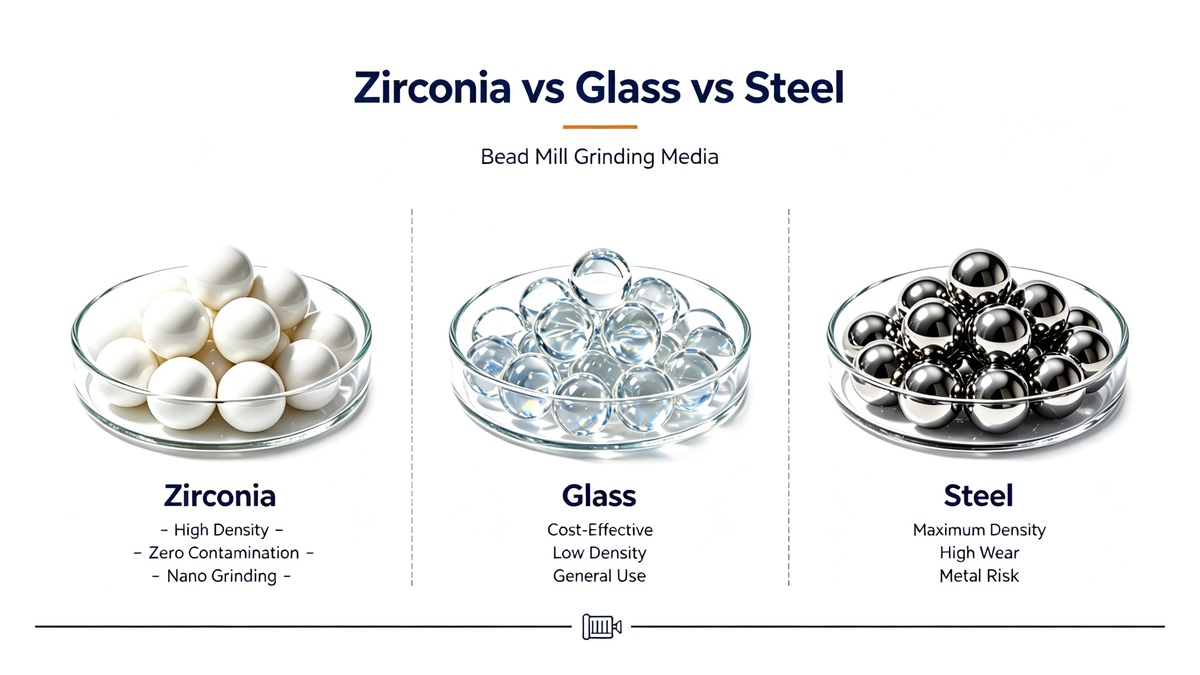
 Grinding media choice determines energy transfer per contact, wear rate, product contamination and ultimately the total cost of milling. Zirconia, glass and steel differ substantially on each of these dimensions, and choosing incorrectly either limits achievable fineness or inflates media consumption and contamination risk.
Yttria-stabilised zirconia is the standard for fine and nano milling, offering high density and very low wear. Glass beads are cheaper and suit coarse, cost-driven duties where contamination and fineness requirements are modest. Steel media provides aggressive grinding but introduces metallic contamination that rules it out for most high-value applications.
This article compares the three on the criteria that matter in production and explains why zirconia frequently delivers the lowest total cost of ownership despite the highest purchase price. It also covers the contact material and verification steps that determine whether contamination limits are actually met.
Grinding media choice determines energy transfer per contact, wear rate, product contamination and ultimately the total cost of milling. Zirconia, glass and steel differ substantially on each of these dimensions, and choosing incorrectly either limits achievable fineness or inflates media consumption and contamination risk.
Yttria-stabilised zirconia is the standard for fine and nano milling, offering high density and very low wear. Glass beads are cheaper and suit coarse, cost-driven duties where contamination and fineness requirements are modest. Steel media provides aggressive grinding but introduces metallic contamination that rules it out for most high-value applications.
This article compares the three on the criteria that matter in production and explains why zirconia frequently delivers the lowest total cost of ownership despite the highest purchase price. It also covers the contact material and verification steps that determine whether contamination limits are actually met.
Key Takeaways
- Zirconia: high density and low wear, the default for fine, nano and contamination-sensitive work
- Glass: lowest cost, suited to coarse grinding where fineness and contamination limits are modest
- Steel: aggressive grinding but metallic contamination rules it out for most high-value products
- Compare media on total cost of ownership, not purchase price
- Verify contamination control with trial milling and analysis rather than assuming it
Zirconia: The Standard for Fine and Nano Milling
Yttria-stabilised zirconia combines high density, around 6.0 g/cm3, with very low wear. High density means each contact transfers substantial energy, which supports efficient fine grinding, while low wear keeps both media consumption and product contamination low. These two properties make it the default choice wherever fineness or contamination control matters.
In practice zirconia serves coatings, inks, agrochemical suspension concentrates, battery materials and ceramics. It supports the small media sizes required for nano work and is compatible with ceramic-lined chambers, which is the standard configuration for contamination-controlled applications. Its toughness also means the size distribution stays stable longer between screening intervals.
The main drawback is purchase price, which is significantly higher than glass. This is why the comparison should be made on total cost of ownership. Where throughput is higher and replacement intervals far longer, zirconia frequently costs less per tonne of product despite costing more per kilogram of media.
Glass Beads: Lowest Cost, Coarse Duty
Glass beads are considerably cheaper than zirconia and lower in density, typically around 2.5 g/cm3. Lower density means less energy per contact, which limits the fineness they can practically achieve and lengthens cycle times for fine targets. They suit coarse grinding and applications where fineness requirements are modest.
Wear is the other limitation. Glass wears faster than zirconia, which increases media consumption, changes the size distribution more quickly and introduces silica into the product. For white pigments, electronics and battery materials, that contamination is unacceptable regardless of the cost advantage.
Where glass is appropriate, it is genuinely economical: coarse mineral slurries, some filler dispersions and non-critical intermediate grinding. The key is matching the media to the requirement honestly, recognising that the cheapest media per kilogram is not necessarily the cheapest per tonne of finished product.
Steel Media: Aggressive but Contaminating
Steel media offers the highest density of the three, giving aggressive grinding that is effective in some mineral and coarse applications. It is mechanically robust and, per unit volume, comparatively inexpensive. For coarse duties where metallic contamination is acceptable, it remains a legitimate choice.
The limiting factor is contamination. Steel wear introduces iron into the product, which is unacceptable for white pigments where it causes discolouration, for battery materials where it degrades electrochemical performance, and for electronics and ceramics. In most high-value coating and ink applications, iron contamination is similarly disqualifying.
Where steel is used downstream, additional separation or purification steps are often required to remove the iron, and those costs should be included in the comparison. In most cases the conclusion is that ceramic-lined chambers with zirconia media remove both the contamination problem and the remediation cost.
Comparing on Total Cost of Ownership
Purchase price is the most visible but least useful comparison. Total cost includes media consumption per tonne of product, the throughput each media supports, the energy consumed, the cost of any downstream contamination remediation, and the labour and downtime associated with screening and replacement.
On that basis zirconia usually wins in fine and nano applications. Higher density shortens cycle times, low wear extends replacement intervals, and the absence of metallic contamination eliminates remediation. Glass wins where requirements are coarse and contamination limits are loose, because its purchase price advantage is then not eroded by consumption or remediation.
A practical way to decide is to run a trial with each candidate, measuring cycle time to specification, media consumption and any measurable contamination. Those three numbers usually make the decision obvious and are far more reliable than comparing datasheets.
Verifying Contamination Control
Where contamination limits exist, they should be verified rather than assumed. The standard approach is trial milling with the selected media and contact materials, followed by analysis of the product for magnetic and elemental impurities. This establishes a baseline that can be re-checked after any change of media, wear part or supplier.
Contact materials must be considered alongside media. Using high-purity zirconia in a stainless chamber undermines the purpose, because the chamber itself releases metal under high shear. Fully ceramic-lined chambers with ceramic or polymer-coated rotors, compatible separators and appropriate downstream piping form a complete contamination-controlled path.
Document the baseline and the configuration that produced it. When contamination limits matter, that documentation is what allows a change in media or wear part to be evaluated quickly rather than triggering a full re-qualification of the process.
Technical Specifications
| Zirconia density | approximately 6.0 g/cm3, yttria-stabilised |
| Glass density | approximately 2.5 g/cm3 |
| Steel density | approximately 7.8 g/cm3, with metallic contamination risk |
| Typical zirconia size range | 0.05 - 2.5 mm |
| Wear ranking | zirconia lowest, glass moderate, steel highest in abrasive duty |
| Contamination risk | zirconia very low, glass silica, steel iron |
Troubleshooting Guide
Cannot reach the target fineness with glass beads
Cause: Glass density too low to deliver adequate energy per contact
Solution: Move to zirconia media, which transfers substantially more energy per contact and supports smaller bead sizes
Media consumption is higher than budgeted
Cause: Media wear rate too high for the abrasiveness of the product
Solution: Select zirconia for abrasive duty and pair it with ceramic-lined or hardened-alloy contact parts
White product shows discolouration after milling
Cause: Iron contamination from steel media or stainless contact surfaces
Solution: Switch to zirconia media with a fully ceramic-lined chamber and ceramic or polymer-coated rotor
Battery slurry fails magnetic impurity limits
Cause: Metallic contamination from media or chamber contact surfaces
Solution: Use high-purity zirconia in a ceramic-lined chamber, verify with trial milling and analysis, and document the baseline
Frequently Asked Questions
Which media gives the finest grinding result?
Zirconia, because its high density transfers more energy per contact and it supports the small bead sizes needed for nano work. Glass is limited by lower density, and steel by contamination. Achievable fineness should always be confirmed by trial with your formulation.
Is zirconia worth the higher purchase price?
Usually yes for fine and nano work. Higher throughput, far longer replacement intervals and the absence of contamination remediation typically make it cheaper per tonne of product. The reliable comparison is a trial measuring cycle time, consumption and contamination.
Can glass beads be used for paint and ink?
They can for coarse, non-critical grinding, but they wear faster and introduce silica. For white pigments, fine specifications and most high-value coatings, zirconia is the appropriate choice because contamination and fineness requirements are tighter.
Why is steel media unsuitable for battery materials?
Steel wear introduces iron, which degrades cell performance by increasing self-discharge and shortening cycle life. Battery work requires high-purity zirconia media in fully ceramic-lined chambers, with verification by analysis rather than assumption.
Do contact materials matter as much as media?
Yes. Using high-purity media in a stainless chamber undermines contamination control, because the chamber releases metal under high shear. A complete path of ceramic lining, coated rotor, compatible separator and appropriate piping is required.
How should I verify that contamination limits are met?
Run trial milling with the selected media and contact materials, then analyse the product for magnetic and elemental impurities. Document the result as a baseline so later changes in media, wear parts or supplier can be evaluated quickly.
What density should I look for in zirconia media?
Yttria-stabilised zirconia is typically around 6.0 g/cm3. Density determines energy transferred per contact, so it directly affects achievable fineness and cycle time. Confirm the specification with the supplier and match it to your mill and product.
Recommended POLYC MACHINE equipment
The following machines are commonly evaluated for the process described above. Final selection depends on formulation, target particle size, viscosity, capacity and contamination limits.
Related technical guides
Next step
Share your material, required capacity, target fineness and operating conditions with POLYC MACHINE engineers for a configuration review and quotation.
Explore our Fine Chemicals solutions for application-specific equipment configurations and process recommendations.