Filling & Filtering

MODEL: PVS450 / PVS500

Vibration Screen

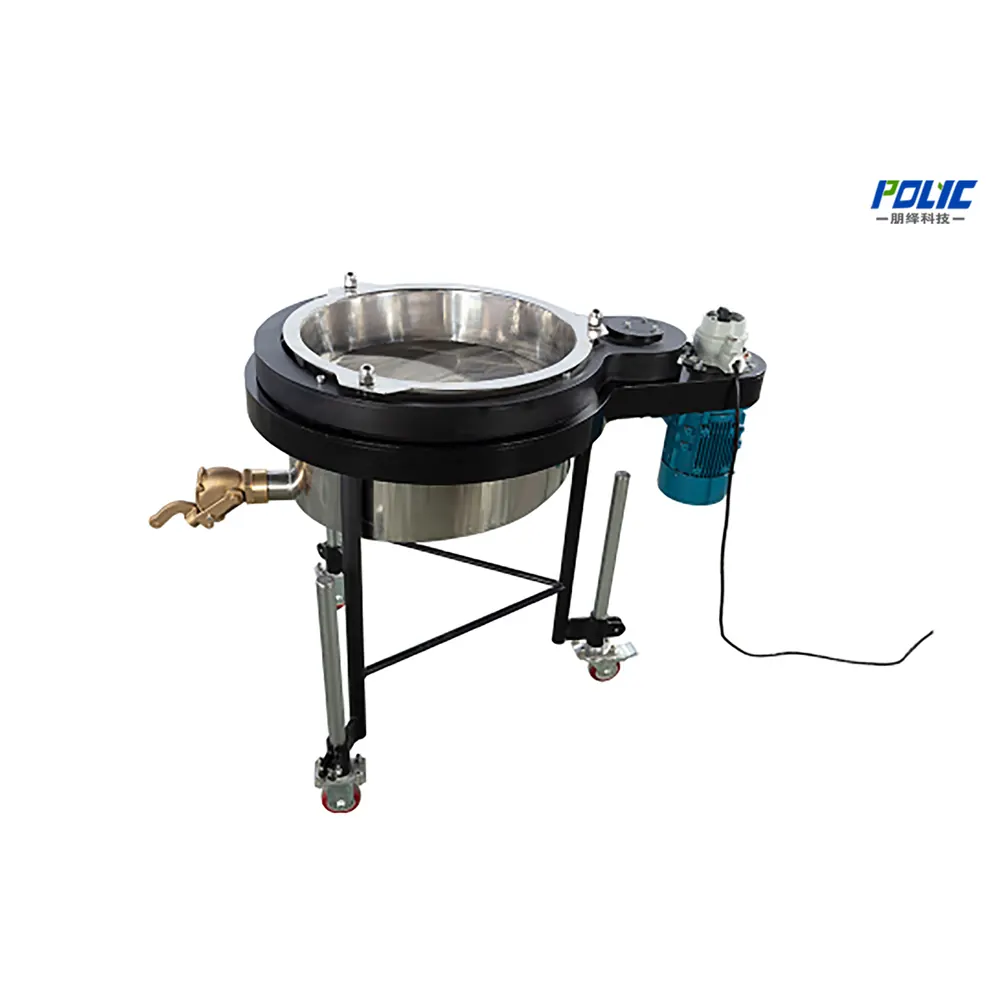
The PVS Series Industrial Vibrating Screen Sifter is a precision high-frequency screening and liquid-solid separation machine operating at 3,000 vibrations per minute (vpm). Engineered for chemical slurries, ceramic glazes, battery active pastes, coatings, inks, and fine dry powders, the PVS series creates continuous three-dimensional multi-plane kinetic motion that allows liquids to pass rapidly through screen apertures while oversized agglomerates, dried skinning flakes, and foreign contaminants are automatically discharged through the side outlet. Available in PVS450 (0.15 m2, SS304) and PVS500 (0.2 m2, aluminum) configurations with 60-200 mesh standard screens.

Key Facts

Equipment Type
Filling & Filtering
Motor Power
0.55, 0.37
Typical Applications
Coatings and paints: removal of agglomerates, skin, and oversize pigment particles before filling or bead milling., Printing inks: filtration of solvent-based and water-based inks to ensure consistent particle size and color strength., Chemical slurries: liquid-solid separation and particle classification for various industrial chemical processes., Ceramic glazes: removal of oversize particles and agglomerates from glaze formulations before application.
Response within 24 hoursEngineering consultationApplication review availableGlobal shipping supportCE · EC Declaration of Conformity availableLab to 12,000 L production scale

Request a Quote

Response within 24 hours · Engineering consultation · Application review available

Or contact us directly: [email protected] / WhatsApp +86-136-9679-4730

Description

How it works

The PVS Series Industrial Vibrating Screen Sifter is a precision high-frequency screening and liquid-solid separation machine engineered for chemical slurries, ceramic glazes, battery active pastes, coatings, printing inks, pigments, and fine dry powders. Operating at 3,000 vibrations per minute (vpm), it creates continuous three-dimensional multi-plane kinetic motion, allowing liquids to pass rapidly through screen apertures while oversized agglomerates, dried skinning flakes, and foreign contaminants are automatically discharged through the side outlet.

In complete chemical production lines, the PVS sifter serves two vital roles: installed after high-speed dispersers to protect downstream horizontal bead mills from screen clogging and dynamic seal damage, or positioned as a terminal safety sieve before automated filling and packaging. The screen hole is not easy to plug, and the quick-change design makes screen replacement and cleaning convenient and fast. It features simple operation, low work noise, and good flexibility of use during working.

The series includes two standard models: PVS450 with 0.15 m2 effective screen area in SS304 stainless steel, and PVS500 with 0.2 m2 effective screen area in cast aluminum alloy. Both models operate at 3,000 vpm with 60-200 mesh standard screens. Optional configurations include ultrasonic de-blinding systems, sanitary pharma-grade mirror finishes, and multiple voltage options (220V/380V/440V, 50Hz/60Hz) to meet different international requirements.

Product Overview & Process Integration:

The PVS Series Industrial Vibrating Screen Sifter is a precision high-frequency screening and liquid-solid separation machine. Operating at 3,000 vibrations per minute (vpm), it creates continuous three-dimensional multi-plane kinetic motion, allowing liquids to pass rapidly through screen apertures while oversized agglomerates, dried skinning flakes, and foreign contaminants are automatically discharged through the side outlet.

Two Vital Roles in Production Lines:

  1. After high-speed dispersers: Protects downstream horizontal bead mills from screen clogging and dynamic seal damage by removing oversize particles and agglomerates before milling.
  2. Before automated filling: Serves as a terminal safety sieve to ensure final product quality and protect filling equipment from contaminants and oversize particles.

Key Features:

  1. High-frequency 3,000 vpm vibration prevents screen mesh blinding, even with high-viscosity materials.
  2. Quick-change screen design enables tool-free mesh changes and cleaning in minutes.
  3. Two models: PVS450 (0.15 m2, SS304) and PVS500 (0.2 m2, cast aluminum alloy).
  4. Standard 60-200 mesh screens; optional ultrasonic de-blinding system available.
  5. Sanitary pharma-grade mirror finish (Ra) option for pharmaceutical and food applications.
  6. Multiple voltage options: 220V/380V/440V, 50Hz/60Hz for international compatibility.

Equipment Selection

Selection Principles

  • Select model based on required flow rate, material viscosity, and particle loading; PVS450 (0.15 m2) for lower throughput and PVS500 (0.2 m2) for higher capacity.

  • Choose barrel wetted material based on chemical compatibility: SS304 stainless steel for corrosive or sanitary applications, cast aluminum alloy for standard chemical and powder sieving.

  • Select screen mesh size (60-200 mesh standard) based on target particle retention rating, considering both oversize removal efficiency and required throughput.

  • Consider optional configurations: ultrasonic de-blinding system for sticky materials, sanitary mirror finish for pharmaceutical/food applications, and voltage requirements for the target market.

  • Confirm integration points: post-disperser protection for bead mills, or terminal safety sieve before filling equipment, and verify inlet/outlet connections match existing piping.

Process Engineering

Working Principle

  1. A high-frequency vertical vibration motor (3,000 vpm) generates continuous three-dimensional multi-plane kinetic motion on the screen surface.

  2. Liquid material is fed onto the center of the screen; the vibration motion spreads material evenly across the mesh while particles smaller than the mesh opening pass through rapidly.

  3. Oversized agglomerates, dried skinning flakes, and foreign contaminants move toward the screen edge and discharge automatically through the side outlet, while filtered liquid exits through the bottom outlet.

  4. Bouncing silicone cleaning balls (standard) or optional ultrasonic de-blinding transducers prevent screen mesh blinding, maintaining consistent throughput even with high-viscosity or sticky materials.

Equipment Benefits

Equipment Advantages

  • Protects downstream horizontal bead mills from screen clogging and dynamic seal damage when installed after high-speed dispersers.

  • Ensures final product quality as a terminal safety sieve before automated filling and packaging, removing oversize particles and contaminants.

  • High-frequency 3,000 vpm vibration with bouncing silicone cleaning balls prevents screen mesh blinding, maintaining consistent throughput.

  • Quick-change screen design enables tool-free mesh changes and cleaning in minutes, ideal for multi-product facilities with frequent batch changeovers.

  • Two material options (SS304 / cast aluminum alloy) and optional sanitary finish address different industry requirements and chemical compatibilities.

  • Simple operation, low work noise, and good flexibility make it suitable for both standalone use and integration into complete production lines.

Technical Data

Technical Specifications

Technical Specifications
ModelEffective Screen Area (m2)Vibration Frequency (vpm)Motor Power (kW)Standard Sieve MeshBarrel Wetted Material
PVS4500.153,0000.5560 - 200SS304
PVS5000.23,0000.3760 - 200Cast Aluminum Alloy

PRODUCT INQUIRY

Get Price & Specs for This Product

Tell us your material and capacity, our engineer will reply within 24 hours.

Equipment Guidance

Frequently Asked Questions

Are you a manufacturer or a trading company?

POLYC MACHINE is a direct manufacturer with 25 years of experience in wet grinding, dispersing and mixing equipment. Our 9,000 m2 factory in Wuxi, Jiangsu handles fabrication from cutting and welding to final assembly and testing, ensuring factory-direct pricing and full quality control.

What warranty do you offer?

We provide a 3-year warranty on complete machines from the bill of lading date, excluding wear parts. Beyond the warranty period, we offer lifetime technical support and spare parts supply. For quality issues caused by non-human factors within the warranty period, repairs and replacements are handled at no cost.

Do you support OEM or ODM?

Yes. We support OEM/ODM services including custom machine configuration, branding, voltage, paint color, and control systems. Multiple standard models are available, and we can design custom solutions for specialized applications.

How long can your machines last?

With proper maintenance, POLYC bead mills and dispersers typically serve for more than 10 years. Many customers have been running our machines for 15+ years without major issues. We use heavy-duty components and precision-machined parts to ensure long service life.

How do you control machine quality and precision?

Quality is built into every step. Our in-house fabrication line covers cutting, welding, rolling, polishing, assembling, testing, painting and packaging. An experienced engineering team continuously improves designs based on real-world customer feedback. We strictly control accuracy at each stage and never cut corners on materials or workmanship.

Engineering Features

Key Features

  • High-frequency 3,000 vpm vibration creates three-dimensional multi-plane kinetic motion, preventing screen mesh blinding and ensuring rapid liquid passage through apertures.

  • Serves two vital production roles: post-disperser protection for downstream bead mills (preventing screen clogging and seal damage), and terminal safety sieve before automated filling and packaging.

  • Quick-change screen design with bouncing silicone cleaning balls enables tool-free mesh changes and thorough cleaning in minutes, minimizing downtime between batches.

  • Two standard models: PVS450 with 0.15 m2 effective screen area in SS304 stainless steel, and PVS500 with 0.2 m2 effective screen area in cast aluminum alloy.

  • Standard 60-200 mesh screens; optional ultrasonic de-blinding transducers available for difficult-to-screen materials.

  • Optional sanitary pharma-grade mirror finish (Ra) and multiple voltage configurations (220V/380V/440V, 50Hz/60Hz) for international and regulated industry requirements.

Technical Consultation

Need help choosing the right equipment?

Tell us about your material and process. Our engineering team will recommend the right configuration.

Talk to an Engineer →
Get a Quote →WhatsApp