
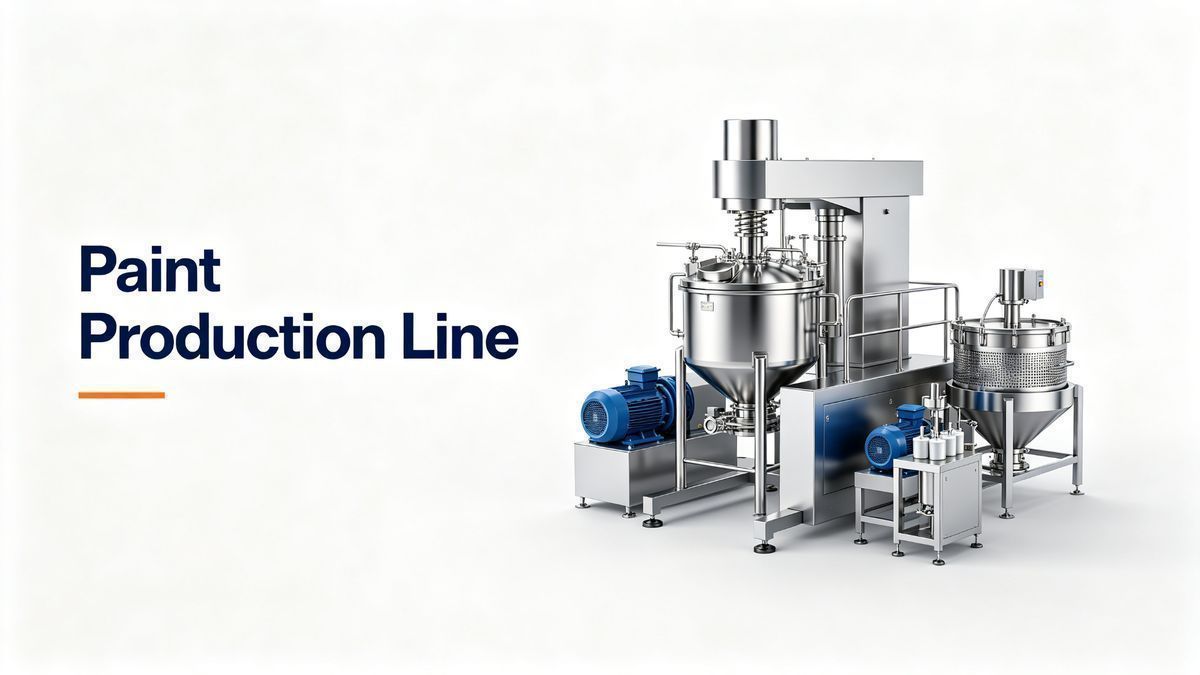
A basket mill grinds inside the production vessel, circulating material through a media-filled basket so that dispersion and fine grinding happen in one place. There is no external circuit, pump or piping, which is the source of both its main advantage and its main limitation.
The advantage is flexibility and fast changeover: the basket lifts clear for cleaning and media inspection, making the machine well suited to plants running many colours or formulations in moderate batches. The limitation is throughput, since grinding occurs in one vessel at a time and cycle time depends on batch size and viscosity.
This guide sets out how to specify a basket mill: matching vessel and basket size to your batch range, selecting media against target fineness, setting tip speed, and specifying the lift and cleaning provisions that determine changeover time. It reflects 25 years of application experience.
POLYC MACHINE builds basket mills from laboratory units to 1,000 litre production machines, specified for the batch range and changeover frequency you actually run. Send your requirements through the inquiry form.
Key Takeaways
- Match vessel and basket size to your typical batch range, since under-filling reduces efficiency
- Select media size against target fineness, and remember the basket can be lifted for inspection
- Basket mills suit batch flexibility and fast changeover rather than maximum throughput
- Specify lift height and cleaning access deliberately, since these determine changeover time
- Above roughly 150,000 cP, or for nano targets, a horizontal or nano bead mill is usually required
What a Basket Mill Does Differently
In a basket mill the grinding basket is mounted in the production vessel and lowered into the batch. An impeller inside the basket circulates material through the media, so grinding and dispersion occur in the same vessel. When the batch is complete, the basket lifts clear, leaving the finished product in the vessel ready for letdown or discharge.
This arrangement removes the external circuit entirely. There is no feed pump, no transfer piping and no separate premix vessel to clean, which makes changeover substantially faster than for a horizontal bead mill and simplifies installation into an existing plant.
The trade-off is that grinding is inherently batch. Throughput is governed by batch size, viscosity and how effectively the basket circulates material, and it does not scale in the way a continuous horizontal mill does. This is why basket mills are chosen for flexibility rather than for maximum tonnage.
Understanding this trade-off is the basis of selection. Where product variety is high and volumes moderate, the basket mill usually delivers more effective annual output. Where a few products run at high volume with contractual fineness, a horizontal mill is generally the better economic choice.
Sizing: Vessel and Basket Capacity
Basket mills are specified by working capacity, commonly from around 20 litres for laboratory and pilot units up to around 1,000 litres for production machines. The critical principle is that the vessel should be matched to your typical batch rather than to your largest occasional batch.
Efficiency falls when the machine runs well below its nominal fill, because circulation through the basket depends on there being sufficient material to move. Running a large basket mill at a fraction of its capacity therefore produces longer cycles than running a correctly sized machine, which is a common and avoidable inefficiency.
Where batch sizes vary widely, several smaller machines in parallel often give better throughput and flexibility than one large unit. This also provides resilience: if one machine is down for maintenance, production continues at reduced rate rather than stopping.
For plants evaluating capacity, list the distribution of batch sizes rather than a single figure. The most economical configuration frequently differs from the one implied by peak batch size alone, and this is worth modelling before ordering.
Media Selection and Tip Speed
Media size is selected against target fineness, with the same principle that applies to any media mill: use the largest media that still reaches specification. Typical basket mill media ranges from about 1.0 to 2.5 mm zirconia, suiting fineness in the range of roughly 5 to 20 micron depending on formulation and cycle time.
One practical advantage of the configuration is accessibility. Because the basket lifts clear, media can be inspected, screened and topped up quickly during changeover rather than requiring a separate procedure. This makes media maintenance easier to keep current, which in turn keeps fineness stable.
Tip speed should be set to reach specification at the lowest practical energy input, since excess energy becomes heat rather than finer product. Variable speed control allows the wetting and grinding stages to run at appropriate speeds and supports repeatable recipes.
Where the target fineness is below the practical capability of basket geometry, or where nano-scale grinding is required, a horizontal or nano bead mill with smaller media is the appropriate machine. Confirming achievable fineness by trial avoids specifying a basket mill for a duty it cannot meet.
Changeover, Cleaning and Lift Provisions
Changeover speed is the main reason to choose a basket mill, so the provisions that determine it should be specified deliberately. The lift must raise the basket clear of the vessel with enough height for cleaning and media access, and it should include a mechanical lock for safe working.
Cleaning is then a defined flush or wash sequence, with the basket and vessel accessible for inspection. Machines intended for frequent colour changes benefit from smooth internal geometry, good drainage and quick-release features that reduce the time between products.
A documented changeover procedure, developed during commissioning, makes the process repeatable and trainable. Where products are changed many times per shift, the time saved by a well-specified lift and cleaning provision usually exceeds the value of any marginal increase in grinding speed.
For high-viscosity products, a scraper or butterfly agitator option helps keep material moving through the basket. Where viscosity exceeds the practical window, circulation slows and grinding efficiency falls, so rheology should be reviewed before specifying.
Applications and When to Choose Otherwise
Basket mills are widely used for architectural and decorative paints, industrial coatings, printing ink bases, pigment concentrates and masterbatch, wood and furniture lacquers, leather and textile coatings, and paper coating colours. They are also common in laboratory and pilot work, where their geometry allows results to transfer to production basket mills.
They are the right choice where batch sizes are moderate, product variety is high, fineness requirements are within their range, and changeover speed matters. They are also appropriate where floor space or services are limited, because they need no external circuit.
Choose a horizontal bead mill instead where a few products run continuously at high volume, where fineness specifications are tight and contractual, or where nano-scale grinding is required. Choose a planetary mixer where viscosity exceeds the practical range for basket circulation.
Send your batch size distribution, fineness targets, viscosity data and changeover frequency through the inquiry form, and we will model whether a basket mill, a horizontal mill or a combination gives the better result for your plant.
Technical Specifications
| Parameter | Specification |
|---|---|
| Working capacity | approximately 20 - 1,000 L |
| Typical fineness | approximately 5 - 20 micron depending on media and formulation |
| Media size | 1.0 - 2.5 mm zirconia, selected against target fineness |
| Tip speed | up to approximately 12 m/s depending on model |
| Motor power | approximately 4 - 45 kW depending on capacity |
| Lift | hydraulic with mechanical lock for safe cleaning access |
| Contact material | stainless steel 304 / 316L, optional hardened alloy |
Troubleshooting Guide
1. Cycle time much longer than expected
Cause: Batch too small for the vessel, or viscosity limiting basket circulation
Solution: Match the vessel to your typical batch and review rheology; consider a scraper agitator option for higher viscosity
2. Fineness will not reach specification
Cause: Target below the practical capability of basket geometry, or media too coarse
Solution: Confirm achievable fineness by trial, use finer media, or move to a horizontal or nano bead mill for finer targets
3. Changeover takes longer than anticipated
Cause: Lift height or cleaning access inadequate for the vessel in use
Solution: Specify lift height and access for your tallest vessel, and document a validated changeover procedure
4. Fineness drifts between batches
Cause: Media wear or inconsistent cycle settings
Solution: Inspect and top up media at changeover, and standardise tip speed and cycle time as a documented recipe
5. Material does not circulate through the basket
Cause: Viscosity above the practical window for basket geometry
Solution: Review rheology at working temperature and consider a planetary mixer for high-viscosity duty
Frequently Asked Questions
1. What batch size should I specify a basket mill for?
Match it to your typical batch rather than your largest occasional one, because efficiency drops when running well below nominal fill. If batch sizes vary widely, several smaller machines in parallel often give better throughput and flexibility than one large unit.
2. What fineness can a basket mill achieve?
Typically around 5 to 20 micron depending on media, formulation and cycle time. Below that range, or for nano-scale targets, a horizontal or nano bead mill with smaller media is the appropriate machine. Confirm achievable fineness by trial before specifying.
3. Why choose a basket mill over a horizontal bead mill?
For flexibility and fast changeover. The basket lifts clear, so there is no external circuit to flush, which suits plants running many colours or formulations in moderate batches. Horizontal mills suit high-volume continuous production of fewer products.
4. How is media maintained in a basket mill?
The basket lifts clear, so media can be inspected, screened and topped up quickly during changeover. This accessibility makes media maintenance easier to keep current, which in turn keeps fineness stable between batches.
5. Can a basket mill handle high-viscosity products?
Standard units suit low to medium viscosity millbases, with a scraper or butterfly agitator option for more viscous material. Above the practical window, circulation through the basket slows and efficiency falls, so review rheology before specifying.
6. What determines changeover time?
Lift height, cleaning access, internal geometry and drainage. Specify these for your tallest vessel and document a validated flush procedure. Where products change many times per shift, time saved here usually exceeds any marginal gain in grinding speed.
7. Should I have both a basket mill and a horizontal mill?
Many plants do. Basket mills handle development, small batches and multi-colour work, while horizontal mills handle higher-volume products more economically. Modelling your batch size distribution and product mix usually shows where each belongs.
Recommended POLYC MACHINE equipment
The following machines are commonly evaluated for the process described above. Final selection depends on formulation, target particle size, viscosity, capacity and contamination limits.
Related technical guides
Next step
Share your material, required capacity, target fineness and operating conditions with POLYC MACHINE engineers for a configuration review and quotation.
Explore our Coatings solutions for application-specific equipment configurations and process recommendations.