
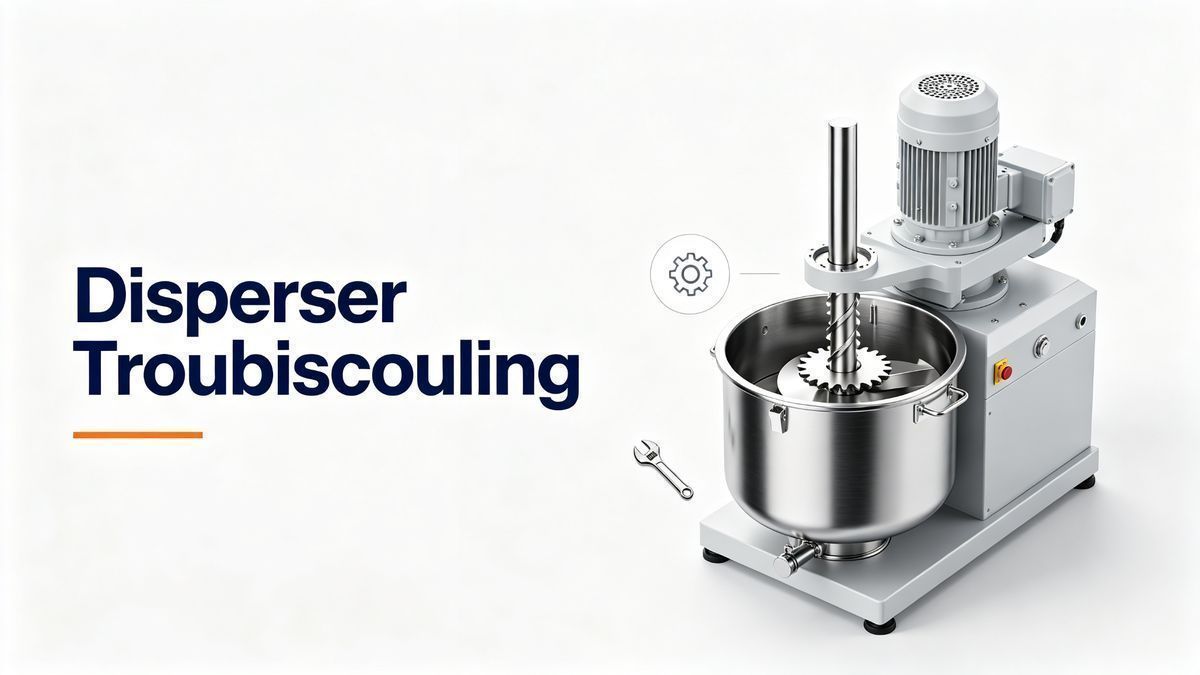
 High speed disperser problems usually present as slow dispersion, poor fineness despite long cycles, visible air entrainment, excessive temperature rise, or a vortex that reaches the disc. In most cases the cause is setup rather than machine condition, which means the correction is quick and costs nothing.
The most important variables are disc diameter relative to vessel diameter, immersion depth, tip speed, and the order in which raw materials are added. Getting these right resolves the majority of complaints; getting them wrong produces symptoms that look like equipment failure but are not.
This guide sets out each fault with its cause and correction, then covers the preventive checks worth building into a standard operating procedure. The recommendations reflect 25 years of commissioning dispersers across coatings, inks, adhesives and construction chemical plants.
High speed disperser problems usually present as slow dispersion, poor fineness despite long cycles, visible air entrainment, excessive temperature rise, or a vortex that reaches the disc. In most cases the cause is setup rather than machine condition, which means the correction is quick and costs nothing.
The most important variables are disc diameter relative to vessel diameter, immersion depth, tip speed, and the order in which raw materials are added. Getting these right resolves the majority of complaints; getting them wrong produces symptoms that look like equipment failure but are not.
This guide sets out each fault with its cause and correction, then covers the preventive checks worth building into a standard operating procedure. The recommendations reflect 25 years of commissioning dispersers across coatings, inks, adhesives and construction chemical plants.
Key Takeaways
- Most disperser faults are setup issues: disc sizing, immersion depth and tip speed
- Poor fineness despite long cycles usually means inadequate wetting, not insufficient time
- Air entrainment wastes energy because the disc works on air rather than product
- Correct disc-to-vessel ratio matters more than absolute disc diameter
- Document the validated cycle so deviations are identified before a batch fails
Fault 1: Slow Dispersion
Slow dispersion is most often a disc sizing or immersion problem. If the disc is too small relative to the vessel, circulation is inadequate and material never reliably passes through the shear zone, so the batch appears to be mixing while little deagglomeration occurs. If the disc is too large, the drive is overloaded, viscosity rises locally and motor trips become common.
Correct disc-to-vessel ratio and immersion depth resolve most cases. As a working principle, the disc should be large enough to drive material down and outward across the vessel floor, and immersed deeply enough that no vortex reaches it during normal operation. Because batch viscosity changes during addition, the correct setting often differs between the wetting stage and the dispersion stage.
Where the formulation is genuinely viscous, confirm that a disperser is the right machine at all. Above roughly 30,000 to 50,000 cP, circulation breaks down and a butterfly double-shaft mixer or planetary mixer becomes the appropriate choice rather than a larger disperser.
Fault 2: Poor Fineness Despite Long Cycles
When fineness stops improving despite extended running, the usual cause is that pigment was never properly wetted, or that tip speed is below the level the formulation requires. Wetting replaces air and moisture on the pigment surface with the vehicle, and it must happen before mechanical deagglomeration can work effectively. Running longer on poorly wetted pigment simply generates heat.
Check the order and timing of addition first. Adding pigment too quickly, or adding it before the vehicle and dispersant are properly distributed, produces persistent agglomerates that no amount of additional shear will resolve. Slow, staged addition with adequate wetting time is usually the correction.
Then confirm tip speed against the value validated during development. Tip speed, not shaft rpm, is the transferable parameter, so the same machine running at the same rpm with a different disc produces different results. If the specification still cannot be reached, the product likely requires bead milling rather than dispersion alone.
Fault 3: Air Entrainment and Foaming
Air entrainment appears as foam and as reduced efficiency, because the disc is working on air rather than product. It is caused by incorrect immersion, excessive speed, or a vortex that reaches the disc surface. Beyond the quality problem, entrained air creates surface defects and stability issues that appear later in the finished coating.
The correction is to lower speed, adjust immersion depth, and ensure adequate batch volume so the vortex cannot reach the disc. Where the formulation is foam prone, a defoamer may be needed, but mechanical causes should be eliminated first because adding defoamer to mask a setup problem introduces its own defects.
For products where air must be excluded entirely, such as moisture-curing sealants, a vacuum-rated vessel is the correct answer. Specifying vacuum capability at the design stage is far cheaper than retrofitting it once foam problems appear in production.
Fault 4: Excessive Temperature Rise
Temperature rise comes from running longer or faster than the validated cycle requires. Because viscosity is temperature dependent, overheating accelerates: warmer product shears differently, operators extend the cycle to compensate, and the batch gets hotter still. Breaking that loop starts with confirming that the documented cycle is actually being followed.
Where the vessel is jacketed, verify cooling water flow and temperature. Where it is not, and the formulation is temperature sensitive, consider specifying jacketing, since consistent temperature gives consistent dispersion results across seasons as well as within a batch.
The general principle is to reduce speed and extend time rather than to force the cycle at maximum speed. High tip speed generates heat faster than it generates dispersion once the formulation's practical shear limit is reached, so the fastest setting is rarely the fastest route to specification.
Preventive Checks for a Standard Operating Procedure
Build five checks into the standard operating procedure: disc diameter and condition, immersion depth, tip speed setting, order and rate of addition, and batch temperature at the end of the cycle. Each is quick to verify and each prevents a class of faults rather than a single symptom.
Disc condition deserves particular attention. A worn disc has a reduced effective diameter and produces different shear behaviour, so periodic inspection and replacement should be scheduled rather than reactive. This is a low-cost item with a disproportionate effect on consistency.
Documenting the validated cycle with all five parameters gives operators a reference rather than a judgement call. Plants that do this consistently report fewer failed batches and shorter cycle times, because the process is reproducible rather than operator dependent.
Root-Cause Checklist Before You Adjust Settings
Before changing speed, batch size or disc, run a short root-cause check, because most disperser faults are process faults, not machine faults. Confirm the order and rate of addition, the wetting time, the dispersant dose and the premix viscosity, then confirm the disc is the right type and is not worn. Adjusting the dial before the process is understood usually hides the cause and wastes time.
A simple log of each batch, its settings and its result, turns recurring faults into a pattern you can see. The same fault on every batch points to a fixed cause (disc, formula, vessel); a fault that appears only on one product points to that product's premix or rheology.
Disc Condition and Tip-Speed Verification
The disperser disc does the work, and a worn, bent or wrongly sized disc cannot develop the tip speed the process needs. Tip speed is the peripheral speed of the disc edge, set by rpm and diameter; when the disc wears or the drive is mismatched to the batch, the effective tip speed drops below the range that breaks agglomerates.
Verify by measuring the disc diameter, confirming the rpm against the nameplate and calculating the tip speed, then comparing it with the value the formulation was developed at. If the disc is scored or the teeth are rounded, replacement restores performance more reliably than raising the speed, which only adds heat and foam.
When a Disperser Is the Wrong Tool
| Symptom | Likely cause | First action |
| Slow dispersion, long cycles | Poor wetting or wrong disc | Check addition order, replace disc, verify tip speed |
| Coarse tail remains | Disperser cannot reach target fineness | Move to bead mill for final grind |
| Excessive foam | Too high tip speed, air entrainment | Lower speed, add defoamer, check vortex |
| Overheating | Viscosity too high for disc | Reduce solids or viscosity, control residence |
Technical Specifications
| Typical tip speed | 18 - 24 m/s for dispersion, lower for letdown and tinting |
| Disc to vessel ratio | selected to drive circulation across the vessel floor |
| Viscosity range | low to medium, up to approximately 30,000 - 50,000 cP |
| Immersion | deep enough that no vortex reaches the disc |
| Batch volume | sufficient to maintain circulation at all addition stages |
| Key checks | disc size and condition, immersion, tip speed, addition order, temperature |
Troubleshooting Guide
Dispersion is slow and fineness will not improve
Cause: Disc too small or too large for the vessel, or incorrect immersion depth
Solution: Correct the disc-to-vessel ratio and immersion depth, and confirm the speed setting is right for the current process stage
Fineness plateaus even with extended running
Cause: Pigment not properly wetted before the dispersion stage, or tip speed too low
Solution: Review the order and rate of addition with adequate wetting time, then confirm tip speed against the validated value
Foam forms during dispersion
Cause: Incorrect immersion, excessive speed, or a vortex reaching the disc
Solution: Lower speed, adjust immersion, ensure adequate batch volume, and address mechanical causes before adding defoamer
Batch overheats during the cycle
Cause: Running faster or longer than the validated cycle requires
Solution: Follow the documented cycle, verify jacket cooling where fitted, and reduce speed while extending time
Motor trips under load
Cause: Disc oversized for the vessel or product viscosity above the machine design range
Solution: Reduce disc diameter, add material in stages, or move to a high-viscosity mixer such as a butterfly double-shaft or planetary mixer
Frequently Asked Questions
Why is my disperser slow even though the motor is powerful?
Power does not compensate for poor circulation. If the disc is too small for the vessel, material never reaches the shear zone; if it is too large, the drive overloads. Correct disc-to-vessel ratio and immersion depth matter more than installed power in most slow dispersion cases.
What tip speed should I use for pigment dispersion?
Effective dispersion typically occurs in a defined tip speed range, with higher speeds improving deagglomeration but risking air incorporation and heat. Use the value validated during development rather than maximum speed, and remember that tip speed, not shaft rpm, is the parameter that transfers between machines.
How do I stop foam without adding defoamer?
Eliminate mechanical causes first: lower the speed, correct the immersion depth, and ensure the batch is large enough that no vortex reaches the disc. Adding defoamer to mask a setup problem introduces its own surface defects, so mechanical correction should come first.
Can a disperser reach the fineness my specification requires?
Many architectural coatings can be finished with dispersion alone, while industrial and automotive coatings generally need bead milling. A practical test is whether additional disperser time still improves fineness; if it plateaus while agglomerates remain, the product needs milling.
When should I move from a disperser to a high-viscosity mixer?
Once circulation breaks down, typically above about 30,000 to 50,000 cP, a disperser stops being effective regardless of power. At that point a butterfly double-shaft mixer or a planetary mixer is the appropriate machine rather than a larger disperser.
Does a worn dispersing disc really affect performance?
Yes. Wear reduces the effective disc diameter and changes shear behaviour, which is why periodic inspection and scheduled replacement matter. It is a low-cost item with a disproportionate effect on batch-to-batch consistency.
Why does my disperser make foam instead of dispersing?
Foam usually means the disc is running too fast for the viscosity and is whipping air in, or the batch level is wrong and a vortex draws air down the shaft. Lower the tip speed into the working range, keep the batch level above the disc, and add defoamer or vacuate where the product allows. If foam persists on a properly set machine, the premix rheology is the next thing to check.
Recommended POLYC MACHINE equipment
The following machines are commonly evaluated for the process described above. Final selection depends on formulation, target particle size, viscosity, capacity and contamination limits.
Related technical guides
Next step
Share your material, required capacity, target fineness and operating conditions with POLYC MACHINE engineers for a configuration review and quotation.
Explore our Fine Chemicals solutions for application-specific equipment configurations and process recommendations.