
Moagem húmida vs seca e distribuição de tamanho de partícula (d10, d50, d90)
Em resumo Ao especificar um processo de moagem, duas questões dominam: moer húmido ou a seco, e como provar que o resultado é bom? As respostas …

ENGINEERING RESOURCES
Technical articles, application guides and equipment selection resources for wet grinding, dispersion and powder processing from POLYC MACHINE.
Technical articles, selection guides, and application notes from our engineering team.Em resumo Ao especificar um processo de moagem, duas questões dominam: moer húmido ou a seco, e como provar que o resultado é bom? As respostas …

Kurz gesagt Bei der Auslegung eines Mahlprozesses dominieren zwei Fragen: nass oder trocken mahlen, und wie weist man nach, dass das Ergebnis gut ist? Beide Antworten …

Кратко Выбор мелющих тел определяет передачу энергии при каждом контакте, скорость износа, загрязнение продукта и в итоге совокупную стоимость помола. Диоксид циркония, стекло и сталь существенно …

Em resumo A escolha dos meios de moagem determina a transferência de energia por contacto, a taxa de desgaste, a contaminação do produto e, em última …

Kurz gesagt Die Wahl des Mahlkörpers bestimmt die Energieübertragung pro Kontakt, die Verschleißrate, die Produktverunreinigung und letztlich die Gesamtkosten der Mahlung. Zirkonoxid, Glas und Stahl unterscheiden …

Em resumo Depois de decidir por um moinho de esferas, a próxima decisão é a orientação: moinho de esferas horizontal vs vertical. Ambos usam o mesmo …

Kurz gesagt Sobald Sie sich für eine Perlmühle entschieden haben, ist die nächste Frage die Ausrichtung: horizontale versus vertikale Perlmühle. Beide nutzen dasselbe Prinzip — ein …

Em resumo Moinhos de esferas e moinhos de bolas reduzem ambos o tamanho de partícula usando corpos moedores, mas diferem fundamentalmente na forma como a energia …

Kurz gesagt Perlmühlen und Kugelmühlen verkleinern Partikel beide mit Mahlkörpern, unterscheiden sich jedoch grundlegend in der Art, wie die Energie eingebracht wird. Eine Kugelmühle nutzt die …

Kurz gesagt Wenn Sie eine Perlenmühle auslegen, bestimmt eine Entscheidung alles Weitere: Charge oder kontinuierlich. Eine Chargenmühle mahlt eine feste Charge in einem geschlossenen Behälter; eine …

Em resumo Ao especificar um moinho de esferas, uma decisão define tudo o resto: lote ou contínuo. Um moinho de lote moí uma carga fixa em …

Kurz gesagt Bei der Bewertung von Nassmahltechnik für Farben, Druckfarben und Beschichtungen ist der Vergleich zwischen der Korbmühle und der Perlenmühle einer der häufigsten — und …

Em resumo Ao avaliar equipamentos de moagem úmida para tintas, tintas de impressão e revestimentos, a comparação entre o moinho de cesto e o moinho de …

المبعثرات عالية السرعة مصنع ومطاحن الخرز مورد كثيراً ما تُقارَن كما لو كانتا بديلين لبعضهما، لكنهما تؤديان وظيفتين مختلفتين في عملية التشتيت. فالمبعثر يبلل الصبغة ويفكك …

Kurz gesagt Für Hersteller, die Pigmentpasten, Batteriesuspensionen, Keramikdruckfarben oder pharmazeutische Suspensionen verarbeiten, stellt sich die Frage Sandmühle vs Perlmühle bei nahezu jeder Gerätebewertung. Beide Begriffe werden …

Em resumo Para fabricantes que processam pastas de pigmento, suspensões para baterias, tintas cerâmicas ou suspensões farmacêuticas, a pergunta moinho de areia vs moinho de esferas …
No resources match your search. Try another topic or filter.
THANK YOU
START A TECHNICAL DISCUSSION
Our guides explain wet grinding and dispersion in principle. Share your material and target fineness, and our engineers will translate it into a concrete equipment selection.
Ask an Engineer →POLYC's technical resources cover wet grinding, dispersion and mixing across the process chain — bead mills, high-speed dispersers, mixers and complete production lines — with application guides for coatings, inks, pigments, battery materials, ceramics, pharmaceuticals and agrochemicals, plus equipment selection and process scale-up from laboratory to production.
A high-speed disperser is typically used for pre-mixing and coarse dispersion of lower-viscosity batches; a bead mill is used for fine and sub-micron grinding where particle-size distribution, gloss or transparency matter. Many processes use both — disperse first, then mill. The right choice depends on your target fineness, viscosity, batch size and throughput.
The guides cover laboratory, pilot and production scales. For a specific recommendation, share your material, target particle size (D50/D90), batch size and throughput — POLYC engineers can map the guidance to your process and suggest suitable equipment configurations.
PRESENTATION LIBRARY
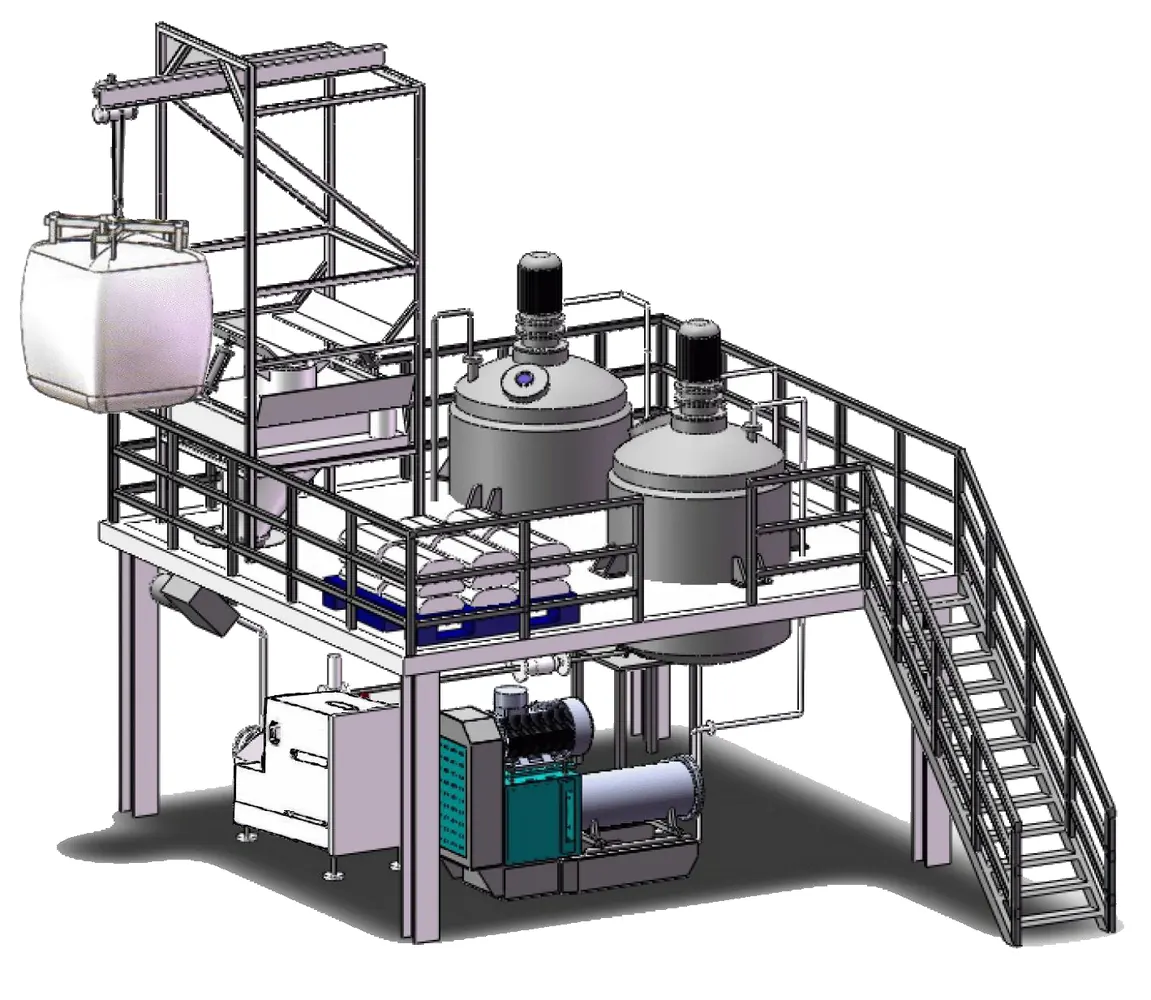
Inline dispersion, horizontal bead milling and complete ink production workflows.
View web presentation →
Manufacturing capability, core equipment and integrated production solutions.
View web presentation →