
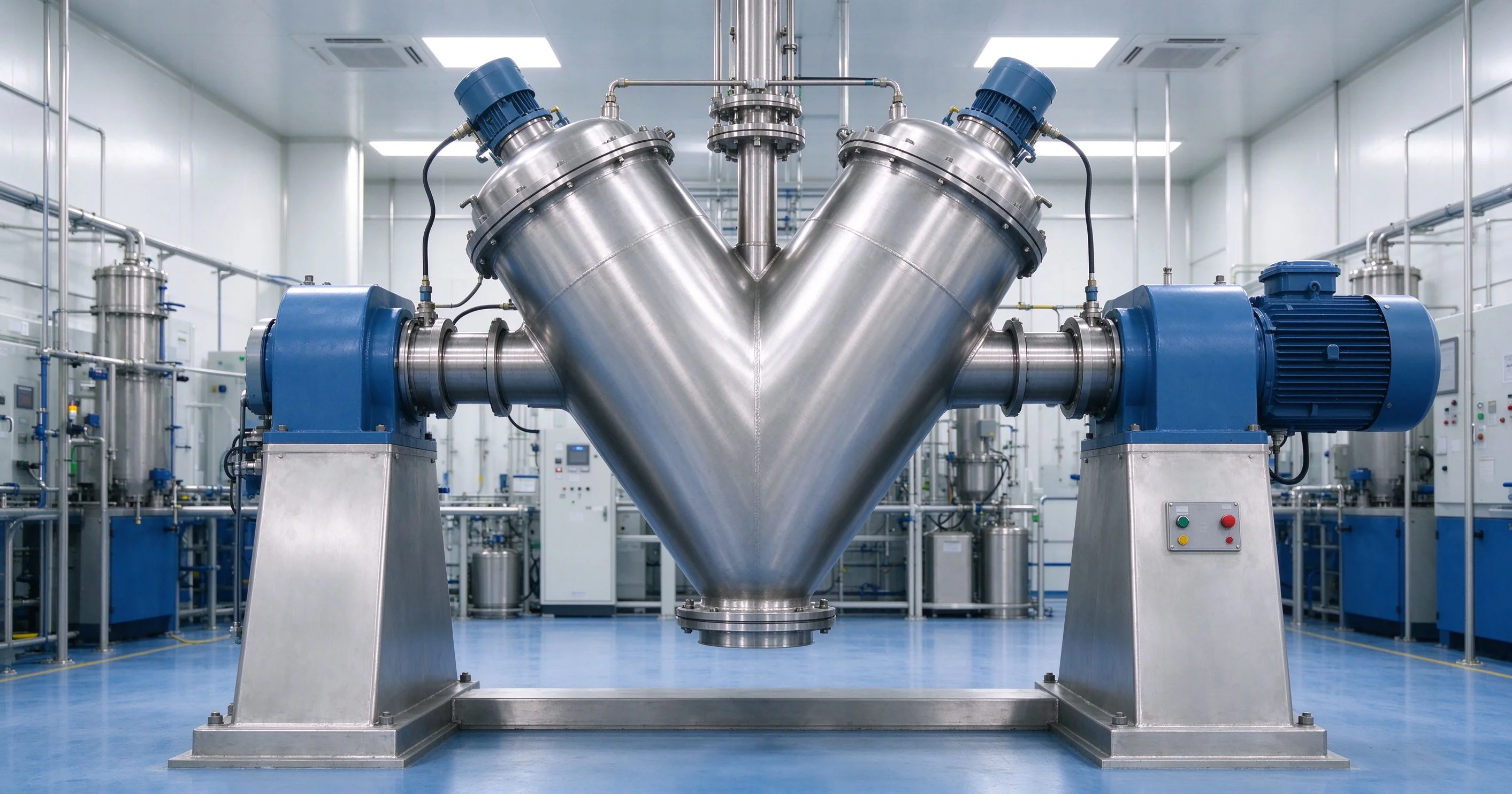
A practical engineering reference for specifying, sizing, and operating V-type tumble blenders for dry powder mixing.
What Is a V Blender?
A V blender — also called a V mixer or tumble blender — is a batch-type dry powder mixing machine consisting of two cylindrical shells welded together at an angle of 75° to 90°, forming a V-shaped vessel. The entire assembly rotates around a horizontal axis, causing the powder inside to cascade, divide, and recombine repeatedly until a homogeneous blend is achieved.
What sets the V blender apart from agitator-based mixers is the absence of internal stirring elements. There are no paddles, ribbons, or screws inside the vessel. All mixing energy comes from the rotation of the shell itself, which creates an avalanche-like diffusive motion as the material falls from one leg of the V into the other.
This design brings two distinct advantages:
- Gentle mixing action. Because there is no agitator shearing the product, particle degradation is minimal. This makes the V blender especially valuable for fragile granules, heat-sensitive materials, and high-purity applications where mechanical damage must be avoided.
- Easy cleaning and full discharge. The smooth V-shaped interior has no crevices where product can accumulate. Clean-in-place is straightforward, and the geometry ensures nearly complete discharge with minimal residue — a critical requirement in pharmaceutical and food processing.
The trade-off is that V blenders work best with free-flowing powders. Cohesive or sticky materials that resist tumbling may not achieve sufficient dispersion, and in those cases a plough shear mixer or a V blender with an intensifier bar is typically the better choice.
Where V Blenders Are Used
V blenders are among the most widely used dry powder mixers in process industries. Their simplicity, reliability, and cleanability make them a standard choice for small-to-medium batch operations. Typical applications include:
| Industry | Common Uses |
|---|---|
| Food & Beverage | Premixes, cereal blends, coffee mixes, dairy powders, vitamin fortification, soup bases, spice blends |
| Pharmaceutical | Powder blending prior to granulation, tablet premixes, excipient mixing |
| Plastics | Masterbatch dilution, pellet blending, color compounding |
| Chemicals | Metallic powder mixtures, mineral blends, detergent powders |
| Construction | Steel pre-blends, dry mortar additives |
| Cosmetics | Powder foundations, blush, dry shampoo formulations |
At POLYC, our V-Shape Powder Mixer is engineered specifically for high-purity dry powder blending, with a capacity range of 5 L to 2000 L and optional intensifier bars for applications that require additional shear.
How V Blenders Work: The Mixing Mechanism
Understanding the mixing mechanism is essential for proper operation and scale-up.
When the V vessel rotates, the powder is carried upward along the rising leg and then cascades down into the descending leg. This creates a continuous diffusive mixing process in which particles are repeatedly divided between the two cylinders and recombined at the junction. After a sufficient number of rotations — typically 10 to 15 minutes for most formulations — an optimum homogeneity is reached.
Key characteristics of this mechanism:
1. No internal agitator. All motion is driven by shell rotation. This eliminates shear damage but also means the mixer relies entirely on the free-flowing nature of the product.
2. Avalanche effect. The powder behaves like a landslide inside the rotating vessel. The quality of mixing depends on having enough free space inside the vessel for this avalanche to develop properly.
3. Symmetrical loading matters. If all of ingredient A is loaded into one leg and all of ingredient B into the other, mixing time increases dramatically. Layered loading — with minor ingredients placed between major components — is the recommended practice.
4. Demixing risk. Because the action is purely diffusive, V blenders can be susceptible to segregation if the blend has large particle-size or density differences. This must be monitored during process validation.
Key Operating Parameters
Filling Ratio: 40% to 70% of Total Volume
The single most important operating parameter is the fill level. Tumble blenders require empty space inside the vessel for the powder to roll over and diffuse between the two legs.
| Fill Level | Effect |
|---|---|
| 40% | Optimum diffusion, shortest mixing time |
| 50% | Good balance of capacity and mixing efficiency |
| 60% | Acceptable, but mixing time may increase up to 3× vs. 40% |
| 70% | Maximum practical limit; mixing time roughly doubles vs. 50% |
| >70% | Not recommended — insufficient space for avalanching, very long mixing times |
A common rule of thumb: divide your target batch weight by the powder's loose bulk density to get the working volume, then divide by 0.50 to get the required total vessel volume. This keeps the fill in the 40%–60% sweet spot for most products.
Mixing Speed and Critical Rotation
V blenders have a critical speed — the rotational rate at which centrifugal force equals gravitational force, pinning the powder to the vessel walls and preventing mixing entirely.
The critical speed can be estimated as:
N_crit ≈ 42.3 / √R_swing
where R_swing is the maximum radius from the shaft centerline to the tip of the V cylinders (in meters), and N_crit is in RPM.
The optimum operating speed is typically 50% to 80% of critical speed. For medium-size blenders (500–2000 L), this usually falls in the range of 10 to 25 RPM, with larger machines running slower.
An important nuance: for free-flowing powders, the total number of rotations matters more than the rotation rate itself (as long as speed is well below critical). This allows approximate scale-up by keeping the total number of rotations constant between lab and production sizes — though this approach should always be validated with actual product trials.
Loading Method
How you load the blender has a surprisingly large impact on mixing time:
- Layered loading is preferred: add major components first, then minor ingredients in the middle, then top with the remaining major component.
- Symmetrical distribution: if the fill level is above the junction of the two cylinders, distribute equal amounts into both legs.
- Minor ingredients should represent at least 1% of the total batch. Below this threshold, mixing time increases significantly and homogeneity becomes harder to verify.
Mixing Time and Power
- Typical mixing time: 10–15 minutes for most free-flowing blends.
- Power input: relatively low, in the range of 1–3 kW per m³ of vessel volume.
- Factors that extend mixing time: overfilling, non-free-flowing material, large particle/density differences, incorrect loading sequence.
How to Size a V Blender
Step 1: Calculate Working Volume
Determine the required working volume from your target batch weight:
V_working (m³) = Batch weight (kg) ÷ Bulk density (kg/m³)
Example: 500 kg batch, powder bulk density 800 kg/m³ → V_working = 500 ÷ 800 = 0.625 m³ = 625 L
Step 2: Calculate Total Vessel Volume
Apply a filling factor of 0.40 to 0.70 (0.50 is a safe default):
V_total = V_working ÷ Filling factor
Example: 625 L ÷ 0.50 = 1250 L → select a 1500 L model from the catalog
Step 3: Calculate Throughput
The hourly throughput depends on the full cycle time:
t_cycle = t_load + t_mix + t_discharge (minutes)
m_throughput (kg/h) = V_total × r × ρ × 60 ÷ t_cycle
Where:
- r = filling ratio (0.4–0.7)
- ρ = bulk density (kg/m³)
- V_total = total vessel volume (m³)
Example: 1.25 m³ vessel, fill 0.5, density 800 kg/m³, cycle 20 min → m = 1.25 × 0.5 × 800 × 60 ÷ 20 = 1,500 kg/h
Typical Sizing Reference
| Vessel Size | Typical Batch (50% fill) | Motor Power | Typical Speed |
|---|---|---|---|
| 100 L | 40–60 kg | 1.1–1.5 kW | 20–30 RPM |
| 500 L | 200–300 kg | 2.2–3.0 kW | 15–20 RPM |
| 1000 L | 400–600 kg | 4.0–5.5 kW | 12–18 RPM |
| 1500 L | 600–900 kg | 5.5–7.5 kW | 10–15 RPM |
| 2000 L | 800–1200 kg | 7.5–11 kW | 8–12 RPM |
Note: Actual parameters vary by manufacturer and application. Always consult the supplier for specific recommendations.
Loading, Discharge & Instrumentation
Loading
Because the entire shell rotates, the blender must be disconnected from upstream and downstream process piping during the mixing cycle. Loading is typically done manually through the two charging ports on top of the V. For dust-sensitive operations, the blender can be positioned at a dedicated tipping station with flexible connections — though some operator intervention remains necessary.
Discharge
The discharge valve is typically a manually operated butterfly valve located at the bottom apex of the V. The V geometry itself promotes complete discharge. For automated processes, pneumatic or electric actuated valves can be specified, and flexible sleeves can be connected to downstream equipment.
Instrumentation
V blenders are inherently simple machines, and instrumentation is usually limited to:
- Mixing timer — the primary control parameter
- Rotation speed controller — variable frequency drive for speed adjustment
- Optional NIR (Near-Infrared) sensor — mounted along the mixer axis to monitor blend homogeneity in real time and optimize mixing cycles
ATEX and Safety Considerations
Explosion Protection (ATEX)
If the blender handles powders capable of forming explosive dust clouds, an ATEX risk assessment is mandatory. Risk areas include:
- Inside the vessel during mixing
- Around the charging ports during loading
- At the discharge point during unloading
- Spill zones in case of powder release during rotation
The blender itself, motor, and controls must be rated for the appropriate ATEX zone (typically Zone 22 for dust). Explosion venting or suppression may be required depending on the dust characteristics.
Mechanical Safety
- Safety cage: A guard must enclose the rotating vessel, high enough to prevent operator access to the mixing area.
- Door interlock: The mixer must not start if the safety door is open, and the door must lock when the mixer is running.
- Flexible connection sensors: If flexible sleeves are used for loading or discharge, proximity switches should prevent rotation while sleeves are still connected.
Special V Blender Designs
Asymmetrical Vessels
A standard V blender uses two equal-length cylinders. An asymmetrical design uses cylinders of different lengths, which creates an imbalance that promotes material transfer between the two legs. This can:
- Reduce segregation tendencies
- Shorten mixing time
- Improve consistency for difficult blends
The same effect can sometimes be achieved by adding internal baffles, though baffles reduce cleanability and accessibility — a significant drawback in pharmaceutical and food applications. Note that baffles improve mixing by breaking symmetry but do not add shear.
Intensifier Bars
For cohesive powders or blends that tend to agglomerate, some manufacturers offer an intensifier bar — a high-speed rotating shaft mounted along the mixer axis, equipped with blades or spray nozzles.
The intensifier bar adds localized shear mixing to the otherwise purely diffusive tumbling action, helping to break up agglomerates and disperse cohesive components.
However, this comes with trade-offs:
- Particle degradation: the high-speed agitator can cause significant attrition, which may be unacceptable for fragile materials
- Cleaning complexity: the intensifier bar adds internal surfaces that must be cleaned
- Cost: additional motor, seals, and controls increase capital cost
POLYC's V-Shape Powder Mixer is available with an optional intensifier bar for applications requiring liquid addition or deagglomeration. For purely cohesive powders that tumbling cannot handle, consider our Horizontal Plough Shear Mixer instead.
Common Problems and Fixes
| Problem | Root Cause | Solution |
|---|---|---|
| Mixing time too long | Overfilling (>70%) | Reduce batch size to 40–60% fill |
| Mixing speed too low | Increase RPM toward 70–80% of critical | |
| Incorrect loading sequence | Use layered loading; place minor ingredients between majors | |
| Non-free-flowing material | Consider intensifier bar or switch to plough shear mixer | |
| Product damage / breakage | Excessive mixing time | Optimize cycle time to minimum needed for homogeneity |
| Intensifier bar running too fast | Reduce intensifier speed or remove it | |
| Segregation after mixing | Large particle/density differences | Minimize handling after discharge; consider binder addition |
| Overfilling causing dead zones | Reduce fill level | |
| Incomplete discharge | Product buildup at junction | Improve discharge procedure; inspect for product accumulation |
| High residue | Static buildup or cohesive product | Consider surface treatment or intensifier bar |
How to Choose the Right V Blender
When sourcing a V blender for your process, answer these questions before requesting a quotation:
1. What is the target batch weight and hourly throughput? This determines the vessel size.
2. What is the bulk density of your product? Needed for volume calculation.
3. Is the product free-flowing? If not, you may need an intensifier bar or a different mixer type.
4. What mixing time and cycle time are required? Affects throughput calculation and motor sizing.
5. How will the blender be loaded and discharged? Manual vs. automated, dust control requirements.
6. Is an ATEX environment involved? Determines certification and explosion protection needs.
7. What material of construction is required? 304 stainless steel is standard; 316L for corrosive or high-purity applications.
8. Do you need an intensifier bar? For liquid addition, deagglomeration, or cohesive powders.
9. What is your available floor space and ceiling height? V blenders require headroom for the rotating vessel.
For high-purity dry powder blending in pharmaceutical, food, cosmetic, fine chemical, or ceramic applications, the POLYC V-Shape Powder Mixer offers a 5–2000 L capacity range, optional intensifier bar, CE certification, and custom engineering to match your specific process requirements. Our engineers can review your formulation, target fineness, and batch volume to recommend the optimal configuration.
Frequently Asked Questions
How is a V blender's required total size calculated?
Divide your target batch weight by the loose bulk density of your powder to obtain the working volume, then divide by a filling factor of 0.40 to 0.60 (0.50 is typical). Because tumble mixers rely on avalanche-like diffusive action, keeping the vessel filled within 40% to 60% of its water capacity is necessary to allow particles to roll over and slide between the cylinders.
What is the critical speed of a tumble blender?
The critical speed is the rotational rate at which centrifugal force equals gravitational force, pinning the powder to the vessel walls and preventing mixing. It is approximately N_crit ≈ 42.3 / √R_swing, where R_swing is the maximum radius from the shaft centerline to the tip of the V cylinders. The optimum operating speed is 50% to 80% of critical speed.
What is an intensifier bar inside a V blender?
An intensifier bar is a high-speed, motorized internal shaft carrying blades or spray nozzles, designed to introduce shear forces to cohesive powders during tumbling. While standard tumbling is purely diffusive, the intensifier bar provides localized mechanical dispersion to break up agglomerates — though it can cause significant particle attrition.
Can a V blender handle cohesive powders?
Standard V blenders without an intensifier bar are best suited to free-flowing powders. For cohesive materials, options include: adding an intensifier bar, switching to a plough shear mixer, or pre-treating the product to improve flow. Always conduct trials with your actual product before finalizing equipment selection.
How long does a typical V blender cycle take?
Mixing alone typically takes 10–15 minutes for free-flowing products. The full cycle (loading + mixing + discharge) usually ranges from 15 to 30 minutes depending on batch size, automation level, and material handling setup.
Need Help Selecting the Right Mixer?
Not sure whether a V blender, ribbon mixer, or plough shear mixer is right for your application? Send us your formulation, target bulk density, batch volume, and required throughput. Our engineers review every inquiry before issuing a quotation — and we can arrange material testing to validate the mixing process before you commit.
Request a Quote for V-Shape Powder Mixer →
Or explore our full range of Powder Mixers, including Ribbon Mixers, Horizontal Paddle Blenders, and Plough Shear Mixers.
Published: September 2026 | Author: POLYC Engineering Team | Category: Powder Mixing Technology
Explore our Food & Beverage solutions for application-specific equipment configurations and process recommendations.