
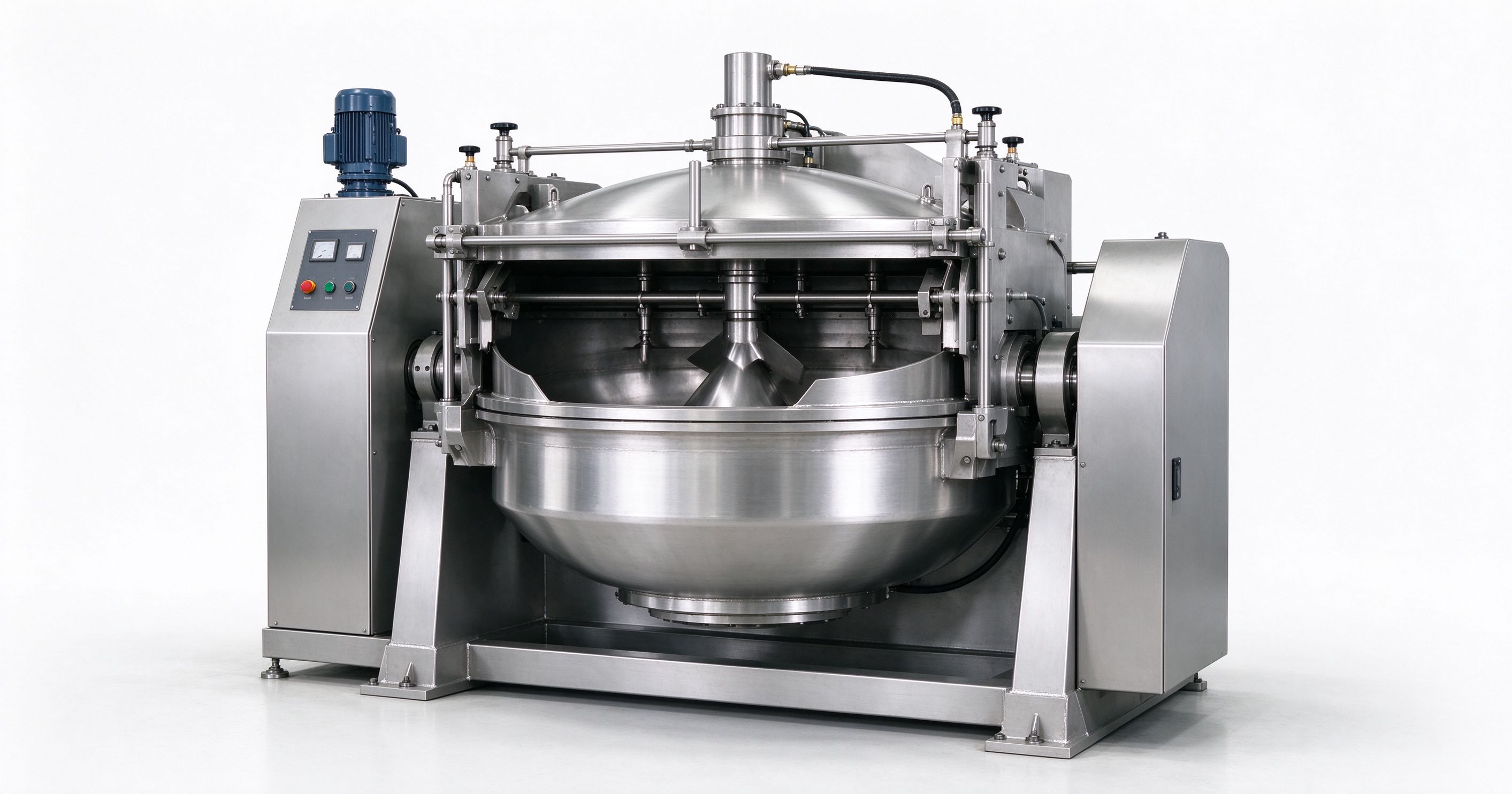
A basket mill is a batch wet grinding system that combines dispersion and milling in a single vessel. The milling basket, charged with grinding media, is immersed in the product and agitated by an internal impeller. Product circulates through the basket, is ground by the media, and returns to the vessel, repeating until the target fineness is reached.
Basket mills are especially suited to production environments with frequent product changeovers, such as ink plants, pigment paste production and custom coating manufacturing. Because the product stays in one vessel and the basket is the only wetted grinding assembly, cleaning between batches is fast and product loss is minimal.
However, the performance of a basket mill depends heavily on correct operation and maintenance. An improperly charged basket, incorrect impeller speed or neglected separator can reduce throughput by 30-50%, produce inconsistent fineness batch to batch, and lead to premature wear. This guide covers the complete operating procedure, from initial setup and media charging to preventive maintenance and troubleshooting.
How a Basket Mill Works
A basket mill consists of three main components: the milling basket, the agitator shaft and impeller, and the lifting mechanism.
During operation, the rotating impeller creates a low-pressure zone at the center of the basket and a high-pressure zone at the periphery. Product is drawn into the basket through the bottom, passes through the grinding media where particle size reduction occurs, and exits through the sides and top back into the vessel. This circulation continues until the entire batch reaches the target fineness.
The key advantage of this design is that the product vessel remains stationary. The basket can be lifted out, cleaned, and lowered into a different vessel with a different product, enabling rapid changeover without draining and cleaning piping, pumps or horizontal mill chambers.
Initial Setup and Media Charging
Media Selection
| Target Fineness (D90) | Recommended Bead Size | Media Material |
|---|---|---|
| 10-20 µm | 1.5-2.0 mm | Zirconia (YTZ) |
| 5-10 µm | 0.8-1.2 mm | Zirconia (YTZ) |
| 2-5 µm | 0.5-0.8 mm | Zirconia (YTZ) |
| 1-2 µm | 0.3-0.5 mm | Zirconia (YTZ) |
For most ink and coating applications, yttria-stabilized zirconia (YTZ) is the standard media. Its high density (6.0 g/cm³) delivers efficient grinding, and its chemical inertness prevents contamination.
Charge Volume
The basket should be charged to 80-90% of its usable volume. Undercharging reduces the number of active grinding points and lowers throughput. Overcharging can cause the media bed to lock up, preventing product circulation and causing excessive power draw.
To charge the basket: ensure it is clean and dry, weigh the required amount of media (calculate from basket volume x 85% x media bulk density ~3.8 kg/L for zirconia), pour media into the basket through the top opening, and distribute evenly by gently rotating the basket.
Operating Parameters: Speed, Time and Viscosity
Impeller Speed
Impeller tip speed is the primary control parameter. Typical range is 8-12 m/s. Lower speeds (6-8 m/s) suit high-viscosity products and fine media. Medium speeds (8-10 m/s) are standard for most coatings and inks. Higher speeds (10-12 m/s) suit low-viscosity products and coarse media when maximum throughput is needed.
Excessive tip speed causes accelerated media and basket wear, higher product temperature, and increased risk of media fracture. Insufficient tip speed causes poor circulation and longer batch times.
Batch Time
| Product Type | Target D90 | Typical Batch Time |
|---|---|---|
| Architectural coatings | 10-20 µm | 20-40 min |
| Industrial coatings | 5-10 µm | 30-60 min |
| Printing inks | 2-5 µm | 45-90 min |
| Pigment concentrates | 1-3 µm | 60-120 min |
Monitor fineness at regular intervals using a Hegman gauge or particle size analyzer. Stop when the target is reached, as over-milling wastes energy and can cause particle reagglomeration in some systems.
Viscosity Management
Product viscosity significantly affects basket mill performance. Above 5,000 cP, product cannot circulate effectively. The optimal range is 500-3,000 cP. If viscosity is too high, dilute with solvent or water before milling.
Batch Procedure: From Premix to Discharge
Step 1: Premix Preparation. Charge solvent/water and resin, start disperser at low speed, add pigment gradually, add dispersants and additives, mix for 15-30 minutes until homogeneous.
Step 2: Milling. Lower the basket into the premix, start impeller at low speed, gradually increase to target speed over 2-3 minutes, monitor power draw, check fineness at 15-minute intervals, reduce speed gradually when target is reached, lift basket and allow to drain.
Step 3: Letdown and Discharge. Add letdown ingredients, mix at low speed for 10-15 minutes, adjust viscosity and color, filter and discharge.
Cleaning and Product Changeover
The basket mill's main advantage is fast cleaning between batches. Standard cleaning takes 10-20 minutes: lift basket and drain for 2-3 minutes, lower into cleaning solvent, run at medium speed for 5-10 minutes, lift and drain, repeat with fresh solvent if needed, inspect basket interior and separator, wipe exterior.
For color change or long shutdown, perform a deep clean: remove media, inspect and clean separator screen with a soft brush, clean impeller and shaft, check gaskets and seals, recharge with fresh media if needed.
Always clean immediately after use, as dried product is much harder to remove. Never use metal brushes or scrapers on the separator screen.
Preventive Maintenance Schedule
| Frequency | Tasks |
|---|---|
| Daily | Check media charge level, inspect separator, verify impeller rotates freely, check shaft seal for leaks, ensure cooling water flows |
| Weekly | Inspect basket exterior for dents, check impeller blades for wear, verify fasteners tight, clean separator screen |
| Monthly | Remove and inspect media, measure size distribution, inspect separator gap with feeler gauge, check shaft alignment |
| Quarterly | Replace media if worn >20%, replace separator if worn, inspect shaft seal, check gearbox oil |
| Annually | Complete disassembly and inspection, replace all gaskets and seals, inspect basket interior, motor service |
Common Operational Problems and Solutions
| Problem | Likely Cause | Solution |
|---|---|---|
| Low throughput, long batch time | Undercharged basket, incorrect bead size, high viscosity | Check charge volume, verify bead size, reduce viscosity |
| Inconsistent fineness batch to batch | Worn media, clogged separator, varying premix quality | Replace media, clean separator, standardize premix |
| High product temperature | Excessive speed, overcharged basket, cooling failure | Reduce speed, check charge volume, verify cooling water |
| Media escaping into product | Damaged separator, incorrect gap | Inspect and replace separator |
| High power draw / motor overload | Overcharged basket, excessive speed, high viscosity | Reduce charge, lower speed, dilute product |
| Basket vibration / noise | Worn bearings, misaligned shaft, fractured media | Inspect bearings, check alignment, replace media |
| Separator clogging | Fractured media, high solids, bead size too small | Replace media, reduce solids, increase bead size |
| Shaft seal leaking | Worn seal, incorrect pressure | Repack or replace seal |
Wear Parts and Replacement Intervals
| Part | Typical Service Life | Replacement Indicator |
|---|---|---|
| Grinding media (zirconia) | 6-18 months | Size reduced >20%, throughput drop >15% |
| Separator screen | 12-24 months | Visible wear, media escape, increased pressure |
| Impeller blades | 12-36 months | Visible wear, reduced pumping action |
| Shaft seal | 12-24 months | Leakage, product buildup around seal |
| Basket shell | 3-5 years | Thinning, dents, perforation |
| Bearings | 3-5 years | Noise, vibration, temperature rise |
Technical Specifications
| Parameter | Typical Range |
|---|---|
| Batch size | 30-1,500 L |
| Media material | Yttria-stabilized zirconia |
| Bead size | 0.3-2.0 mm |
| Charge volume | 80-90% of basket |
| Tip speed | 8-12 m/s |
| Motor power | 7.5-132 kW |
| Operating viscosity | 500-5,000 cP |
| Operating temperature | <50-60°C |
| Typical fineness (D90) | 2-20 µm |
| Cleaning time | 10-30 min between batches |
Frequently Asked Questions
How do I know when to replace the grinding media?
Replace media when average bead size has decreased by 20% from original, throughput has dropped by more than 15% with no other changes, particle size distribution has widened, or visual inspection shows significant fractured or chipped beads. A simple test: sieve a media sample and compare size distribution to new media.
Can I use glass media instead of zirconia in a basket mill?
Glass media can be used for coarse grinding (above 20 µm) but is not recommended for finer targets. Its lower density (2.5 g/cm³ vs 6.0 for zirconia) reduces grinding efficiency, and it wears faster. For most ink and coating applications, zirconia is more cost-effective despite higher initial cost.
Why is my basket mill vibrating?
Vibration is usually caused by worn bearings, misaligned shaft, fractured or unevenly distributed media, or loose mounting bolts. Stop the machine immediately and inspect. Continued operation with vibration can cause catastrophic failure.
How deep should the basket be submerged?
The product level should be at least 100 mm above the top of the basket. If the basket is not fully submerged, air can be drawn into the media bed, causing foaming, reduced efficiency and increased wear.
Can I run a basket mill continuously?
Basket mills are designed for batch operation. Continuous operation is possible with a recirculation loop, but the basket must remain fully submerged and the product must be monitored for temperature buildup. For true continuous production, a horizontal bead mill is usually more efficient.
What is the typical energy consumption per batch?
Energy consumption depends on product hardness, target fineness and batch size. Typical range is 0.1-0.5 kWh per kg of product for coatings, and 0.3-1.0 kWh/kg for inks and pigment concentrates. Monitor energy use as an indicator of media wear and process efficiency.
Recommended POLYC MACHINE Equipment
- PBM Series Basket Mills — 30-1,500 L capacity, hydraulic lift, variable speed drive. Suitable for inks, coatings, pigments and color pastes.
- PBM-Lab Basket Mill — 2-10 L capacity for formulation development and scale-up.
- Complete Ink Production Lines — integrated premix, basket milling, letdown and filling systems with PLC control.
Related Technical Guides
- How to Choose a Bead Mill for Ink and Paint
- Zirconia Grinding Media Guide
- Horizontal Bead Mill vs Basket Mill Compared
- Ink Production Process Deep Dive
Next Step
Share your product type, batch size, target fineness and current operating parameters through the inquiry form. POLYC MACHINE engineers will review your application and recommend a basket mill size, media specification and optimized operating parameters, with a detailed maintenance schedule tailored to your production schedule.