
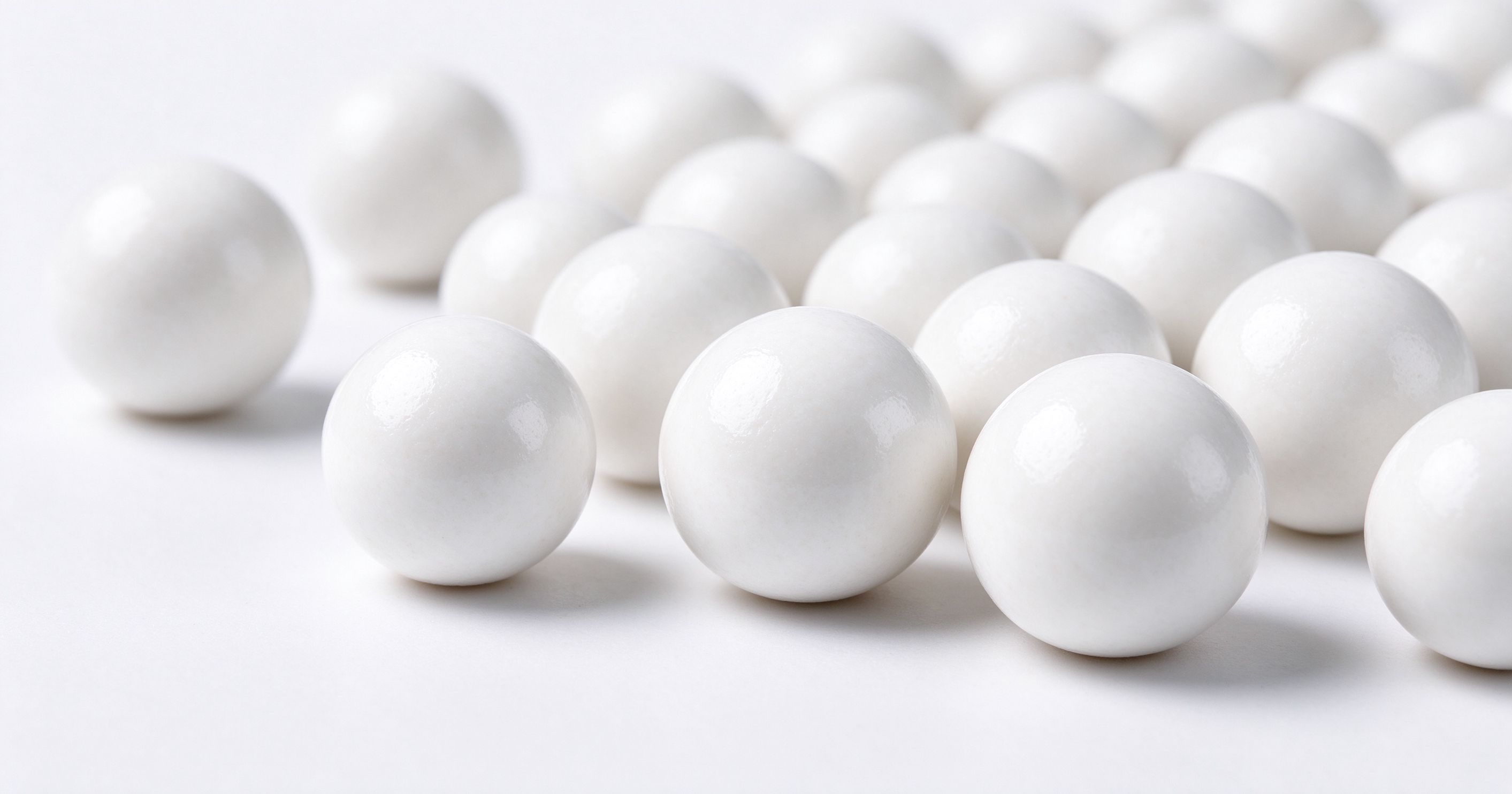
Zirconia grinding media is the standard choice for fine and ultrafine wet milling in inks, coatings, pigments, ceramics and battery materials. Its high density, chemical inertness and low wear rate make it more cost-effective than glass or steel media for most production applications below 10 microns.
This guide covers how to select the right zirconia media type and bead size, how to charge a mill correctly, how wear affects performance, and how to manage media replacement to keep fineness and throughput consistent batch after batch. POLYC MACHINE supplies bead mills and basket mills from laboratory to production scale, with over 25 years of application experience in wet grinding and dispersion.
Why Zirconia Dominates Wet Grinding
Grinding media performance depends on four properties: density, hardness, fracture toughness and chemical inertness. Zirconia leads on all four for fine wet milling.
| Media Type | Density (g/cm³) | Hardness (Mohs) | Typical Use |
|---|---|---|---|
| Glass | 2.5 | 5.5 | Coarse grinding >20 µm, low cost |
| Zirconia-silicate | 3.8 | 7.0 | General coatings, 5-20 µm |
| Yttria-stabilized zirconia (YTZ) | 6.0 | 8.5 | Fine grinding 1-10 µm, inks, pigments |
| Ceria-stabilized zirconia | 6.1 | 8.5 | High wear resistance, acidic products |
| Steel | 7.8 | 6.0 | Mining, minerals, contamination acceptable |
Higher density means each bead carries more kinetic energy at the same tip speed, producing more efficient grinding. Yttria-stabilized zirconia (YTZ) at 6.0 g/cm³ is the industry standard for inks, coatings and pigments because it balances density, wear rate and cost.
Bead Size Selection
Bead size is the single most important selection parameter. Smaller beads give more grinding points and finer results, but reduce throughput and increase separator wear. Larger beads give higher throughput but cannot reach fine fineness.
| Target D90 | Recommended Bead Size | Typical Products |
|---|---|---|
| 10-20 µm | 1.5-2.0 mm | Architectural coatings, general pigments |
| 5-10 µm | 0.8-1.2 mm | Industrial coatings, solvent inks |
| 2-5 µm | 0.5-0.8 mm | Printing inks, automotive coatings |
| 1-2 µm | 0.3-0.5 mm | Inkjet inks, high-performance pigments |
| <1 µm | 0.1-0.3 mm | Nano pigments, battery materials |
As a rule of thumb, the bead diameter should be 50-100 times the target particle size. For a 5 µm target, use 0.5-0.8 mm beads. Using beads much larger than this wastes energy; using beads much smaller reduces throughput and risks separator clogging.
Charge Volume and Bed Density
Correct media charge is critical. Undercharging reduces the number of active grinding contacts and lowers throughput. Overcharging causes the media bed to lock up, preventing product circulation and drawing excessive power.
- Horizontal bead mills: 70-85% of chamber volume
- Basket mills: 80-90% of basket volume
- Vertical mills: 60-75% of chamber volume
For zirconia media with a bulk density of approximately 3.8 kg/L, a 10-liter horizontal mill chamber charged to 80% requires about 30 kg of media. Always weigh the charge rather than estimating by volume, because bead size and packing affect bulk density.
Wear Mechanisms and Media Life
Zirconia media wears through three mechanisms: surface abrasion, bead fracture and fatigue cracking. Surface abrasion is normal and gradual, reducing bead diameter over time. Fracture occurs when beads exceed their fracture toughness limit, typically from excessive tip speed or bead-on-bead impact at the chamber inlet.
Normal wear rate for YTZ zirconia is 0.01-0.05 g per kg of product milled, depending on product hardness and operating conditions. At this rate, a 30 kg charge lasts 600,000-3,000,000 kg of product. In practice, media is replaced when average bead size drops by 20% or when throughput falls by more than 15%.
Separator Design and Media Retention
The separator (or screen) is the critical interface between the media chamber and product outlet. Its gap must be smaller than the smallest bead to prevent media escape, but large enough to avoid clogging with product particles.
For 0.3 mm beads, separator gap should be 0.15-0.2 mm. For 1.0 mm beads, 0.3-0.5 mm is standard. Slot-type separators are preferred over hole-type because they resist clogging and are easier to clean. Inspect the separator monthly and replace when wear widens the gap by more than 20%.
Operating Parameters Affecting Media Performance
Tip speed directly affects media energy and wear. Typical range is 8-14 m/s for horizontal mills and 8-12 m/s for basket mills. Exceeding 14 m/s dramatically increases bead fracture and separator wear without proportional fineness improvement.
Product viscosity also matters. Below 100 cP, product flows through the media bed too quickly for efficient grinding. Above 5,000 cP, circulation is impaired and the media bed may fluidize unevenly. The optimal range for most fine grinding is 500-3,000 cP.
Common Problems and Solutions
| Problem | Likely Cause | Solution |
|---|---|---|
| Media escaping into product | Worn or damaged separator | Inspect and replace separator |
| Throughput dropping over time | Media wear, bead size reduction | Replace 20-30% of media or full charge |
| Bead fracture, fine debris | Excessive tip speed, contaminated media | Reduce speed, inspect for foreign material |
| Separator clogging | Bead size too small, high solids | Increase bead size, reduce solids |
| Inconsistent fineness batch to batch | Uneven media wear, poor charge control | Standardize charge, replace media on schedule |
| High product contamination | Media wear, incompatible material | Check media type, reduce tip speed |
Technical Specifications
| Parameter | YTZ Zirconia Standard |
|---|---|
| Composition | ZrO₂ + 5% Y₂O₃ |
| Density | 6.0 g/cm³ (min 5.95) |
| Hardness | 1200 HV (Vickers) |
| Fracture toughness | 6-8 MPa·m^0.5 |
| Bead sizes available | 0.1, 0.2, 0.3, 0.5, 0.8, 1.0, 1.2, 1.5, 2.0 mm |
| Size tolerance | ±0.05 mm |
| Bulk density | 3.6-3.9 kg/L |
| Typical wear rate | 0.01-0.05 g/kg product |
Frequently Asked Questions
How often should I replace zirconia grinding media?
Replace when average bead diameter drops by 20% from original, or when throughput falls by more than 15% with no other process changes. For most production mills, this is every 6-18 months depending on product abrasiveness and operating hours.
Can I mix old and new media?
Yes, but only partially. Adding 20-30% new media to a worn charge can restore performance temporarily. However, a full replacement gives more consistent results. Never mix different bead sizes in the same charge, as this causes uneven grinding and accelerated wear.
What is the difference between yttria and ceria stabilized zirconia?
Yttria-stabilized zirconia (YTZ) is the standard for most applications, offering good wear resistance at moderate cost. Ceria-stabilized zirconia has slightly higher fracture toughness and better resistance to acidic environments, but costs 30-50% more. Use ceria-stabilized for highly acidic products or when bead fracture is a recurring problem.
How do I measure media wear?
The simplest method is to sieve a representative sample and compare size distribution to new media. More precise methods include measuring the total charge weight (wear reduces weight) or using a particle size analyzer on a cleaned media sample. Track measurements monthly to establish a wear trend.
Can zirconia media be cleaned and reused?
Yes. Between product changeovers, clean media in the mill with appropriate solvent for 5-10 minutes, then drain. For extended shutdowns, remove media from the mill, clean thoroughly, and store dry. Never leave media sitting in product for more than 24 hours, as dried product can cement beads together.
Does bead color indicate quality?
YTZ zirconia is typically white or off-white. Yellow or gray discoloration may indicate contamination or improper sintering. High-quality media should be uniform in color and size, with no visible cracks or chips under 10x magnification.
Recommended POLYC MACHINE Equipment
- PZM Series Horizontal Bead Mills — 5-500 L chamber, pin-type or disc-type agitators, suitable for 50 nm to 20 µm fineness
- PBM Series Basket Mills — 30-1,500 L batch capacity, ideal for frequent product changeovers
- PZM-Lab Bead Mill — 0.5-2 L chamber for formulation development and media selection testing
Related Technical Guides
- How to Choose a Bead Mill for Ink and Paint
- Horizontal Bead Mill vs Basket Mill Compared
- Ink Production Process Deep Dive
Next Step
Share your product type, target fineness, mill model and current media specification through the inquiry form. POLYC MACHINE engineers will recommend the optimal zirconia media type, bead size and charge volume, with a calculated wear replacement schedule based on your production volume.