
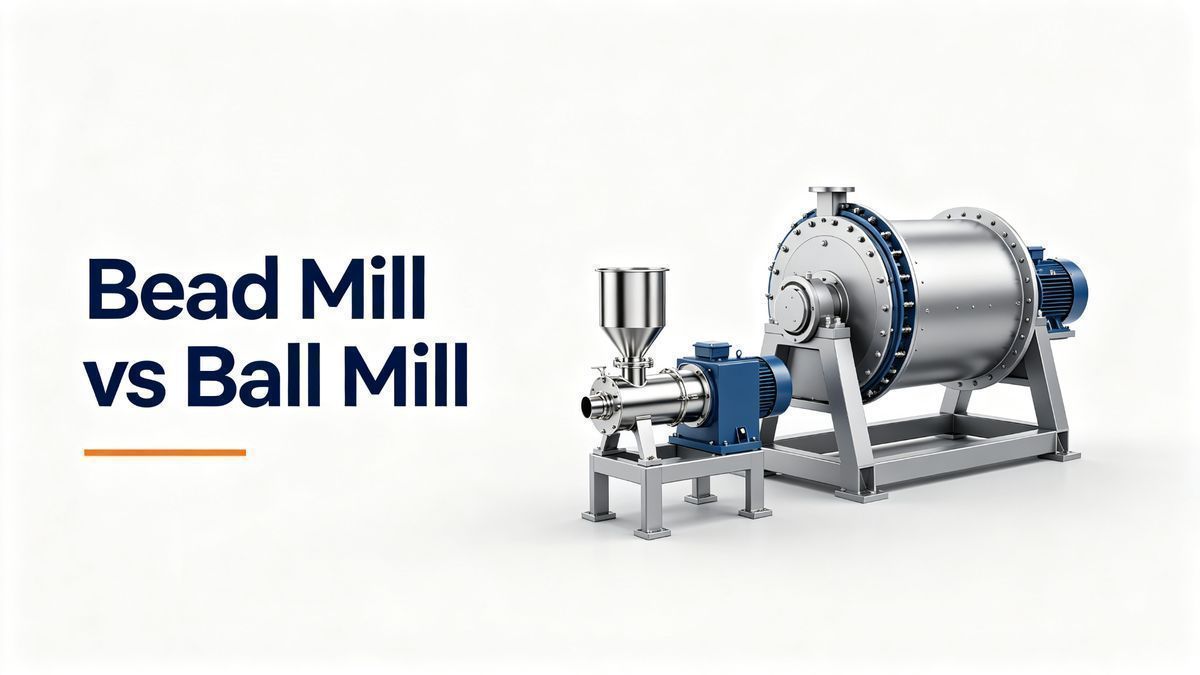
 Bead mills and ball mills both reduce particle size using grinding media, but they differ fundamentally in how energy is delivered. A ball mill relies on the tumbling action of a rotating shell to lift and drop media, while a bead mill uses an agitator to impart motion to a dense media charge within a fixed chamber.
That difference in energy density drives everything else: achievable fineness, specific energy consumption, media wear, contamination and the scale at which each technology becomes economical. Bead mills generally reach finer specifications with lower energy input in wet processing, while ball mills remain relevant for coarse grinding and very large continuous mineral duties.
This article compares the two technologies on the criteria that matter in production, explains where each remains the better choice, and covers the hybrid cases where both appear in the same flowsheet. The guidance reflects 24 years of wet grinding application experience.
Bead mills and ball mills both reduce particle size using grinding media, but they differ fundamentally in how energy is delivered. A ball mill relies on the tumbling action of a rotating shell to lift and drop media, while a bead mill uses an agitator to impart motion to a dense media charge within a fixed chamber.
That difference in energy density drives everything else: achievable fineness, specific energy consumption, media wear, contamination and the scale at which each technology becomes economical. Bead mills generally reach finer specifications with lower energy input in wet processing, while ball mills remain relevant for coarse grinding and very large continuous mineral duties.
This article compares the two technologies on the criteria that matter in production, explains where each remains the better choice, and covers the hybrid cases where both appear in the same flowsheet. The guidance reflects 24 years of wet grinding application experience.
Key Takeaways
- Bead mills deliver far higher energy density and reach finer specifications in wet processing
- Ball mills suit coarse grinding and very large continuous mineral duties
- Specific energy consumption is generally lower with agitated bead milling for fine targets
- Contamination control is easier in bead mills through ceramic linings and zirconia media
- Some flowsheets use both: ball milling for coarse reduction, bead milling for finishing
How Energy Is Delivered in Each Machine
A ball mill grinds by rotating a horizontal shell so that the media charge is lifted and cascades back down. Grinding occurs through impact and attrition as the media falls. Energy input depends on shell speed, media charge and media size, and the process is effective but comparatively diffuse in terms of energy density.
A bead mill uses an agitator, either discs or pins, to impart motion to a dense media charge inside a stationary chamber. Product is pumped through the charge, so grinding occurs continuously across very many contact events rather than through discrete impacts. This gives far higher energy density per unit volume.
The practical consequence is cycle time and achievable fineness. For fine and ultrafine wet grinding, the agitated charge reaches specification far faster and finer than a tumbling charge. For coarse reduction where energy density is less critical, the difference matters less, which is where ball mills remain competitive.
Fineness Capability and Energy Efficiency
For fine wet grinding, bead mills reach substantially finer specifications. Sub-micron and nano-scale distributions are routine with small zirconia media in agitated mills, whereas tumbling mills become increasingly inefficient as the target fineness falls because the impact energy is not well matched to very small particles.
Specific energy consumption follows the same pattern. Agitated milling delivers energy more directly to the product-media contact zone, so less is lost to moving the shell and the media mass. For fine targets this translates into meaningfully lower energy per tonne of product, which becomes significant at production scale.
For coarse grinding the gap narrows considerably. Where the target is in the tens of microns and throughput is very large, the simplicity and scale of a ball mill can make it the more economical choice, particularly in mineral processing where the product specification is relatively coarse.
Contamination, Media Wear and Product Quality
Contamination control differs substantially. Bead mills can be specified with fully ceramic-lined chambers, ceramic or polymer-coated rotors and high-purity zirconia media, which gives a genuinely low-contamination grinding path. This is essential for battery materials, electronics, white pigments and ceramics.
Ball mills typically use larger media and steel or ceramic liners, and wear rates are higher in relative terms for fine grinding. Where iron contamination must be avoided, ceramic linings and media are available, but the wear dynamics of a tumbling charge make contamination control harder to guarantee at fine targets.
Product quality also includes distribution width. Agitated milling with controlled residence time and multi-pass operation gives narrower distributions, which matters where a specification is defined by D90 or where coarse tails cause functional failures such as nozzle blocking or dielectric breakdown.
Where Each Technology Remains the Better Choice
Bead mills are the appropriate choice for almost all fine and ultrafine wet grinding: coatings, inks, agrochemical suspension concentrates, battery materials, ceramics, pharmaceuticals and cosmetics. They reach specification faster, consume less energy per tonne at fine targets, and support the contamination control these products require.
Ball mills remain relevant for coarse reduction, very large continuous mineral duties, and some dry grinding applications. Their simplicity, robustness and ability to handle very large feed sizes and throughputs keep them competitive where fineness requirements are moderate and the process is continuous at very large scale.
Hybrid flowsheets are common in minerals and ceramics: ball milling or another coarse stage reduces the feed size economically, and agitated bead milling completes the fine grind. This combination usually costs less than either technology attempting the full size reduction alone.
Practical Selection Checklist
Begin with the target particle size and its distribution width. If the requirement is below roughly 10 micron, or if the distribution must be narrow, agitated bead milling is almost always the answer. If the target is coarse and throughput is very large, evaluate both technologies against capital and operating cost.
Next, define contamination limits. Where iron, copper or nickel must be controlled, specify ceramic-lined agitated milling with high-purity zirconia media and verify by analysis rather than assumption. This requirement alone usually settles the decision in favour of a bead mill.
Finally, consider the flowsheet. Where feed arrives coarse, plan a staged approach rather than asking one machine to do the full reduction. Send your material, feed size, target specification and throughput through the inquiry form and our engineers will compare both routes against your actual duty.
Technical Specifications
| Bead mill energy density | high, delivered through agitated media charge |
| Ball mill energy delivery | tumbling impact and attrition from cascading media |
| Bead mill fineness | sub-micron to 15 micron typical |
| Ball mill fineness | coarse to moderate, inefficient at very fine targets |
| Contamination control | ceramic-lined bead mills with zirconia media offer the lowest risk |
| Typical hybrid flowsheet | coarse reduction followed by agitated fine grinding |
Troubleshooting Guide
Ball mill cannot reach the required fineness economically
Cause: Tumbling energy is poorly matched to very small particles at fine targets
Solution: Move the finishing stage to an agitated bead mill, keeping the ball mill for coarse reduction if it is already installed
Energy cost per tonne is too high for the fineness achieved
Cause: Energy delivered diffusely rather than to the product-media contact zone
Solution: Use agitated bead milling for fine targets, where specific energy consumption is significantly lower
Iron contamination fails product limits
Cause: Steel liners or media in a tumbling mill
Solution: Specify ceramic-lined agitated milling with high-purity zirconia media and verify by analysis
Distribution is too broad with coarse tails present
Cause: Insufficient control of residence time and energy distribution
Solution: Use multi-pass agitated milling or mills in series, which narrow the distribution progressively
Frequently Asked Questions
Can a ball mill reach sub-micron particle sizes?
In principle over very long cycles, but it is inefficient because tumbling impact energy is poorly matched to very small particles. Agitated bead milling reaches sub-micron and nano distributions far faster and with lower specific energy, which is why it is standard for fine wet grinding.
Is a bead mill always more energy efficient?
For fine targets, generally yes, because energy is delivered directly to the product-media contact zone. For coarse grinding the gap narrows and a ball mill can be competitive, particularly at very large continuous throughput where simplicity and scale matter.
Which is better for battery materials?
Agitated bead milling, without question. Battery work requires nano dispersion combined with strict metallic contamination control, which means ceramic-lined chambers, coated rotors and high-purity zirconia media. That contamination path is far easier to guarantee in an agitated mill.
Should I keep my ball mill if I add a bead mill?
Often yes. A staged flowsheet where the ball mill handles coarse reduction and the bead mill completes fine grinding usually costs less than either machine doing the full reduction. Review the split with your actual feed and target sizes.
How do contamination risks compare?
Bead mills offer better control because they can be fully ceramic-lined with high-purity zirconia media. Ball mills can use ceramic linings and media, but the wear dynamics of a tumbling charge make guarantees harder at fine targets. Verify either configuration by analysis.
What information is needed to compare the two properly?
Feed particle size, target particle size and distribution, solids loading and rheology, required throughput, contamination limits and available utilities. With those, both routes can be sized and compared on capital and operating cost rather than on generalisation.
Recommended POLYC MACHINE equipment
The following machines are commonly evaluated for the process described above. Final selection depends on formulation, target particle size, viscosity, capacity and contamination limits.
Related technical guides
Next step
Share your material, required capacity, target fineness and operating conditions with POLYC MACHINE engineers for a configuration review and quotation.
Explore our Coatings solutions for application-specific equipment configurations and process recommendations.