
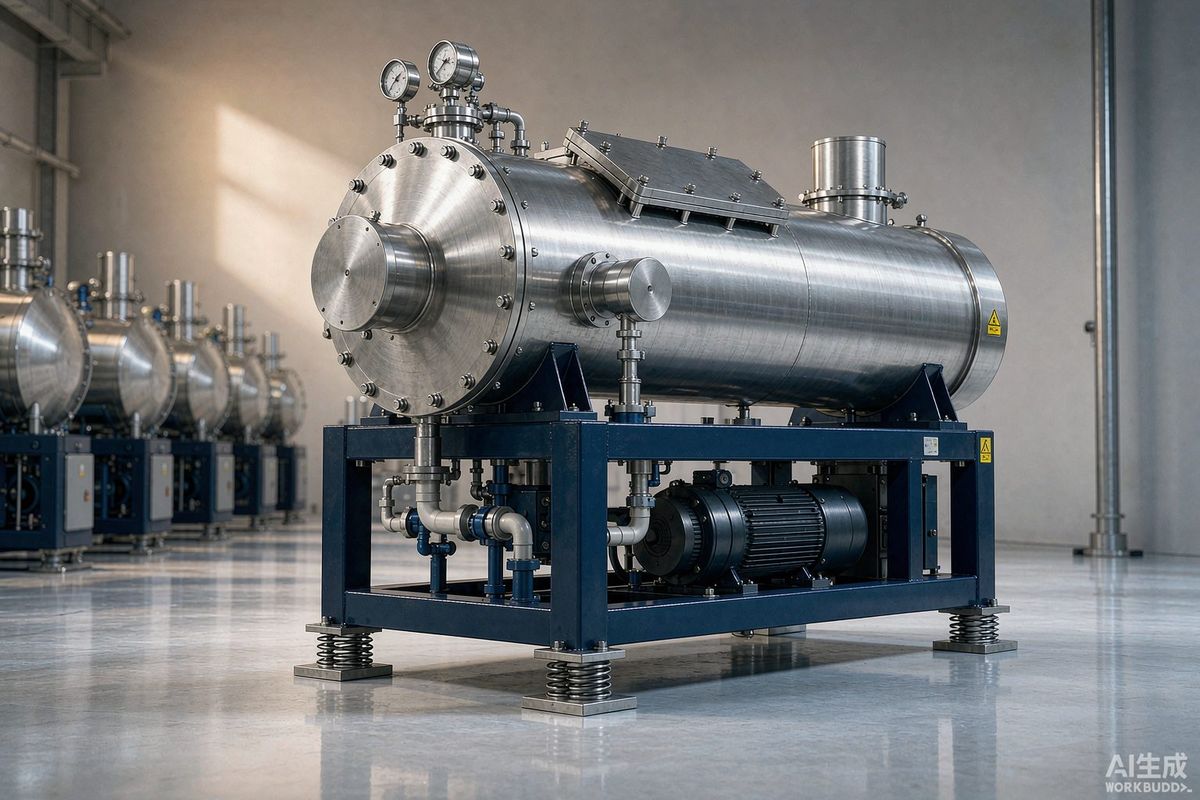
A bead mill is a wet grinding machine that disperses solid particles in a liquid using grinding media inside a closed chamber. When buyers compare a horizontal bead mill from POLYC MACHINE (established 2001) against a Bühler system, the real question is not "which brand is older" but "which supply model, lead time and total cost fit my plant."
What a Bead Mill Does — and Where Bühler Sits in the Market
A bead mill (also called a sand mill or agitator bead mill) passes a pre-dispersed slurry through a chamber filled with small grinding beads. The rotating agitator transfers energy to the beads, which break agglomerates down to the target particle size. The technology is standard across paints, inks, pigments, agrochemical suspensions and battery slurries.
Bühler is a long-established Swiss engineering group with a broad portfolio that includes wet grinding systems for paints, inks and advanced materials. It is a reference name in large-scale, fully integrated process lines. POLYC MACHINE, by contrast, focuses specifically on bead mills, basket mills, dissolvers and complete grinding lines for coatings, inks and fine chemicals.
Supply Model: Integrated Multinational vs Focused Specialist
The most practical difference is the sales and service model. A multinational supplier typically quotes through regional offices, with longer decision chains and consolidated spare-parts logistics. POLYC MACHINE operates as a focused manufacturer: engineering, fabrication and commissioning are handled in-house, and project engineers respond directly to buyers.
For a plant manager who needs a single bead mill or a turnkey grinding skid, a specialist often shortens the path from inquiry to commissioning. For a greenfield megaproject that needs one vendor to integrate mixing, grinding, filtration and filling across dozens of units, a full-line multinational may be preferable.
Machine Architecture: Horizontal Chamber Design
Both suppliers build horizontal bead mills, where the grinding chamber lies parallel to the floor and the product flows through under pump pressure. POLYC MACHINE's dynamic disc-type horizontal bead mill uses a disc agitator with separated grinding zones, which keeps the media bed stable at high flow rates.
| Design aspect | POLYC horizontal bead mill | Typical large European mill |
|---|---|---|
| Chamber orientation | Horizontal, disc or pin agitator | Horizontal, disc or pin agitator |
| Sealing | Mechanical seal with barrier fluid | Mechanical seal with barrier fluid |
| Grinding media | 0.1–1.0 mm zirconia or glass | 0.1–1.0 mm zirconia or glass |
| Typical drive | 11–315 kW per module | Comparable industrial range |
| Throughput scaling | Single or multi-pass, modular | Single or multi-pass, modular |
The architecture is convergent because the physics is convergent: there is a limited set of proven ways to agitate beads in a chamber. Differences show up in details such as cooling surface, separator (screen or gap), and how the machine is packaged for your specific feed.
Grinding Media and Bead Selection
Fineness is decided as much by media as by the mill. POLYC MACHINE supplies yttria-stabilised zirconia beads from 0.1 mm up, which give high density and low contamination for sensitive pigments and inks. Glass beads remain an option for coarse, non-critical dispersions.
Regardless of brand, the same principle applies: smaller beads reach finer sizes but need a tighter separator; denser beads carry more energy but wear the chamber faster. Media choice is a process decision, not a brand decision.
Throughput, Fineness and Energy
Reported fineness from a well-run bead mill typically lands in the 5–50 nm to low-micron range depending on product, with d50 often below 1 µm for inks and pigments. Throughput depends on viscosity, solids loading and target fineness more than on the logo on the nameplate.
POLYC MACHINE has shipped more than 8,000 grinding and dispersion systems to over 60 countries since 2001, so the configurations behind common coatings and ink formulations are well documented. Energy use is governed mainly by the specific energy (kWh/kg) needed to reach your target, which a process test on your own material defines.
Process Integration: From Premix to Filling
A bead mill is rarely bought alone. It sits between a high-speed disperser (which wets out the powder) and filtration and filling. POLYC MACHINE packages these as linked lines — for example a turnkey ink production line or a paint and coating production line — so the mill, disperser, reactor and filler are sized to the same duty.
This integration matters more than a single-machine comparison, because bottlenecks almost always appear at the interfaces, not inside the mill.
Lead Time, Spares and After-Sales
For many buyers the deciding factor is lead time. Large multinational lines can carry long build and customs windows. POLYC MACHINE's focused build model and direct project engineering typically compress delivery and keep a single point of contact for spares and commissioning.
A 3-year warranty on core grinding equipment (against POLYC MACHINE's standard terms) also changes the risk calculation compared with a shorter base warranty plus expensive service contracts.
Total Cost of Ownership
Purchase price is the smallest line in the total cost of ownership. The meaningful costs are media consumption, seal and separator wear, energy per tonne, downtime, and the speed of getting a spare part. A focused supplier with local stock and direct engineering usually wins on the variables that actually hit your P&L.
Which Buyer Should Choose Which
- Choose a large multinational integrated line if you are building a very large greenfield plant and want one contract covering the entire process train.
- Choose POLYC MACHINE if you need a specific bead mill, a basket mill for small batches, or a compact turnkey grinding line with short lead time, direct engineering and a strong warranty.
How POLYC MACHINE Supports Your Line
POLYC MACHINE (founded 2001) builds horizontal bead mills, pin-type bead mills, basket mills and complete grinding lines, and backs them with engineering support from inquiry to commissioning. Every system is configured to your material and capacity rather than taken from a fixed catalogue.
Frequently Asked Questions
Is a Bühler bead mill "better" than a POLYC MACHINE bead mill?
Not in a way that applies to every buyer. The underlying agitation and chamber physics are similar across reputable manufacturers. The practical differences are lead time, integration scope, spares logistics and warranty — areas where a focused supplier like POLYC MACHINE is often competitive for single mills and turnkey grinding lines.
Can POLYC MACHINE bead mills reach the same fineness as European mills?
Yes, for the typical coatings, ink and pigment duties. Fineness is set by media size, residence time, cooling and feed stability — all of which are configurable on POLYC MACHINE horizontal and pin-type bead mills. A process test on your own material confirms the achievable d50 before you commit.
What is the typical lead time for a POLYC MACHINE bead mill?
Lead time depends on chamber size, drive power and whether the mill is part of a turnkey line. Because POLYC MACHINE engineers and builds the equipment in-house, delivery is generally shorter than for large multinational consolidated projects. Your project engineer will confirm a dated schedule at quotation.