
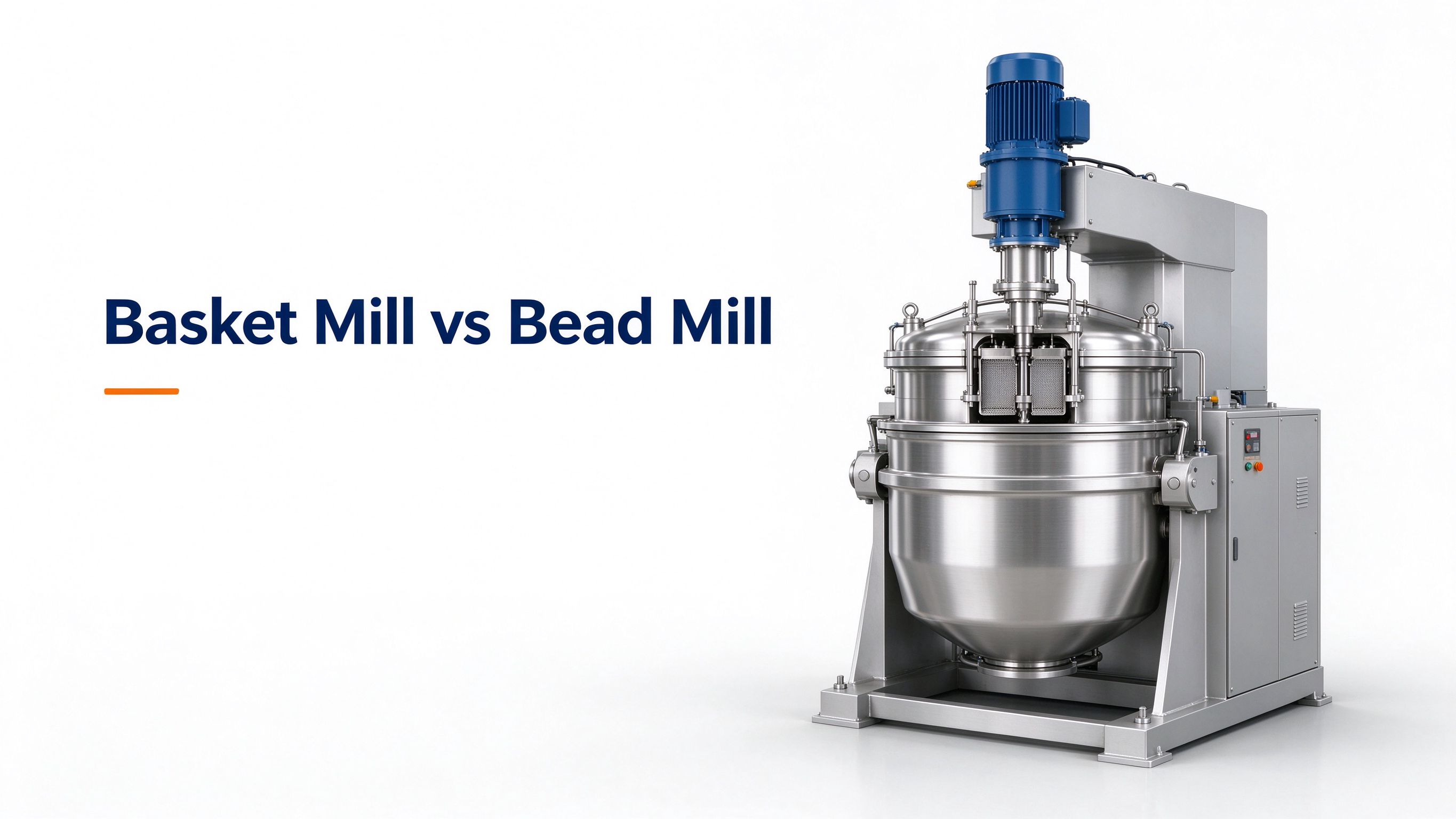
When evaluating wet grinding equipment for paints, inks, and coatings, the basket mill vs bead mill comparison is one of the most common — and most misunderstood. Both are high-energy media mills that disperse and grind pigments in liquid, and both can produce excellent results. But they differ fundamentally in how the milling chamber is integrated with the batch, how they handle small versus large volumes, how quickly they can be cleaned between colors, and what fineness they realistically achieve. This guide breaks down the design, operation, and economics of each so you can specify the right machine for your plant instead of guessing.
What Is a Basket Mill and How Does It Work?
A basket mill is an immersion-style mill: a perforated basket containing grinding beads and a rotating peg or disc agitator is lowered directly into the product vessel (often the same mixing tank used for premixing). As the basket spins, the agitated beads grind the pigment while the holes in the basket let processed slurry flow back into the batch. There is no separate pump, feed tank, or external circulation loop — the mill and the batch are one unit.
This integration is the basket mill's defining advantage. Setup is fast, material waste is minimal because there is no separate circuit to fill and flush, and cleaning is simple: lift the basket out, rinse it, and you are ready for the next color. Basket mills are especially popular for small to medium batches, frequent color changes, and labs where flexibility matters more than brute throughput. POLYC's basket mills pair the immersion basket with a high-speed disperser function in the same drive for true one-pot processing.
What Is a Bead Mill and How Does It Work?
A bead mill (horizontal or vertical) is a closed, pressurized chamber filled with grinding media through which the product is pumped continuously or recirculated. The product enters, is intensely sheared by the beads, and exits through a separator that holds the media inside. Because the chamber is a dedicated, optimized grinding zone, a bead mill sustains very high energy density and can run extremely fine media for sub-micron and nano output.
The trade-off is infrastructure: you need a feed tank, a pump, piping, and a cooling circuit, and you lose some product to the loop that must be flushed between batches. But for high-volume, fine, continuous production — coatings at scale, inks, battery slurries — the bead mill's throughput and fineness are unmatched. POLYC's horizontal bead mills use a dynamic front separator that holds beads as small as 0.1 mm without screen clogging.
Design and Operation: The Core Difference
The cleanest way to frame basket mill vs bead mill is "integrated batch immersion" versus "dedicated continuous chamber." The basket mill brings the mill to the product; the bead mill brings the product to the mill. That single architectural choice drives every other difference — batch size limits, cleaning speed, fineness ceiling, and capital cost.
A basket mill shines when you have many small batches and frequent changeovers: there is almost nothing to clean and almost no waste. A bead mill shines when you have one or a few large products running continuously and you need the finest possible particle size. Neither is "better" in the abstract; they occupy different points on the batch-size-versus-finery curve. The comparison table below makes the split obvious.
| Factor | Basket Mill | Bead Mill |
|---|---|---|
| Integration | Immersion into the batch vessel | Separate pressurized chamber + pump |
| Typical batch size | Small to medium | Medium to very large / continuous |
| Achievable fineness | Generally 1–10 µm | Sub-micron to nano |
| Material waste | Very low (no loop) | Some (loop must be flushed) |
| Cleaning / changeover | Fast (lift & rinse basket) | Slower (flush chamber & piping) |
| Capital cost | Lower initial cost | Higher initial cost |
| Best application | Multi-color, small batches, labs | High-volume fine/continuous |
Fineness and Particle Size Distribution
Because a bead mill's chamber is a purpose-built, high-energy-density zone, it reaches finer particle sizes and tighter distributions than a basket mill, which shares its volume with the whole batch and therefore operates at lower effective energy density per unit of media. For architectural paints and many inks where 1–10 micron fineness is enough, a basket mill delivers beautiful results with less fuss. For automotive coatings, digital inks, or battery materials needing sub-micron or nano output, the bead mill is required.
If your quality spec sits at the boundary, run a lab trial on both. POLYC routinely trials customer products on basket and bead mills side by side so the fineness and distribution numbers come from your actual formulation, not a catalog claim. Understanding distribution width (D10–D90 span) matters as much as the D50 — see our particle size distribution guide for how to read the curve.
Batch Size, Throughput, and Production Scale
Basket mills are batch machines by nature: you grind one vessel at a time, and very large volumes become impractical because the basket must be proportionally large and the single-vessel cycle lengthens. Bead mills scale elegantly — you can recirculate a large tank through a modest chamber, or run multiple chambers in series, achieving high throughput without an enormous mill. Horizontal bead mills in particular are the workhorses of continuous coating and ink plants.
The rule of thumb from the field: match the mill to your production scale. Horizontal bead mills suit large-scale, continuous work; basket mills are ideal for small batches and frequent color changes. If you run both profiles — a few high-volume products plus many short custom colors — a hybrid line with one bead mill and one or two basket mills is common and cost-effective.
Cleaning, Material Waste, and Changeover Cost
This is where the basket mill's design pays dividends. Because the mill is immersed in the batch with no external circuit, there is essentially no product trapped in piping, and the basket rinses in seconds. For toll coaters and ink blenders switching colors several times a shift, that speed directly reduces labor and downtime. Bead mills, by contrast, hold product in the chamber, pump, and lines, all of which must be flushed — wasting some material and adding wash time.
However, modern horizontal bead mills with quick-open chambers and CIP flush ports have closed much of this gap. The honest comparison: basket mills still win on fastest changeover and least waste, but a well-designed bead mill is no longer painful to clean. Factor your number of daily changeovers into the decision — if it is more than a handful, basket mill convenience is worth real money. POLYC offers both, so we can spec a balanced line; review the basket mill series and the horizontal bead mill series.
Cost: Initial Outlay vs Total Ownership
Basket mills have a lower initial cost and are easier to maintain — fewer seals, no high-pressure loop, and simple mechanics. That makes them attractive for startups, labs, and plants with diverse small jobs. Bead mills cost more upfront and require more supporting equipment, but they deliver higher throughput and finer product, which for high-volume lines means lower cost per kilogram over time.
A practical way to choose is to model three years of total ownership rather than comparing sticker prices. Capture capital, expected media and seal replacement cost and interval, energy per kilogram of product, and the labor and material cost of color changeovers. For a custom ink or coatings blender running many colors per week, the basket mill's minimal flush waste and minutes-long rinse often dominates the equation, because a circulating bead mill would discard expensive pigment and add wash labor on every switch. For a plant producing one or two high-volume products continuously, the bead mill's throughput and sub-micron fineness win decisively, and its higher capital amortizes quickly. The crossover point is almost never the machine's purchase price — it is the shape of your production: batch diversity, fineness spec, and changeover frequency. POLYC helps customers build this model during evaluation, because the right answer protects both quality and margin. Since 2001, POLYC has supplied both technologies to 80+ countries across 8,000+ installations, and our 3-Year Warranty applies across the range. The right answer is rarely "buy only one type" — it is "buy the type that fits each product." Our selection guide helps you map products to machines and build a defensible capital plan.
Frequently Asked Questions
What are the key differences between a sand mill and a bead mill?
A sand mill is the older design using coarse silica sand as media; a bead mill uses precision ceramic or zirconia beads in a separated chamber. Bead mills achieve finer, cleaner, more uniform grinding. Most machines sold today as "sand mills" are actually bead mills with a legacy name — judge by media size and separator, not the label.
What are the disadvantages of ball mills (and how do basket/bead mills avoid them)?
Ball mills use large tumbling balls, run slowly, and cannot reach fine or nano fineness; they are poor for dispersion. Basket and bead mills use tiny high-intensity media for fast, fine wet grinding and dispersion. For pigments and coatings, agitated media mills (basket or bead) replaced ball mills decades ago for exactly this reason.
Which one should you choose, basket mill or bead mill?
Choose a basket mill for small-to-medium batches, frequent color changes, labs, and products needing ~1–10 micron fineness with minimal waste. Choose a bead mill for high-volume, continuous, or sub-micron/nano production. Many plants run both. Base the call on batch size, fineness spec, and changeover frequency.
Can a basket mill reach the same fineness as a bead mill?
Generally no. A basket mill typically reaches about 1–10 microns because its energy density is shared with the whole batch. A bead mill's dedicated chamber reaches sub-micron and nano. If your product needs D50 below 1 micron or a very tight distribution, the bead mill is the correct tool.
Is a basket mill cheaper than a bead mill?
Yes, in initial outlay. Basket mills cost less to buy and maintain. But for high-volume fine production, a bead mill's throughput lowers cost per kilogram, so the cheaper machine upfront is not always the cheaper machine over five years. Match the technology to the product economics.
Application Examples: Which Mill to Choose
The theory is easier to apply with concrete examples. A plant making water-based architectural paint in 300–800 kg batches across dozens of colors per week is the textbook basket mill case: fast changeover, almost no flush waste, and a fineness of a few microns that the basket mill reaches comfortably. A toll coater producing custom industrial paints for many clients lives or dies on the same flexibility. By contrast, a plant running a single automotive basecoat or a continuous ink line at several tonnes per hour should choose a horizontal bead mill, where the dedicated high-energy chamber delivers the sub-micron, narrow-distribution output and the throughput that batch immersion cannot match. A battery-materials producer grinding cathode slurry to a tight D50 with zero contamination is squarely in bead-mill territory regardless of batch size, because only a sealed, lined, fine-media chamber protects the chemistry. POLYC sizes both and will tell you honestly when a simpler basket mill is the smarter buy rather than pushing the more expensive bead mill.
Conclusion
The basket mill vs bead mill question is really about batch intimacy versus continuous intensity. Basket mills bring the mill to the product — fast, clean, low-waste, ideal for small batches and color changes. Bead mills bring the product to a dedicated high-energy chamber — unmatched for volume and sub-micron fineness. POLYC has built both since 2001, with 8,000+ systems in 80+ countries and a 3-Year Warranty across the lineup, so our recommendation follows your spec, not our inventory.
Need help sizing the right mill?
We will trial your formulation on both basket and bead mills and return real fineness and throughput data. Request a quote & lab trial »
Basket Mill | Horizontal Bead Mill | Selection Guide | Contact POLYC