
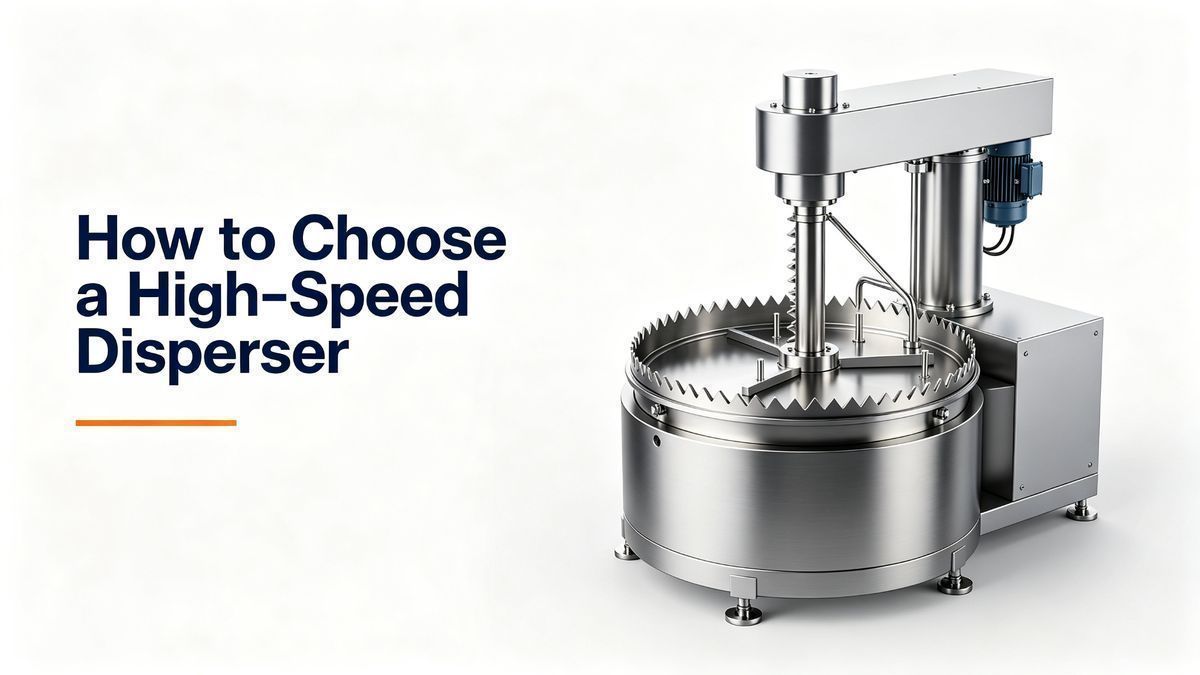
A high speed disperser is the most widely used machine in a coatings or ink plant, and the most frequently mis-specified. Selection is usually made on motor power alone, which is the least useful of the four variables that actually determine performance: power, disc diameter, vessel geometry and tip speed.
Tip speed is the parameter that governs deagglomeration, disc-to-vessel ratio governs circulation, vessel geometry determines whether material reaches the shear zone, and power determines whether the machine can sustain the load at the required viscosity. Specifying any one in isolation produces a machine that underperforms despite appearing well sized.
This guide explains each variable, sets out practical sizing rules and common mistakes, and covers the installation and operating practices that determine whether a correctly specified machine delivers its capability in daily production. It reflects 25 years of application experience across coatings, inks, adhesives and construction chemicals.
POLYC MACHINE supplies high speed dispersers from laboratory to production scale, specified by tip speed and disc geometry rather than by power alone. Send your vessel dimensions and rheology through the inquiry form.
Key Takeaways
- Tip speed, not shaft rpm, governs deagglomeration and is the parameter that transfers between machines
- Disc-to-vessel ratio governs circulation; too small gives poor turnover, too large overloads the drive
- Power must be sized for peak viscosity during the batch, not for the average
- Immersion depth must prevent a vortex reaching the disc at every stage
- A worn disc changes tip speed even when rpm is unchanged, so inspect and replace on schedule
Tip Speed: The Governing Parameter
Tip speed is the linear velocity at the outer edge of the dispersing disc, calculated from shaft speed and disc diameter. It determines the shear applied to the material and therefore the rate of deagglomeration. Effective dispersion typically occurs within a defined tip speed range for a given formulation, with higher speeds giving faster breakdown but risking air incorporation and heat.
The critical point is that tip speed, not shaft rpm, is the meaningful variable. The same machine running at the same rpm with a different disc diameter produces a different tip speed and therefore a different result. This is why rpm settings should never be transferred between machines without recalculating tip speed.
Variable speed control is therefore worth specifying. It allows the wetting stage, the dispersion stage and the letdown or tinting stage to run at appropriate speeds rather than forcing one compromise setting across the whole cycle. Recipes can then store validated speeds per stage, which improves repeatability between operators.
Where a specification has been validated on one machine, the tip speed should be documented alongside it rather than the rpm. This makes the setting transferable to any other machine in the plant and removes a common source of variation between apparently identical batches.
Disc Diameter and Vessel Matching
Disc diameter should be selected relative to vessel diameter rather than in absolute terms. A disc that is too small cannot drive circulation across the vessel floor, so material never reliably passes through the shear zone and the batch appears to mix while little deagglomeration occurs. A disc that is too large overloads the drive, raises viscosity locally and causes motor trips.
Vessel geometry matters as much as the ratio. The disc should be positioned so that it drives material down and outward across the vessel floor and back up the walls, creating a toroidal flow pattern. Incorrect immersion depth disrupts this pattern, and a vortex that reaches the disc introduces air and wastes energy.
Because viscosity changes during the batch, the ideal immersion often differs between the wetting stage and the dispersion stage. Establishing immersion by observation during commissioning and marking the shaft or recording the setting makes the cycle reproducible rather than operator dependent.
For vessels that deviate from standard proportions, or where batch sizes vary widely, it is worth confirming disc selection against the actual range of batch volumes. A disc optimised for full batches may perform poorly at partial fill, which matters in plants that run varied batch sizes on one machine.
Power Sizing for Peak Viscosity
Power must be sized for the peak viscosity encountered during the batch rather than for the average. Viscosity typically peaks during or shortly after pigment addition, before the formulation is fully wetted and before any solvent adjustment. A drive sized for the average will slow or trip at exactly the point where throughput matters most.
Providing the full rheology curve through the cycle, measured at working temperature, allows correct sizing. Where that data is unavailable, a conservative approach with margin is preferable to a nominal rating, because the cost of an undersized drive is repeated slow batches and nuisance trips rather than a one-off expense.
It is worth noting that additional power cannot compensate for poor circulation. If the disc-to-vessel ratio is wrong, a larger motor will not improve deagglomeration; it will simply draw more current. Geometry should be corrected before power is increased.
Where viscosity exceeds roughly 30,000 to 50,000 cP, a disperser is no longer the correct machine regardless of power, and a butterfly double shaft mixer or planetary mixer should be specified instead. Recognising this boundary avoids specifying an increasingly large disperser for a duty it cannot perform.
Installation and Operating Practice
Installation details determine whether a correctly specified machine delivers its capability. The vessel must be stable and centred under the disc, the lift mechanism must allow full travel for cleaning, and services including electrical supply and any cooling must be adequate. Vessel clamping is frequently overlooked and causes vibration that limits usable speed.
Operating practice matters equally. Staged pigment addition with adequate wetting time before high shear is the single most effective way to shorten total cycle time, and it costs nothing to implement. Rushed addition shifts work downstream and produces longer cycles overall.
Disc condition should be inspected on schedule. Wear reduces effective diameter, which changes tip speed even when rpm is unchanged, so a worn disc quietly alters the process. Scheduled replacement is a low-cost item with a disproportionate effect on batch-to-batch consistency.
Finally, document the validated cycle: disc size, immersion, speed per stage, addition sequence and end-of-cycle temperature. Plants that do this report fewer failed batches and shorter cycles, because the process becomes reproducible rather than dependent on individual judgement.
Common Specification Mistakes
The first common mistake is specifying on motor power alone. Power does not determine tip speed or circulation, both of which govern performance, so a powerful machine with poor geometry underperforms a correctly configured smaller one.
The second is transferring rpm settings between machines. Because tip speed depends on disc diameter, the same rpm on a different disc gives a different result. Documenting tip speed instead of rpm removes this error entirely.
The third is ignoring the wetting stage. Adding pigment too quickly or before the vehicle is distributed produces agglomerates that no amount of additional shear will remove, and the usual response of extending the cycle only generates heat.
The fourth is specifying a disperser for a duty that requires a different machine. Once viscosity exceeds the circulation limit, or once a particle specification requires grinding, the correct response is a butterfly mixer, a planetary mixer or a bead mill rather than a larger disperser.
Technical Specifications
| Parameter | Specification |
|---|---|
| Typical tip speed | 18 - 24 m/s for the dispersion stage, lower for letdown and tinting |
| Disc selection basis | ratio to vessel diameter, sufficient to drive floor-to-wall circulation |
| Immersion requirement | deep enough that no vortex reaches the disc at any stage |
| Power sizing basis | peak viscosity during the batch, not the average |
| Practical viscosity limit | approximately 30,000 - 50,000 cP |
| Working capacity | approximately 20 - 5,000 L depending on model |
| Recommended options | variable speed, vessel clamping, hydraulic lift, jacketed vessel |
Troubleshooting Guide
1. Dispersion is slow despite a powerful motor
Cause: Disc-to-vessel ratio or immersion incorrect, so circulation is inadequate
Solution: Correct disc diameter and immersion to drive floor-to-wall circulation before increasing power
2. Same rpm gives different results on another machine
Cause: Tip speed differs because disc diameters differ
Solution: Document and set tip speed rather than rpm, so the setting transfers between machines
3. Motor trips shortly after pigment addition
Cause: Drive sized for average rather than peak viscosity, or disc oversized
Solution: Provide the full rheology curve for sizing, and reduce disc diameter if the drive is overloaded
4. Foam forms and fineness stops improving
Cause: Vortex reaching the disc, or excessive speed for the stage
Solution: Lower speed, correct immersion, ensure adequate batch volume, and use stage-specific speeds
5. Results vary between operators
Cause: No documented cycle, so addition and speed settings differ
Solution: Document disc size, immersion, speed per stage and addition sequence, and train operators on the standard cycle
Frequently Asked Questions
1. What matters most when choosing a high speed disperser?
Tip speed, disc-to-vessel ratio, vessel geometry and power sizing for peak viscosity. Tip speed governs deagglomeration, the ratio governs circulation, and power must cover the peak load. Specifying on motor power alone is the most common mistake and produces underperformance despite an apparently large machine.
2. Why is tip speed more important than rpm?
Tip speed is the linear velocity at the disc edge and determines the shear applied. The same rpm with a different disc diameter gives a different tip speed, so rpm settings do not transfer between machines. Documenting tip speed instead makes validated settings portable across the plant.
3. How do I choose the disc diameter?
Select it relative to vessel diameter so the disc drives material down and outward across the floor and back up the walls. Too small gives inadequate circulation; too large overloads the drive. Confirm the selection against your actual range of batch sizes, since partial fill behaves differently from full.
4. What viscosity can a disperser handle?
Practical operation typically extends to around 30,000 to 50,000 cP. Beyond that, circulation breaks down regardless of power and a butterfly double shaft mixer or planetary mixer is the correct machine. Recognising this boundary avoids specifying an ever-larger disperser for unsuitable duty.
5. Should I specify variable speed?
Yes. It allows wetting, dispersion and letdown or tinting to run at appropriate speeds rather than forcing one compromise setting. Recipes can store validated speeds per stage, which improves repeatability between operators and reduces air incorporation during finishing stages.
6. Does a worn disc affect performance?
Yes. Wear reduces effective diameter, which changes tip speed even when rpm is unchanged, so the process drifts quietly. Periodic inspection and scheduled replacement are low-cost measures with a disproportionate effect on batch-to-batch consistency.
7. What should I send when requesting a proposal?
Send vessel dimensions, batch size range, formulation rheology through the cycle, target fineness and available services. With that we can specify disc diameter, tip speed range and drive power correctly rather than by rule of thumb.
Recommended POLYC MACHINE equipment
The following machines are commonly evaluated for the process described above. Final selection depends on formulation, target particle size, viscosity, capacity and contamination limits.
Related technical guides
Next step
Share your material, required capacity, target fineness and operating conditions with POLYC MACHINE engineers for a configuration review and quotation.
Explore our Fine Chemicals solutions for application-specific equipment configurations and process recommendations.