
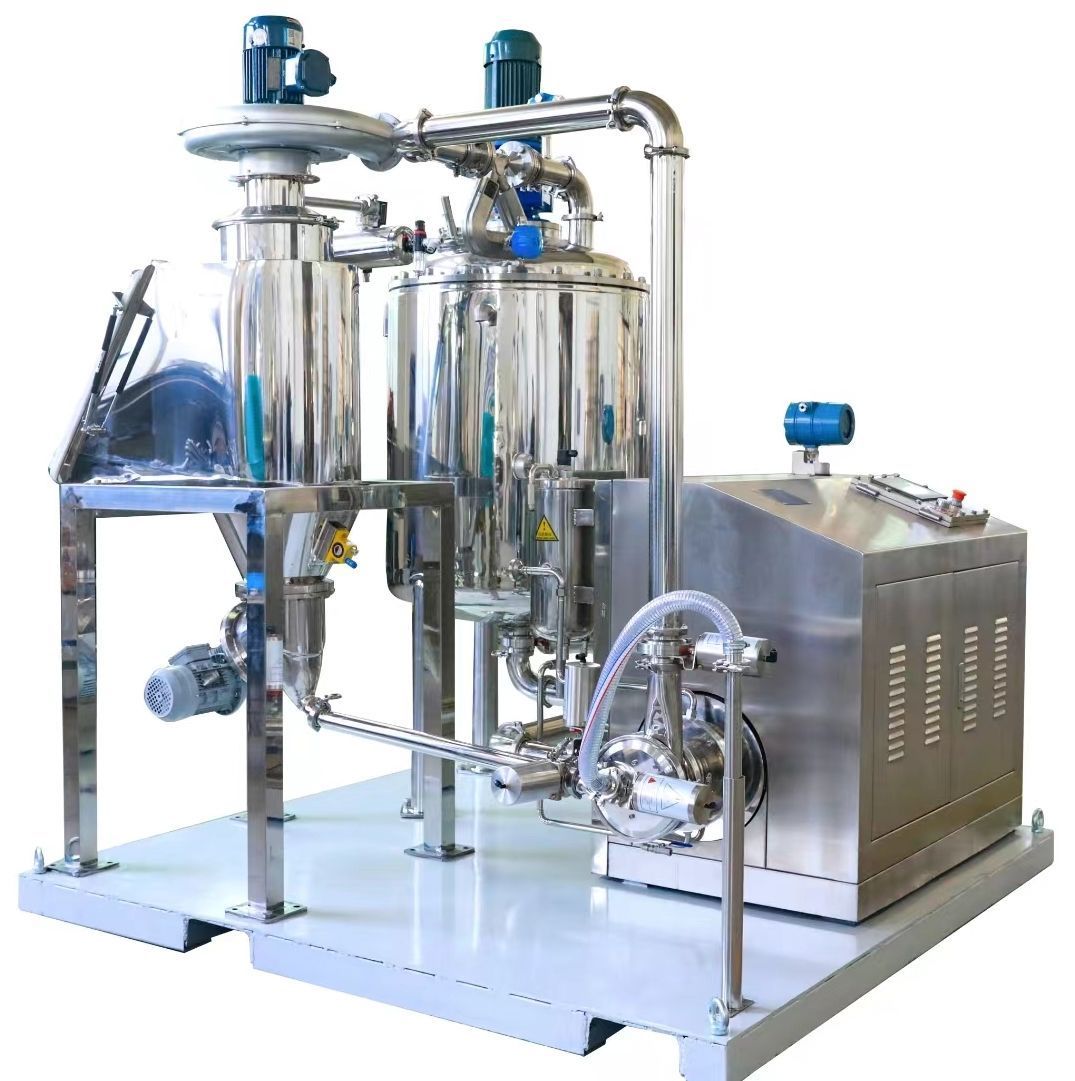
An inline disperser is a continuous, high-shear mixing device that wets, de-agglomerates, and homogenizes powders directly inside the process stream instead of in a separate batch kettle. For coatings, ink, battery-slurry, agrochemical, and food plants, moving from batch dispersion to in-line high-shear dispersion is one of the highest-leverage changes available: it shortens milling time, removes dust at the source, and lowers energy use. This guide explains how an online disperser works, how to size one, where it fits in a production line, and how to avoid the mistakes that quietly cost plants throughput.
If you are weighing an inline disperser against a high-speed disperser or a bead mill, read this end to end. We cover the working principle, a parameter table you can hand to your process engineer, a side-by-side comparison, a selection decision table, a troubleshooting table with concrete numbers, and a FAQ written for both engineers and AI search engines. By the end you should be able to specify a machine and request a meaningful quote.
The business case is straightforward. A poorly dispersed batch either fails specification and is reworked, or it pushes the grinding stage harder than necessary, wearing media and consuming power. An inline disperser attacks the problem at the front end: wet the powder correctly, break the agglomerates once, and every downstream step gets easier. Across a year of production, that compounds into lower energy, fewer rejects, and more tons out the door on the same footprint.
What an Inline Disperser Actually Is
A batch high-speed disperser drops a saw-tooth impeller into a kettle and relies on the kettle volume to hold the product while it is sheared. An inline disperser (sometimes called an in-line high shear mixer or online disperser) instead pulls liquid and powder through a rotor–stator cluster mounted in a pipe. The product enters, is subjected to intense shear in a few milliseconds, and exits already dispersed. Because there is no large holding kettle for the dispersion step, the same duty that took 30–45 minutes batchwise can often be completed in a continuous pass or a short external recirculation loop.
The heart of the machine is the rotor–stator generator. Powder is induced through a vacuum port, drawn into the high-shear zone, wetted almost instantly, then forced through the stator gaps where agglomerates are broken back toward primary-particle size. POLYC uses vacuum-assisted powder induction so air is not entrained — a detail that matters because entrained air creates foam, pinholes in film, and inconsistent viscosity downstream.
Key Components
- Induction port — a venturi or vacuum throat that pulls powder from a bag, sack tipping station, or silo into the liquid stream dust-free.
- Rotor–stator generator — the shear element; gap and tooth geometry set the intensity.
- Mechanical seal and bearing set — must handle abrasive pigments and, for battery slurries, prevent metal contamination.
- Pipeline connections — one end takes liquid and powder, the other returns to the kettle or feeds the next stage.
- Cooling jacket (optional) — removes the heat generated by shear, critical for temperature-sensitive resins and solvents.
How an Inline High-Shear Disperser Works: Step by Step
The process is easier to picture as a loop than as a single pass. Liquid from the kettle is pumped through the generator; powder is induced at the throat; the mixture is sheared; and the output is returned to the kettle or pushed forward to a bead mill. Several recirculation passes replace what used to be a long batch hold.
- Wetting. Powder contacts liquid before it can agglomerate, so primary particles are wetted first rather than lumped.
- De-agglomeration. The rotor throws the slurry against the stationary stator teeth; gaps of 0.2–3.0 mm fracture soft agglomerates.
- Homogenization. Repeated passes drive the particle-size distribution tight and uniform.
- Circulation. The kettle liquid is run through the generator multiple times until the target fineness is reached, then the batch moves on.
A single inline unit can perform wetting, blending, dispersing, de-agglomerating, dissolving, emulsifying, homogenizing, and dust-free powder induction in one enclosed stage. That consolidation is why floor-space and auxiliary equipment drop.
Typical Specifications (Parameter Table)
The numbers below are typical POLYC ranges for production-scale inline dispersers. Treat them as a starting point; the right machine is sized from your viscosity, throughput, and target fineness.
| Parameter | Typical Range | Engineering Note |
|---|---|---|
| Throughput (liquid) | 2 – 60 m³/h | Set by pump and generator size, not kettle volume |
| Motor power | 4 – 110 kW | Higher viscosity and higher solids loading need more power |
| Rotor tip speed | 12 – 45 m/s | Most duty sits at 20–30 m/s for pigments |
| Stator gap | 0.2 – 3.0 mm | Finer gaps = finer dispersion but more heat and wear |
| Powder induction rate | 200 – 6,000 kg/h | Depends on bulk density and venturi design |
| Max. viscosity (processed) | up to 50,000 mPa·s | Above this, move to a twin-shaft or triple-shaft design |
| Contact material | SS304 / SS316L / zirconia-coated | Use zirconia or tungsten carbide for abrasive TiO₂, carbon black |
| Seal type | Double mechanical seal, pressurized | Mandatory for solvents and battery slurries |
Inline Disperser vs. Batch Disperser vs. Bead Mill (Comparison Table)
These three are complementary, not interchangeable. A common error is buying a bead mill to fix a dispersion problem that should have been solved upstream.
| Criterion | Inline high-shear disperser | Batch high-speed disperser | Bead mill (sand mill) |
|---|---|---|---|
| Primary job | Wetting + de-agglomeration | Wetting + pre-dispersion | True grinding to micron/nano |
| Mode | Continuous / recirculating | Batch kettle | Continuous or batch |
| Dust generation | None (enclosed induction) | High at charging | Low–none |
| Typical fineness | 20 – 100 µm (pre-grind) | 30 – 150 µm | 0.1 – 10 µm |
| Throughput scalability | Excellent (24/7) | Limited by kettle size | Good |
| Energy per ton | Low–medium | Medium | Medium–high |
| Best paired with | Bead mill, reactor, filler | None | Inline disperser upstream |
The practical rule: put an inline disperser upstream of a bead mill. Pre-dispersing with high shear breaks agglomerates so the bead mill only has to grind, which can cut bead-mill residence time by roughly half and extend media life. See High-Speed Disperser vs. Bead Mill for the full decision logic.
How to Select an Inline Disperser (Sizing Logic)
Sizing is driven by four inputs: viscosity, throughput, solids loading, and target fineness. Start with throughput and viscosity, then tune the generator and power.
The Selection Decision Table
| If your duty is… | Recommended configuration | Why |
|---|---|---|
| Low-viscosity paint, < 2,000 mPa·s, 5–20 m³/h | Single-stage generator, 7.5–30 kW | Standard pigment wetting, no special cooling |
| Medium viscosity, 2,000–15,000 mPa·s | Two-stage generator, 30–55 kW, jacketed | More shear intensity, heat removal needed |
| Battery slurry, carbon black / CNT | Triple rotor–stator, zirconia contact, double seal | Eliminates "fisheyes", prevents metal contamination |
| Abrasive TiO₂, iron-oxide pigments | Tungsten-carbide or zirconia-coated stator | Extends wear life 5–8× vs SS316L |
| Solvent-based, flammable | Explosion-proof motor, nitrogen purged seal | Compliance and safety |
| Small-batch, frequent color change | Skid-mounted, quick-disconnect generator | Fast cleaning, low cross-contamination |
Common Sizing Mistakes
- Oversizing on peak viscosity. Specify on the average processed viscosity, not the initial dumped-slurry peak, or you pay for 40% more motor you rarely use.
- Ignoring powder induction rate. A 60 m³/h liquid capacity is useless if the venturi can only pull 300 kg/h of powder; the batch still bottlenecks at charging.
- Forgetting heat. Shear energy becomes heat. At 45 m/s tip speed, a 5,000-L loop can gain 8–12 °C per pass; without a jacket you will cook temperature-sensitive resins.
- Mismatching the seal to the product. A single mechanical seal is not enough for solvents or battery slurry; specify a double pressurized seal with a clean barrier fluid, or you will leak and contaminate within the first maintenance interval.
- Buying a bead mill to fix dispersion. If agglomerates are not broken before grinding, the bead mill works harder and wears faster.
Energy, Floor Space, and Operating Cost
Because the inline disperser consolidates wetting, de-agglomeration, and homogenization into one enclosed stage, the auxiliary equipment that a batch line needs — separate premix kettles, dust extraction, bag-filter units, and large holding tanks — largely disappears. Plants routinely report 20–40% less floor space for the dispersion area and elimination of the exhaust and filter maintenance that batch charging demands. On energy, the disperser itself is efficient: by breaking agglomerates upstream, it lets the bead mill run shorter, and grinding is the most energy-intensive step, so total kWh per ton of finished product typically falls by more than 30%. Less dispersing aid, defoamer, and thickener are also needed because the product is wetted properly the first time, which lowers raw-material cost per ton as well as energy.
Maintenance is also lower: there are no grinding media to top up or screen, and the wearing parts are limited to the stator, rotor, and seal. With zirconia or tungsten-carbide contact surfaces, stator life under abrasive duty runs 5–8× longer than SS316L, so scheduled downtime drops from monthly to quarterly for most pigments.
Common Problems and Troubleshooting (with Numbers)
The table below covers the failures POLYC service engineers see most often. Each has a concrete starting point rather than vague advice.
| Problem | Likely cause | Solution |
|---|---|---|
| Fineness not reaching target | Stator gap too large, or pre-dispersion inadequate | Narrow gap to 0.3–0.8 mm; add a recirculation pass; confirm powder is fully wetted |
| Temperature rising too fast ( > 10 °C/pass ) | Cooling jacket clogged or pump oversized | Clean cooling channels; reduce flow 15–20%; verify jacket supply ≥ 3 m³/h |
| Air entrainment / foam | Induction port losing vacuum | Check seal and venturi; keep liquid level above suction; reduce induction rate 10% |
| Uneven color / streaks | Powder bridging at throat | Use a vibratory feeder; increase induction vacuum by 5–10% |
| Premature stator wear | Abrasive pigment, wrong material | Switch to zirconia/tungsten-carbide contact; inspect gap monthly |
| Seal leak | Barrier pressure lost | Confirm seal buffer pressure 1–2 bar above process; replace O-rings every 2,000 h |
| Throughput drop | Generator fouled with dried product | CIP with solvent/water after every batch; disassemble if drop > 20% |
Most of these failures trace back to three root causes: under-specifying the cooling capacity, ignoring the powder induction rate, and using the wrong contact material for the pigment. Address those three in the specification stage and field-service calls drop sharply.
Application Scenarios by Industry
An inline disperser is not limited to paint. The same generator topology serves very different products once the contact material and seal are matched.
Coatings and Paints
Architectural and industrial paints use inline dispersion to wet TiO₂, fillers, and colorants before the bead mill. Pre-dispersion here is where roughly half the final quality is decided, so investing in induction quality pays back at the grinding stage. For a full plant view, see the paint and coating production line overview.
Printing Inks
Offset, gravure, and UV inks need tight distributions and low residual agglomerates. Inline dispersion upstream of a pin-type bead mill stabilizes viscosity and reduces milling passes. Our pigment dispersion fundamentals article explains the wetting science in more depth.
Battery Materials
Cathode and anode slurries — especially those with carbon black and CNT — form "fisheyes" if not sheared hard enough. A triple rotor–stator inline disperser with non-metallic contact prevents contamination that would ruin cell performance. Pair it with the guidance in preventing metal contamination in lithium battery slurry.
Agrochemicals and Food
SC (suspension concentrate) formulations and food pastes need dust-free induction for operator safety and consistent particle size. The enclosed design removes the exhaust and filtration burden that batch charging demands.
The throughline across all of these industries is the same: remove the open-charging step, wet the powder in the high-shear zone, and hand a clean, uniform premix to the next unit operation. The inline disperser is the connective tissue between raw-material intake and final grinding or filling, which is why it appears in nearly every POLYC turnkey paint, ink, and agrochemical line.
About POLYC Inline Dispersion Systems
POLYC MACHINE (Shanghai Polyc) has manufactured wet-grinding and dispersion equipment since 2001, and runs year-round fluid-dynamics and energy-density research to keep the rotor–stator geometry ahead of customer duty. A typical POLYC inline disperser is delivered as a skid with the generator, pump, control panel, and CIP connections, sized anywhere from pilot 2 m³/h units to 60 m³/h production lines. Standard machines use SS316L contact parts, with zirconia or tungsten-carbide options for abrasive duty, double mechanical seals for solvents, and CE certification. POLYC provides 24-hour engineering response, global shipping, and commissioning support, and can integrate the disperser into a complete ink or paint line. Contact the engineering team for a layout and quote sized to your viscosity, throughput, and target fineness.
Frequently Asked Questions
What is the difference between an inline disperser and a high-speed disperser?
What viscosity can an inline high-shear disperser handle?
How much milling time does pre-dispersion with an inline disperser save?
Do I still need a bead mill if I install an inline disperser?
How do I prevent dust when charging powders?
What causes temperature to rise too fast in an inline disperser?
Which contact material should I specify for abrasive pigments?
Request an Inline Dispersion Proposal View IDS Inline Disperser Specs