
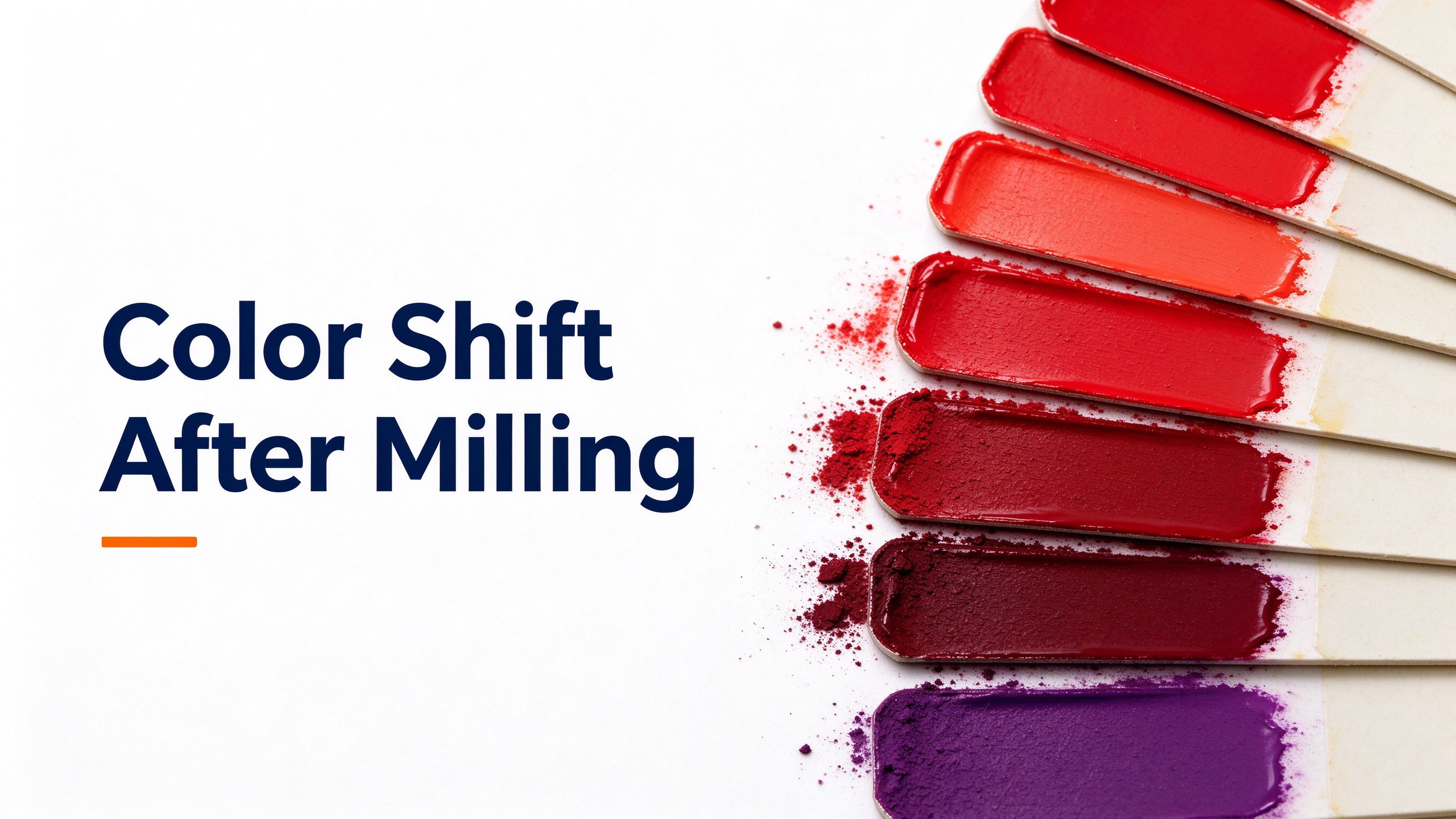
Few things frustrate a coatings or ink producer more than a batch that looks right out of the mill and then shifts color on the shelf or in the can. Color shift after milling is a real, measurable phenomenon with identifiable causes — and most of them are controllable at the process level. The shift is rarely "the mill changed the pigment chemistry" in a mysterious way; it is usually heat, oxidation, particle-size-driven optical effects, or contamination altering how light interacts with the coating. This guide walks through the mechanisms and the concrete fixes that keep color stable from mill to customer.
The Core Mechanisms of Post-Milling Color Shift
Color is an optical property: it depends on how pigment particles absorb, scatter, and reflect light. Anything that changes particle size, surface state, or the surrounding medium changes the color. The four dominant mechanisms are: (1) heat and oxidation during grinding, (2) particle-size reduction altering scatter (a finer grind often looks lighter or more saturated), (3) re-agglomeration or settling after milling, and (4) contamination or pH drift introducing a new hue. Research on milling methods shows that the milling type itself produces significant color differences, with pigment hue changing as particle structure is altered.
In practice, the shift you see "after milling" is often the sum of a small change during grinding plus a larger change during storage as the system relaxes. POLYC's application engineers treat color shift as a process signature, not a mystery, and trace it methodically across the 8,000+ systems we have shipped to 80+ countries since 2001.
Heat and Oxidation During Grinding
Grinding is energy-intensive and generates heat. For many pigments — especially some organic reds, blues, and certain iron oxides — heat plus exposure to air during milling or storage leads to partial oxidation or reduction that visibly changes hue. A pigment that mills fine but hot can emerge a slightly different shade than one milled cool, and the shift can continue as the batch sits in a warm warehouse.
The fix is temperature and atmosphere control. Use a jacketed, cooled milling chamber, monitor batch temperature, and avoid over-grinding (more passes than needed raises heat without benefit). For oxidation-sensitive pigments, consider inert blanketing or a closed, low-air-exposure bead mill. POLYC horizontal bead mills pair with jacketed vessels and controlled tip speed so the heat input is tuned to the pigment's stability limit — protecting both color and rheology.
Particle Size and the Optical Effect of Fineness
This is the most counterintuitive cause. Reducing particle size does not just make a pigment "finer" — it changes its optical scattering. Below a certain size, a pigment scatters less and the color can appear lighter, weaker, or shifted in undertone. Conversely, an under-milled batch with coarse agglomerates looks darker or duller. So the same pigment can shift simply because the grind is too fine or uneven batch to batch.
The lesson is to hold a tight, repeatable particle size distribution — not just a target D50 but a controlled D90 and span. A bead mill that delivers a narrow distribution will give more consistent color than one that varies pass to pass. Our particle size distribution guide explains how to set D10/D50/D90 acceptance limits that lock in color stability.
| Cause | What You See | Primary Fix |
|---|---|---|
| Heat / oxidation | Hue drift, darkening/lightening | Cool milling, inert blanketing |
| Over-fine grind | Lighter / weaker color | Control D50, avoid over-grinding |
| Re-agglomeration | Dullness, inconsistency | Proper dispersant, stabilization |
| Contamination / pH | New undertone, haze | Clean media, pH control |
| Milling method | Method-dependent shift | Standardize mill type & params |
Re-Agglomeration and Stabilization Failures
Even a perfectly milled batch can shift if the dispersion is not stabilized. Without the right dispersant and pH, milled particles re-agglomerate slowly in the can, changing scatter and therefore color over days or weeks. This "storage shift" is common and mistaken for a milling defect. The cure is formulation: match dispersant to the resin and pH, verify storage stability with accelerated tests, and confirm fineness does not climb during shelf life.
POLYC's dispersion resources (using TiO₂ as the classic example) cover how dispersant loading and stabilization prevent re-agglomeration. The same principles apply to organic and inorganic pigments: mechanical milling breaks agglomerates, but only the right stabilization keeps them apart.
Contamination, Media Wear, and pH Drift
Contamination is an underrated color-shift source. Worn steel liners or low-quality media shed metal or silica into the product, introducing a gray or yellow cast. A worn mechanical seal can leak lubricant. pH drift in waterborne systems changes pigment surface charge and thus color and stability. All of these are "silent" until the batch is compared to standard.
Prevent with dense, clean zirconia media and ceramic or carbide liners for sensitive pigments, a reliable seal package (POLYC backs mills with a 3-Year Warranty and sized seal kits), and routine pH checks. Treat media wear and seal integrity as color-quality variables, not just maintenance items — because for a white or pastel product, a few ppm of contamination is the whole difference.
Practical Prevention Checklist
To stop color shift after milling, standardize and control: (1) mill temperature with jacketed cooling and monitored tip speed; (2) a tight particle-size spec (D50 + D90 + span), not just median; (3) dispersant type and loading validated for storage stability; (4) inert or low-air exposure for oxidation-sensitive pigments; (5) clean, dense media and lined chambers; (6) pH control in waterborne systems; and (7) a documented, repeated milling recipe so batch variation disappears. Most "mysterious" shifts vanish once these are locked.
POLYC can trial your pigment on our mills and return not just fineness but color measurements (e.g., spectro L*a*b*) before and after milling and after accelerated storage, so you qualify the process with data. See the horizontal bead mill series and basket mill series for the equipment side.
A Step-by-Step Color-Shift Diagnostic
When a color-shift complaint arrives, resist the urge to blame the mill. Work the problem systematically. Step one: compare the shifted sample's CIELAB values to the standard and to a fresh batch to quantify the drift direction — lighter, darker, or hue-shifted. Step two: separate causes by re-measuring particle size; if D50 dropped or the distribution narrowed after milling, the shift is an optical fineness effect, and you simply over-ground. Step three: check batch temperature and any oxidation exposure; a hue drift toward yellow or brown in sensitive pigments points to heat or air.
Step four: inspect for contamination — run an ICP or simple ash test for metal or silica pickup from worn media or liners, which adds a gray cast. Step five: evaluate stability by re-measuring fineness and color after accelerated storage; if the shift appears only on the shelf, the failure is stabilization (dispersant or pH), not milling. Step six: confirm the milling recipe was actually repeated — tip speed, pass count, and media condition — because an unlogged parameter change is the most common "mystery." POLYC's trial service returns before/after and post-storage L*a*b* and PSD precisely so this diagnostic is data-driven rather than guesswork.
The payoff of this workflow is that it converts a vague complaint into a specific, fixable root cause — usually one of cooling, fineness control, stabilization, or contamination — and prevents the expensive habit of "just mill it more," which often makes the shift worse. For oxidation-sensitive pigments, add inert blanketing; for fineness-driven shifts, cap the grind; for stabilization failures, fix the dispersant. Each fix is cheap once the cause is named.
Frequently Asked Questions
Why does pigment color change after milling?
Because color is optical and depends on particle size, surface state, and medium. Milling changes particle size (altering light scatter), generates heat that can oxidize sensitive pigments, and if dispersion is not stabilized the particles re-agglomerate in storage — all of which shift the perceived color. Standardizing grind and stabilization controls it.
Can over-grinding cause color shift?
Yes. Reducing particles below the optimal size changes scattering and can make a color look lighter or weaker; it also adds heat that may degrade the pigment. Grind to a controlled D50 with a tight distribution rather than "as fine as possible," and avoid unnecessary extra passes.
Does the milling method affect color?
Research shows the milling method and particle structure produce significant color differences. Different mills and parameters yield different fineness, heat, and exposure, all of which influence hue. Standardizing the mill type and operating parameters is essential for repeatable color.
How do I prevent color shift in storage?
Ensure proper stabilization: the right dispersant at the right loading, controlled pH, and verified storage stability via accelerated testing. Also prevent contamination with clean dense media and lined chambers. A stable dispersion will not re-agglomerate and shift in the can.
Is heat during milling really that important?
For many pigments, yes. Heat plus air exposure during milling or storage can partially oxidize the pigment and shift hue. Cooled, jacketed milling and inert blanketing for sensitive pigments prevent this. Monitoring batch temperature is one of the cheapest, highest-impact controls available.
Designing a Color-Stable Process From the Start
The cheapest color-shift fix is the one you build in before the first batch, not the one you chase after a complaint. Design the process around four locked parameters: a maximum milling temperature with automatic interlock, a tight particle-size spec (D50 plus D90 and span) rather than a vague "fine enough," a validated dispersant and pH with documented storage stability, and clean, dense media with lined chambers for sensitive pigments. Standardize the milling recipe — tip speed, pass count, media condition, and addition rate — as a controlled procedure, not tribal knowledge, and verify it with periodic before/after color and fineness checks. For oxidation-sensitive pigments, design in inert blanketing from day one rather than bolting it on after a shift appears. POLYC builds mills and dispersers with the cooling, sealing, and control architecture these requirements demand, and our trial service returns L*a*b* and PSD data so you can qualify the process before production. A color-stable process is mostly discipline plus the right hardware, and both are achievable with intent rather than luck.
In practice, the plants that never see color complaints are the ones that treat these four controls as non-negotiable specifications rather than suggestions, and that verify them with data instead of eyeballing. A basket or bead mill is only as color-stable as the process wrapped around it; the hardware enables consistency, but discipline delivers it. POLYC's trial service is built to establish that discipline on your pigment before production, returning L*a*b* and PSD evidence you can baseline against and reproduce batch after batch.
Conclusion
Color shift after milling is almost always a controllable process signature — heat, oxidation, fineness-driven optics, re-agglomeration, or contamination — not a mystery defect. Lock in cooling, a tight particle-size spec, proper stabilization, clean media, and pH control, and the shift disappears. Since 2001, POLYC has built dispersion and grinding systems across 8,000+ installations in 80+ countries, with a 3-Year Warranty, and we qualify pigments with before/after color data so you ship consistent color with confidence.
Stop the color shift — qualify your process
Send us your pigment and a problem batch; we will run mill trials with color (L*a*b*) measurement before, after, and post-storage. Request a quote & lab trial »
Horizontal Bead Mill | PSD Guide | Dispersion Resource | Contact POLYC