
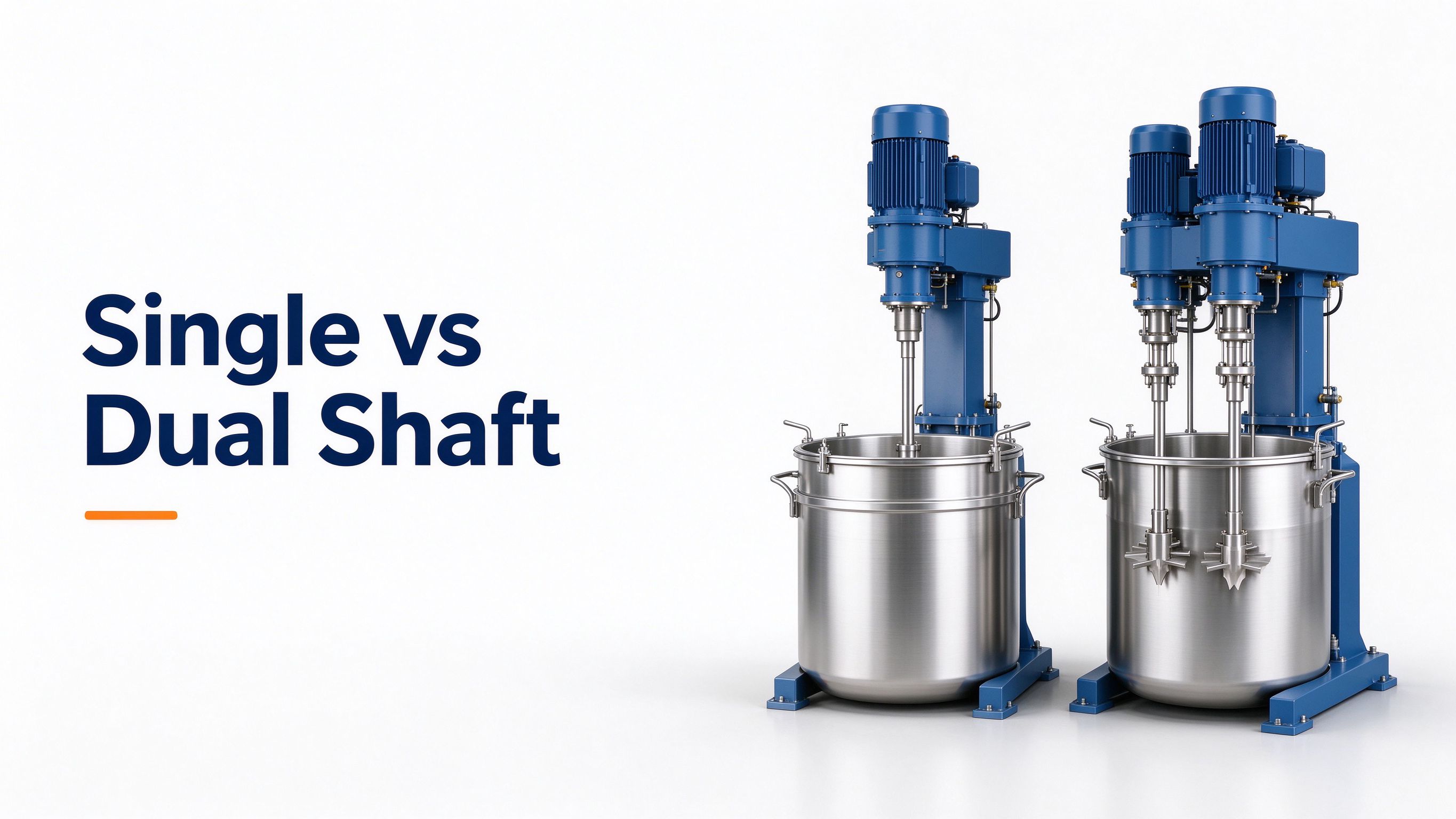
In any paint, ink, adhesive, or paste plant, the high-speed disperser is the workhorse that breaks pigment agglomerates before fine milling. The choice between a single shaft vs dual shaft disperser determines how fast you reach a mill-ready premix, how high a viscosity you can handle, and how much floor space and capital you commit. A single-shaft disperser is a high-speed impeller on one shaft; a dual-shaft unit combines that high-speed disperser with a separate low-speed anchor or mixer on a second shaft. This article compares them on action, viscosity range, batch time, homogeneity, cleaning, and cost so you can specify the right machine.
How a Single Shaft Disperser Works
A single shaft disperser mounts one high-speed shaft carrying a saw-tooth or serrated disc (the "disperser blade") that spins at 1,000–4,000 rpm, drawing material down and throwing it outward through the teeth to create intense localized shear. This is superb at wetting pigments and breaking soft agglomerates in low-to-medium viscosity liquids (roughly up to 50,000–100,000 cP depending on design). It is simple, robust, and cheap, which is why it is the default premixer in countless coating and ink plants.
The limitation is that a single shaft only does high-shear dispersion; it does not provide bulk movement or gentle folding of the batch. In a tall tank, material at the top and corners can stay unmixed unless the batch is well proportioned to the tank, and very high viscosities stall the disc. POLYC's single-shaft dispersers are built for exactly this premix role and pair cleanly with our bead mills for a complete grind line. For many products, this simplicity is all you need.
How a Dual Shaft Disperser Works
A dual shaft disperser adds a second, low-speed shaft — typically an anchor, paddle, or helical ribbon — that slowly folds the entire batch while the high-speed shaft disperses. The anchor scrapes the wall and bottom, eliminating dead zones, while the disperser blade does the shear work. Some designs use a low-speed mixer plus a high-speed emulsifier on the second shaft for particularly demanding emulsions.
The result is a machine that handles much higher viscosities (commonly up to 500,000 cP and beyond with the right anchor), produces a more homogeneous premix in less time, and reduces the need for manual tank entry to scrape walls. For thick paints, sealants, and high-solid paste, the dual shaft is often the difference between a smooth batch and a lumpy one. POLYC builds dual-shaft units with vacuum-capable jackets for degassing during mixing.
Viscosity Range and What It Decides
Viscosity is the single variable that most often settles the single shaft vs dual shaft disperser debate. Single-shaft units excel in low-to-medium viscosity where the disc can move material freely. Push the viscosity too high and the disc cavitates, draws excessive current, and fails to wet pigment evenly. Dual-shaft units, with the anchor providing bulk transport, stay effective into very high viscosities that would stall a single shaft.
If your products are thin stains, inks, or standard architectural paints, a single shaft is usually perfect and economical. If you run high-solid industrial coatings, adhesives, or thick pastes, the dual shaft pays for itself by eliminating unmixed zones and shortening cycle time. The comparison table below summarizes the split.
| Factor | Single Shaft Disperser | Dual Shaft Disperser |
|---|---|---|
| Shafts / action | One high-speed disc | High-speed disc + low-speed anchor |
| Viscosity range | Low to medium (up to ~100k cP) | Medium to very high (up to ~500k+ cP) |
| Batch homogeneity | Good in well-proportioned tanks | Excellent; no dead zones |
| Cycle time | Longer for thick batches | Shorter, folds entire batch |
| Capital cost | Lower | Higher |
| Best fit | Inks, stains, architectural paint | High-solid coatings, adhesives, paste |
Batch Time, Homogeneity, and Quality
Because the dual shaft continuously folds the batch, pigment and resin reach a uniform state faster, and there is far less reliance on operator skill to "find" the right disc position. Single-shaft batches can be just as good when formulated and proportioned correctly, but they are more sensitive to tank geometry and operator technique. For consistent, repeatable premix across shifts, the dual shaft removes a variable.
Quality downstream also improves: a well-dispersed premix means the bead mill works less and lasts longer, lowering media and energy cost. POLYC sees this repeatedly across 8,000+ systems — investing in a better disperser often reduces the load (and wear) on the mill. Our selection guide covers how premix quality affects total grinding cost.
Cleaning, Footprint, and Maintenance
Single-shaft dispersers are simpler to clean — one shaft, one disc, easy to lift out. Dual-shaft units have more components (anchor, second seal, often a complex drive), so cleaning and maintenance take longer, and the footprint is larger because the two shafts and tank must be arranged to avoid interference. For multi-product plants with frequent changeovers, the single shaft's simplicity is a real advantage.
That said, dual-shaft designs with jacketed, vacuum-capable tanks and CIP spray balls close much of the cleaning gap, and the time saved in mixing often outweighs the extra wash effort. POLYC offers both with 3-Year Warranty coverage and provides changeover-friendly options; see the single-shaft disperser series and the dual-shaft mixer series.
Cost and When Dual Shaft Is Worth It
A single-shaft disperser is cheaper to buy and maintain, which makes it the rational choice for low-to-medium viscosity, single-product or simple multiproduct plants. The dual shaft costs more but earns it back through shorter cycle times, fewer rejects from unmixed zones, and the ability to process high-viscosity products you could not otherwise make. If your portfolio is moving toward high-solid or high-viscosity formulations, buying dual-shaft capability ahead of need is usually cheaper than retrofitting later.
Since 2001, POLYC has equipped plants in 80+ countries with dispersers matched to their real viscosity and throughput, backed by a 3-Year Warranty. The decision should follow your product's viscosity distribution and batch-size mix — not a generic "bigger is better" assumption.
Scale-Up and Integration With Downstream Equipment
Choosing a disperser is never an isolated decision — it sets up everything downstream, especially the mill. A well-dispersed premix means the bead mill works less, wears media slower, and reaches target fineness in fewer passes; a poor premix forces the mill to do de-agglomeration it is inefficient at, burning media and energy. This is why the single vs dual shaft decision should be made together with your milling plan, not separately. POLYC routinely specs disperser and mill as one line so the premix viscosity and solids loading arrive at the mill optimized for its chamber.
Scale-up from a lab disperser to production follows a simple rule: keep tip speed and power density (kW per liter of batch) constant, and preserve geometric similarity of the tank-to-shaft ratio. A common failure is scaling by volume alone while letting tip speed drop, which silently ruins dispersion. Dual-shaft units scale more predictably into high-viscosity production because the anchor maintains bulk movement at every size; single-shaft units can stall at scale if the batch is too thick for the disc. Document the lab recipe's tip speed, dispersion time, and final fineness, then reproduce those parameters, not just the formula, on the plant machine.
Integration also means controls and utilities: variable-frequency drives for tip-speed control, jacketed tanks for temperature, and — for the dual-shaft — a robust second-shaft seal and gearbox rated for your duty. POLYC builds dispersers that bolt into turnkey skids with the mill, feed tank, pump, and cooling on one control platform, which removes the interface guesswork that causes most scale-up surprises. Since 2001 across 8,000+ systems in 80+ countries, this integrated approach has proven the most reliable path from pilot to plant.
Frequently Asked Questions
What are the three main types of mixers relevant here?
For dispersion duty, the three common types are the single-shaft high-speed disperser (shear only), the dual-shaft disperser (high-speed disc + low-speed anchor for bulk folding), and the triple/planet design for very high viscosity. Each scales to a different viscosity and homogeneity requirement; choose by your thickest, most demanding product.
What viscosity can a single shaft disperser handle?
Single-shaft high-speed dispersers typically handle low-to-medium viscosities, roughly up to 50,000–100,000 cP depending on disc size, motor power, and tank design. Above that, the disc stalls or cavitates. For higher viscosities, move to a dual-shaft or anchor-assisted design.
When should I choose a dual shaft disperser?
Choose dual shaft when your products are high-viscosity (pastes, high-solid coatings, adhesives), when batch homogeneity is critical across shifts, or when you want shorter cycle times with less operator dependence. The low-speed anchor eliminates dead zones that a single shaft leaves behind.
Is a dual shaft disperser harder to clean?
Yes, somewhat — there are two shafts, an anchor, and often a more complex drive and seal. But jacketed, vacuum, CIP-ready designs reduce this penalty, and the mixing-time savings usually offset the extra wash effort. Single-shaft units remain simpler and faster to clean for frequent changeovers.
Which is more cost-effective overall?
Single shaft is cheaper to buy and maintain and ideal for low-to-medium viscosity. Dual shaft costs more but reduces cycle time, rejects, and lets you process high-viscosity products. The breakeven is your product viscosity mix and batch volume — model it before choosing.
Disperser Blade Geometry: Saw-Tooth vs Wing vs Flag
The high-speed shaft is only as good as the blade on its end, and blade choice is a real variable buyers overlook. The classic saw-tooth (serrated disc) blade is the generalist: it throws material outward through its teeth to create intense localized shear, ideal for wetting pigments and breaking soft agglomerates in most coatings and inks. A wing or turbo blade pushes more bulk flow with slightly less intense shear, suiting higher-viscosity pastes where you need both movement and dispersion from one impeller. A flag (paddle) blade on the low-speed shaft of a dual-shaft unit folds the batch and scrapes the wall rather than shearing. Matching blade type and diameter to the tank and viscosity is what turns a rated "disperser" into a machine that actually reaches fineness in the quoted time. POLYC selects blade geometry per application and includes the recommended tip speed and power density in the quote, so the disperser arrives tuned rather than generic — which is the difference between a premix that feeds the mill efficiently and one that forces the mill to redo its work.
Conclusion
The single shaft vs dual shaft disperser decision is fundamentally about viscosity and homogeneity. Single-shaft units are the economical, simple choice for inks, stains, and standard paints; dual-shaft units earn their higher cost on high-viscosity, high-homogeneity, and high-throughput lines. POLYC has matched dispersers to real processes since 2001 across 8,000+ systems in 80+ countries, with a 3-Year Warranty on the equipment we build.
Spec the right disperser for your viscosity
Tell us your product viscosity, batch size, and formulation and we will recommend single or dual shaft with a cycle-time estimate. Request a quote & lab trial »
Single Shaft Disperser | Dual Shaft Mixer | Selection Guide | Contact POLYC