
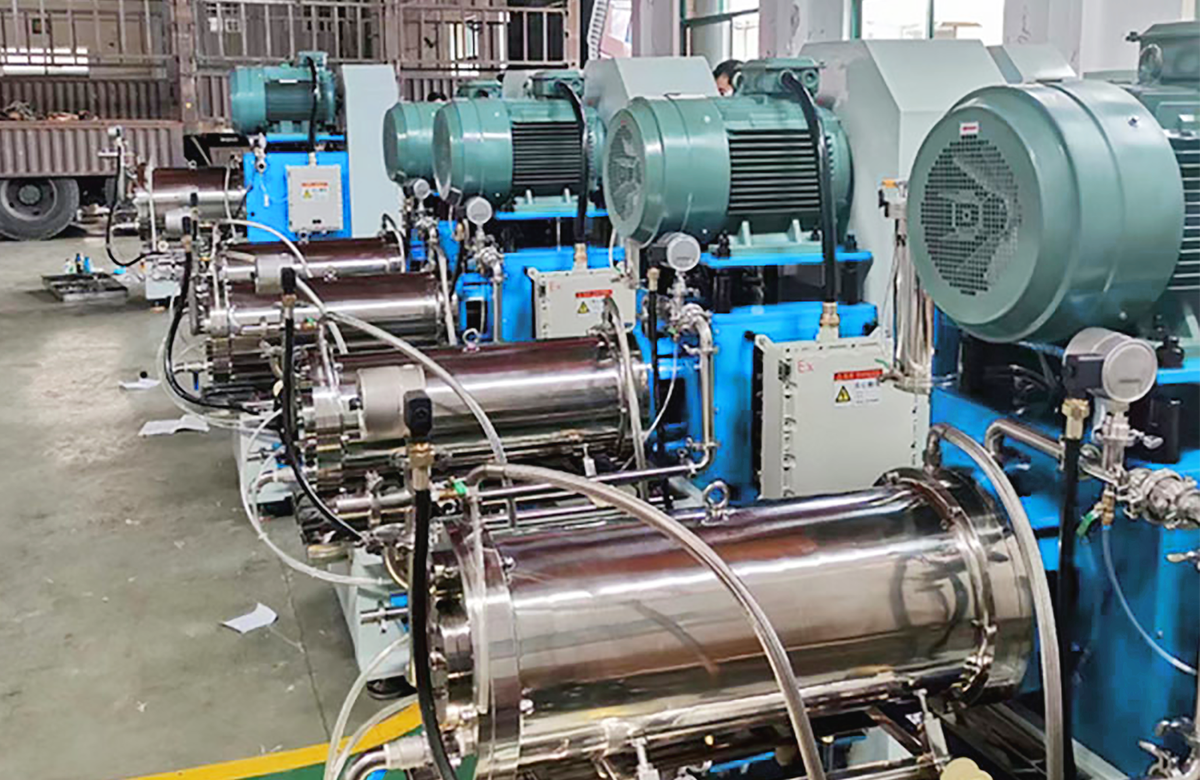
Choosing a bead mill manufacturer is a procurement decision that affects years of uptime. POLYC outlines the four points every buyer should check: equipment stability, component materials, grinding fineness and efficiency, and after-sales. POLYC has built bead mills since 2001.
1. Equipment Stability
Stability means low fault rates and no long downtime over time. It is driven by rational internal design and sound material selection for key parts. POLYC equipment leads the industry here: a PZB-series bead mill installed at a water-based paint factory in 2017 has run stably for more than five years with no maintenance.
2. Component Materials
Check the mechanical seal (leakage risk) and the wear rate and material of core components. POLYC uses double-end mechanical seals with safe, reliable compatibility between lubricating fluid and product, and imports bearings, transfer pumps, belts and pulleys as standard parts.
3. Fineness, Efficiency and Energy
Match the maker's capability to your required fineness, and benchmark efficiency and energy use against reference cases to avoid high-consumption, low-efficiency machines. POLYC's PZN series can use grinding media below 0.1 mm and grind materials to the nanometer level.
4. After-Sales Service
Installation, debugging and operation support, first-time problem solving and a professional technical team all protect your mill's performance. POLYC backs every machine with a 3-Year Warranty and application engineering.
POLYC Bead Mill Range
- Pin-Type Bead Mill for high-throughput ultrafine milling.
- CeramicPU Pin-Type Nano Bead Mill for nano fineness.
- Dynamic Disc Horizontal Bead Mill for stable production.
- Basket Mill for flexible small batches.
- Vertical Pin-Type Bead Mill for compact lines.
| Checklist item | What to verify |
|---|---|
| Stability | Design, key-part materials, reference runtime |
| Components | Double-end seal, imported standard parts |
| Fineness | Media <0.1 mm, nano capability |
| After-sales | Install, debug, 3-Year Warranty |
The Technology Behind How to Choose a Bead Mill Manufacturer: A Procurement Checklist
Advances discussed at How to Choose a Bead Mill Manufacturer: A Procurement Checklist only pay off on the factory floor when the grinding and dispersion step is controlled. Whether the material is a nano pesticide, a solid-state battery material or a ceramic slurry, the same physics applies: agglomerates must be broken down to a stable, narrow particle-size distribution without overheating the product. POLYC's bead mills and high-shear dispersers are built around that requirement, with temperature control and separator design that protect heat-sensitive formulations during long production runs.
From Lab Result to Volume Production
A promising lab result is not a production line. Scaling up usually exposes viscosity, cooling and feeding problems that a small batch hides. POLYC's engineers run the customer's actual material on lab equipment first, then specify the production machine and the supporting pre-mix and let-down steps so the same process knowledge carries from the bench to the plant. That continuity is what keeps fineness and yield consistent when output grows by orders of magnitude.
How POLYC Equipment Applies
For laboratories and pilot lines, POLYC's Basket Mill grinds and disperses in one vessel and is easy to clean between samples, while the Pin-Type Bead Mill scales the same process to nano-range fineness. Producers moving from R&D to volume can keep the same process knowledge while stepping up machine size, which shortens the path from a promising material to a shippable product.
| Development stage | Suitable POLYC machine |
|---|---|
| Screening and samples | Basket Mill |
| Pilot batches | Lab pin-type bead mill |
| Volume production | Horizontal bead mill or turnkey line |
POLYC's Engineering Support
POLYC MACHINE has engineered dispersion and grinding systems since 2001, with more than 8,000 systems delivered to over 60 countries and a 3-year warranty. Application engineers run customer materials on lab equipment before quoting, so the recommended machine is matched to the real behavior of the product, not a generic specification, and the trial data travels with the order into commissioning.
Standards and Quality POLYC Builds To
POLYC machines are built to CE requirements with contact parts in stainless steel appropriate to the product, explosion-proof motors and seals where solvents are present, and documented factory acceptance testing. For technology buyers, those standards are the unglamorous guarantee that a machine demonstrated at a conference will still perform after years of continuous operation in a real plant.
Take the Next Step with POLYC
If How to Choose a Bead Mill Manufacturer: A Procurement Checklist is relevant to your operation, POLYC's engineering team can review your product, target fineness and throughput and propose a machine or line matched to your process. With more than 8,000 systems delivered to over 60 countries since 2001 and a 3-year warranty on core machines, the recommendation is backed by a track record, not just a brochure.
Frequently Asked Questions
What should I check in a bead mill maker?
Stability, component materials (seals, wear parts), achievable fineness and efficiency, and after-sales support. POLYC addresses all four.
Why choose POLYC?
Proven five-year-plus stable installs, double-end mechanical seals, imported standard parts, nano capability (PZN) and a 3-Year Warranty.
How fine can POLYC bead mills grind?
The CeramicPU and PZN-series mills grind to the nanometer level with media below 0.1 mm.
Talk to a POLYC Engineer
POLYC MACHINE has delivered 8,000+ systems to 60+ countries since 2001, with a 3-Year Warranty. Share your fineness and throughput for a bead mill recommendation.