
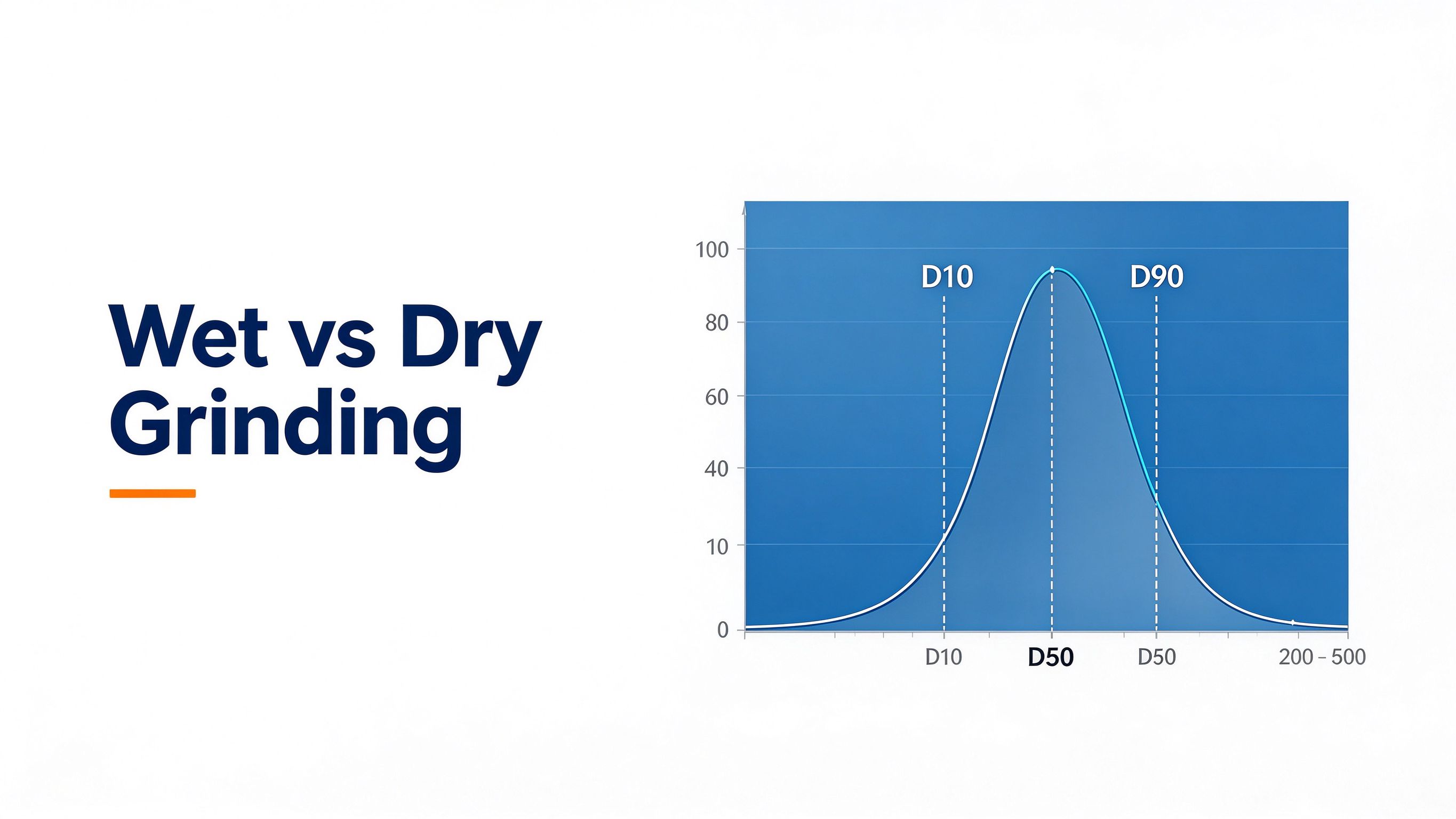
When specifying a grinding process, two questions dominate: should you grind wet or dry, and how do you prove the result is good? The answers meet in particle size distribution. The wet vs dry grinding d10 d50 d90 relationship determines whether your product meets spec, and misunderstanding it leads to costly rework. D10, D50, and D90 are percentile markers on the cumulative size distribution — they describe not a single number but the spread of particle sizes. This article explains what these metrics mean, how wet and dry milling change them, and how to choose the method for your material.
What Are D10, D50, and D90?
Particle size distribution (PSD) describes what fraction of particles fall below a given diameter. D10 means 10% of the particles are smaller than this diameter; D50 (the median) means half are smaller and half are larger; D90 means 90% are smaller. Together they describe both the central size and the width of the distribution. A small gap between D10 and D90 means a narrow, uniform distribution; a large gap means a broad mix of fine and coarse particles.
These volume-based percentiles matter more than any single "average" because downstream behavior — packing density, reactivity, color strength, flow — depends on the tails. A coarse D90 tail in a coating causes surface defects; a broad distribution in a battery electrode causes uneven density. Understanding D10/D50/D90 is the foundation of any grinding specification, which is why we devoted a full particle size distribution guide to reading the curve.
Wet Grinding: How It Works and What It Does to PSD
Wet grinding disperses solids in a liquid using beads or other media (as in a bead mill). The liquid lubricates particle fracture, carries heat away, and — critically — keeps particles separated so they do not re-agglomerate. Wet dispersion, often aided by a surfactant and controlled ultrasonication, addresses the clustering that skews dry measurements. The result is typically a finer D50 and a tighter distribution (smaller D90–D10 span) than dry grinding for the same energy.
Research consistently shows wet grinding reaches much smaller particle sizes than dry. In one study, wet grinding reduced particles to about D50 ≈ 2 µm and D90 ≈ 4–5 µm, whereas dry grinding stalled at coarser sizes. For pigments, ceramics, and battery materials, wet milling is the route to sub-micron and nano fineness with controlled distribution. POLYC's bead mills are purpose-built wet grinders; our wet vs dry resource compares energy and outcomes.
Dry Grinding: How It Works and Its Limits
Dry grinding uses mechanical impact and compression (ball mills, jet mills, roller mills) without a liquid carrier. It avoids the cost and complexity of a liquid phase and a downstream drying step, which is attractive for materials that tolerate coarser sizes or where adding liquid is undesirable. But dry grinding has hard physical limits: particles tend to re-agglomerate as they fracture, heat builds up, and the energy does not translate into fineness as efficiently as in wet systems.
For many bulk minerals and coarse powders, dry grinding is perfectly adequate and economical. But when the target is fine or ultra-fine with a tight distribution, dry grinding struggles and wet grinding wins decisively. The choice is not ideological — it follows from your fineness target and whether a liquid phase is acceptable in your process.
| Aspect | Wet Grinding | Dry Grinding |
|---|---|---|
| Typical D50 reachable | Sub-micron to nano | Coarser (µm range, limited fine tail) |
| Distribution width | Narrow (tight D10–D90) | Broader, more re-agglomeration |
| Heat management | Liquid carries heat away | Heat builds, can damage material |
| Extra steps | Needs dewatering/drying | No liquid phase, no drying |
| Best application | Pigments, inks, batteries, pharma | Bulk minerals, coarse powders |
Distribution Width Matters More Than the Median
Engineers fixate on D50, but the span (D90–D10, sometimes expressed as "span" = (D90−D10)/D50) often predicts product quality better. A narrow distribution means consistent behavior; a wide one means a coarse tail that causes defects even when the median looks fine. Wet grinding's ability to suppress re-agglomeration is precisely why it produces the narrow distributions high-end applications demand.
When you set a grinding spec, define not just D50 but also an upper limit (D90) and a lower/uniformity target. For coatings and inks, cap D90 to avoid grit; for battery materials, tighten the span for uniform electrode density. POLYC trials report full D10/D50/D90 so you can judge distribution, not just the median — see our PSD guide for how to set acceptance limits.
Contamination, Energy, and Total Cost
Dry grinding can introduce contamination from mill liners and media and offers no liquid to suppress dust — a workplace and yield hazard. Wet grinding avoids dust and, with dense zirconia media and ceramic liners, keeps contamination极低. On energy, wet grinding can use less energy per unit of output to reach a given fineness, but you must then dewater or dry the slurry, which can erase the saving if drying is expensive or the product is moisture-sensitive.
The total-cost question is therefore material-specific: moisture-tolerant, fine-target products favor wet; coarse, moisture-sensitive, or bulk products favor dry. POLYC's 8,000+ systems shipped to 80+ countries since 2001 span both, and our engineers will model energy plus drying cost for your specific case rather than assume one method is universally cheaper.
How to Choose: A Decision Checklist
Answer these in order: (1) What D50 and D90 must you hit? If sub-micron/nano, choose wet. (2) Is a liquid phase acceptable, or is the product moisture-sensitive? If sensitive, dry may be forced. (3) Is dust a hazard or yield loss in your plant? Wet suppresses it. (4) Can you absorb a dewatering/drying step? If not, dry may win despite coarser output. (5) What does the full energy + drying cost model say? Let the numbers decide.
For the majority of fine-powder and pigment applications we see, wet grinding with a bead mill is the performance choice, while dry grinding remains king for coarse bulk minerals. POLYC's wet vs dry resource and selection guide give you the worksheets to quantify the decision before committing capital.
How D10, D50, and D90 Are Actually Measured
The numbers are only as trustworthy as the method that produces them, and buyers should know how D10/D50/D90 are generated. The classic approach is sieve analysis for coarse dry powders, but it is slow, limited to larger sizes, and poorly suited to fine or wet samples. Laser diffraction is the modern standard: it shines a laser through a dispersed sample and infers a size distribution from the scattering pattern. It is fast and covers a wide range, but it assumes a particle shape model and can misread agglomerates or mixed compositions, so sample preparation — especially dispersion — dominates the result.
Imaging methods count and size individual particles from microscopy, giving direct, shape-aware data but covering tiny sample volumes that may not represent the bulk. Dynamic light scattering handles the nano range but assumes spherical, well-dispersed particles. The key point for wet vs dry grinding is that the measurement itself should match the process: measure wet samples in a wet dispersion cell, because drying a sample before measuring can re-agglomerate it and report a falsely coarse distribution — exactly the artifact that makes dry grinding look worse than it is.
For quality control, standardize one method and one sample-prep protocol, then trend the percentiles over time rather than chasing absolute numbers between instruments. A well-run laser diffraction setup with controlled wet dispersion is what POLYC uses in trials to report honest D10/D50/D90 on your material, so the comparison between wet and dry routes is fair. Our PSD guide walks through setting measurement and acceptance standards your lab can replicate.
Where the Wet and Dry Paths Meet in a Real Plant
Few production lines are purely wet or purely dry. A mineral processor may crush and dry-grind to a coarse specification and then switch to wet milling for a fine grade. A coatings plant almost always wet-grinds its pigment dispersion but dry-blends extenders. When you read a PSD specification, check which step it describes. A D90 quoted for milled slurry is not the number you will measure after spray drying, because drying reintroduces agglomerates that the wet measurement never saw.
Two practical consequences follow. First, specify the measurement method alongside the target: laser diffraction on a diluted slurry will not reproduce a sieve result on dried granules, and the two numbers can differ by a factor that matters commercially. Second, decide where the fineness has to be achieved. If the specification is set at the dry end, wet grinding earlier in the route is often wasted energy; if it is set on a liquid product, dry grinding upstream merely creates work for the mill downstream.
For the equipment side of that decision, the practical differences between chamber orientations are set out in our guide to horizontal versus vertical sand mills. The media-selection logic that fixes your achievable distribution is in the bead mill specifications and selection guide. If your product is a pigment or ink dispersion rather than a bulk mineral, a horizontal bead mill is the usual reference machine for the wet stage, while laboratory and small-batch work is more often handled by a basket mill and coarser dry feeds by a pin-type bead mill running a wider media charge.
Frequently Asked Questions
What do D10, D50, and D90 mean in particle size distribution?
They are cumulative volume percentiles: D10 is the diameter below which 10% of particles fall, D50 is the median (50% below), and D90 is the diameter below which 90% fall. Together they describe both the central size and the width of the distribution. The gap between D10 and D90 indicates uniformity — smaller is tighter.
What is the difference between wet and dry milling?
Wet milling grinds solids suspended in a liquid using media; dry milling uses impact/compression with no liquid. Wet reaches finer sizes with narrower distributions and suppresses dust and re-agglomeration, but needs a dewatering/drying step. Dry avoids liquid and drying but stalls at coarser sizes with broader distributions.
Why is wet grinding finer than dry grinding?
In wet grinding the liquid lubricates fracture and, with surfactant and shear, keeps particles separated so they cannot re-agglomerate. Dry grinding lets fractured particles clump back together and builds heat, so energy does not convert to fineness efficiently. Studies show wet can reach D50 around 2 µm where dry cannot.
How do I interpret a particle size distribution curve?
Read the cumulative curve at the 10%, 50%, and 90% marks to get D10/D50/D90, then look at the slope between them — a steep, narrow curve means uniform particles; a shallow, wide one means a broad mix. For quality control, set both a median target and an upper limit (D90) to catch coarse tails that cause defects.
Is wet grinding more energy efficient than dry?
Per unit of output to a given fineness, wet grinding often uses less grinding energy because it reaches fineness more efficiently and suppresses re-agglomeration. However, you must add dewatering or drying energy. The true comparison is total process energy including any drying step, which is material-dependent.
Industry Examples: When Each Method Wins
The wet-vs-dry decision becomes concrete when mapped to industries. Coatings and inks almost always choose wet, because they need fine, narrow distributions and cannot tolerate a coarse tail or dust, and the liquid vehicle is already part of the product. Battery electrode materials choose wet for the same reason plus contamination control — a few ppm of metal from dry milling can ruin cell performance, while a lined wet bead mill keeps the slurry clean. Pharmaceuticals and many ceramics choose wet to reach nano fineness with tight distribution. Bulk minerals, cement, and coarse industrial powders, by contrast, often stay dry: the product tolerates coarser sizes, moisture is undesirable, and avoiding a dewatering step protects margin. The pattern is consistent — fine, pure, and distribution-critical favors wet; coarse, moisture-sensitive, and bulk favors dry. POLYC supplies wet bead mills for the former and will model the energy-plus-drying trade-off honestly when a product sits on the boundary, so the method follows the physics and the economics rather than habit.
Conclusion
D10, D50, and D90 are not trivia — they are the language of grinding quality, and the wet vs dry choice rewrites them. Wet grinding delivers finer medians and tighter distributions by suppressing re-agglomeration and heat; dry grinding avoids liquid and drying but caps fineness. For fine pigments, inks, batteries, and pharma, wet is usually right; for coarse bulk minerals, dry still wins. Since 2001, POLYC has built 8,000+ grinding systems across 80+ countries, backed by a 3-Year Warranty, and will model the full energy-and-drying cost for your material.
Model wet vs dry for your material
Tell us your target D50/D90 and product sensitivity, and we will run trials and a full energy-plus-drying cost comparison. Request a quote & lab trial »
Horizontal Bead Mill (Wet) | PSD Guide | Wet vs Dry Resource | Contact POLYC