
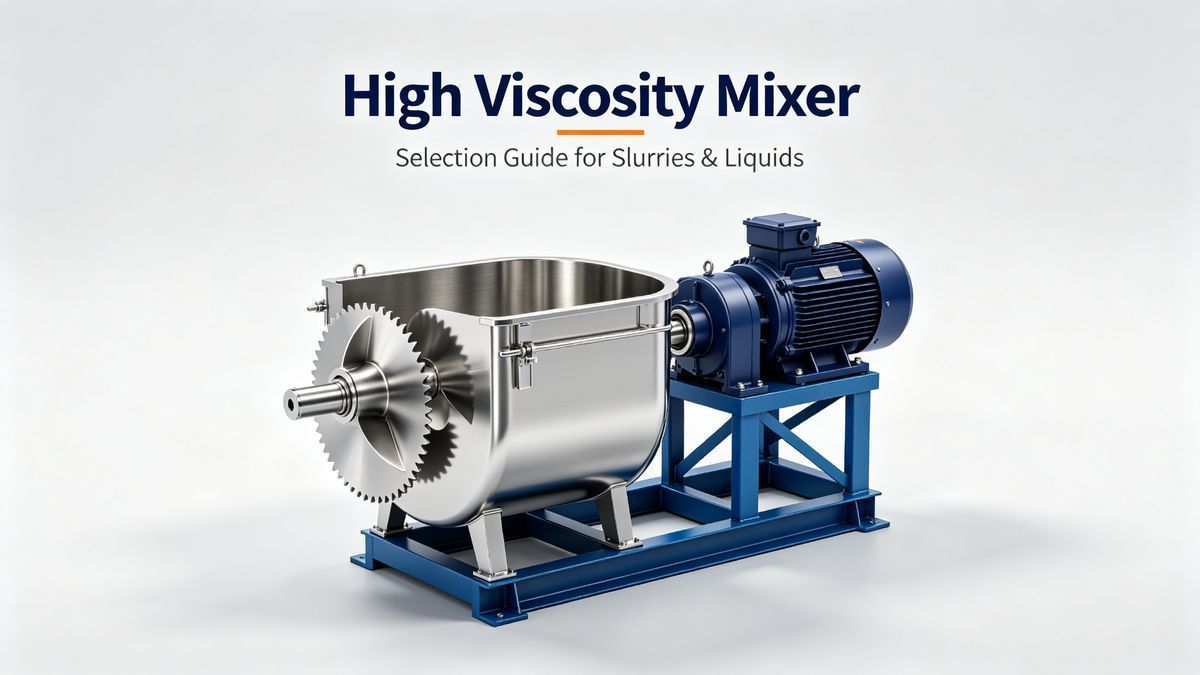
High viscosity mixing is governed by a different principle from dispersion. Below roughly 50,000 cP, material flows readily to a high-shear disc and the problem is one of shear. Above that, circulation breaks down and the machine must instead physically carry material through the vessel.
This makes agitator geometry rather than installed power the basis of selection. Planetary mixers orbit agitators through the batch and serve the stiffest compounds. Butterfly and concentric designs combine scraping with dispersion for the mid-range. Three shaft configurations add coverage for larger vessels and heavier fills.
This guide sets out the specifications that matter for each configuration, including viscosity range, torque sizing, sealing, heating and cooling, and maintenance requirements. POLYC MACHINE builds all of these types and specifies them from measured rheology, drawing on 25 years of application experience.
Send your rheology curve and batch requirements through the inquiry form, and POLYC MACHINE will specify agitator geometry, torque and thermal provision for your product.
Key Takeaways
- Select by agitator geometry and torque, not by vessel volume or motor power
- Planetary mixers serve compounds well beyond 1,000,000 cP; butterfly and concentric serve the mid-range
- Torque must be sized from the full rheology curve at working temperature
- Sealing, heating, cooling and discharge provisions should be specified at purchase
- Scraper and wall-contact components are scheduled wear items, not fit-and-forget parts
Viscosity Ranges by Mixer Type
The first selection step is placing your product on the viscosity scale, because each mixer type has a range where it is the correct choice. Using a machine outside its range produces slow batches, motor trips or unmixed material rather than merely slower processing.
Butterfly double shaft mixers, combining a wall-scraping agitator with a high-speed dispersing shaft, are typically specified up to around 150,000 cP. Concentric double shaft mixers, pairing an outer anchor with an inner dispersing shaft, reach a comparable range in a more compact arrangement with simpler sealing.
Three shaft configurations extend the practical range to roughly 300,000 cP by adding coverage and distributing load across agitators. They suit stiff plasters, renders and heavy filled compounds in larger vessels.
Planetary mixers serve the stiffest duties, specified well beyond 1,000,000 cP when torque is sized correctly. For mastics and compounds with high yield stress, planetary geometry is usually the only reliable option because it moves material rather than waiting for it to flow.
Torque Sizing and Drive Protection
Torque, not vessel volume, sets the practical limit for high viscosity mixing. The drive must be sized from the full rheology curve measured at working temperature, with margin for startup load and batch-to-batch variation.
Where viscosity changes substantially during the cycle, for example as filler is incorporated or as the product cools, the curve through the whole cycle should be provided rather than a single value. Sizing for the worst case avoids the nuisance trips that otherwise occur at predictable points in every batch.
Drive protection should include torque monitoring, overload protection and controlled ramp-up. These protect the mechanical components during startup against cold, stiff material, which is when most overload events occur.
Variable speed control is standard and valuable. It allows slow incorporation of filler at low speed, higher speed for dispersion stages where appropriate, and controlled slow speed during vacuum deaeration if fitted.
Agitator Geometry and Wall Contact
At high viscosity the agitator must move material rather than rely on it flowing to the tool. Wall scrapers prevent the stagnant insulating layer that otherwise forms on the vessel wall, which both improves mixing and substantially improves heat transfer.
Scraper and wall-contact components are wear items. They run against the vessel surface and require periodic adjustment or replacement, so they should be specified deliberately with material and adjustment provision rather than treated as an afterthought.
Planetary configurations may use one, two or three agitators depending on rheology. Additional agitators improve turnover for stiffer products, but they also increase capital cost, energy input and cleaning time, so the minimum effective number is usually best.
Interchangeable vessels raise utilisation on planetary mixers by allowing the next batch to be prepared while the previous one is being mixed, and they simplify cleaning by moving it away from the machine.
Sealing, Vacuum, Heating and Cooling
Sealing selection depends on whether the process runs under vacuum. Vacuum-rated shaft seals, gasketed vessel closures and sealed feed ports are required for deaeration, and regular seal inspection is the main maintenance item in vacuum service.
Vacuum is specified for sealants and reactive systems because entrained air causes bubbles and pinholes, and because residual moisture causes premature curing in polyurethane and silicone chemistry. Typical working levels fall in the range of 1 to 30 mbar depending on the formulation.
Heating and cooling are provided through a jacketed vessel, and sometimes a jacketed bottom, connected to a heating and cooling unit sized for the thermal duty. Reactive compounds generate exotherm that must be removed, so cooling capacity is as important as heating capacity.
Product temperature should be monitored in the mass and interlocked to the drive, so the batch can be slowed or cooled automatically if it exceeds the set limit. This protects product quality and operator safety during reactive compounding.
Applications, Maintenance and Discharge
Typical duties include silicone and MS polymer sealants, polyurethane structural adhesives, two-component epoxies, mastics and butyl compounds, battery electrode slurry, solder paste, dental composites, cosmetic creams and heavy food pastes.
Maintenance covers scraper adjustment and replacement, seal inspection, gearbox oil checks, and verification of agitator clearance and alignment. Keeping a short maintenance record makes gradual changes visible before they affect product quality.
Discharge must be planned from the outset. Stiff compound will not gravity-feed, so a hydraulic discharge press or screw discharge is normally required, integrated with cartridge, pail or drum filling to avoid manual handling and product loss.
Where several products are made on one machine, a documented cleaning and changeover procedure protects both quality and capacity. Changeover time frequently determines effective output more than mixing speed does.
Technical Specifications
| Parameter | Specification |
|---|---|
| Butterfly and concentric range | up to approximately 150,000 - 200,000 cP |
| Three shaft range | up to approximately 300,000 cP |
| Planetary range | well beyond 1,000,000 cP with correct torque sizing |
| Drive sizing basis | full rheology curve at working temperature, worst case with margin |
| Vacuum where fitted | typically 1 - 30 mbar depending on formulation |
| Thermal provision | jacketed vessel with heating and cooling, product temperature interlock |
| Discharge | hydraulic press or screw discharge for stiff compound |
Troubleshooting Guide
1. Bulk material does not move around the disc
Cause: Viscosity above the range where flow to the agitator occurs
Solution: Move to a butterfly or concentric mixer with wall scraping, or a planetary mixer for stiffer compounds
2. Motor trips or slows under load
Cause: Drive undersized for peak viscosity, or ramp-up too fast on cold material
Solution: Provide the full rheology curve for sizing and use controlled ramp-up with torque monitoring
3. Heating or cooling cycles take too long
Cause: Stagnant insulating layer at the vessel wall, or thermal unit undersized
Solution: Ensure scraper contact is correctly adjusted and size the heating and cooling unit to the actual thermal duty
4. Bubbles in finished sealant
Cause: No vacuum stage, or vacuum level inadequate for the formulation
Solution: Specify vacuum capability and validate level and hold time against your formulation during commissioning
5. High product residue at discharge
Cause: Stiff compound cannot gravity-feed and discharge was not specified
Solution: Add a hydraulic discharge press or screw discharge and integrate it with the filling equipment
Frequently Asked Questions
1. How do I choose the right high viscosity mixer?
Start from viscosity. Butterfly or concentric designs suit up to roughly 150,000 cP, three shaft configurations reach around 300,000 cP, and planetary mixers serve compounds well beyond 1,000,000 cP. Then size torque from the full rheology curve rather than from vessel volume.
2. Why is torque more important than motor power?
Torque determines whether the agitator can move the material at all. Power without sufficient torque at working speed simply trips or stalls. Sizing from the full rheology curve at working temperature, with margin for startup load, is what prevents slow batches and nuisance trips.
3. Do I need vacuum on a high viscosity mixer?
For sealants, reactive adhesives and appearance-critical products, yes. Vacuum removes entrained air and moisture in the mixing vessel, preventing bubbles and premature curing. Typical working levels fall between 1 and 30 mbar depending on the formulation.
4. What heating and cooling provision is needed?
A jacketed vessel connected to a heating and cooling unit sized for the actual thermal duty. Reactive compounds generate exotherm that must be removed, so cooling capacity matters as much as heating. Product temperature should be monitored and interlocked to the drive.
5. How is stiff compound discharged?
It will not gravity-feed, so a hydraulic discharge press or screw discharge is normally required. Integrating discharge with cartridge, pail or drum filling gives a continuous path from mixer to package with minimal residue and no manual handling.
6. What maintenance does a high viscosity mixer need?
Scraper adjustment and replacement, seal inspection, gearbox oil checks, and verification of agitator clearance and alignment. Scrapers and wall-contact parts are scheduled wear items rather than fit-and-forget components, and a short maintenance record makes gradual changes visible.
7. Can one machine handle several products?
Yes, with a documented cleaning and changeover procedure. Because changeover time often determines effective output more than mixing speed, evaluate machines on cleaning access and drainage as seriously as on mixing capability when the product mix is broad.
Recommended POLYC MACHINE equipment
The following machines are commonly evaluated for the process described above. Final selection depends on formulation, target particle size, viscosity, capacity and contamination limits.
Related technical guides
Next step
Share your material, required capacity, target fineness and operating conditions with POLYC MACHINE engineers for a configuration review and quotation.
Explore our Pharmaceuticals solutions for application-specific equipment configurations and process recommendations.