
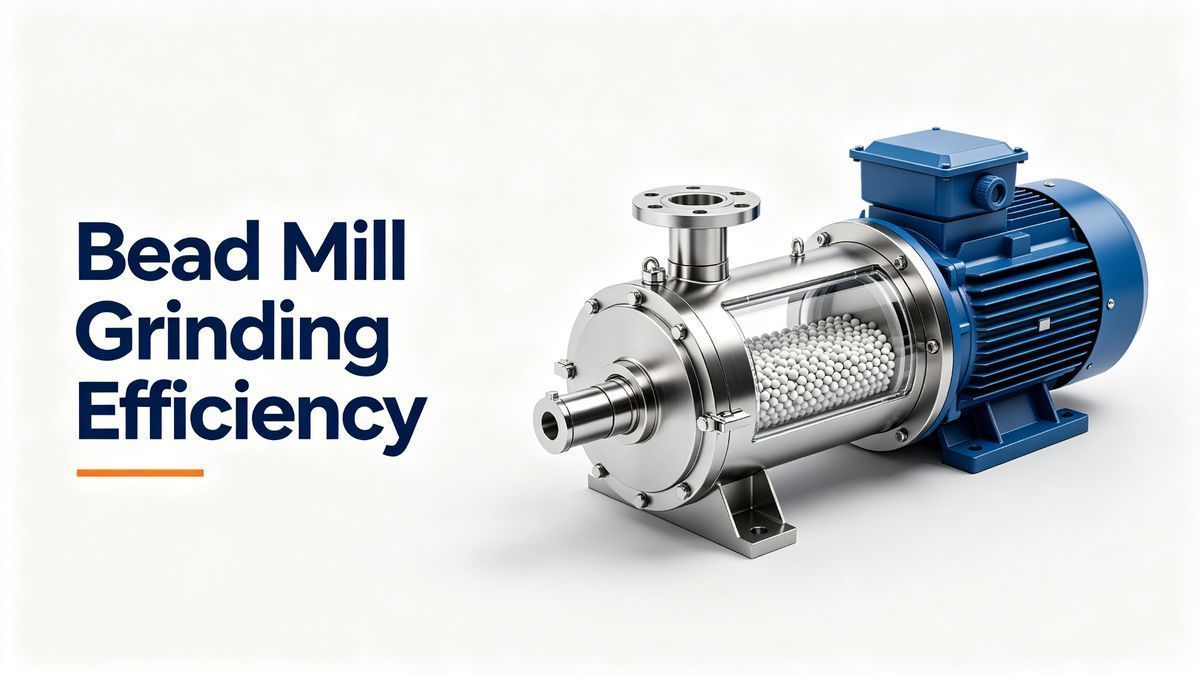
 Selecting a bead mill is not a matter of choosing a chamber volume. The decision is driven by target particle size, millbase rheology, validated throughput, and how often the product changes. Specifying in that order avoids the most common and most expensive error, which is sizing from chamber volume and discovering later that the specification cannot be reached economically.
This guide sets out the specification sequence we use with customers. It covers the relationship between target fineness and machine type, why media size selection determines both fineness and throughput, how throughput must be validated rather than estimated, and how contact materials should be chosen from the product rather than from habit.
It also covers the cleaning and changeover provisions that should be specified at purchase rather than retrofitted, and the laboratory to production pathway that makes scale-up predictable. The approach reflects 24 years of application engineering across coatings, inks, agrochemicals, battery materials and ceramics.
Selecting a bead mill is not a matter of choosing a chamber volume. The decision is driven by target particle size, millbase rheology, validated throughput, and how often the product changes. Specifying in that order avoids the most common and most expensive error, which is sizing from chamber volume and discovering later that the specification cannot be reached economically.
This guide sets out the specification sequence we use with customers. It covers the relationship between target fineness and machine type, why media size selection determines both fineness and throughput, how throughput must be validated rather than estimated, and how contact materials should be chosen from the product rather than from habit.
It also covers the cleaning and changeover provisions that should be specified at purchase rather than retrofitted, and the laboratory to production pathway that makes scale-up predictable. The approach reflects 24 years of application engineering across coatings, inks, agrochemicals, battery materials and ceramics.
Key Takeaways
- Specify from the fineness target, not from chamber volume
- Validate throughput with your own formulation rather than estimating from chamber size
- Select contact materials from the product: ceramic for abrasive, contamination-controlled or battery work
- Specify cleaning and changeover provisions at purchase, not as a retrofit
- Use laboratory, pilot and production machines sharing the same geometry for predictable scale-up
Start with the Particle Size Specification
The fineness target determines machine type more than any other factor. A D90 target of 3 to 5 micron with conventional actives is normally reached with a disc-type horizontal bead mill running 1.0 to 1.4 mm zirconia media. This is the most economical configuration for standard coatings, inks and many agrochemical suspension concentrates.
When the target tightens below 2 micron, or the active has a high melting point and low solubility, a pin-type mill with smaller media and higher energy density is required. The higher energy input reaches the specification faster, but throughput per pass falls, so cycle planning and possibly multiple passes must be accounted for in the specification.
Fineness also determines the separator. Smaller media requires a separator able to retain it at production flow rate, and retention capability is usually the practical limit on how fine the media can be. Specifying a nano target without confirming separator capability is a frequent cause of media carryover in production.
Define the Millbase and the Pre-dispersion Stage
Millbase rheology determines whether material can be pumped reliably through the chamber, and solids loading determines both throughput and cooling duty. A formulation that cannot be pumped at the required rate will not reach its throughput target regardless of mill size, so rheology must be measured at working temperature rather than assumed.
Pre-dispersion quality is part of the specification rather than a separate concern. A well-wetted, deagglomerated premix from a high-shear disperser raises bead mill throughput substantially, because the mill then performs only the grinding work it was designed for. Plants that invest in pre-dispersion consistently get more from an existing mill than plants that buy a larger one.
When specifying a complete installation, size the disperser and the mill together. A common mistake is specifying a large mill with an undersized premix stage, which makes the premix the bottleneck and leaves the mill running below its capability.
Validate Throughput, Do Not Estimate It
Chamber volume alone does not determine throughput. Media size, tip speed, separator design, product rheology and pass arrangement all intervene, which is why laboratory and pilot trials are the only reliable basis for production sizing. Trials also reveal the achievable fineness for your specific chemistry, which no datasheet can predict.
Multi-pass operation generally gives a narrower particle size distribution than a single aggressive pass, because the distribution narrows progressively rather than in one high-energy event. Two mills in series, with a coarse grind followed by a fine grind, usually outperform one machine attempting both stages, in both energy efficiency and distribution control.
Plan the pass arrangement during trials rather than after installation. The number of passes affects not only cycle time but also the layout, since recirculation requires holding capacity between stages. Deciding this later usually means re-piping rather than simply adjusting settings.
Select Contact Materials from the Product
Contact material selection follows the product. Abrasive technicals justify ceramic or hardened-alloy linings, separators and shafts, because wear directly determines maintenance intervals and metal contamination. Specifying stainless contact parts for abrasive work shortens service life and introduces wear metal into the product.
Battery and electronic applications require fully ceramic-lined chambers with ceramic or polymer-coated rotors, because trace iron, copper or nickel degrades cell performance. High-purity zirconia media should be specified to the same standard, and material certificates for product-contact parts are worth requesting at this stage.
For white pigments, ceramics and cosmetics, iron contamination causes discolouration, so the same ceramic-lined approach applies. In all contamination-sensitive cases, the piping and holding tanks downstream should be specified to match, since reintroducing metal contact after the mill defeats the purpose.
Specify Cleaning and Changeover Provisions Early
Cleaning provisions are far cheaper to specify at purchase than to retrofit. Where a plant runs many products or colours, choose chamber geometry that can be flushed and stripped quickly, with smooth internal surfaces, good drainage and quick-release access for media inspection.
Documented changeover procedures should be developed during commissioning, with flush volumes validated against your contamination limits. Machines intended for frequent campaign changes should be evaluated on changeover time as seriously as on throughput, because changeover is often the larger constraint on effective capacity.
For regulated or multi-product plants, consider whether clean-in-place provision is required and whether validation documentation will be needed. Stating these requirements early allows finishes, access and drainage to be specified correctly rather than compromised later.
Technical Specifications
| Fineness vs machine type | D90 3 - 5 micron: disc type; below 2 micron: pin type with smaller media |
| Media size | 0.05 - 2.5 mm zirconia, selected against target fineness |
| Typical tip speed | 8 - 14 m/s depending on design and product |
| Pass arrangement | single pass for moderate targets; multi-pass or two mills in series for narrow distributions |
| Contact materials | stainless steel, hardened alloy, or ceramic-lined for abrasive and contamination-sensitive work |
| Scale-up path | laboratory 0.5 - 20 L, pilot 30 - 100 L, production from 200 L/h |
Troubleshooting Guide
Production mill cannot reach the laboratory fineness result
Cause: Laboratory development used different geometry, media or specific energy
Solution: Develop on laboratory and pilot machines sharing production geometry, and hold media type and specific energy constant while scaling volume
Throughput is far below the expected figure
Cause: Throughput estimated from chamber volume rather than validated, or premix quality limiting the mill
Solution: Run trials with your formulation, and size the pre-dispersion stage together with the mill so the premix is not the bottleneck
Media appears in the product after changing to finer media
Cause: Separator not rated to retain the smaller media at production flow
Solution: Confirm separator capability before reducing media size, since retention usually sets the practical fineness limit
Wear parts need replacing far more often than expected
Cause: Contact materials specified for non-abrasive duty on an abrasive product
Solution: Specify ceramic-lined or hardened-alloy chambers, separators and shafts for abrasive formulations and confirm wear part materials at order stage
Frequently Asked Questions
Should I choose a pin-type or disc-type bead mill?
Disc-type is usually more economical for conventional coatings and inks with a D90 of 3 to 5 micron. Pin-type delivers higher energy density and is preferable for nano targets, hard agglomerates or high-viscosity millbases. We compare both against your formulation during laboratory trials.
How do I know what throughput to expect?
Throughput must be validated with your formulation rather than estimated from chamber volume, because media size, tip speed, separator design and rheology all intervene. Laboratory and pilot trials give the reliable figure, and we size production machines from that data.
What media size should I specify?
Use the largest media that still reaches your specification, since this maximises throughput and reduces separator loading. Smaller media gives finer product with more contact points but lower throughput. Where very fine targets are needed, staged coarse-then-fine milling usually works better.
Do I need ceramic-lined contact parts?
For abrasive products, yes, because wear determines maintenance intervals and contamination. For battery materials, ceramics and white pigments, ceramic lining is required to prevent metallic contamination. For conventional coatings with non-abrasive pigments, stainless contact parts are usually adequate.
Can I specify now and add cleaning provisions later?
Retrofitting is possible but more expensive and usually less effective. Cleaning and changeover provisions depend on chamber geometry, surface finish, drainage and access, all of which are determined at manufacture. Specify them at purchase where product variety is high.
How do I plan for scale-up?
Use laboratory, pilot and production machines that share rotor and chamber geometry, and hold media type and specific energy constant while increasing volume. Confirm thermal behaviour at pilot scale, since cooling area does not scale proportionally with chamber volume.
What information should I send when requesting a proposal?
Send the product or application, target particle size, solids loading and rheology, required throughput, current process if any, available utilities, and destination country with preferred incoterms. The more process detail provided, the more accurate the first proposal will be.
Recommended POLYC MACHINE equipment
The following machines are commonly evaluated for the process described above. Final selection depends on formulation, target particle size, viscosity, capacity and contamination limits.
Related technical guides
Next step
Share your material, required capacity, target fineness and operating conditions with POLYC MACHINE engineers for a configuration review and quotation.
Explore our Coatings solutions for application-specific equipment configurations and process recommendations.