
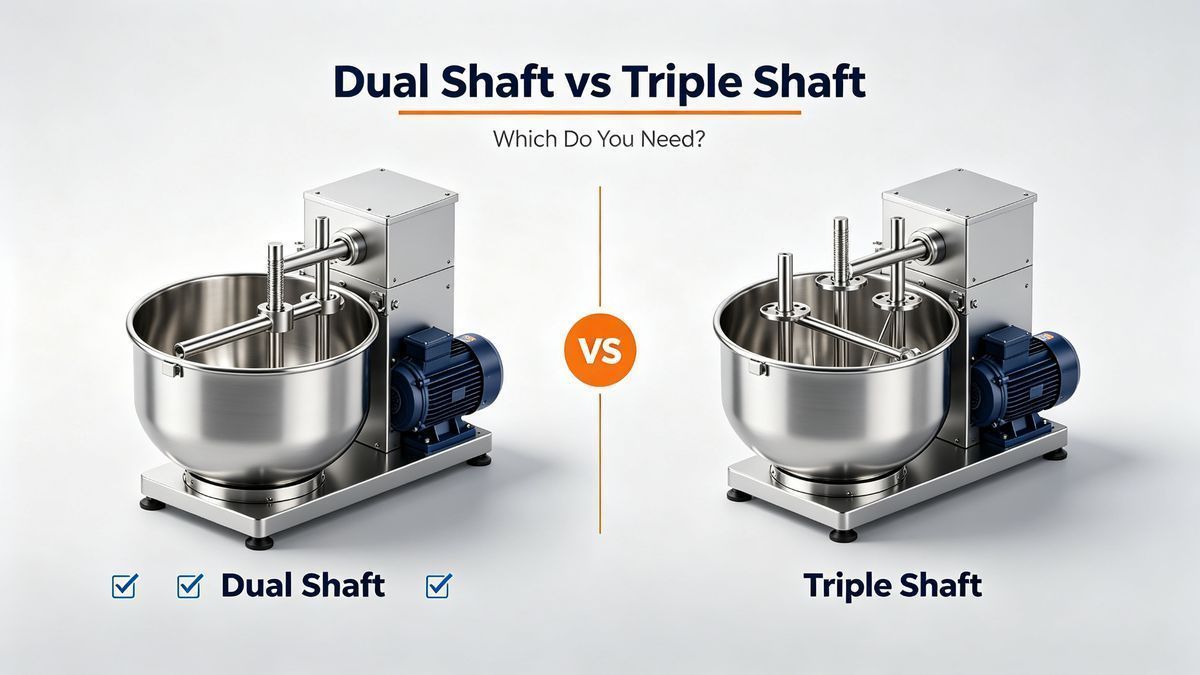
Dual shaft and triple shaft mixers both combine high-shear dispersion with low-speed bulk movement in one vessel, and both are widely used for sealants, adhesives and viscous coatings. The question of whether to specify a third agitator is not one of capability inflation: it is determined by whether two shafts can keep the whole batch in motion while dispersing.
As viscosity rises and vessel diameter increases, two shafts increasingly leave poorly mixed zones, particularly near the vessel wall and in the upper regions of the batch. A third agitator, typically a further dispersing shaft or a wall-scraping anchor, restores coverage and allows the batch to be processed uniformly.
This article compares the two configurations on agitator geometry, viscosity range, torque demand, cycle time and cleaning, then sets out the decision criteria we use when advising customers. It also covers the applications where a planetary mixer rather than either configuration is the correct choice.
POLYC MACHINE supplies both dual shaft and triple shaft mixers, sized from measured rheology rather than from vessel volume. Send your viscosity curve and batch size through the inquiry form for a specific recommendation.
Key Takeaways
- Choose by whether two shafts keep the whole batch moving at your viscosity and vessel size
- Dual shaft suits medium to high viscosity coatings, adhesives and standard sealants
- Triple shaft suits stiff plasters, renders and heavy filled compounds
- Torque, not volume, sets the practical limit, so size the drive from measured rheology
- Above roughly 300,000 cP, a planetary mixer is usually the correct machine
Agitator Geometry: What Each Shaft Does
In a dual shaft configuration, one shaft carries a high-speed dispersing disc that provides shear, while a second, low-speed shaft carries an anchor or butterfly agitator providing bulk movement and wall scraping. The combination handles products that a disperser alone cannot circulate and that a planetary mixer would process more slowly than necessary.
A triple shaft configuration adds a third agitator, most commonly a second dispersing shaft or a more substantial wall-scraping anchor. The additional shaft increases total shear input and improves coverage of the vessel cross-section, which is what allows stiff material to be processed uniformly rather than in zones.
The important distinction is that the third shaft addresses coverage and torque distribution, not simply more power. Where a batch stalls or leaves unmixed regions around the wall, an additional agitator corrects the geometry problem, whereas simply fitting a larger motor usually does not.
Viscosity Range and Torque Demand
Dual shaft mixers are typically specified up to around 150,000 cP for standard geometries, which covers most coatings, adhesives, sealants and construction chemical compounds. Triple shaft configurations extend the practical range, commonly to around 300,000 cP, by improving material turnover and distributing load across agitators.
Torque, not vessel volume, is the limiting factor in both cases. The drive must be sized from measured rheology at working temperature, with margin for startup load and batch-to-batch variation. Under-sizing the drive is the most common cause of slow batches and nuisance motor trips in high-viscosity applications.
Where viscosity changes substantially during the cycle, for example as filler is incorporated or as the product cools, the rheology curve through the whole cycle should be provided rather than a single value. This allows the drive and agitator geometry to be sized for the worst case rather than the average.
Cycle Time and Mixing Quality
A third agitator generally shortens cycle time for stiff products, because it removes the slow step of waiting for material to be carried into the dispersing zone. It also improves homogeneity, since more of the vessel cross-section is actively swept during the cycle.
For products well within dual shaft capability, however, a third agitator adds little. It increases capital cost, raises total energy input and adds a further component to clean, without measurable benefit. Adding agitators beyond what the product requires is a common form of over-specification.
The practical test is whether the batch shows unmixed regions or stalls with two shafts. If it processes uniformly within an acceptable cycle, dual shaft is the correct and more economical choice. Extending mixing time to compensate for poor coverage is the signal that a third agitator would pay for itself.
Cleaning, Changeover and Maintenance
Each additional shaft adds cleaning time and maintenance. In plants with frequent product or colour change, this is a real operating cost that should be weighed against the cycle time benefit. Machines intended for frequent changeover should be specified with smooth shaft geometry and good access for washing.
Wall-scraping components wear against the vessel and require periodic adjustment or replacement. Where scraping is central to the process, as with stiff plasters, the scraper material and adjustment provision should be specified deliberately rather than treated as a consumable afterthought.
A documented changeover procedure, with validated flush volumes where applicable, keeps changeover predictable. Where changeover dominates effective capacity, as it often does in multi-product plants, the simpler configuration with faster cleaning may outperform a more capable machine that takes longer to clean.
Selection Criteria and When to Choose a Planetary Mixer
Choose dual shaft for medium to high viscosity coatings, adhesives, standard silicone and MS polymer sealants, and construction chemical compounds within its viscosity range. It is usually the more economical choice and easier to clean, which matters where products change frequently.
Choose triple shaft for stiff plasters, renders, heavy filled compounds and larger vessels where two shafts cannot maintain coverage. The deciding evidence is unmixed regions, stalling or extended cycle times with a dual shaft machine at your actual viscosity and batch size.
Above roughly 300,000 cP, or for mastics and compounds with high yield stress, a planetary mixer is usually the correct machine rather than either configuration, because planetary geometry physically carries material rather than relying on it flowing to the agitator. Send your rheology data and batch sizes through the inquiry form for a specific recommendation.
Technical Specifications
| Parameter | Specification |
|---|---|
| Dual shaft viscosity | up to approximately 150,000 cP for standard geometries |
| Triple shaft viscosity | up to approximately 300,000 cP for standard geometries |
| Working capacity | typically 300 - 6,000 L depending on model |
| Agitation | one or two dispersing shafts plus anchor, butterfly or scraper |
| Drive sizing | from measured rheology at working temperature, not from volume |
| Above 300,000 cP | planetary mixer generally recommended |
| Options | vacuum, jacketed vessel, hydraulic lift, interchangeable vessels |
Troubleshooting Guide
1. Unmixed material remains near the vessel wall
Cause: Two shafts cannot maintain coverage at the current viscosity and vessel size
Solution: Add a third agitator or a wall-scraping anchor, and confirm the drive is sized from measured rheology
2. Motor trips under load during filler addition
Cause: Drive undersized for peak viscosity during the cycle
Solution: Provide the full rheology curve through the cycle so the drive can be sized for the worst case
3. Cycle time much longer than expected for stiff compound
Cause: Material not being carried into the dispersing zone efficiently
Solution: Move to a triple shaft configuration, or to a planetary mixer above roughly 300,000 cP
4. Changeover takes too long between products
Cause: Additional shafts and scraping components increasing cleaning time
Solution: Review whether the third agitator is genuinely required, and specify smooth geometry with good access for washing
5. Scraper wears quickly and loses wall contact
Cause: Scraper material or adjustment provision not specified for the duty
Solution: Specify scraper material and adjustment deliberately, and include inspection in the maintenance schedule
Frequently Asked Questions
1. How do I decide between dual shaft and triple shaft?
Decide by whether two shafts keep the whole batch moving at your actual viscosity and vessel size. If the batch shows unmixed regions, stalls or needs extended time, a third agitator will pay for itself. If it processes uniformly, dual shaft is more economical and easier to clean.
2. What viscosity range does each handle?
Dual shaft configurations are typically specified to around 150,000 cP, and triple shaft to around 300,000 cP for standard geometries. Torque rather than volume sets the limit, so the drive must be sized from measured rheology at working temperature.
3. Is a third shaft just more power?
No. It addresses coverage and torque distribution. If a batch stalls or leaves unmixed zones around the wall, the problem is geometric and an additional agitator corrects it, whereas fitting a larger motor usually does not.
4. Does a third agitator always reduce cycle time?
For stiff products, yes, because it removes the slow step of waiting for material to reach the dispersing zone. For products well within dual shaft capability it adds cost and cleaning time without measurable benefit.
5. When should I choose a planetary mixer instead?
Above roughly 300,000 cP, or for mastics and compounds with high yield stress. Planetary geometry physically carries material through the vessel rather than relying on it flowing to the agitator, which is what very stiff compounds require.
6. Does the third shaft increase cleaning time?
Yes, and this should be weighed against the cycle time benefit, particularly in plants with frequent product changes. Where changeover dominates effective capacity, the simpler configuration with faster cleaning may give better annual output.
7. What information is needed for a recommendation?
Send the rheology curve through the whole cycle at working temperature, batch size, vessel dimensions, target cycle time and changeover frequency. With that we can specify agitator geometry and drive correctly rather than by rule of thumb.
Recommended POLYC MACHINE equipment
The following machines are commonly evaluated for the process described above. Final selection depends on formulation, target particle size, viscosity, capacity and contamination limits.
Related technical guides
Next step
Share your material, required capacity, target fineness and operating conditions with POLYC MACHINE engineers for a configuration review and quotation.
Explore our Pharmaceuticals solutions for application-specific equipment configurations and process recommendations.