
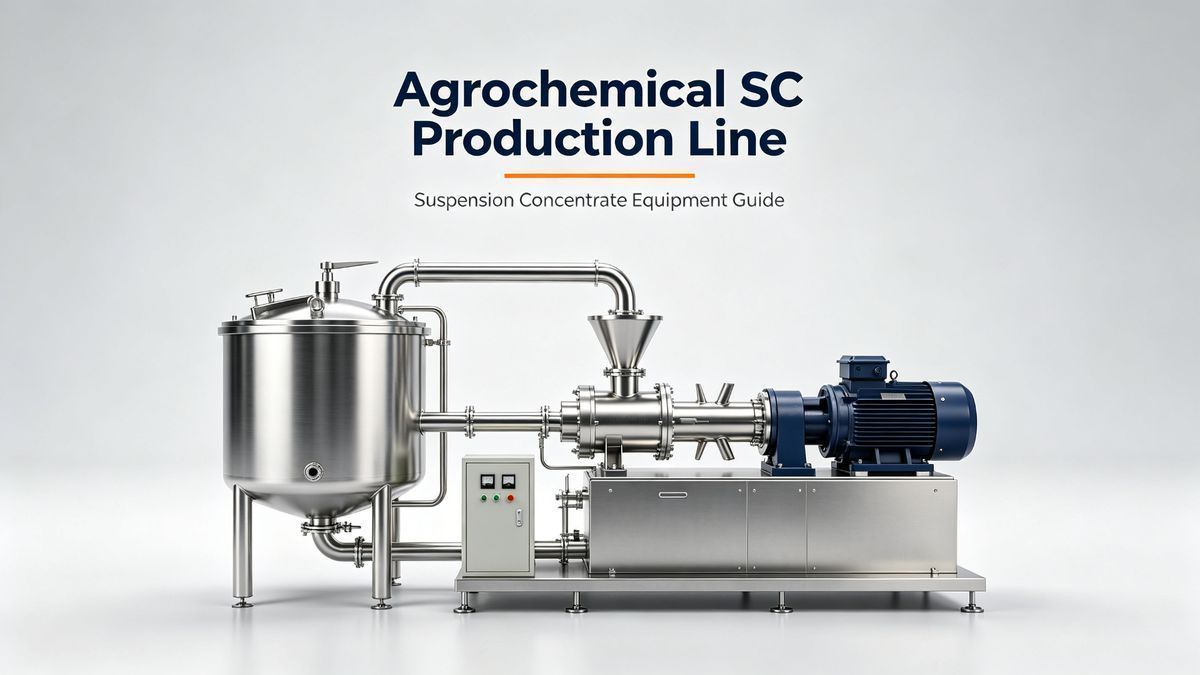
Suspension concentrate formulation is now the dominant agrochemical product type, because it delivers high active loading with reduced solvent use, lower operator exposure and less spray drift. Performance depends on particle size distribution and long-term physical stability more than on the active ingredient alone.
That places wet grinding at the centre of the process and makes equipment selection a quality decision rather than a capacity decision. A line must reach a repeatable particle specification, typically a D90 below 5 micron, while controlling abrasive wear and preventing cross-contamination between active ingredients.
This guide sets out the equipment configuration for an SC line, explains how each stage is sized and controlled, and covers the quality control and cleaning practices that determine whether a line produces consistent, stable product campaign after campaign. It reflects 25 years of application experience in agrochemical plant engineering.
POLYC MACHINE supplies complete SC formulation plants and individual mills, with contact materials selected for abrasive actives and validated cleaning protocols. Send your active and target specification through the inquiry form.
Key Takeaways
- Design around the particle specification and the number of actives, not around annual volume alone
- Reach a repeatable D90, typically below 5 micron, through validated milling trials
- Abrasive actives justify ceramic or hardened-alloy contact parts to control wear and contamination
- Cross-contamination control requires validated cleaning and equipment specified for fast flushing
- Stability testing should inform both formulation and milling endpoint, not simply verify the result
Why SC Formulation Depends on Wet Grinding
In a suspension concentrate, the active ingredient is dispersed as solid particles in a liquid carrier, stabilised by dispersing agents and thickeners. Performance in the field depends on how those particles behave: too coarse and they block nozzles and settle in the spray tank, too fine and crystal growth during storage becomes more likely.
The practical target is usually a D90 below 5 micron with a narrow distribution. A narrow distribution matters because it reduces the driving force for Ostwald ripening, where smaller crystals dissolve and redeposit onto larger ones, causing particle growth and eventual sedimentation during storage.
Achieving that specification consistently is a milling problem. High-shear dispersion alone cannot reach it, so a bead milling stage is essential. The mill, the media and the circuit must be selected together to reach the target while managing the heat and wear that abrasive technicals produce.
Because the specification is contractual and stability is measured over months, the milling endpoint should be established by trial and then held as a documented parameter rather than adjusted to suit throughput on individual batches.
Line Configuration: Dosing Through Filling
An SC line begins with dosing of active ingredient, dispersants, wetting agents, antifreeze, thickener and carrier. Accurate dosing determines batch consistency, and for abrasive or high-value actives it also affects exposure control, so closed handling and dust collection should be specified from the outset.
High-shear pre-mixing follows, producing a homogeneous, well-wetted millbase. This stage has a large influence on milling throughput, because a properly wetted millbase lets the mill do only grinding work. Undersizing pre-mixing is a common cause of a mill that appears too small.
Bead milling then reduces particle size to specification, often in two stages or in multi-pass arrangement for tighter distributions. Stabiliser or thickener addition follows under controlled shear, since excessive shear after thickening can degrade the stabilising network.
Filtration and filling complete the line. Filtration removes any coarse particles or contamination before packaging, and filling is specified for the container formats used, with accuracy requirements set by product labelling regulations.
Milling Selection and Wear Management
Mill selection follows the fineness target and the abrasiveness of the active. For conventional SC targets, a horizontal bead mill with 1.0 to 1.4 mm zirconia media is typical. Where the specification tightens below 2 micron, a pin-type mill with smaller media and higher energy density is required, accepting lower throughput per pass.
Abrasive technicals increase wear on chambers, agitators, separators and shafts. Specifying ceramic-lined or hardened-alloy contact parts for abrasive duty extends service intervals and reduces metallic contamination, which matters both for product quality and for downstream equipment protection.
Media should be high-purity zirconia, sized to the target and screened on a documented schedule. Worn or broken media changes grinding behaviour and increases separator loading, so media condition is a routine check rather than an occasional one.
Cooling deserves deliberate attention. Heat changes viscosity and can affect both milling efficiency and formulation stability, so jacketed chambers with outlet temperature monitoring and interlocks are standard on production SC lines.
Quality Control and Stability
Quality control should cover particle size distribution, viscosity, active content and suspensibility, with measurement points defined at pre-mix, after milling and at final standardisation. Measuring at more than one point makes it possible to identify which stage is responsible when a batch deviates.
Particle size distribution, reported as D10, D50 and D90, is more informative than a single fineness value because it reveals coarse tails. Two batches with the same D90 can behave very differently in the spray tank if one contains a small fraction of oversize particles.
Stability testing under accelerated and ambient conditions should inform the milling endpoint, not merely verify it. Where storage testing shows particle growth, the response is usually to narrow the distribution through milling configuration rather than to increase dispersant dosage alone.
Documenting the validated parameter set, including media charge, tip speed, feed rate, temperature limits and pass count, allows future deviations to be identified quickly and gives a reference for investigating any stability issue.
Cross-Contamination Control and Cleaning
Plants running multiple actives must control cross-contamination, since even small carryover can affect crop safety and regulatory compliance. Control relies on a validated cleaning sequence using a compatible flush, with the flush volume and verification method set against your contamination limits.
Equipment intended for frequent campaign changes should be specified with smooth internal geometry, effective drainage and documented drain points, so that flushing is thorough and verifiable. Retrofitting these provisions later is substantially more difficult.
A written cleaning protocol should be developed during commissioning and followed consistently, with records kept per campaign. Where contamination limits are tight, consider dedicated equipment for particular chemistry families rather than relying solely on cleaning validation.
Operator exposure control belongs in the same review. Closed dosing and transfer, dust collection at powder addition and sealed milling circuits all reduce exposure, and the specific provisions should match the active ingredients and applicable local requirements.
Technical Specifications
| Parameter | Specification |
|---|---|
| Typical line capacity | 1,000 - 15,000 tonnes per year depending on configuration |
| Batch size | typically 500 - 8,000 L per vessel |
| Target fineness | D90 below 5 micron, tighter on request |
| Media | zirconia, typically 1.0 - 1.4 mm for conventional SC targets |
| Milling arrangement | 1 - 3 stages or multi-pass depending on specification |
| Contact materials | stainless steel 316L, ceramic-lined or hardened alloy for abrasive actives |
| Quality checks | particle size distribution, viscosity, active content, suspensibility |
Troubleshooting Guide
1. D90 specification not reached consistently
Cause: Media too coarse, insufficient passes, or separator limiting finer media
Solution: Confirm achievable fineness by trial, reduce media size with verified separator retention, and add passes or a second milling stage
2. Particle growth during storage
Cause: Distribution too broad, driving Ostwald ripening
Solution: Narrow the distribution through multi-pass milling rather than relying on dispersant dosage alone
3. Wear parts failing prematurely
Cause: Contact materials not specified for abrasive technicals
Solution: Specify ceramic-lined or hardened-alloy chambers, agitators and separators for abrasive formulations
4. Suspensibility test fails
Cause: Stabiliser degraded by shear, or distribution too coarse
Solution: Add thickener under controlled shear after milling and verify the particle distribution meets specification
5. Carryover detected between campaigns
Cause: Cleaning sequence not validated against contamination limits
Solution: Develop and document a validated flush protocol with verification, and consider dedicated equipment for sensitive chemistries
Frequently Asked Questions
1. What particle size does an SC formulation need?
A D90 below 5 micron is typical, with a narrow distribution preferred. Narrow distributions reduce Ostwald ripening, where small crystals dissolve and redeposit onto larger ones, causing growth and sedimentation during storage. Confirm the achievable target with milling trials on your active.
2. Can one line handle several active ingredients?
Yes, with a validated cleaning protocol. Specify equipment with smooth geometry and good drainage so flushing is thorough, and set flush volumes and verification against your contamination limits. Where limits are tight, dedicated equipment for particular chemistries is safer than relying on cleaning alone.
3. Which mill is right for SC production?
For conventional targets a horizontal bead mill with 1.0 to 1.4 mm zirconia media is typical. Below 2 micron, use a pin-type mill with smaller media and accept lower throughput per pass. Abrasive actives justify ceramic-lined or hardened-alloy contact parts.
4. How important is pre-mixing?
Very. A well-wetted homogeneous millbase lets the mill do only grinding work, which raises throughput substantially. Undersizing the pre-mix stage is a common reason a mill appears too small, and correcting it later usually costs more than specifying it correctly.
5. Why is my product settling during storage?
Common causes are a distribution that is too broad, inadequate stabiliser, or degradation of the stabilising network through excessive shear after thickening. Measure particle distribution, add thickener under controlled shear, and confirm stability by accelerated and ambient testing.
6. What quality checks should be performed?
Particle size distribution reported as D10, D50 and D90, plus viscosity, active content and suspensibility. Measure at pre-mix, after milling and at final standardisation so that when a batch deviates, the responsible stage is identifiable.
7. How do I control operator exposure?
Use closed dosing and transfer, dust collection at powder addition points and sealed milling circuits. The specific provisions should match your active ingredients and applicable local requirements, and they should be specified at design stage rather than added later.
Recommended POLYC MACHINE equipment
The following machines are commonly evaluated for the process described above. Final selection depends on formulation, target particle size, viscosity, capacity and contamination limits.
Related technical guides
Next step
Share your material, required capacity, target fineness and operating conditions with POLYC MACHINE engineers for a configuration review and quotation.
Explore our Fine Chemicals solutions for application-specific equipment configurations and process recommendations.