
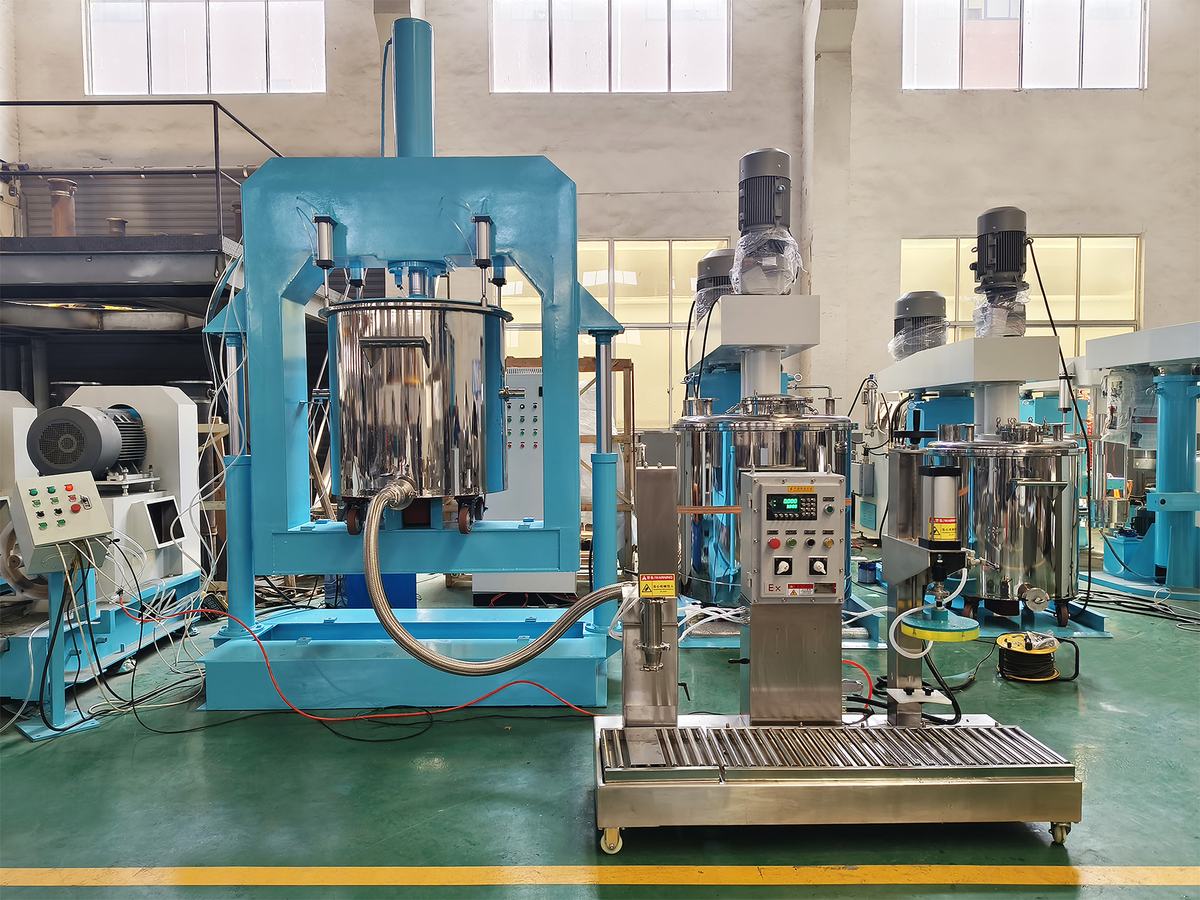
A Mexico customer producing plaster wall putty, paint, adhesives, sealants and waterproof coatings ordered a production line from POLYC. With over 20 years of experience, POLYC's engineers recommended a concentric double-shaft mixer and a full line, delivered a custom drawing and process, and the customer confirmed the order with a deposit within a week. POLYC has built lines since 2001.
A Line for Plaster Wall Putty
The customer's plaster wall putty fills gaps in plaster walls and has a high solid content. POLYC communicates in a timely way, supplies customized drawings and line processes, and the customer was satisfied with the exclusive solution.
- Wall Putty / Car Putty Production Line for plaster putty.
- Concentric Double-Shaft Mixer for high-solid material.
- Paint & Coating Production Line for related output.
- Mixing / Tinting Kettle for batch preparation.
- Filling Machine for finished product packing.
The Dust Problem with Powder Addition
The customer adds powder during mixing. Many conventional mixers have only one top hand hole, so the fast-rotating shafts disperse powder into the air, creating dust pollution that is hard to operate and harmful to workers' health.
Custom Dust-Free Powder Hopper
For this process POLYC custom-built a load hopper to feed hopper: a flat-bottomed large powder load hopper on the lid with a movable opening/closing plate at the feed port. The large flat bottom lets workers place heavy powder bags steadily; opening the plate adds powder, then closing it seals the port and greatly reduces dust diffusion from the tank.
Automatic Pressing and Filling Linkage
Connecting the pressing machine to the filling machine through piping enables automatic linkage: simultaneous and quantitative pressing and filling that is very operator-friendly. Our Mexico coatings guide, paint line setup guide and paint line equipment guide cover the scope.
| Challenge | POLYC solution |
|---|---|
| Powder dust during mixing | Flat-bottom load hopper + movable plate |
| High-solid plaster putty | Concentric double-shaft mixer |
| Filling efficiency | Pressing + filling linkage |
How a coating or ink production line Is Built
A coating or ink production line is more than a list of machines; it is a balanced flow from pre-mixing through grinding, let-down, filtration and filling. The slowest station sets the real capacity, so POLYC designs each line around the customer's most demanding product and daily volume, then sizes the rest to absorb it. Skipping that balancing step is the most common reason a new line underperforms its quoted output, because every faster station simply waits for the bottleneck.
Utilities and Civil Works
A production line also needs the unglamorous parts: power and earthing for motors, cooling water or chiller capacity for the mill, compressed air for valves and filling, and floor loads strong enough for a filled bulk tank. POLYC supplies the layout and utility schedule up front so the civil works and the machines are ordered together, which avoids the expensive late surprises that stall a commissioning.
POLYC's Turnkey Scope
POLYC MACHINE takes a coating or ink production line from layout and utility sizing to installation, commissioning and operator training. Since 2001 the company has delivered more than 8,000 systems to over 60 countries, with a 3-year warranty on core machines and application engineering that begins with the customer's formulation. For producers scaling from manual batches to an automated plant, this single-supplier scope avoids the finger-pointing that happens when several vendors each own one station of the same line.
| Line stage | POLYC equipment |
|---|---|
| Pre-mix and wet-out | High-speed disperser, mixing kettle |
| Grinding | Bead mill or basket mill |
| Let-down and fill | Planetary mixer, filling machine |
| Control and traceability | Recipe management, batch records |
Plan Your Line With POLYC
Share your product, target fineness and daily volume with POLYC's engineering team, and you receive a configuration and quotation built around your real process rather than a standard package, with the utility schedule included so installation starts clean.
What a Realistic Delivery Timeline Looks Like
A turnkey line is not delivered overnight. After the layout is agreed, the typical sequence is equipment manufacturing and factory test, then shipping and customs, then installation and commissioning on site, then operator training and a supervised first production run. POLYC sequences these so civil works and machines are ready together, which is why a line quoted in weeks is usually producing within a planned, predictable window rather than an open-ended one.
Take the Next Step with POLYC
If Plaster Wall Material Production Line for a Mexico Customer is relevant to your operation, POLYC's engineering team can review your product, target fineness and throughput and propose a machine or line matched to your process. With more than 8,000 systems delivered to over 60 countries since 2001 and a 3-year warranty on core machines, the recommendation is backed by a track record, not just a brochure.
Frequently Asked Questions
What did POLYC build for the Mexico customer?
A plaster wall putty line with a concentric double-shaft mixer and a custom dust-free powder hopper, confirmed within a week.
How does the dust-free hopper work?
A flat-bottom load hopper with a movable plate lets workers add powder, then seals the port to cut dust diffusion and protect health.
Can POLYC design to my process?
Yes. POLYC engineers customize drawings and processes to your material and plant, with a 3-Year Warranty.
Talk to a POLYC Engineer
POLYC MACHINE has delivered 8,000+ systems to 60+ countries since 2001. Share your plaster or coating process for a custom line.