
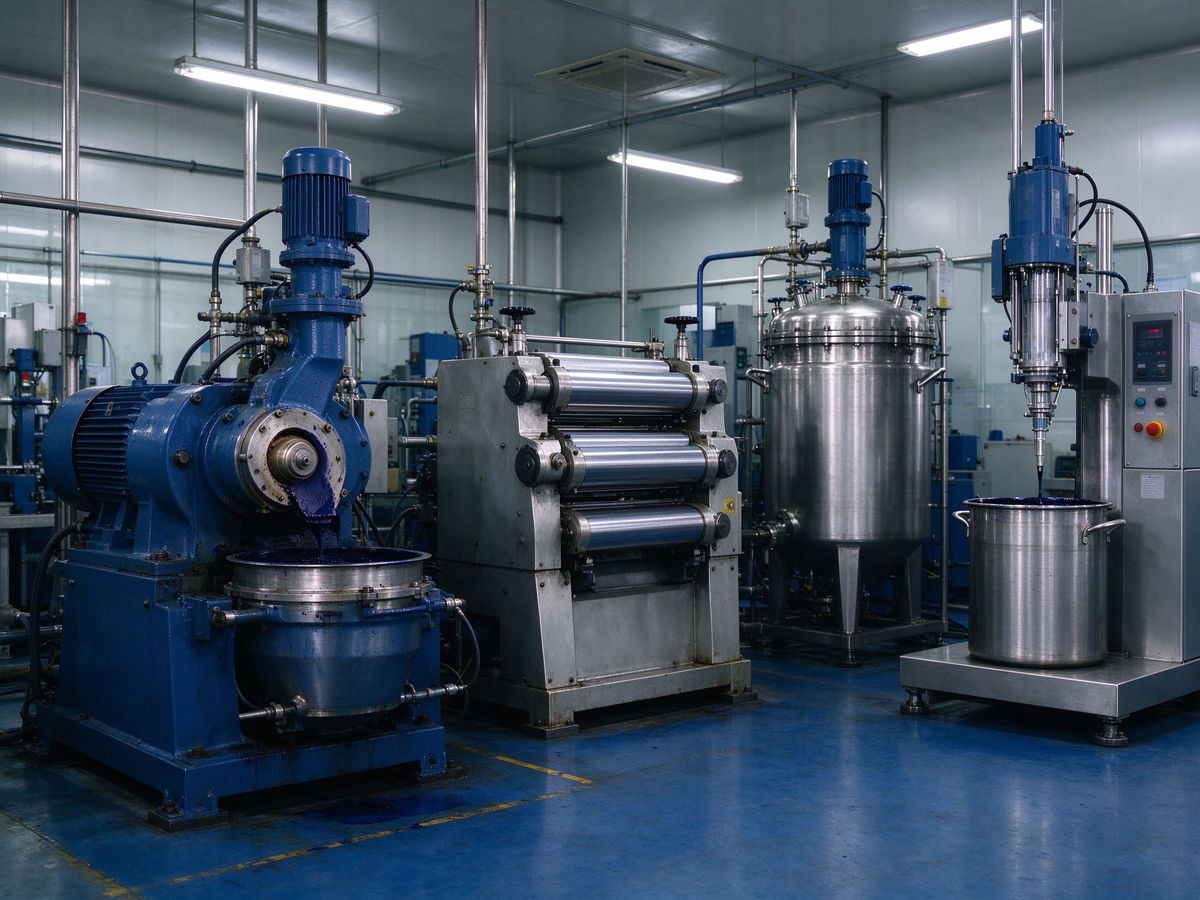
An ink production line turns resin, solvent or water, pigment, and additives into finished printing ink through premix, fine grinding, let-down, filtration, and filling. The difference between a consistent, high-color-strength ink and a batch that drifts on press comes down to how tightly each stage is controlled. A modern ink production line pairs a bead mill or triple-roll mill for grinding with disciplined let-down and quality control. This guide explains how the line works end to end, when a bead mill beats a triple-roll mill, how to match equipment to each ink type, the process parameters that decide quality, and the quality checks that keep color strength consistent from the first can to the last. POLYC MACHINE has built ink and coating lines for global producers since 2001, and the recommendations below come from lines we have commissioned on three continents.
If you are specifying a new ink plant or reworking a bottleneck, read this end to end. By the end you should be able to name the right grinder, mixer, and filler for each ink you make, and you should understand why the line — not any single machine — decides your output ceiling. We cover the five process stages, a stage-by-stage equipment reference, the bead-mill-versus-triple-roll decision, ink-type-specific configuration, grinding parameters, QC, troubleshooting, and a FAQ written for both formulators and search engines.
How an Ink Production Line Works
Ink is deceptively simple to describe and notoriously hard to make repeatably. The chemistry is stable; the problem is particle size, rheology, and cleanliness. Every successful ink line runs the same five stages, and the stage that is weakest sets the quality of the whole batch.
1) Pre-mixing. Resin, solvent or water, and wetting agents are blended with pigment in a high-speed disperser to form a pumpable millbase. Good premix is what makes the grinding stage consistent; powder that is not wetted here becomes agglomerates that no grinder fully recovers downstream.
2) Fine grinding. The millbase is ground to the fineness the print process demands. Bead mills handle most liquid inks; triple-roll mills finish very high-viscosity pastes and some specialty inks. This is the heart of the line and the stage where color strength and gloss are actually created.
3) Let-down and blending. Ground base is let down with more resin and additives, blended in a planetary mixer or triple-shaft mixer to final rheology. Getting the let-down right is what keeps the ink stable on the shelf and predictable on the press.
4) Filtration. A fine screen removes oversized particles that would plug anilox rolls or plates. Filtration is cheap insurance; skipping it is the fastest way to turn a good batch into a customer complaint.
5) Filling. A filling machine doses ink into cans, pails, or bottles at consistent weight, then the batch is labeled and dispatched. Inconsistent fill weight is give-away cost and a compliance risk.
Process Stage Reference Table
The table below maps each stage to the equipment POLYC typically specifies and the quality target it must hold. Use it as a checklist when you scope a line.
| Stage | Primary equipment | Key quality target | Typical batch time |
|---|---|---|---|
| Pre-mixing | High-speed disperser | Lump-free, pumpable millbase | 15 – 45 min |
| Fine grinding | Bead mill or triple-roll mill | D90 to press spec (1 – 10 µm) | 30 – 120 min |
| Let-down | Planetary or triple-shaft mixer | Final viscosity and stability | 20 – 60 min |
| Filtration | Vibrating or inline screen | No particle above grade | 5 – 20 min |
| Filling | Weight or volumetric filler | ± 0.2% fill accuracy | Per container rate |
Bead Mill or Triple-Roll Mill for Ink?
POLYC MACHINE, a Shanghai-based equipment manufacturer supplying ink and coating producers since 2001, usually specifies a bead mill for the bulk of liquid ink because it is continuous, energy-efficient, and easy to clean between colors. A horizontal bead mill reaches sub-micron fineness with narrow distribution and suits solvent- and water-based ink at volume. A triple-roll mill is the better choice for very high-viscosity paste inks and short, multi-color runs where changeover speed beats throughput.
The decision is not about which machine is "better" in the abstract; it is about viscosity and run length. A bead mill thrives on pumpable slurry and long campaigns. A triple-roll mill wins when the material is too thick to pump or when you change color every few hundred kilograms. Many plants run both — a bead mill for the workhorse inks and a roll mill for the thick specialty pastes.
Grinder Comparison Table
| Criterion | Horizontal bead mill | Triple-roll mill |
|---|---|---|
| Best viscosity | Pumpable liquid ink | Paste, not pumpable |
| Fineness | Sub-micron, narrow | Sub-micron, gap-controlled |
| Throughput | High, continuous | Lower, batch |
| Color change | Medium (chamber clean) | Fast (open rolls) |
| Energy per kg | Lower at volume | Higher |
| Typical use | Flexo / gravure base inks | High-solid, paste, UV inks |
Matching the Line to Ink Type
Ink is not one product. The rheology and grade of a solvent-borne publication gravure ink, a water-based flexo ink, a UV/EB ink, and an offset paste are completely different, and the line must be configured for the hardest one you run. POLYC matches equipment to actual rheology, not to a generic catalog.
Solvent-based liquid inks. Flexographic and gravure inks are the classic bead-mill application; they are pumpable and produced in volume, so a horizontal bead mill with solvent-rated seals and explosion-proof motors is standard. Filtration must be tight because anilox rolls are easily plugged.
Water-based inks. These are more forgiving on safety but more demanding on foam and drying. A bead mill still does the grinding; the let-down stage needs defoamer discipline and the filler must handle water-borne residues without corrosion.
UV and EB inks. These cure by radiation rather than evaporation, so they are high-solid and often thick. A triple-roll mill or a bead mill with aggressive cooling handles the grind, and the formulation leaves little margin for contamination, so cleanability is critical.
Offset and paste inks. Too viscous to pump, these are the domain of the triple-roll mill, which gaps the pigment into the vehicle without a separator screen to clog.
Ink Type Configuration Table
| Ink type | Recommended grinder | Let-down mixer | Key concern |
|---|---|---|---|
| Solvent flexo / gravure | Horizontal bead mill | Planetary | Explosion-proof, anilox-safe filtration |
| Water-based flexo | Horizontal bead mill | Planetary | Foam control, corrosion-resistant fill |
| UV / EB | Bead mill or triple-roll | Triple-shaft | Cooling, cleanability |
| Offset paste | Triple-roll mill | Planetary | Gap control, no pump |
Wet Grinding Parameters That Decide Quality
Two lines can buy the same mill and get very different results if these parameters are wrong. The numbers below are the ones our process engineers tune first.
Tip speed and energy density. The rotor peripheral speed, typically 8 – 18 m/s in the grinding chamber, sets how hard the media hits the pigment. Too low and agglomerates survive; too high and you generate heat that thins resin and risks flash-off. Specify the speed, not just the motor kilowatt.
Target fineness (D50 / D90). Define the particle size distribution before sizing any mill. Flexographic and gravure inks often target D90 below 5 – 10 µm, while high-gloss or transparent inks push toward 1 µm or below. The press and anilox or plate requirement set the target, and the grinder is sized to hold it.
Bead size and density. Smaller, denser beads (0.2 – 0.8 mm YTZ zirconia) reach finer sizes but demand more cooling and a tighter separator. Match bead diameter to your fineness goal, not to what came with the machine.
Cooling duty. Continuous grinding generates friction heat; dual-jacketed cooling keeps slurry below 40 – 50 °C so solvents and rheology stay stable. Undersized cooling caps your throughput in summer, not just on paper.
Quality Checks That Hold Color Strength
Color strength is won or lost on the production floor, not in the lab after the fact. The checks below should be part of the routine, not the exception.
- Fineness. Hegman gauge or laser particle size confirms the grind meets the press requirement before let-down.
- Viscosity and rheology. Brookfield or ICI cone-plate checks keep print runnability stable across batches.
- Color strength. Spectrophotometer comparison against the standard catches drift before filling, not at the customer press.
- Residual solvent and density. Verifies formulation and dosing consistency so every can matches the last.
- pH and stability. For water-based inks, pH and settling tests predict shelf life and re-dispersibility.
Common Ink Line Problems and Fixes
Most ink complaints are process or cleaning problems wearing the mask of equipment failure. The table lists the issues POLYC service engineers see most often and the fix that actually works.
| Symptom | Likely cause | Fix |
|---|---|---|
| Color strength drift between batches | Uneven grind or let-down | Tighten D90 target; verify let-down ratio every batch |
| Plugged anilox or plate | Undersized filtration | Filter to the ink's finest requirement; add inline screen |
| Off-shade light tints | Cross-contamination | CIP and quick-open media chambers; purge lines between colors |
| Thin, weak ink after grind | Heat thinning from poor cooling | Upgrade jacket cooling; lower throughput per pass |
| Foaming in water-based ink | Wrong defoamer or over-shear | Adjust defoamer; control disperser tip speed |
| Settling in storage | Insufficient wetting or stabilizers | Recheck premix wetting; add rheology control agent |
Specification Mistakes to Avoid
1) One grinder for every ink. Match bead mill or triple-roll to viscosity and run length; a paste ink will never run well through a bead mill sized for liquid. 2) Skipping color QC before fill. Off-spec ink is only caught at the customer press, which is the most expensive place to find it. 3) Poor cleaning between colors. Cross-contamination ruins light shades; plan CIP and quick-open media chambers from the design stage. 4) Undersized filtration. A plugged anilox roll is an expensive failure; filter to the ink's finest requirement. 5) Ignoring solvent recovery and ventilation. Ink lines need solvent-rated seals and explosion-proof design wherever flammable solvents are present.
Application Scenarios by Ink Type
Publication and Packaging Gravure
Gravure inks are high-volume, low-viscosity, and unforgiving on fineness. A horizontal bead mill plus tight inline filtration is the standard, and throughput matters more than flexibility because campaigns are long.
Flexographic Printing
Flexo spans solvent and water-based, both pumpable, so a bead mill handles grinding and a planetary let-down delivers consistency. Anilox protection through filtration is the recurring theme.
UV and Energy-Curing Inks
UV/EB inks are high-solid and heat-sensitive, so cooling and cleanability dominate the equipment choice. A triple-shaft let-down and aggressive mill cooling keep the formulation in spec.
Offset and Specialty Paste
Paste inks that cannot be pumped go to a triple-roll mill, where gap control replaces a separator screen. Changeover speed is the selling point for short specialty runs.
Plant Layout and Material Flow
The physical layout of an ink line matters as much as the machines. Material should move in one direction — receiving, premix, grinding, let-down, filtration, fill — with the QC lab between filling and dispatch so off-spec batches are caught before they ship rather than at the customer press. Keep solvent and resin zones separated for safety, place dispersers near raw-material weighing so powder transfer is short, and site bead mills on a solid floor with cooling water supply and space for media change. POLYC lays out lines so grinding never waits on let-down pumps and so color-change routes are short, because footfall and cross-contamination rise with every unnecessary step and every meter of unnecessary hose.
Throughput and Capacity Planning
Size grinding and dispersion to your toughest product, then size mixing and filling to absorb its output without queuing. A single bead mill may feed two let-down vessels; a fast filler can outrun a slow grinder, creating a buffer that becomes a bottleneck. For high volume, parallel grinding lines and automated transfer remove the single-machine dependency, while a well-sequenced line lets each stage run at its rated capacity instead of its slowest point. POLYC models the whole line, not just the mill, so the throughput quoted on paper is the throughput you actually get on the floor, and the line balances instead of stalling at one machine.
Color Change and Cleaning Strategy
Ink lines change color constantly, and cleaning is where many plants quietly lose their margin. Quick-open media chambers, CIP-ready vessels, and purge routes between colors keep changeover under 15 minutes instead of hours, and they stop the cross-contamination that ruins light tints. POLYC designs the cleaning path into the line from day one, because a mill that is hard to clean is a mill that gets used less than it should be, and a line with poor cleaning discipline cannot hold color consistency no matter how good the grinder is.
About POLYC Ink Line Equipment
POLYC MACHINE (Shanghai Polyc) has manufactured wet-grinding and mixing equipment since 2001 and runs year-round process research so the disperser, bead mill, mixer, and filler work as one line instead of as separate purchases. A typical POLYC ink line is delivered with the drive, jacket, agitator, separator, and control panel integrated, and sized from laboratory units to fully automatic turnkey plants. Standard machines use SS304 or SS316L contact parts, with explosion-proof motors and solvent-rated seals for flammable systems, and CE certification. POLYC provides 24-hour engineering response, global shipping, and commissioning support, and can integrate the line into a complete coating line. Tell us your ink type, viscosity, and daily volume, and the engineering team will size the grinding and filling stages to hold color strength rather than quoting a machine that cannot run your hardest ink.
Frequently Asked Questions
What fineness does printing ink need?
It depends on the print process. Flexographic and gravure inks often target D90 below 5–10 µm, while high-gloss or transparent inks push toward 1 µm or below. The press and anilox or plate requirement set the target, and the grinder is sized to hold it consistently, not just to reach it once.
Is a bead mill or triple-roll mill better for ink?
A bead mill is usually better for volume liquid ink — continuous, efficient, and easy to clean between colors. A triple-roll mill wins for very high-viscosity paste inks and short multi-color runs where fast changeover matters more than throughput. Many plants run both for different ink families.
How do you keep ink color strength consistent?
Control the grind fineness, verify viscosity and rheology, and check color strength on a spectrophotometer against the standard before filling. Tight let-down discipline and clean changeover between colors prevent drift, and logging each parameter per SKU keeps the next batch repeatable.
Why does a bead mill need good cooling?
Continuous grinding generates friction heat that thins resin and risks solvent flash-off, which changes rheology and fineness mid-batch. Dual-jacketed cooling keeps slurry below 40–50 °C so quality stays stable, and it protects your throughput in warm months.
Can one line make both solvent and water-based ink?
Yes, with correct material selection — solvent-rated seals, explosion-proof motors where required, and corrosion-resistant contact parts for water-borne residues. Plan ventilation and cleaning from the design stage, and size the drive for the heavier of the two products.
How important is filtration in an ink line?
Filtration is cheap insurance against the most expensive failure in printing — a plugged anilox roll or plate. Filter to the ink's finest requirement, ideally inline before filling, and treat it as a quality gate rather than an optional step.
Do I need a resin reactor for ink production?
Only if you make resin in-house. If you buy ready-made resin, you can skip reaction equipment and focus spend on dispersion, mixing, and filling. Reactors only pay off when in-house resin is core to your product, because that is where the longest cycle and highest heat duty sit.
Ready to scope your ink line?
Tell POLYC your ink type, viscosity, and daily volume, or review the turnkey ink production line equipment.
View Ink Production Line Specs