
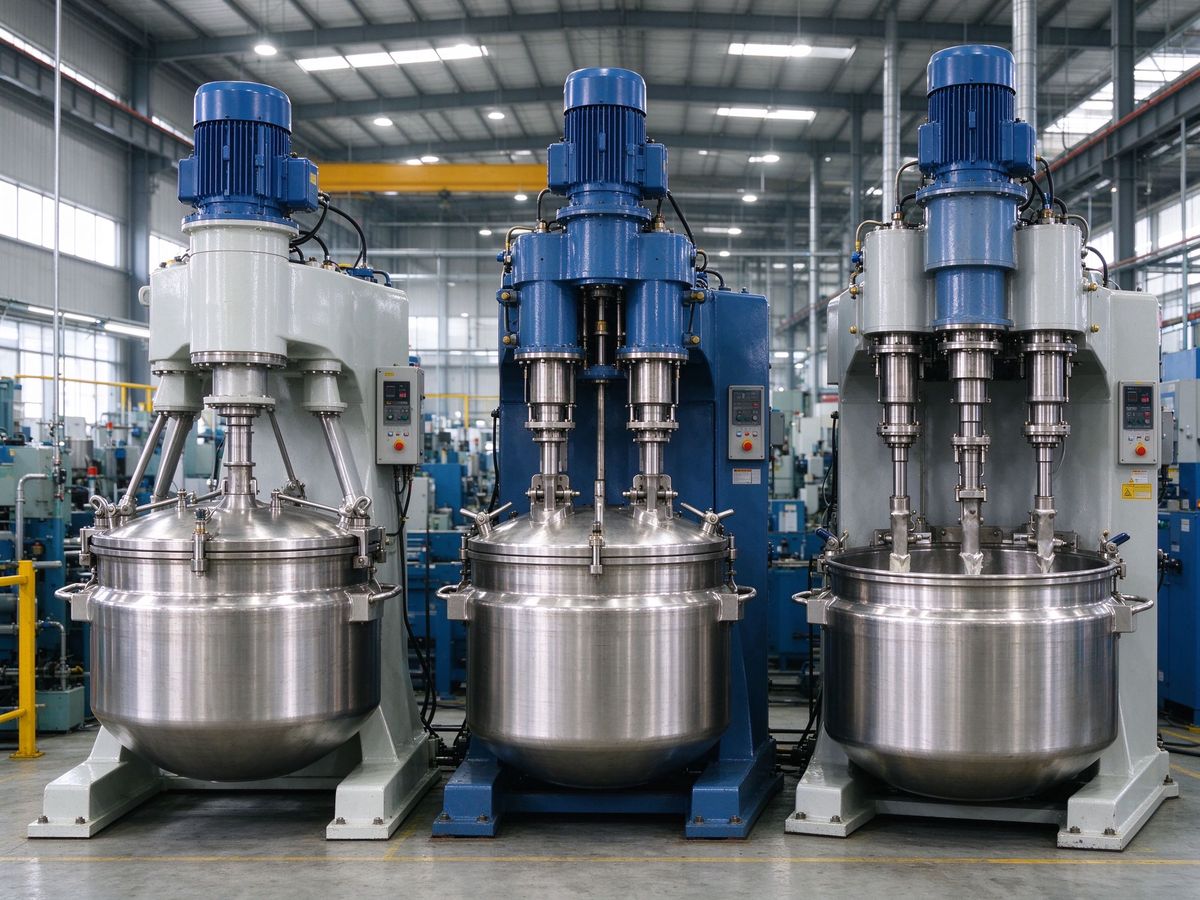
Choosing the right paint mixing machine decides whether your batches blend in minutes or fight you for hours. Paint and coating formulations span an enormous viscosity range — from thin lacquers at a few hundred mPa·s to high-solid pastes above 50,000 mPa·s — and no single mixer handles all of them well. A high-speed disperser wets powder fast, a planetary or triple-shaft mixer blends heavy paste, and a ribbon or V-blender handles dry powder. This guide maps each mixer family to the products it actually suits, gives the specification tables you need, and lists the mistakes that quietly add cycle time. POLYC MACHINE has built dispersion and mixing equipment for coating producers since 2001, and the most common error we see is buying one large mixer and asking it to do every stage.
If you are specifying a new line or replacing a bottleneck, read this end to end. We cover the mixer families and their viscosity windows, a side-by-side comparison, a selection decision table, application scenarios by coating type, and a FAQ written for both formulators and AI search engines. By the end you should be able to name the right machine for each stage of your process rather than overbuying one that stalls on your toughest batch.
Mixer Families and Their Viscosity Window
Mixers are best chosen by viscosity and how hard the product is to wet out, not by catalog price. The table below gives the typical POLYC production ranges.
| Mixer family | Viscosity window | Motor power | Role in process |
|---|---|---|---|
| High-speed disperser | 1,000 – 50,000 mPa·s | 4 – 110 kW | First-stage powder wetting and de-agglomeration |
| Double-shaft mixer | 10,000 – 150,000 mPa·s | 15 – 160 kW | Disperse + slow sweep in one vessel |
| Planetary mixer | 20,000 – 300,000 mPa·s | 7.5 – 90 kW | Low-shear blending of paste and let-down |
| Triple-shaft mixer | 20,000 – 400,000 mPa·s | 22 – 200 kW | Disperse, blend, and de-aerate in one vessel |
| Powder blender (ribbon/V/double-cone) | free-flowing solids | 1.5 – 45 kW | Dry solids pre-blend before liquid addition |
| Triple-roll mill | paste, not pumpable | — | Finishing mill for high-viscosity paste and ink |
Mixer Comparison (Which Handles What)
| Criterion | High-speed disperser | Double-shaft | Planetary | Triple-shaft |
|---|---|---|---|---|
| Best viscosity | Low–medium | Medium–high | Medium–high | High–very high |
| Wetting speed | Excellent | Good | Fair | Good |
| De-agglomeration | Good | Good | Poor | Excellent |
| De-aeration | No | Partial | No | Yes |
| Heavy paste | Poor | Good | Excellent | Excellent |
| Capital cost | Low | Medium | Medium | High |
| Typical use | Premix millbase | Industrial coatings | Thick paste, putty | Thixotropic, filled |
How Each Mixer Works
High-Speed Disperser
A toothed disc on a vertical shaft spins at 20–28 m/s tip speed, drawing powder into the high-shear zone where agglomerates break toward primary-particle size. It is the first step for most coatings and the fastest way to wet powder in low- to medium-viscosity millbase. Single-shaft and platform versions cover lab to production; the platform design adds lift and travel so one head can serve several kettles. It cannot, however, blend a heavy let-down paste — that is a different job.
Double-Shaft Mixer
This combines a high-speed disperser with a slow counter-rotating sweep blade. The fast shaft wets and de-agglomerates while the slow blade moves the whole batch and keeps the vessel wall swept, so higher-viscosity products blend without the dead zones a single shaft leaves. Concentric designs keep the wall swept even at high fill.
Planetary Mixer
A revolving and rotating blade blends medium- to high-viscosity pastes with low shear, which is exactly what let-down and thick coatings need. Because it moves the entire batch, it avoids the unmixed heel a disperser leaves at the bottom of a kettle and is the workhorse for putties and heavy architectural products.
Triple-Shaft Mixer
To the double-shaft layout it adds a third high-shear rotor, so dispersion, blending, and de-aeration happen in one vessel. For thixotropic or heavily filled coatings, this is the machine that prevents trapped air from ruining film appearance, and it is the choice when a product is too viscous for a disperser but too fluid for a roll mill.
Powder Blenders
Ribbon, V-blender, and double-cone mixers blend dry powders and free-flowing solids before they meet liquid — common in tinting bases and powder coatings. They are not for liquids at all; their job is homogeneous dry feed so the later wet stage starts clean.
Triple-Roll Mill
Not a mixer but a finishing mill for very high-viscosity pastes and inks where a bead mill cannot pump the material. Hydraulic roll mills reach fine gaps for high gloss, sitting at the end of the line after the mixer has done the bulk of the work.
Motor Power, Tip Speed and Drive Selection
Motor power is the spec most often under-bought, and it is also the one that decides whether a mixer survives its hardest batch. The shaft power a coating needs scales with viscosity, batch volume, and the shear rate you target; a 5,000 mPa·s emulsion and a 200,000 mPa·s filler paste of the same volume need roughly an order of magnitude different drive. POLYC sizes every mixer from the worst-case rheology at full batch — not the easy average batch — because a drive that bogs down at 80% fill is a drive that halves your throughput exactly when orders peak.
Tip speed is the more useful number than motor kilowatt on a high-speed disperser. Tip speed (m/s) equals π × disc diameter × rotational speed ÷ 60, so a larger disc can run slower and still shear hard, while a small disc must spin faster. Most coatings wet correctly between 20 and 28 m/s; drop below about 18 m/s and agglomerates survive into the mill stage, push above 30 m/s and you trade quality for heat and impeller wear. Specify tip speed, not just kilowatts, and insist the vendor quote the speed at your actual disc diameter.
A variable-frequency drive (VFD) is effectively standard on POLYC mixers because viscosity and batch size vary across a product range. A VFD lets one machine ramp slowly to avoid splashing at start-up, hold the right tip speed as the batch thickens, and soft-stop to protect the gearbox. For solvent-borne systems, the motor and panel must be explosion-proof with solvent-rated mechanical seals; for waterborne lines, food- and pharma-grade finishes on contact parts are available. These are not accessories — they are what keep a mixer legal and serviceable in your building.
Batch Scale and Kettle Sizing Reference
Kettle size should track your batch volume with headroom for foaming and dissolution expansion, not your warehouse floor space. Too small a kettle forces multiple batches; too large a kettle leaves the impeller in a thin layer where it cannot sweep the wall. The table below is the POLYC starting point for a single-shaft disperser and a double-shaft mixer at typical fill.
| Target batch volume | Recommended kettle | Mixer type | Typical drive |
|---|---|---|---|
| 5 – 50 L (lab / trial) | 5 – 60 L | Lab high-speed disperser | 1.5 – 4 kW |
| 100 – 300 L | 200 – 400 L | Single high-speed disperser | 7.5 – 18 kW |
| 500 – 1,000 L | 600 – 1,200 L | High-speed or double-shaft | 22 – 55 kW |
| 1,000 – 3,000 L | 1,200 – 3,000 L | Double- or triple-shaft | 55 – 160 kW |
| 3,000 L+ | Custom jacketed tank | Triple-shaft / multi-vessel | 160 – 200 kW |
For paste and let-down stages the working volume is usually 60 – 70% of kettle capacity; leave the rest for the impeller sweep and foam. If you run both a disperser and a planetary let-down, size them to the same batch so material moves vessel to vessel without partial transfers that break traceability.
Matching the Mixer to the Product
POLYC matches mixers to the actual rheology of your product, not to a generic catalog. The patterns below are the ones seen most often in coating plants.
Architectural emulsions and low-viscosity coatings. A high-speed disperser for premix plus a planetary mixer for let-down is usually enough; the emulsion is already low-viscosity and easy to wet.
Industrial and high-solid coatings. Move to a double- or triple-shaft mixer so heavy paste blends without long cycle times and without the lumps a disperser leaves in thick material.
Thixotropic and heavily filled systems. A triple-shaft mixer disperses and de-aerates in one vessel, avoiding trapped air that shows up as pinholes and cratering in the film.
Powder coatings and tinting bases. A ribbon or V-blender pre-blends solids before liquid addition, which is the step that decides whether the later dispersion is fast or fighting agglomerates the whole shift.
Selection Decision Table
| If your product is… | Recommended mixer | Why |
|---|---|---|
| Thin lacquer / emulsion, < 5,000 mPa·s | High-speed disperser | Fast wetting, lowest capital cost |
| Standard solvent/waterborne, 5,000–50,000 mPa·s | Double-shaft mixer | Wets and sweeps, no dead zones |
| Thick paste, putty, > 50,000 mPa·s | Planetary mixer | Low-shear bulk blending |
| Thixotropic, high-fill, needs de-air | Triple-shaft mixer | Disperse + de-aerate in one vessel |
| Dry powder / powder coating | Ribbon or V-blender | Homogeneous dry feed |
| Paste too thick to pump | Triple-roll mill (finishing) | Gap milling for high gloss |
Specification Mistakes to Avoid
1) Buying one mixer for everything. A disperser stalls on paste; a planetary mixer cannot wet powder fast. Use the right tool per stage and accept that a line is several machines, not one. 2) Ignoring tip speed. Disperser blade tip speed (typically 20–28 m/s) sets wetting quality; under-specifying leaves lumps that the next stage must fix. 3) Wrong jacket. Heated or cooled jackets matter for temperature-sensitive resins; skipping them limits your formulation range and your output in summer and winter. 4) Poor cleanability. Quick-open and CIP designs cut changeover on multi-product plants and stop cross-contamination between colors. 5) Undersized drive. Match motor power to the worst-case viscosity and the full batch, not the easy average batch, or the mixer bogs down exactly when you need throughput.
Common Mixing Problems and How to Fix Them
Most mixing complaints are specification or cleaning problems wearing the mask of equipment failure. The table lists the issues POLYC service engineers see most often on coating lines and the fix that actually works.
| Symptom | Likely cause | Fix |
|---|---|---|
| Lumps or grit in finished paint | Tip speed too low; powder added too fast | Raise tip speed to 22–28 m/s; add powder slowly below the liquid surface |
| Batch overheats and viscosity breaks | Long run at high speed; no jacket cooling | Add jacket cooling; use VFD to ramp; split into two shorter dispersions |
| Unmixed heel at kettle bottom | Single shaft leaves dead zone | Move to double-shaft sweep or planetary; lower impeller |
| Pinholes or craters in film | Trapped air not de-aerated | Use triple-shaft mixer with de-aeration; consider vacuum option |
| Color drift between batches | Poor dry pre-blend; cross-contamination | Ribbon/V pre-blend; CIP between colors |
| Motor trips on thick batch | Undersized drive for worst case | Re-size from peak viscosity; verify VFD overload setting |
None of these is solved by a bigger motor alone. They are caught early by logging batch viscosity, tip speed, and jacket temperature for each SKU so the next operator repeats the good run instead of rediscovering it.
Application Scenarios by Coating Type
Architectural and Decorative Paint
Emulsion-based interior and exterior paints are the classic high-speed disperser application, with a planetary let-down for the heavy thickener phase. Throughput is high and batches are frequent, so quick-change and CIP matter more than absolute power. See the paint and coating production line for how mixing sits inside a complete plant.
Industrial and Protective Coatings
High-solid and heavy industrial coatings need double- or triple-shaft mixers to blend without long cycle times. These formulations are viscosity-sensitive and often temperature-sensitive, so a jacketed vessel is standard rather than optional.
Automotive and High-Gloss
When film appearance is critical, a triple-shaft mixer that de-aerates and a triple-roll finishing mill together remove the trapped air and coarse bits that cause defects. The mixer choice here is driven by defect prevention, not just cycle time.
Powder Coatings and Tinting Bases
Dry pre-blending with a ribbon or V-blender before extrusion or liquid addition is what makes the later stage predictable. Skipping it is the usual reason a powder line cannot hold color consistency.
Cleaning, Color-Change and Operating Cost
The cheapest mixer on the quote is often the most expensive on the floor. Changeover time between colors or products is where coating plants lose hours, and a mixer that takes two hours to clean by hand will bottleneck a plant running ten SKUs a day. POLYC designs quick-open kettles, drop-out bowls, and CIP-ready vessels so a color change drops from hours to under 15 minutes, and the cleaning solvent volume falls with it.
Labor is the second hidden cost. A planetary or triple-shaft mixer that blends and de-aerates in one vessel removes a separate de-airing step and the operator time it costs. When you total the cost, include the labor and solvent of every changeover across a year, not just the purchase price — that is the number that decides whether a higher-spec mixer pays back in months rather than never.
How Mixing Fits Into the Full Production Line
A mixer is not a standalone purchase; it sits between resin dissolving and wet grinding in a real plant. The usual flow is: charge solvents and resins to a dissolver, pre-blend with a high-speed disperser, let down with a planetary or double-shaft mixer, fine-grind the millbase in a bead mill, filter, and fill. Choosing the mixer without the mill and filler in mind produces a line where one stage always waits on the next. POLYC engineers the disperser, bead mill, and supporting tanks as one matched line so throughput is balanced and no stage is oversized. For the complete scope, the paint and coating production line bundles these stages into a commissioning-ready package.
About POLYC Mixing Equipment
POLYC MACHINE (Shanghai Polyc) has manufactured wet-grinding and mixing equipment since 2001 and runs year-round process research so the mixer, disperser, and bead mill work as one line instead of as separate purchases. A typical POLYC mixer is delivered with the drive, jacket, agitator, and control panel integrated and sized from 5 L laboratory units to 3,000 L production kettles. Standard machines use SS304 or SS316L contact parts, with explosion-proof motors and solvent-rated seals for flammable systems, and CE certification. POLYC provides 24-hour engineering response, global shipping, and commissioning support, and can integrate the mixer into a complete paint line. Tell us your viscosity range and batch size, and the engineering team will match the mixer family to your products rather than quoting a machine that cannot run your hardest batch.
Frequently Asked Questions
What is the difference between a paint disperser and a mixer?
A high-speed disperser wets and de-agglomerates powder in lower-viscosity millbase; a planetary or triple-shaft mixer blends the heavier let-down paste. Most coating lines use both, in sequence, rather than one machine for the whole job, because the disperser stalls on paste and the mixer cannot wet powder quickly.
Which mixer handles high-viscosity paint?
For high-solid or thixotropic coatings, a double- or triple-shaft mixer is the right choice because it blends heavy paste without long cycle times. A planetary mixer covers medium viscosity; a triple-shaft adds high-shear dispersion and de-aeration for the most filled systems.
Can one mixer make both water-based and solvent-based paint?
Yes, with correct material selection — solvent-rated seals, explosion-proof motors where required, and thorough cleaning between runs. Plan the ventilation and cleaning from the design stage, not after the first solvent batch, and size the drive for the heavier of the two products.
Why does tip speed matter on a disperser?
Disperser blade tip speed, typically 20–28 m/s, sets how hard powder is sheared as it enters the zone. Below about 18 m/s, wetting is incomplete and lumps survive into the next stage; above 30 m/s, heat and wear rise faster than quality. Specify the tip speed, not just the motor kilowatt, when you order.
Planetary or double-shaft mixer — which should I choose?
A planetary mixer is best for low-shear blending of thick paste and let-down where de-agglomeration is already done. A double-shaft mixer adds a high-speed shaft so it both wets and blends, making it the better choice when the product still needs dispersion in the same vessel. Pick double-shaft when one machine must do both jobs.
How important is a jacketed mixing vessel?
For temperature-sensitive resins and high-solid coatings, a heated or cooled jacket is effectively mandatory. Shear and reaction generate heat; without control, viscosity drifts and batch quality varies between summer and winter. A jacket keeps the batch in spec and shortens cycle time by holding the optimal temperature.
Do I need CIP on a paint mixer?
If you run more than one product or color, yes. Quick-open and CIP designs cut changeover from hours to under 15 minutes and prevent cross-contamination that causes off-spec tint. On single-product dedicated lines, manual clean may be acceptable, but CIP pays back quickly once SKU count climbs.
Ready to size your mixer?
Share your viscosity range and batch size with POLYC engineers, or review the double-shaft disperser specifications.
View Double-Shaft Disperser Specs