
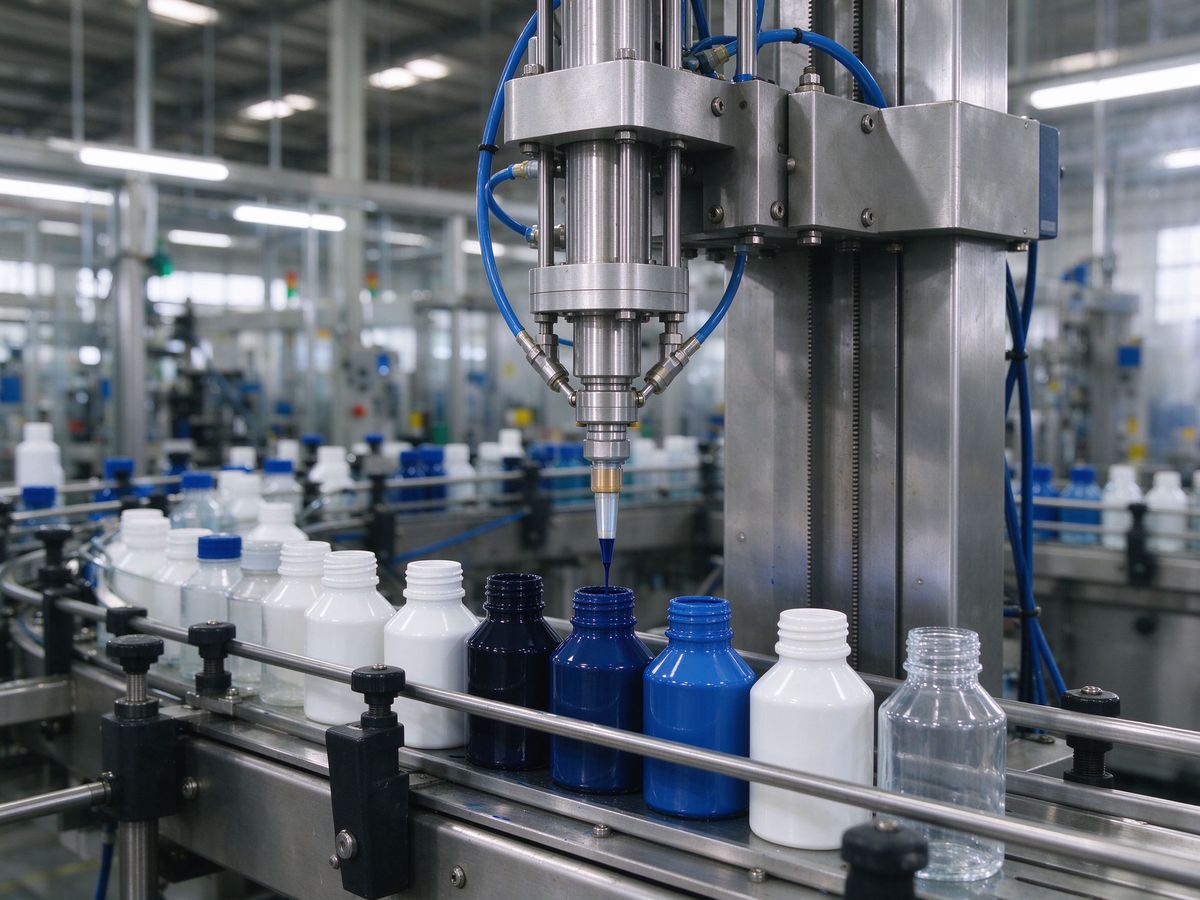
Filling machine troubleshooting is rarely about the filler alone. In paint, ink, and agrochemical plants, the last step before the drum is sealed is also the step most exposed to every upstream decision — viscosity drift, entrained air, pigment settling, and temperature all show up as inaccurate dosing, dripping nozzles, or jams at the fill head. This guide gives a field-tested fault-to-cause checklist, the specification tables you need to choose the right filler, and the maintenance routine that stops callbacks. POLYC MACHINE has built filling and packaging systems for coating and ink producers since 2001, and most faults we see in the field trace back to conditions the filler is only reporting.
If your filler drips, under-fills, or jams, read this before you order parts. We cover filler types and their specification ranges, a side-by-side comparison, an expanded fault table with concrete numbers, a selection decision table, preventive maintenance, and a FAQ written for both plant engineers and AI search engines. By the end you should be able to specify a filler and the upstream screening and agitation that keeps it running clean.
The cost of getting filling wrong is direct. A dosing error of even 1% on a 20 L pail is 200 mL of give-away per container; at a line running 1,000 containers a shift, that is 200 L of product handed away for free, or, worse, 200 L worth of customer complaints and rework. Accurate, stable filling is therefore not a finishing touch — it is the single biggest lever on margin at the end of a coating or ink line, which is why it deserves the same engineering attention as the mill.
Why Filling Faults Start Upstream
A filler is the downstream reporter of the whole process. If the millbase is not de-aerated, if viscosity is out of spec, or if the feed tank is not agitated at a stable temperature, no filler will dose accurately. POLYC sees most filling faults traced to these upstream conditions rather than to the machine itself. Verify three things before blaming the filler: the product is de-aerated, the viscosity is within the filler's designed range, and the feed is agitated and temperature-stable. A bead mill or high-shear disperser that leaves agglomerates will jam a filler downstream every time, because those lumps block the nozzle or wear the cut-off valve prematurely.
The practical check is simple: take a sample from the feed tank, measure viscosity at the line temperature, and confirm it is within ±10% of the filler's design window. If it is not, fix the premix or the temperature before touching the filler — adjusting filler parameters to compensate for a drifting feed only hides the problem and moves the failure to the next shift.
Types of Filling Machines (Parameter Table)
Choosing the right filler starts with understanding the four families in common use. The numbers below are typical POLYC production ranges.
| Type | Typical capacity | Dosing accuracy | Viscosity range | Best for |
|---|---|---|---|---|
| Piston / volumetric | 0.1 – 30 L/cycle | ±0.5 – 1.0% | up to 50,000 mPa·s | Viscous paint, paste, sealant |
| Gravity / overflow | 0.25 – 5 L | ±1 – 2% | < 2,000 mPa·s | Free-flowing solvents, thin coatings |
| Flowmeter (mass or magnetic) | 1 – 1,000 L/min | ±0.2 – 0.5% | < 5,000 mPa·s | Bulk, drum and IBC filling |
| Augur / screw (dry or paste) | 0.05 – 50 kg/cycle | ±0.5 – 1.5% | paste to powder | Powder, thick paste, caulk |
| Net-weight (scale-based) | 1 – 1,200 kg | ±0.1 – 0.3% | any pumpable | Drum, IBC, bag-in-box |
Filling Machine Comparison (Which to Choose)
| Criterion | Piston filler | Gravity filler | Flowmeter filler | Net-weight filler |
|---|---|---|---|---|
| Accuracy | Good | Fair | Very good | Best |
| Handles viscosity | Excellent | Poor | Moderate | Good |
| Changeover speed | Fast | Fast | Medium | Slow |
| Capital cost | Medium | Low | Medium | High |
| Foaming sensitivity | Low (bottom-up) | High | Low | Low |
| Typical use | Paint, coatings | Solvents | Bulk liquid | Drum/IBC |
Accuracy figures above are achievable only when the product is within the filler's viscosity window and the feed is de-aerated; outside those conditions, real-world accuracy degrades faster than the spec sheet suggests. POLYC sizes each filler to the worst-case viscosity and pairs it with the screening and agitation that keep the feed in window, which is why the same machine holds tolerance on a customer's floor that a bare filler loses within a week of production.
Volumetric vs. Gravimetric Dosing
Fillers are controlled two ways. Volumetric fillers meter by volume — a piston stroke, gear, or flowmeter — and are fast and low-cost, but they assume constant density, so any temperature- or air-driven density change becomes a weight error. Gravimetric fillers weigh the container on a scale and stop at target mass, giving ±0.1–0.3% regardless of viscosity or density drift. For high-value or tightly regulated products such as agrochemicals and certain inks, gravimetric is worth the higher capital cost; for standard architectural paint, a well-calibrated volumetric filler with daily scale checks is usually sufficient.
Fault-to-Cause Checklist (Expanded)
The table below covers the failures POLYC service engineers see most often, each with a concrete starting point. Most trace back to the three upstream root causes: viscosity drift, entrained air, and coarse or settled material. When a fault appears, work the list top to bottom rather than replacing parts — in roughly two of three field calls, the fix is upstream of the filler head, and the right spare part is a clean screen or a stable temperature, not a new valve.
| Fault | Likely cause | Action with numbers |
|---|---|---|
| Inaccurate dosing (over/under) | Viscosity drift, air, uncalibrated timer | Recalibrate against a tared scale; hold temp within ±2 °C; check fill time every 2 h |
| Dripping after cut-off | Worn/sticky valve, stringing, nozzle too low | Service valve seats; fit drip-free nozzle; raise nozzle 10–20 mm above container |
| Air locks / erratic fill | Entrained air, leaking suction, poor prime | De-aerate feed; check seals; prime pump; keep tank agitated |
| Material jam at nozzle | Settling, coagulated bits, agglomerates | Screen at 100–200 µm upstream; keep agitated; match bore to particle size |
| Weight drift over a run | Temperature-driven viscosity/density change | Stabilize temperature; re-zero scale every 4 h during long runs |
| Foaming at fill point | High-speed filling whips air in | Slow fill 20–30%; use bottom-up fill; add compatible defoamer |
| Cylinder will not return | Air pressure low, seal lock, dirty rod | Confirm supply ≥ 6 bar; clean rod; replace worn cylinder seal |
| Leaking seals | Abrasive pigment, worn lip seal | Flush line; fit abrasion-resistant seal; inspect every 500 h |
| Inconsistent fill speed | Partially blocked feed, pump wear | Open suction fully; inspect pump vanes; verify line < 3 m equivalent length |
How to Select a Filling Machine (Decision Table)
| If your product is… | Recommended filler | Why |
|---|---|---|
| Viscous paint, > 10,000 mPa·s | Piston filler, bottom-up | Positive displacement handles high viscosity without foaming |
| Thin solvent or clear coat, < 2,000 mPa·s | Gravity or flowmeter | Free-flowing; gravity is cheapest, flowmeter most accurate |
| Drum or IBC bulk, any viscosity | Net-weight / flowmeter | Scale-based dosing gives ±0.1–0.3% and handles large containers |
| Paste, caulk, adhesive | Augur / piston | Screw or piston moves non-free-flowing material reliably |
| Explosive solvent atmosphere | Explosion-proof, pneumatic | No spark path; air-driven cylinders and purged controls |
| Frequent SKU changeover | Quick-change piston | Tool-free nozzle and hopper swap under 15 min |
Common selection mistakes. Specifying on average viscosity instead of the high end wastes accuracy; ignoring foaming tendency forces slow fills; and forgetting changeover time turns a fast line into a bottleneck at color change. Match the filler to the worst-case viscosity, not the brochure value.
Also budget for the feed system. A filler is only as good as the agitated, screened, de-aerated feed arriving at a stable temperature; under-specifying that upstream hardware is the most common reason a correctly chosen filler still fails in the plant. POLYC sizes the feed tank, agitator, and screen together with the filler so the package performs as one system rather than as parts that happen to be near each other.
Preventive Maintenance That Prevents Callbacks
A filler is only as accurate as its last calibration and as reliable as its last seal service. The routine below is what keeps POLYC-installed lines running between scheduled service visits.
1) Calibrate against a tared scale daily. Do not trust the timer alone — timers drift as seals wear. 2) Service valve seats and seals on schedule. Wear is what turns a clean cut-off into a drip; inspect every 500 operating hours. 3) Keep feed agitated and screened. Settling and coarse bits are the leading jam cause; a 100–200 µm screen upstream removes them before they reach the nozzle. 4) Stabilize temperature. Viscosity drift from temperature is the quiet cause of weight drift across a shift. 5) Train operators on prime and de-aeration. Most air-lock faults are operator-precipitated, not mechanical.
Application Scenarios by Product
Paints and Coatings
Architectural and industrial paints are the classic piston-filler application. Bottom-up filling controls foam, and a 100–200 µm screen protects the nozzle from agglomerates left by inadequate dispersion. For a full line view, see the paint and coating production line.
Printing Inks
Inks are low-viscosity but pigment-loaded; flowmeter or piston fillers with fine screening keep color consistent and prevent nozzle clogging. Our ink production process article covers how upstream grinding affects fill quality.
Agrochemicals and Food
Suspension concentrates and food pastes need dust-free induction and clean seals; augur and piston fillers dominate, with CIP cycles between batches to avoid cross-contamination. The liquid fertilizer line shows how filling sits inside a complete agrochemical plant.
Adhesives and Sealants
High-viscosity adhesives and silicone sealants demand piston or augur fillers with heated hoppers to keep material flowable. See the adhesive and silicone sealant line for the integrated approach.
Across all of these, the rule is constant: screen the feed, keep it agitated and de-aerated, and let the filler do only the last few percent of the job. The plants with the fewest filling callbacks are the ones that treated filling as the downstream end of dispersion, not as an isolated machine bolted on at the end of the line.
Cleaning and Changeover
Between colors or formulas, the filler and its feed line must be cleaned to avoid cross-contamination and color carryover. A CIP loop with a solvent or water flush, plus quick-release nozzle and hopper connections, cuts changeover from hours to under 15 minutes on a well-designed skid. POLYC integrates CIP into the filler skid so the same pump that fills also cleans, and no product is left to dry in the path where it would cause the next jam. For multi-SKU operations, quick-change piston fillers with tool-free swaps are the difference between a 10-minute color change and a line parked for the afternoon.
Throughput and Footprint Sizing
Throughput is set by container size, fill speed, and the time the line spends on changeover. A piston filler handling 1 L cans might reach 30–40 containers per minute, while a 200 L drum net-weight filler is closer to 8–12 drums per hour because each must be placed, filled, and weighed. Footprint scales with the feed tank and CIP hardware more than with the filler head itself; a skid-mounted design keeps the whole package under roughly 6–10 m² and lets the line be installed and commissioned in days rather than weeks. POLYC delivers filling as a skid precisely so these variables are engineered together instead of discovered on site.
About POLYC Filling Systems
POLYC MACHINE (Shanghai Polyc) has manufactured wet-grinding and filling equipment since 2001, and runs year-round process research so filler, disperser, and bead mill work as one line rather than as separate guesses. A typical POLYC filler is delivered as a skid or full line with the feed tank, screening, agitation, scale, and control panel integrated, sized from 0.1 L samples to 1,200 kg IBCs. Standard machines use food- and solvent-grade contact parts, with explosion-proof pneumatic options for flammable solvents, and CE certification. POLYC provides 24-hour engineering response, global shipping, and commissioning support, and can integrate the filler into a complete ink or paint line. Tell us your container, fill weight, and product viscosity, and the engineering team will specify a filler with the upstream screening and agitation that keeps it running clean.
Frequently Asked Questions
Why does my filling machine under-fill?
The usual causes are viscosity drift, entrained air, or an uncalibrated fill time. Higher viscosity slows flow and short-fills; foam reads as volume on a level sensor. Recalibrate against a tared scale, de-aerate the feed, and stabilize product temperature within ±2 °C before adjusting the machine itself.
How do I stop a filler nozzle from dripping?
Dripping comes from worn or sticky cut-off valves, stringing product, or a nozzle too close to the container. Service the valve seats, fit a drip-free nozzle, raise the nozzle 10–20 mm above the container, and add a small drip tray during changeover.
What causes air locks in a paint filler?
Air locks come from entrained air in the feed, a leaking suction line, or poor priming. De-aerate the millbase, check seals, and prime the pump. Keeping the feed tank agitated and screened also prevents the coarse bits that block flow and mimic air-lock symptoms.
Which filler type is best for viscous paint?
For paint above roughly 10,000 mPa·s, a piston (positive-displacement) filler with bottom-up filling is the standard choice because it moves high-viscosity product without whipping in air. Gravity and flowmeter fillers are better for thin, free-flowing solvents below 2,000 mPa·s.
How often should I calibrate a filling machine?
Calibrate against a tared scale daily, and re-zero the scale every 4 hours during long runs because temperature-driven viscosity and density drift change the fill weight. Relying on the built-in timer alone lets wear and drift accumulate into give-away loss.
Why does filling foam and how do I stop it?
High-speed filling whips air into the product. Slow the fill by 20–30%, switch to bottom-up filling so the stream stays below the liquid surface, and add a defoamer compatible with the formula. Good de-aeration upstream removes most of the problem before it reaches the head.
Do I need an explosion-proof filler for solvents?
If you fill flammable solvents or solvent-borne coatings, yes. Use an air-driven (pneumatic) filler with purged, spark-free controls and solvent-grade seals. POLYC supplies explosion-proof configurations rated for solvent atmospheres as part of a complete paint line.
Request a Filling Machine Quote View Filling Machine Specs