
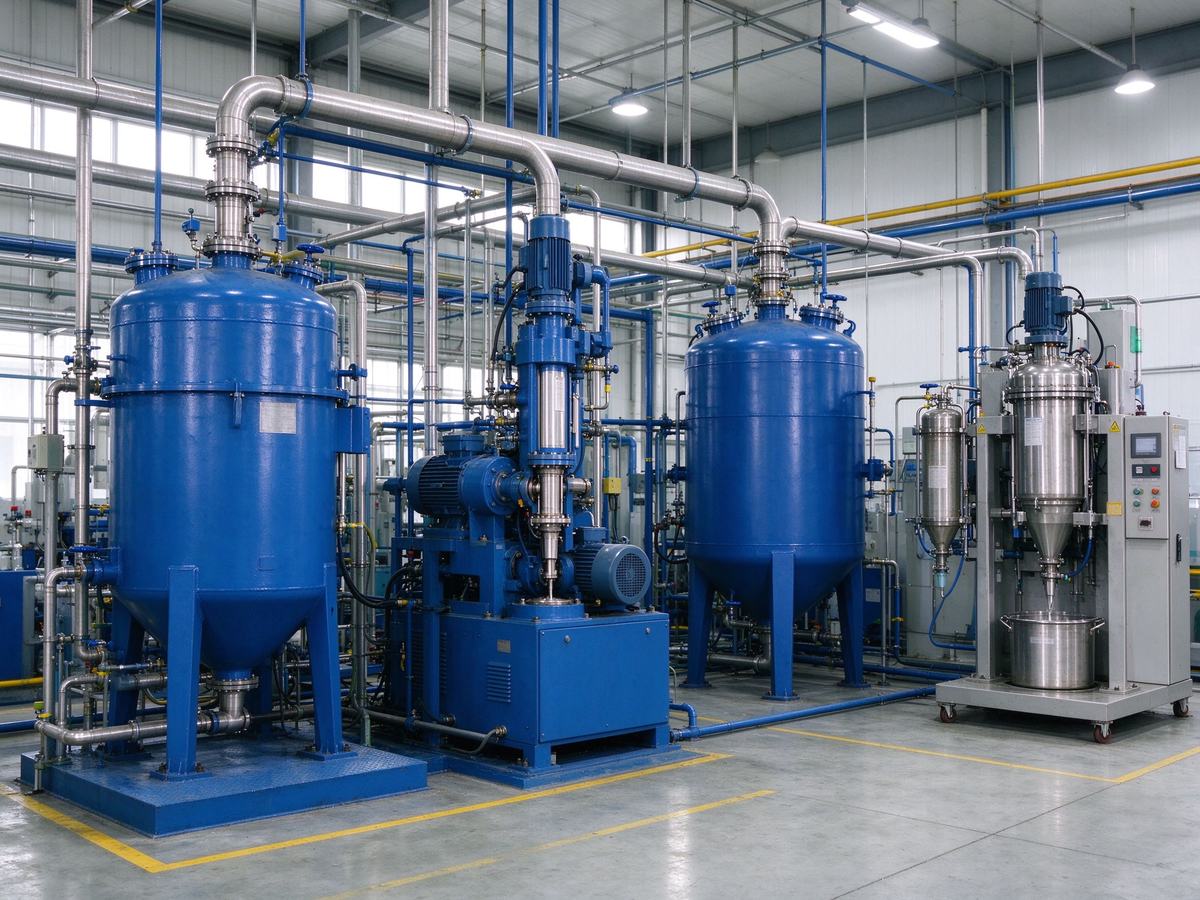
Setting up a paint production line is as much a layout problem as an equipment problem. The order of premix, grinding, let-down, filtration, and filling decides your throughput ceiling long before you size a single machine. A well-sequenced paint production line moves material in one direction, keeps changeover short, and lets each stage run at its rated capacity. This step-by-step guide covers the core process flow, the layout sequence that prevents bottlenecks, how to choose a starting level of automation, the mistakes that silently cap output, and how to commission the line so the quoted capacity is the capacity you get. POLYC MACHINE has supplied coating producers with complete lines and individual machines since 2001, and the layout rules below come from plants we have commissioned on three continents.
If you are planning a new line or reworking an existing one, read this end to end. We cover the five-stage flow, a stage-by-stage reference table, the layout sequence from raw receiving to dispatch, automation levels, troubleshooting, application scenarios, and a FAQ written for both plant managers and search engines. By the end you should be able to lay out a line where every stage runs at its rated capacity instead of its slowest point.
The Core Process Flow
Every paint plant — architectural emulsion, industrial enamel, or wood coating — follows the same five-stage flow, and the stage that is weakest sets the quality and speed of the whole batch.
1) Pre-mixing and wetting. Powders (pigment, filler, extenders) are wet out in a high-speed disperser to break lumps into a pumpable millbase. Good premix is what makes the grinding stage consistent.
2) Dispersion and grinding. The millbase is ground to the target fineness. Continuous lines use a horizontal bead mill; frequent small batches favor a basket mill for easy cleaning.
3) Let-down and blending. Ground millbase is let down into a larger vessel with resins, solvents, and additives, blended with a planetary or triple-shaft mixer.
4) Filtration. A screen removes oversized particles before packaging. This step is cheap insurance against customer complaints.
5) Filling and packaging. A filling machine doses the finished paint into cans or pails at a consistent weight.
Process Flow Reference Table
| Stage | Equipment | Output | Common failure |
|---|---|---|---|
| Pre-mixing | High-speed disperser | Pumpable millbase | Lumps if powder wets poorly |
| Grinding | Bead or basket mill | Target fineness | Heat or wrong bead size |
| Let-down | Planetary / triple-shaft | Final rheology | Trapped air in paste |
| Filtration | Screen / inline | Clean paint | Plugged screen |
| Filling | Weight filler | Consistent packs | Give-away or underfill |
Step-by-Step Layout Sequence
A practical paint production line layout follows material flow, not equipment catalog order. The sequence below keeps material moving in one direction and puts quality control where it catches problems early.
- Raw material receiving and storage. Resins, solvents, and pigments need dedicated, labeled storage with ventilation and spill containment. Keep solvent and resin zones separated for safety.
- Premix room. Place dispersers near raw material weighing so powder transfer is short. Explosion-proof motors and grounded vessels matter where solvents are present.
- Grinding cell. Site bead mills on a solid floor with cooling water supply and enough space for media change and maintenance. Plan a dedicated media handling area.
- Let-down and blending. Larger vessels sit downstream of grinding, with transfer pumps sized so grinding never waits on let-down.
- Filtration and filling. Keep filtration immediately before filling. Inline filters reduce footfall and contamination versus batch screening.
- Quality control lab. A lab for fineness (Hegman gauge), viscosity, and color sits between filling and dispatch so off-spec batches are caught before they ship.
- Utilities. Cooling water, compressed air, and power are planned as part of the line, not bolted on afterward. Undersized utilities are the most common hidden bottleneck.
Layout Zone Reference Table
| Zone | Requirement | Common mistake |
|---|---|---|
| Storage | Ventilation, containment, separation | Mixing solvent and resin zones |
| Premix | Near weighing, explosion-proof | Long powder transfer routes |
| Grinding | Cooling water, maintenance space | No media handling area |
| Let-down | Downstream, sized pumps | Vessels smaller than millbase |
| Fill / QC | Inline filter, lab before dispatch | Lab too far from filling |
Choosing the Right Level of Automation
POLYC MACHINE, a Shanghai-based equipment manufacturer supplying coating and ink producers since 2001, sizes automation to your volume and product mix rather than to a wish list.
Manual / semi-automatic suits pilot plants and specialty coatings with daily recipe changes. Operators move material between vessels; filling is semi-automatic. Low capital, high flexibility.
Automatic batch adds automated transfer, inline filtration, and automatic filling. Good for a steady product range at moderate volume.
Fully automatic links premix, grinding, let-down, filtration, and filling into one controlled sequence with recipe management. Best for high volume and tight consistency, but it demands disciplined cleaning and maintenance.
Automation Level Table
| Level | Best for | Trade-off |
|---|---|---|
| Manual / semi-auto | Pilot, specialty, daily changes | Labor-intensive, flexible |
| Automatic batch | Steady range, mid volume | Moderate capital, consistent |
| Fully automatic | High volume, tight specs | Highest capital, needs discipline |
Layout Mistakes That Create Bottlenecks
1) Grinding sized to average product. Size it to your slowest, most demanding product or the line stalls there. 2) Poor vessel sequencing. If let-down vessels are smaller than the millbase batch, grinding queues. Match vessel capacity to batch size. 3) Undersized transfer pumps. A fast mill feeding a slow pump creates a buffer that becomes a bottleneck. 4) Lab too far from filling. Long sample routes mean off-spec product ships before results return. 5) Utilities added late. Cooling water and air sized after installation cap throughput and force derating.
Common Line Problems and Fixes
| Symptom | Likely cause | Fix |
|---|---|---|
| Grinding queues behind let-down | Vessels too small | Match let-down capacity to millbase batch |
| Off-spec ships to customer | Lab far from fill | Move QC between fill and dispatch |
| Throughput drops in summer | Undersized cooling | Plan cooling water as part of line |
| Color contamination | Poor cleaning routes | CIP-ready vessels; purge between colors |
| Idle mill, busy filler | Mismatched automation | Balance stages; add buffer transfer |
| High give-away on fill | Volumetric, not weight | Switch to weight-based filling |
Application Scenarios by Plant Type
Pilot and Laboratory Plants
These prioritize flexibility: one disperser, a basket mill for easy cleaning, manual let-down, and semi-automatic filling. Recipe changes daily, so quick-open vessels and short routes matter more than volume.
Specialty and Industrial Coatings
Higher viscosity and tighter specs favor a horizontal bead mill, triple-shaft let-down, and automated transfer. The product range is broader, so material flow between vessels decides whether the line keeps pace.
High-Volume Architectural Plants
At scale, parallel grinding, inline filtration, and fully automatic filling remove single-machine dependency. Layout and sequencing — not any one mill — decide throughput, and disciplined CIP keeps multi-color runs clean.
Commissioning and Ramp-Up
A line only delivers its rated capacity after commissioning and a structured ramp-up. POLYC provides commissioning support and 24-hour engineering response, and we validate each stage against its target before handover: fineness at the mill, rheology at let-down, accuracy at fill. A plant commissioned properly and maintained on schedule outperforms a larger plant that is not, because uptime is the real capacity and the slowest stage is what you actually ship.
Equipment Selection for Each Stage
Layout is only half the job; the machines must be specified to the line, not to a catalog. For premix, size the disperser to your heaviest millbase and largest kettle with a variable-frequency drive so tip speed stays correct at full batch. For grinding, choose a horizontal bead mill for volume or a basket mill for frequent changes, and match the separator to your bead size with enough cooling to run continuous. For let-down, pick a planetary mixer for low-shear paste and a triple-shaft when the same vessel must also de-aerate. For filling, choose weight-based dosing with quick changeover between can sizes. Each choice either removes a future bottleneck or creates one, so specify the numbers, not just the model.
Utilities and Civil Works
The building and services are part of the line. Cooling water capacity, compressed air, power supply, floor loading, and drainage must be planned before equipment arrives, because retrofitting them is expensive and often impossible without re-layout. Grinding cells need solid floors and nearby cooling supply; solvent areas need vapor-tight electrical and grounded systems; the lab needs stable conditions for repeatable measurements. POLYC provides utility load estimates with every line so the civil works are right the first time and the line is not capped by a service that was sized for last year's plan.
Safety, Ventilation and Compliance
Coating plants handle flammable solvents, fine powders, and dust, so safety is designed in, not added later. Dedicated, separated storage for solvent and resin, explosion-proof motors and grounded vessels where solvents are present, and a dust-collection plan for powder handling are the baseline. Ventilation must be sufficient for both operator safety and solvent recovery, and spill containment protects both the site and the local environment. These measures are what let a plant pass audit and operate without interruption, and they belong in the equipment scope from the first layout sketch rather than as a late compliance fix.
Digital Controls and Traceability
A modern line logs each batch — fineness, viscosity, color, temperature, and fill weight — so the good run is repeated automatically and drift is flagged before it ships. Recipe management removes operator-to-operator variation, and traceability from raw material to filled can shortens root-cause analysis when something goes wrong. POLYC integrates controls at the machine so the data is captured where the work happens, turning the production record into an asset rather than a clipboard exercise and giving owners a defensible history for every batch.
Cost, Payback and Phasing
Most plants are best built in phases. Start with the slowest, most demanding product and the core grinding and let-down, then add filling and automation as volume justifies. This keeps capital tied to real demand and avoids paying for idle capacity. When you model payback, include energy, labor, and give-away savings from correct sizing and weight-based filling — these often outweigh the equipment cost difference between a good line and a cheap one, and they are what make the project finance rather than just function, because a line that loses margin on every can is not a saving no matter how low the quote.
Common Layout Pitfalls in Detail
Beyond the five mistakes listed earlier, three pitfalls quietly cap output on otherwise good lines. First, insufficient aisle and crane clearance around mills and vessels turns every media change and maintenance into a half-day event; plan service space, not just footprint. Second, ignoring future expansion locks the line at today's volume; leave utility and floor margin for one more grinding line. Third, underestimating cleaning labor on multi-color plants turns flexibility into a cost sink; CIP-ready vessels and purge routes are what keep changeover short enough to matter. Each of these is cheaper to design out than to fix after commissioning, and all three show up only once the line is running at full tilt.
Throughput Balancing in Practice
Balancing a line means the slowest stage sets the pace and every faster stage absorbs its output. In practice this means grinding must be sized to your toughest product, let-down vessels must hold a full millbase batch, transfer pumps must move that batch faster than the mill makes it, and filling must keep up with let-down. When one stage is faster, the excess is buffer, not throughput; when one is slower, everything queues behind it. POLYC models this balance across the whole line so the quoted daily output is the output you actually ship, not a number that dissolves the first time a thick batch appears and exposes the stage that was undersized.
Working With POLYC on a New Line
POLYC engages owners during layout, not after equipment is ordered, so utilities, material flow, and QC position are planned as one system. We validate the layout against your slowest stage, supply utility load and footprint estimates, and commission each stage against its target before handover, with 24-hour engineering response afterward. The aim is simple: the line you commission runs at the capacity quoted, and every stage runs at its rated speed instead of waiting on the one that was undersized or the route that was too long.
About POLYC Paint Production Lines
POLYC MACHINE (Shanghai Polyc) has manufactured wet-grinding and mixing equipment since 2001 and runs year-round process research so the disperser, bead mill, mixer, and filler work as one line instead of as separate purchases. A typical POLYC line is delivered with drives, jackets, agitators, separators, and control panels integrated, and laid out so material flows in one direction from receiving to dispatch. Standard machines use SS304 or SS316L contact parts, with explosion-proof motors and solvent-rated seals for flammable systems, and CE certification. POLYC provides 24-hour engineering response, global shipping, and commissioning support. Tell us your product range, batch size, and target fineness, and the engineering team will lay out a line where every stage runs at its rated capacity.
Frequently Asked Questions
What is the correct order to set up a paint production line?
Follow material flow: raw material storage, premix and wetting, grinding, let-down and blending, filtration, then filling, with a QC lab between filling and dispatch. Sequencing the stages before buying machines prevents the bottlenecks that cap throughput, and it keeps the line moving in one direction.
How much automation does a new paint line need?
Match automation to volume and product mix. Pilot and specialty plants do well manual or semi-automatic; steady moderate volume suits automatic batch; high volume and tight consistency justify a fully automatic line with recipe management. Buying more automation than your mix needs is capital tied up in idle capability.
Why is cooling water part of the layout plan?
Bead milling and dispersion generate friction heat. Undersized cooling water caps your throughput and forces derating in warm months, so it must be planned as part of the line rather than added afterward, alongside compressed air and power.
Where should the quality lab be located?
Between filling and dispatch. A lab there catches off-spec batches before they ship instead of after the customer complains, and short sample routes mean results return before the batch leaves the building.
How do I avoid bottlenecks between grinding and let-down?
Size let-down vessel capacity to the millbase batch and size transfer pumps so grinding never waits on let-down. Match each stage to the slowest product, then let the faster stages absorb its output without queuing.
Can a line make both water-based and solvent-based paint?
Yes, with correct material selection — solvent-rated seals, explosion-proof motors where required, and corrosion-resistant parts for water-borne residues. Plan ventilation and cleaning from the design stage, and size the drive for the heavier of the two products.
What does commissioning involve?
Commissioning validates each stage against its target before handover: fineness at the mill, rheology at let-down, accuracy at fill. POLYC supports this with 24-hour engineering response so the quoted capacity is the capacity delivered, not just a number on paper.
Ready to lay out your line?
Share your product range, batch size, and target fineness, or review the complete paint production line equipment.
View Paint Production Line Specs