
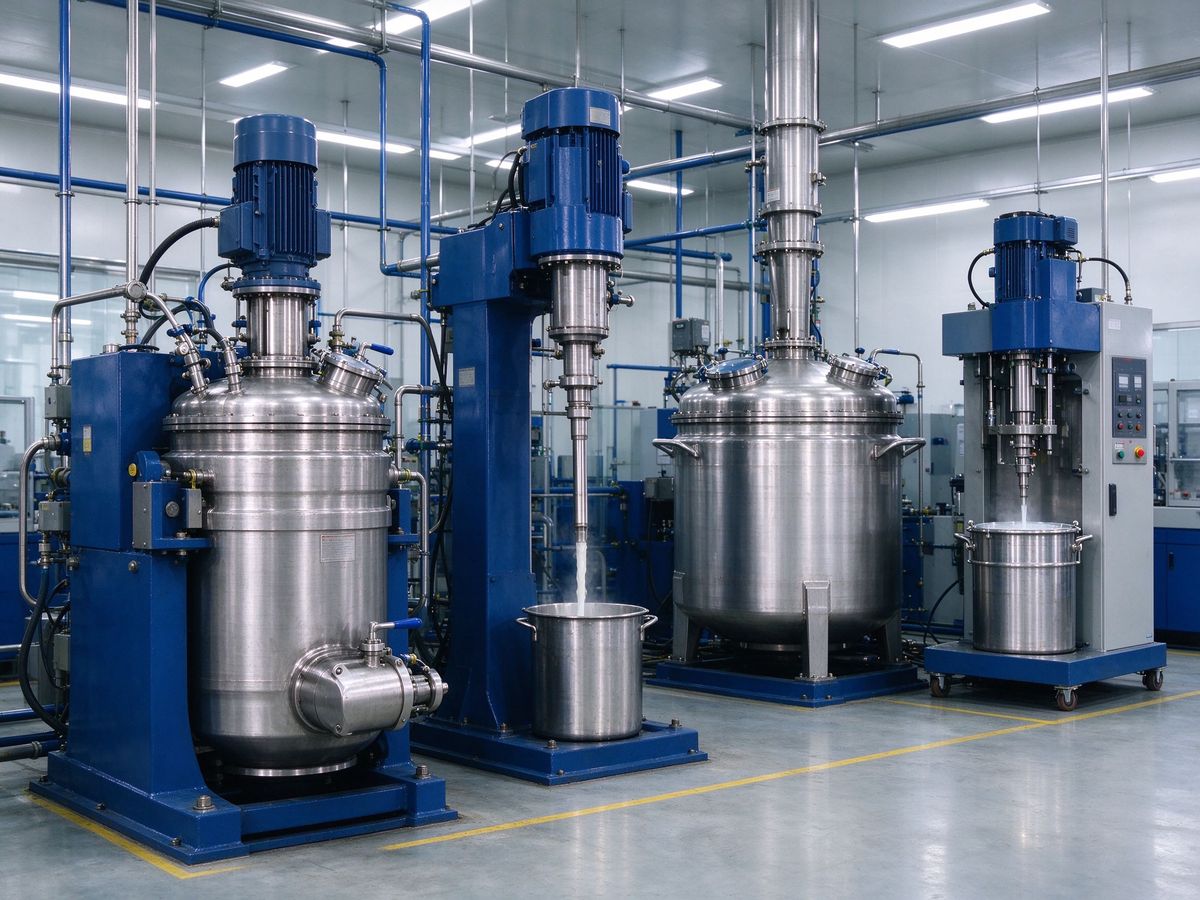
Choosing the right paint factory equipment is the difference between a coating line that hits specification on every batch and one that quietly loses margin to rework. A modern paint plant is not a single machine but a linked chain of process steps — pre-dispersion, wet grinding, let-down blending, resin preparation, filtration, and filling. This guide breaks down the core machinery behind architectural, industrial, and wood coatings, explains how each stage is sized to plant scale, lists the critical parameters that decide quality, and points out the specification mistakes that cost producers the most. POLYC MACHINE has engineered wet-grinding and dispersion systems for coating manufacturers since 2001, and the recommendations below come straight from real factory floors across global markets.
If you are specifying a new plant or reworking a bottleneck, read this end to end. We cover the five equipment groups, a stage-by-stage reference table, the process parameters that separate a good line from a great one, plant-scale sizing, troubleshooting, application scenarios by coating type, and a FAQ written for both plant managers and search engines. By the end you should be able to name the right machine for each stage and understand why the line — not any single purchase — decides your output ceiling.
The Five Equipment Groups in a Coating Plant
Every paint production line — whether it makes 5 tonnes a day or 500 — is built from the same five functional groups. Understanding them is the first step toward specifying a plant that fits your product range.
1) Pre-dispersion and wet grinding. Pigments and fillers must be reduced to a fine, stable particle size before they can deliver hiding power, gloss, and tint strength. The job starts with a high-speed disperser that wets out the powder into a pumpable millbase, then moves to a bead mill or a basket mill for true sub-micron grinding. The choice between a closed horizontal bead mill and an easy-clean basket mill usually comes down to batch size and how often the formulation changes.
2) Let-down and blending. Once the millbase is ground, it is let down into a larger vessel and blended with resins, solvents, and additives. A planetary mixer handles medium-viscosity coatings, while a triple-shaft mixer disperses, blends, and de-aerates in a single vessel for heavier pastes.
3) Resin preparation. Plants that make their own alkyd, acrylic, or epoxy resins need a jacketed resin reactor where monomers and oils are polymerized under controlled temperature and agitation. This is the longest cycle in the plant and sets the ceiling on how fast the rest of the line can run.
4) Filtration and filling. Before packaging, finished paint passes through a screen to remove oversized particles, then moves to a filling machine that doses it into cans or pails at a consistent weight. Skipping filtration is the fastest way to turn a good batch into a customer complaint.
5) Grinding media. A bead mill is only as good as its media. High-density zirconia beads transmit energy efficiently and wear slowly, and the bead diameter is matched to your target fineness. Media is a consumable, so its cost and changeover time belong in the equipment decision, not the footnote.
Equipment Group Reference Table
The table below maps each group to its function and the parameter that matters most when you size it.
| Group | Function | Key parameter | Typical machine |
|---|---|---|---|
| Pre-dispersion | Wet powder into millbase | Tip speed 20–28 m/s | High-speed disperser |
| Wet grinding | Sub-micron particle size | D90 to spec, bead size | Bead or basket mill |
| Let-down | Final rheology and blend | Viscosity and de-aeration | Planetary / triple-shaft |
| Resin prep | Polymerize binders | Temperature and agitation | Jacketed reactor |
| Fill | Consistent dosing | ± 0.2% weight accuracy | Weight filler |
Critical Process Parameters That Decide Quality
Two plants can buy the same mill and get very different results if these parameters are wrong. The numbers below are the ones our process engineers tune first.
- Tip speed. Rotor peripheral speed of 8–18 m/s in the grinding chamber sets the energy density of the grind. Too low and pigment stays agglomerated; too high and you generate heat that thins the resin and risks flash-off.
- Target fineness (D50 / D90). Define the particle size distribution you must hit before sizing any mill. Architectural emulsions often target D90 below 10 µm, while automotive and effect pigments push toward 1 µm or below.
- Bead size and density. Smaller, denser beads (0.2–0.8 mm YTZ zirconia) reach finer sizes but demand more cooling and a tighter separator. Match bead diameter to your fineness goal, not to what came with the machine.
- Viscosity window. A disperser sized for a thin millbase will stall on a high-solid paste. Size shaft power and tip speed to your worst-case viscosity, not your average batch.
- Cooling duty. Continuous grinding generates friction heat; dual-jacketed cooling keeps slurry below 40–50 °C so solvents and rheology stay stable. Undersized cooling caps your throughput in summer, not just on paper.
Process Parameter Reference Table
| Parameter | Typical range | Why it matters |
|---|---|---|
| Grinding tip speed | 8 – 18 m/s | Energy density of the grind |
| Target fineness D90 | 1 – 10 µm | Hiding, gloss, tint strength |
| Bead diameter | 0.2 – 0.8 mm | Finer size needs smaller beads |
| Millbase viscosity | 1k – 50k mPa·s | Determines disperser and mill type |
| Coolant temperature | Below 50 °C | Stabilizes rheology and solvent |
How Each Stage Is Sized to Plant Scale
The same five groups scale very differently. POLYC MACHINE, a Shanghai-based equipment manufacturer supplying coating and ink producers since 2001, sizes lines around the slowest, most demanding product rather than the average one.
Small-batch and pilot plants typically run one disperser plus a basket mill, with manual let-down in a planetary mixer and semi-automatic filling. That footprint suits a flexible product mix where the recipe changes daily and cleaning speed matters more than raw volume.
Mid-size plants add a horizontal bead mill for continuous grinding and a triple-shaft mixer for let-down, backed by one or two reactors for resin. Throughput is steady and the product range is broader, so material flow between vessels starts to matter.
Large plants move to multiple parallel grinding lines, automated transfer, inline filtration, and fully automatic filling. At this scale the layout — vessel sequencing, pump sizing, CIP routes — decides throughput as much as the machines themselves. A poorly sequenced line creates bottlenecks no single mill can fix.
A practical rule: size grinding and dispersion to your toughest product, then size mixing and filling to absorb its output without queuing.
Plant Scale Configuration Table
| Scale | Grinding | Let-down | Resin / fill | Daily output |
|---|---|---|---|---|
| Pilot / small | Disperser + basket mill | Planetary (manual) | Semi-auto fill | < 5 t/day |
| Mid-size | Horizontal bead mill | Triple-shaft | 1–2 reactors, auto fill | 5 – 50 t/day |
| Large | Parallel bead mills | Multiple triple-shaft | Auto reactors, inline fill | 50 – 500 t/day |
Quality and Consistency Control
Equipment only delivers quality when the routine around it is disciplined. The checks that keep a coating line consistent are fineness (Hegman gauge or laser particle size), viscosity (Brookfield or ICI cone-plate), color and tint strength (spectrophotometer against standard), and density or solids check. Logging these per SKU means the next operator repeats the good run instead of rediscovering it. Plants that skip this step trade a few minutes of lab time for customer complaints and rework.
Common Equipment Problems and Fixes
Most coating-plant complaints trace back to specification or cleaning, not to the machine itself. The table lists the issues POLYC engineers see most often and the fix that actually works.
| Symptom | Likely cause | Fix |
|---|---|---|
| Lumps or grit in paint | Poor premix wetting | Raise disperser tip speed; add powder slowly |
| Mill overheats, resin thins | Undersized cooling | Upgrade jacket cooling; split the pass |
| Poor hiding or gloss | Fineness above target | Tighten D90; verify bead size |
| Pinholes in film | Trapped air | Triple-shaft de-aeration; vacuum option |
| Color drift between batches | Cross-contamination | CIP between colors; purge lines |
| Disperser bogs on paste | Undersized drive | Re-size to worst-case viscosity |
Five Costly Specification Mistakes
1) Buying grinding capacity before defining fineness. Without a target D50 / D90 you cannot correctly size a bead mill, and you will either overpay or under-grind. 2) Underestimating viscosity. A disperser sized for a thin millbase stalls on high-solid paste. Match power and tip speed to your worst case. 3) Ignoring cleanability. Frequent formulation changes without quick-open vessels or easy-clean basket mills cause cross-contamination and long changeover. 4) Treating filling as an afterthought. Inaccurate filling means give-away loss and compliance risk. Integrate filling with filtration from day one. 5) Forgetting media quality. Cheap or wrong-sized beads waste energy and shorten mill life. Use matched zirconia media and the correct separator screen.
Application Scenarios by Coating Type
Architectural and Decorative Paint
Emulsion-based interior and exterior paints are high-volume and forgiving on fineness, so a disperser plus bead mill with fast changeover dominates. Throughput and cleaning speed matter more than absolute power, and CIP-ready vessels pay back quickly on multi-color lines.
Industrial and Protective Coatings
High-solid and heavy industrial coatings need stronger dispersion and blending, so a horizontal bead mill plus triple-shaft let-down is standard. These formulations are viscosity- and temperature-sensitive, making jacketed vessels and cooling non-negotiable.
Wood Coatings and Stains
Wood finishes span thin stains and thick fillers, so flexibility matters. A basket mill for frequent color changes plus a planetary let-down covers the range without a large capital footprint.
Powder Coatings
Powder coatings skip liquid grinding but still need pre-blending and extrusion feed. The equipment focus shifts from mills to blenders and extruders, and the same discipline around consistency applies.
Specifying Each Machine in Detail
Knowing the five groups is not the same as specifying the machine. Each has a short list of parameters that decide whether it performs on your product, and the supplier should quote those numbers, not just a model name.
High-speed disperser
Specify disc diameter, motor power, and tip speed together, not separately. The disc sets the tip speed at a given rpm, and the motor must hold that speed at full batch. POLYC sizes the disperser to your heaviest millbase and largest kettle, with a variable-frequency drive so one head serves several vessels on a platform design and ramps slowly to avoid splashing.
Bead mill
Specify chamber volume, separator type, and cooling area. Closed horizontal mills suit volume; the separator screen must match your bead size, and the cooling area decides whether you can run continuous or must batch the grind. A mill that runs hot is a mill that runs slow.
Let-down mixer
Choose a planetary mixer for low-shear paste blending and a triple-shaft mixer when the same vessel must disperse, blend, and de-aerate. Jacket and drive power set how fast you reach final rheology, and for thixotropic or filled systems the de-aeration step is what prevents pinholes in the film.
Resin reactor
Specify jacket type, agitation, and condensation recovery. The reactor is the longest cycle in the plant, so its capacity sets how much resin is available to the rest of the line and therefore caps total output. Skimp here and every downstream stage waits.
Filling machine
Choose weight-based dosing for accuracy and compliance, with clean product contact parts and quick changeover between can sizes. Integrate it with filtration so every filled container is already screened, and treat fill accuracy as margin protection rather than a paperwork step.
Energy, Labor and Operating Cost
The cheapest machine on the quote is often the most expensive on the floor. Energy per tonne of paint is dominated by grinding and dispersion, so a mill sized and cooled correctly costs less to run than an under-cooled one that must batch the grind. Labor is the second hidden cost: CIP-ready vessels and quick-open designs cut changeover from hours to minutes, and automated transfer removes manual handling between vessels. When you total the cost, include energy and labor across a year, not just the purchase price — that is the number that decides payback, and it is the number that separates a line that makes money from one that merely makes paint.
Commissioning, Training and Maintenance
A line only performs once it is commissioned and the operators are trained on it. POLYC provides commissioning support and 24-hour engineering response, and we document the routine checks — fineness, viscosity, color, cooling — that keep the line in spec. Preventative maintenance on separators, seals, and agitators prevents the unplanned downtime that costs more than the service itself. A plant that is commissioned properly and maintained on schedule outperforms a bigger plant that is not, because uptime is the real capacity.
How to Plan a New Paint Plant Project
Most plant projects fail on sequencing, not on machines. Start from the product range and the single hardest formulation, define the target fineness and daily volume, then size grinding to that product and let-down and filling to absorb it. Engage the equipment supplier during layout, not after, so utilities and material flow are planned in rather than bolted on. Build in CIP and QC from the start, and validate the layout against your slowest stage before you buy a single vessel. POLYC works with owners through this sequence so the quoted capacity is the capacity delivered, and the line balances instead of stalling at one machine.
Batch vs Continuous: Which Layout?
Batch lines are flexible and cheaper to start; continuous lines win at high, stable volume. Most coating plants are inherently batch at the grinding stage and continuous at filling, which is exactly why automated transfer and buffers matter. Match the layout to your product mix: frequent recipe changes favor batch flexibility, steady high volume favors continuous flow. The wrong choice locks in either idle capacity or a chronic bottleneck, and both are expensive in their own way.
Material Handling and Safety
Powder handling, solvent storage, and dust control are where coating plants meet regulation. Dedicated, labeled storage with ventilation and spill containment keeps solvent and resin zones separated; explosion-proof motors and grounded vessels are mandatory where solvents are present. Pneumatic or vacuum powder transfer reduces dust and exposure, and a dust-collection plan protects both product and people. These are not optional extras — they are the difference between a plant that passes audit and one that does not, and they belong in the equipment scope from day one.
Digital Controls and Traceability
Modern coating lines log each batch: fineness, viscosity, color, temperature, and fill weight. A recipe-management system repeats the good run automatically and flags drift before it ships. Traceability from raw material to filled can satisfies customer and regulatory audits, and shortens the time to find a root cause when something does go wrong. POLYC integrates controls so the data is captured at the machine, not scribbled on a clipboard, and the history becomes an asset instead of a chore.
About POLYC Factory Equipment
POLYC MACHINE (Shanghai Polyc) has manufactured wet-grinding and mixing equipment since 2001 and runs year-round process research so the disperser, bead mill, mixer, reactor, and filler work as one line instead of as separate purchases. A typical POLYC coating plant is delivered with drives, jackets, agitators, separators, and control panels integrated, and sized from 5 L laboratory units to 3,000 L production vessels and beyond. Standard machines use SS304 or SS316L contact parts, with explosion-proof motors and solvent-rated seals for flammable systems, and CE certification. POLYC provides 24-hour engineering response, global shipping, and commissioning support, and can integrate the line into a complete production line. Tell us your target fineness, batch size, and product range, and the engineering team will size each stage so the line runs at its rated capacity instead of its bottleneck.
Frequently Asked Questions
What is the difference between a bead mill and a basket mill for paint?
A bead mill grinds continuously in a closed chamber with a separator screen, making it the right choice for high-volume, stable formulations. A basket mill immerses a media-filled basket into the batch, so it is far easier to clean and better suited to plants that change formulations frequently.
How do I size a high-speed disperser for a paint millbase?
Size the disperser to your highest-viscosity millbase and largest batch volume, not your average job. Higher solids loading and bigger batches demand more shaft power and a tip speed matched to proper wetting — typically in the 20–28 m/s range for a heavy paste.
Do I need a resin reactor if I only blend purchased resins?
No. If you buy ready-made resin, you can skip reaction equipment and focus spend on dispersion, mixing, and filling. Reactors only pay off when you manufacture resin in-house, because that is where the longest cycle time and highest heat duty sit.
Why does cooling matter so much in grinding?
Continuous grinding generates friction heat that thins resin and risks solvent flash-off, which changes rheology and fineness mid-batch. Dual-jacketed cooling keeps slurry below 40–50 °C so quality stays stable, and it protects your throughput in warm months rather than on paper.
How important is filling accuracy?
Very. Inaccurate filling is direct give-away cost on every container and a compliance risk on labeled weight. Integrating filling with filtration from day one, and choosing a weight-based filler, removes both problems and keeps batches consistent.
What grinding media should I use?
High-density YTZ zirconia beads (0.2–0.8 mm) transmit energy efficiently and wear slowly, and the diameter is matched to your target fineness. Using the right bead size and separator screen is as important as the mill itself, and media cost belongs in the equipment decision.
Can one line make both architectural and industrial paint?
Yes, if it is sized to the harder product. A horizontal bead mill plus triple-shaft let-down covers both ranges, but you must plan for the higher viscosity and cooling duty of industrial coatings, and build in CIP for the color changes between them.
Ready to specify your plant?
Share your target fineness, batch size, and product range, or review the complete paint production line equipment.
View Paint Production Line Specs